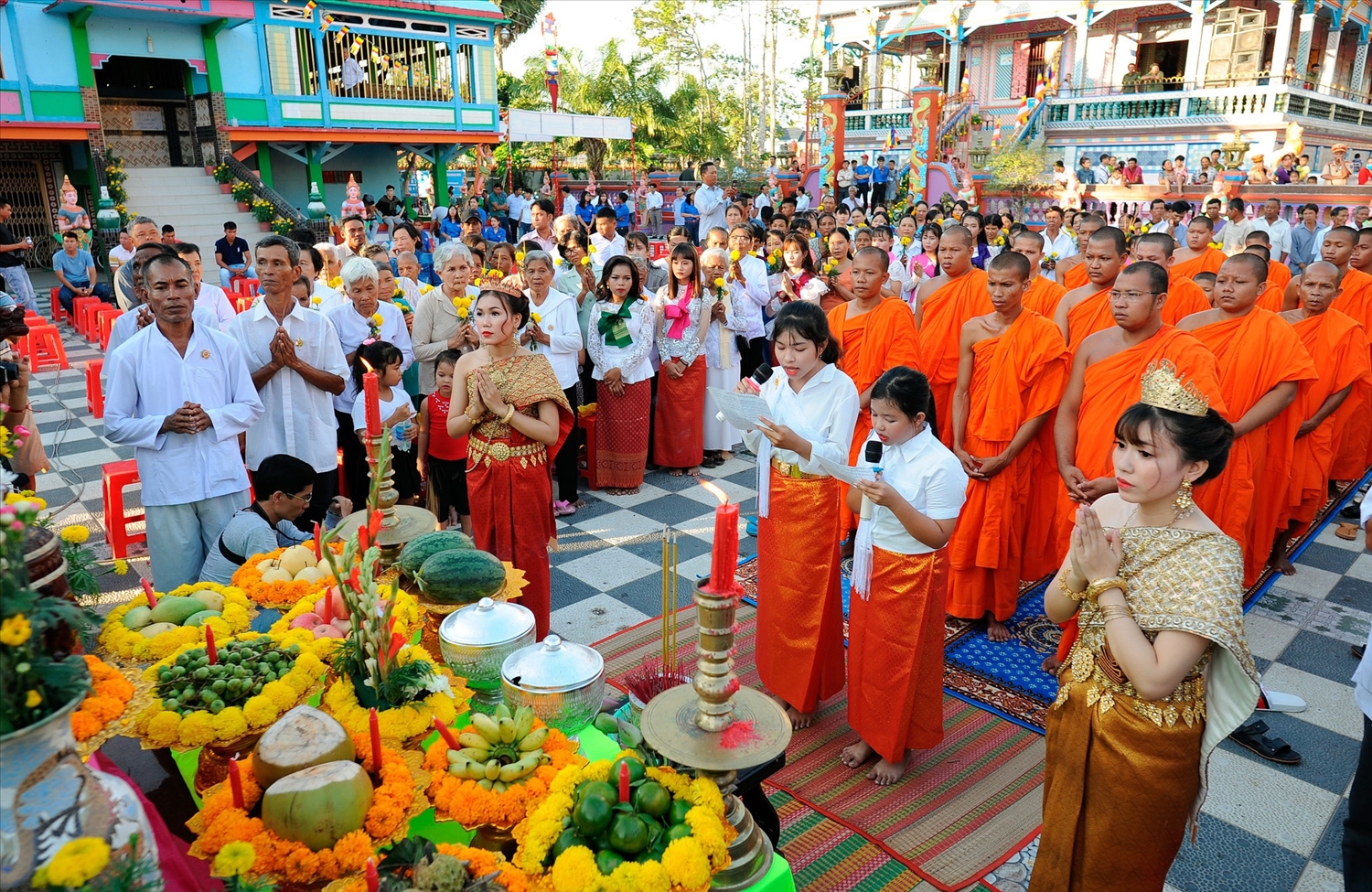
 During the Chol Cham Thmay New Year celebrations, Khmer families in Southern Vietnam often wear their finest clothes to go to the temple together to welcome the new year
Keywords: Cultural values; Agricultural rituals; Khmer people; Southern Vietnam.
1. The agricultural ritual identity of the Khmer people in Southern Vietnam
The Khmer people in Southern Vietnam mainly reside in low-lying areas, deeply influenced by tides and floods, which has shaped a unique rice-farming culture closely linked to the annual rice crop cycle. Therefore, their agricultural ritual system reflects this cultural adaptation to the environment, where the elements of Water (Om Tuk) and Earth (Neak Ta) hold key positions.
The Khmer people in Southern Vietnam have a diverse and rich system of agricultural rituals, including major ceremonies such as: the rain-praying ceremony, the rice worship ceremony, the rice spirit summoning ceremony, the rice mound building ceremony, the Chol Chnam Thmay New Year festival, the moon worship ceremony (Ok-Om-Bok), and the peace-praying ceremony. These agricultural rituals are organized seasonally - according to the planting cycle. The agricultural rituals of the Khmer people in Southern Vietnam are closely linked to the agricultural production cycle that lasts during the rainy season from April to November. The Chol Chnam Thmay New Year, meaning the celebration of the new harvest season is held around mid-April, marking the beginning of the new production season according to the traditional agricultural calendar. During the Chôl Chnam Thmay festival, the Khmer people perform rituals to build mounds of rice or sand to ward off the dry season and welcome the early arrival of the rainy season, ensuring bountiful harvests and increased rice yields. The prayer for peace ceremony is usually held 15 to 30 days after the Chol Chnam Thmây New Year. That’s when the Khmer people begin a new planting season, praying to the gods of nature for blessings and a bountiful harvest. Rain-praying ceremonies are held in May and June, when the rainy season begins. But even if the weather remains intensely sunny, the Khmer people still perform rain-praying ceremonies to ensure favorable conditions for rice production. The rice spirit summoning ceremony is held when the Khmer people begin the rice harvest season. The Moon worship ceremony (Ok-Om-Bok) is held on the 15th of October (Lunar Calendar), marking the end of the harvest season. At this time, the dry season arrives, the Khmer people thank the Moon god for providing favorable weather for a bountiful harvest and express their wish for the dry season to end.
Khmer agricultural rituals take place in various locations such as in the fields, in pagodas, in homes and in pagodas. Among these, ceremonies such as the rain-praying ritual, Chol Chnam Thmay, Ok-Om-Bok, the building of rice mounds, which are held in pagodas, to be a unique characteristic of the Khmer people, as the majority of them are Buddhists.
The offerings in the agricultural rituals of the Khmer people in Southern Vietnam are all agricultural products, cultivated and raised, with the most common being offerings made from rice, prepared in unique ways according to their culinary culture, such as: flattened rice flakes, num tienh (sticky rice cake), num khnhay (ginger cake made from glutinous rice flour mixed with sugar, shaped like ginger root and fried until golden), num akau (steamed rice cake)... Additionally, the Khmer people in Southern Vietnam often offer pig’s head, chicken, or duck as sacrifices because they believe that the deity Neak Ta ma chăs sróc prefers pig’s head, Neak Ta Sre prefers boiled chicken or duck and Neang hing pras tho ra nay prefers fruits and cakes.
In agricultural rituals, the Khmer people in Southern Vietnam have many ceremonies that both show respect for the deities and express their wishes through prayers. These rituals are explained by Buddhist stories and have Buddhist characteristics. For example, the ritual of placing a snakehead fish in a basin of water in front of a monk sitting on the temple steps to chant prayers for rain under the sunny sky originates from a legend. According to this legend: “Once upon a time, in a certain year, there was a great drought that caused all creatures to starve to death. Out of pity for the suffering beings, the Buddha transformed himself into a fish writhing in a dry pond so that the god Indra (a god of rain and wind in Indian mythology) would see the Buddha’s suffering and bring rain”. Another version of this legend suggests that it wasn't a fish writhing in a dry pond waiting for rain, but rather the fish itself came up to the pond.
Heaven is crying for help. The ritual of carrying the great calendar on the first day of the Chôl Chnam Thmay festival (according to which everyone lines up in a single file and walks around the main hall (of pagodar) three times to welcome the new year and receive another year of age) is associated with the mythology of Thomabal and Kabal Maha Prum (the Four-Faced God). In addition, the Khmer people also have Buddhist rituals such as: reciting scriptures, giving sermons, praying for the deceased, bathing Buddha statues during the Chol Chnam Thmay festival and festivals for peace...
Regarding the deities worshipped in agricultural rituals, the Khmer people in Southern Vietnam worship many natural deities, among which the most important deities of agricultural production are the god of Earth, the god of Water and the god of Rice. Each deity plays a significant role in agricultural production, such as in the rain-praying ceremony where Neak Ta ma chas sroc (the god who governs the village) and the god who manages rain-making, in the moon-worshiping ceremony where the moon god is worshipped, in the peace-praying ceremony where Neak Ta sre (the god who governs the fields) and Neang Hing prăs thoranay (the earth god) are worshipped, and in the rice spirit-calling ceremony where the rice god is worshipped.
In addition, the agricultural rituals of the Khmer people in Southern Vietnam also exhibit a unique characteristic: the worship of Buddha, such as the Chol Chnam Thmay ceremony and the prayer for peace ceremony, as the vast majority of Khmer people follow Theravada Buddhism.
An important feature in the agricultural rituals of the Khmer people in Southern Vietnam is the presence of monks and temples, such as during the Chol Chnam Thmay New Year festival, when only the temples are bustling with activity, with many families going inside to celebrate the festival; for example, in the boat race, the boats belong to the temple; in the Moon worship ceremony, the rain-praying ceremony, the peace-praying ceremony, and the rituals of the Chôl Chnăm Thmây New Year, there are several ceremonies performed by monks and carried out at the temple. It can be said that Theravada Buddhism has become a particularly important element in the traditional culture of the Khmer people.
2. The values of Khmer agricultural rituals in Southern Vietnam
The Khmer agricultural ritual system is organized according to the closed cycle of the rice crop, from beginning to end, bringing many values to the Khmer community.
The agricultural rituals of the Khmer people in Southern Vietnam are essentially religious in nature, contributing to the fulfillment of their spiritual lives. Some agricultural rituals take place at the beginning of the season with the desire to invoke ancestors and supernatural forces to help ensure bountiful harvests, favorable weather and harmony between yin and yang; there are also some rituals that take place after the harvest to give thanks to the gods, heaven and earth, ancestors for bringing a bountiful and prosperous harvest. Most Khmer agricultural rituals function as religious practices, based on the belief that the more they attend ceremonies, the more blessings they receive and the more peaceful their lives become. When participating in agricultural rituals that include Buddhist worship, Khmer people chant scriptures, listen to sermons and pray, asking Buddha for protection and guidance to escape all misfortunes in life…
In Khmer culture, agricultural rituals are a place where the moral principles, life philosophy and traditional customs of the Khmer people are expressed. The rituals of the Khmer people demonstrate respect and affection for the agricultural products they create; respecting the products of labor also means respecting human labor. As in the rituals of worshipping the Rice God and invoking the spirit of the rice, the Khmer people show their reverence for the rice grains they produce, believing that rice also has a soul and deserves to be worshipped.
Practicing agricultural rituals is a way for the Khmer people in Southern Vietnam to express their gratitude to their ancestors, grandparents, parents, those who have nurtured them, those who have contributed to the development of their villages. During the ceremony, descendants will use fragrant water to bathe their grandparents and parents, and perform rituals to pray for the souls of deceased relatives... For example, on the Chol Chnam Thmay New Year, the Khmer people and monks perform a prayer ceremony (Bang Skol/Bang Skau) around noon at the stupa where the ashes of the deceased are kept. Some families invite monks to their homes to pray for the souls of their deceased grandparents, parents, or relatives. Through agricultural rituals, the Khmer people foster community bonds through shared activities. During the Chol Chnam Thmay New Year festival, Khmer people not only prepare for the festivities at home, but many, especially the elderly, also go to the pagoda to do volunteer work, cleaning and polishing incense burners and Buddha altars so that everyone can come together to celebrate the new year. Young people also go to the pagoda to practice traditional five-instrument orchestral songs to sing during festivals. Or during the peace prayer ceremony, before the ceremony, people in the villages gather to clean the environment, repair bridges and culverts and build roads to facilitate transportation and create conditions for the ceremony to take place smoothly and properly. Afterward, everyone sits together for a warm and friendly meal, sharing stories about life and experiences in production and daily activities. Each person has their own circumstances, but through this agricultural ritual, the Khmer people find an invisible thread connecting them all, united by a common dream and hope: favorable weather, lush vegetation and a bountiful harvest for the entire village.
Agricultural rituals contribute to preserving the unique culinary culture of the Khmer people. These rituals always involve preparing offerings to the gods as well as dishes for communal meals. Therefore, agricultural rituals also serve as a repository for traditional Khmer cuisine. These are offerings to the deities, so they must be more delicious, more special and beautifully presented... reflecting people’s reverence for the gods. The distinctive culinary culture of the Khmer people, preserved in their agricultural rituals, features dishes made from rice, such as flattened rice flakes and various cakes like num chruk (tet cake), num tienh (it cake), num khnhay (ginger cake made from glutinous rice flour mixed with sugar, shaped like ginger root and fried until golden) and num akau (steamed rice cake). These elaborately prepared dishes are not something the Khmer people can prepare and enjoy every day; therefore, through agricultural rituals, traditional Khmer cuisine has been preserved since ancient times.
Agricultural rituals contribute to the preservation of traditional Khmer art forms. During these rituals, some Khmer folk dances and music have become part of the ceremonies. The Moon Festival includes the release of water lanterns on rivers, canals, ponds and lakes, as well as the release of paper lanterns to float in the wind. Furthermore, after performing agricultural rituals, some places organize traditional folk games such as martial arts, tug-of-war, boat racing or performances of traditional art forms favored by the Khmer people, such as Lam Thon dance, Du Ke art, Ro Bam, Roam Vong singing, Lam Leo, Aday... Therefore, agricultural rituals also serve as a place to preserve many traditional art forms of the Khmer people.
3. Some solutions for preserving and promoting the agricultural rituals of the Khmer people in Southern Vietnam
The agricultural rituals of the Khmer people are facing significant challenges from changes in production models, intensive multi-crop rice cultivation, the use of technology and the decline of folk beliefs, therefore, several solutions are needed to preserve and promote the agricultural rituals of the Khmer people in Southern Vietnam.
Firstly, it is necessary to raise awareness of the Khmer people's cultural traditions, especially among the younger generation, so that each individual will be conscious of preserving and promoting their ethnic agricultural rituals. This helps each Khmer person understand that, although the current socio-economic environment is not the same as the original socio-economic environment that gave rise to the Khmer agricultural rituals, these rituals still need to be preserved and promoted because the positive values they bring to community life still exist.
Secondly, it is necessary to strengthen propaganda efforts and raise awareness and responsibility for preserving and promoting the agricultural rituals of the Khmer people in Southern Vietnam. The Khmer people are the practitioners of these agricultural rituals, therefore they play a particularly important role in their preservation and promotion of agricultural rituals. Agricultural rituals only truly have meaning and value when they originate from the deepest thoughts of people, when people genuinely feel the need, when that need truly motivates them from within. Therefore, to preserve and promote agricultural rituals, it is necessary to make the Khmer people see the necessity and have a genuine need, desire and expectation to practice these rituals. It is necessary to help the people understand the values, beauty, and goodness in the traditional agricultural rituals of the Khmer people. Propaganda and education work needs to be carried out persistently and consistently, focusing on those at risk of losing interest in maintaining and practicing these agricultural rituals, such as those who have left agriculture and the younger generation.
Thirdly, there should be a reasonable policy towards those who still uphold the rituals of agricultural ceremonies. There are not many people who have a relatively complete understanding of the traditional Khmer agricultural rituals; they are mainly Achar (respected elders) and older people in the villages. Therefore, there needs to be appropriate policies to encourage them both physically and mentally to exploit their intellectual capital as well as their role in preserving and promoting traditional agricultural rituals, encouraging them to preserve and pass on the profession to the next generations.
Fourthly, investigation and collection are necessary to provide guidance in preserving and promoting the traditional agricultural rituals of the Khmer people. Since the current environment in which these agricultural rituals exist differs significantly from their original forms, a spirit of “separating the wheat from the chaff” is needed in the preservation and promotion of Khmer agricultural rituals. This requires mobilizing the entire society to effectively preserve and promote historical sites in conjunction with socio-economic development and tourism development in the locality.
Fifthly, paying attention, supporting and creating favorable conditions to build cultural institutions at the grassroots level, a number of key pagodas and equip facilities to enhance information, propaganda and encouragement of the Khmer ethnic people, preserving and promoting the value of agricultural rituals of our people.
Sixthly, support and eliminate outdated customs and practices, combat negative manifestations and commercialization in the organization of agricultural rituals; maintain and develop traditional culinary culture, costumes, performing arts and cultural knowledge of agricultural rituals.
4. Conclusion
It can be said that only when the above solutions are given attention and implemented synchronously will the values of the agricultural rituals of the Khmer people in Southern Vietnam be fully preserved and promoted in community life and in the sustainable development of the country.
References
1. Tran Van Binh (Editor). Culture of the Ethnic Groups of the Southwestern Region - Current Situation and Issues. National Political Publishing House, Hanoi.
2. Tran Van Bon. (1999). Some folk customs of the Khmer people in the Mekong Delta. National Culture Publishing House, Hanoi.
3. Tran Van Bon. (2002). Customs and life cycle rituals of the Southern Khmer people. National University of Hanoi Publishing House, Hanoi.
4. Pham Thi Phuong Hanh (Editor, 2011). Southern Khmer Culture: A Beautiful Aspect of Vietnamese Cultural Identity. National Truth Political Publishing House, Hanoi.
5. Son Nam (Research, 2004). Mekong Delta - Traditional life and garden civilization. Tre Publishing House. Ho Chi Minh City.
6. Huynh Thanh Quang (2008). Khmer cultural values in the Mekong Delta. National Political Publishing House. Hanoi.
7. Center for Lexicography. (2008). Vietnamese Dictionary. Da Nang Publishing House. Da Nang.
