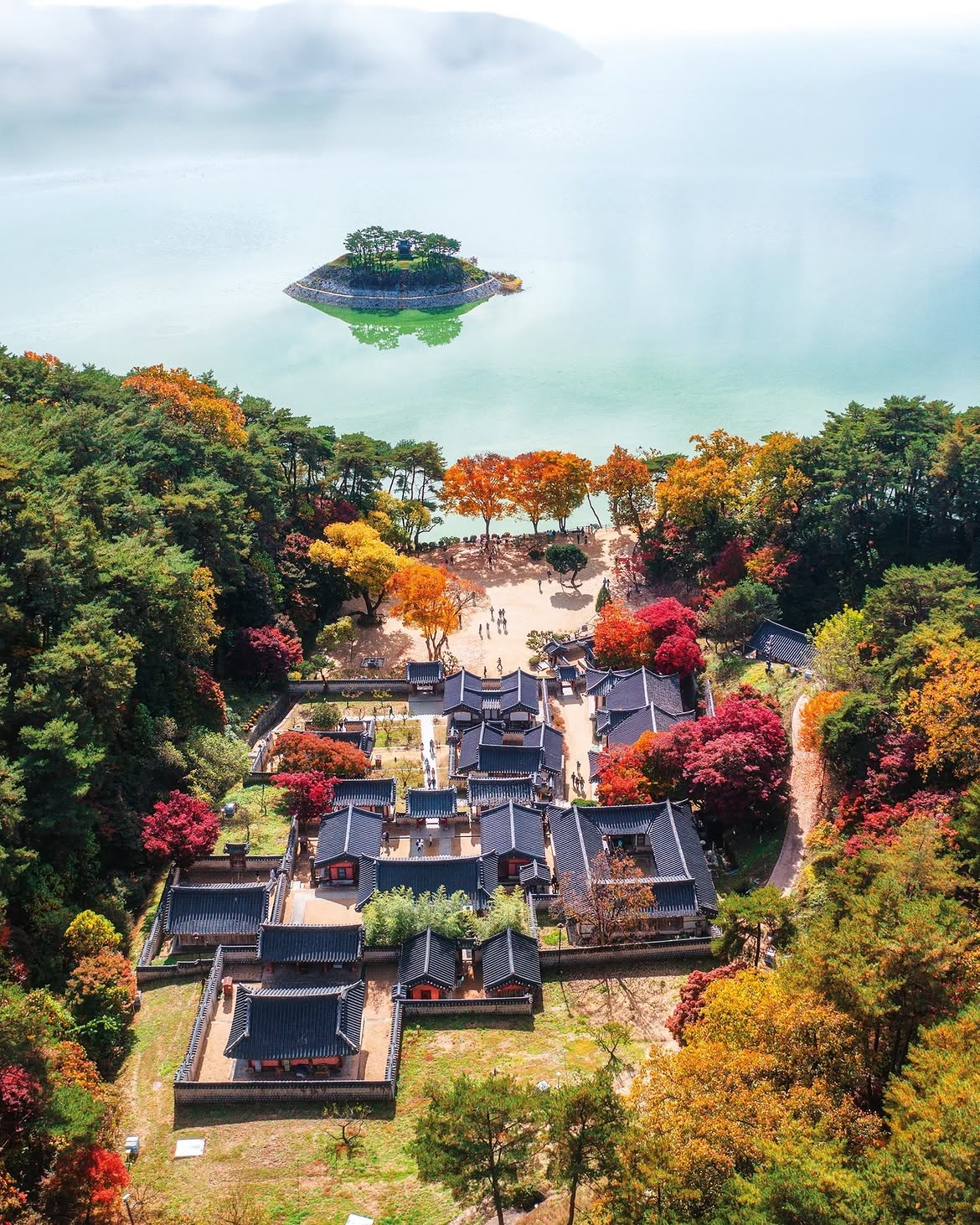
 Dosanseowon Confucian Academy
Keywords: Korean Confucianism; Philosophy of life; Cultivating moral character; Modern social structure.
1. Introduction
When looking at contemporary South Korea, one is often overwhelmed by the explosion of the Hallyu cultural wave, the presence of massive transnational conglomerates (chaebols), remarkable technological advancement and a dizzying pace of urbanization. On the surface, South Korea today is one of the Asian nations with the highest proportions of Christians (including both Protestants and Catholics) and Buddhists. Yet, beneath this modern exterior and religious diversity lies an ideology - one that, while no longer maintaining large-scale institutional structures, continues to function like an underlying operating system, shaping the social behavior, psychological attitudes and family structures of the Korean people: Confucianism.
Confucianism (known in Korea as Yugyo - Confucianism) is not strictly a religion of salvation centered on concepts of the afterlife; rather, it is a philosophy of life, an ethical and political system that focuses primarily on the real world and human existence. In South Korea, Confucianism has been preserved in an extremely orthodox manner, perhaps even more strictly and in a purer form. In order to understand why South Koreans place such great importance on age-based hierarchy, why the pressures of academic examinations and the weight of family reputation rest so heavily on the shoulders of each individual, or why the ritual of ancestral worship remains a sacred duty, even for those who may be devout Christians, one must turn back the hands of time to gain a profound understanding of how Korean Confucianism defines these aspects: What are human beings? Where does human nature come from and what is the mission of humanity in this universe?
2. Historical process and the indigenization of Confucianism in Korea
Confucianism did not sweep into Korea like a whirlwind; rather, it permeated the society gradually over the course of many centuries, beginning in the early Common Era. Throughout the Three Kingdoms period and the Goryeo dynasty, it was Buddhism that reigned as the spiritual sovereign over the lives of the people. At that time, Confucianism served merely as an administrative tool, a body of scholarship intended for civil service examinations. A major turning point, a true, radical overhaul of ideology occurred in 1392 with the establishment of the Joseon dynasty. The new nation-builders, most notably the chief architect Jeong Do-jeon implemented a policy of suppressing Buddhism in favor of Confucianism. They confiscated temple assets, expelled monks and nuns from the capital and elevated Neo-Confucianism to a position of absolute supremacy. This was not merely a change of dynasty; it was a radical cultural revolution aimed at restructuring the very identity of the Korean people and their society.
When the Koreans adopted Neo-Confucianism, they did not seek to compromise or blend it with existing belief systems such as Shamanism or Buddhism. Instead, scholars revered Neo-Confucianism as an absolute, inviolable truth. The classic debate known as the “Four Beginnings and Seven Emotions”, which took place between Yi T’oegye and Ki Kobong in the 16th century, serves as a clear illustration. They engaged in a heated, years-long dispute, all with the aim of clarifying the following: Where do human moral emotions (such as compassion) and natural emotions (such as anger) originate? Do they arise from a transcendent principle (Li), or are they set in motion by material energy (Qi)? The profound philosophical inquiry into human nature transformed Korean Confucianism into an ultimate secular religion, one that offers no promises of an afterlife or a heavenly realm, but instead mandates rigorous self-discipline and the cultivation of morality within this very life.
Another unique aspect of localization is the way Koreans have transformed the structure of the nation into an extended family model. Filial piety, originally a virtue within the family has been elevated to a supreme legal and political value. Koreans have ritualized life down to the most minute details. From the complex system of honorifics in the language and the culturally ingrained habit of observing one’s surroundings to determine appropriate behavior, to the hierarchical order based on age and generation, all of these are products refined from a Confucian identity.
Confucianism in Korea serves as a vivid testament to how an imported ideology, when passed through the filter of the local ethos, can generate a powerful, self-sustaining energy. The journey of Confucianism to becoming the soul of modern Korean society stands as one of the most compelling and distinctive sagas within the landscape of human religion and thought.
3. Human nature in Korean Confucian philosophy
In the thought of Korean Confucian philosophers, the structure of a human being is not divided into soul and body in the Western sense; rather, it is explained through two abstract concepts: Yi (Principle) and Gi (Vital Force). Yi is the transcendent principle, the supreme, inherent goodness bestowed upon each individual by Heaven which is perfect, pure and formless. Qi (vital energy) represents material energy - it is form, flesh and blood and worldly emotions. Human beings exist at the intersection of these two elements. Our primordial nature is inherently good (Li or Principle), but when this goodness passes through the filter of our physical form (Qi), it can become obscured or tainted much like the moonlight being veiled by clouds. The noblest mission of a human being throughout their life is not the pursuit of wealth and glory, but rather the long, arduous journey of self-cultivation: employing “Reason” to master and purify one’s “Vital Energy” (Qi).
The most distinctive and unique feature, one that draws a clear line between Korean Confucianism and its counterparts in China or Vietnam is the centuries-long debate known as the “Four Beginnings and Seven Emotions” (Sadan Chiljeong). This represented an endeavor to define the innermost nature of the human consciousness. The "Four Beginnings" (moral sprouts) consist of: compassion, shame and dislike, reverence and deference and the sense of right and wrong. The “Seven Emotions” (natural human feelings) comprise: joy, anger, sorrow, fear, love, hatred, and desire. The philosopher Yi T’oegye established a strict distinction: the Four Beginnings arise from Li (Principle) and belong to the transcendent moral realm, whereas the Seven Emotions arise from Qi (vital energy/matter) and belong to the mundane, natural realm. He believed that people must remain constantly vigilant against their natural emotions in order to preserve moral purity. In contrast, the brilliant Laozi (Li Er) argued that a human being is an indivisible whole: All emotions, whether compassion or anger, sharing a common source of energy (qi/gi), while a moral principle (li/ri) invariably rides upon that energy. Elevating a theory of human existence to such a subtle, refined level reveals that the ancient Koreans placed an extreme emphasis on the moral essence of human beings.
Another prominent point in the Korean Confucian outlook on life is the absolute denial of the concept of “selfish individual”. Human nature does not exist independently. An individual is only truly human when they are placed in the right position in social relationships. Koreans define themselves through family (filial piety) and nation (Chung character). The individual ego dissolves into the collective “we”. You do not live for yourself alone; your actions reflect the honor of your parents, your family lineage, and the organizations to which you belong. It is this very concept that has shaped the distinct psychological makeup of modern Koreans: a reliance on the collective, a habit of constantly gauging how others perceive one, and an intense fear of being excluded from one’s social network.
Through the many ups and downs of history, debates over concepts like “Li-Qi” (Principle and Vital Energy) or the “Four Beginnings and Seven Emotions” may have largely receded into the pages of academic texts. Yet, when observing the intense pressure to succeed faced by students preparing for the “Suneung” (college entrance exam) or the ironclad discipline of employees within major corporations, it becomes clear that a Confucian essence continues to flow vigorously beneath the surface of modern-day South Korea. They remain individuals who continuously practice self-discipline and self-cultivation, defining themselves through their responsibility toward the community, an ideological legacy that continues to be passed down to this day.
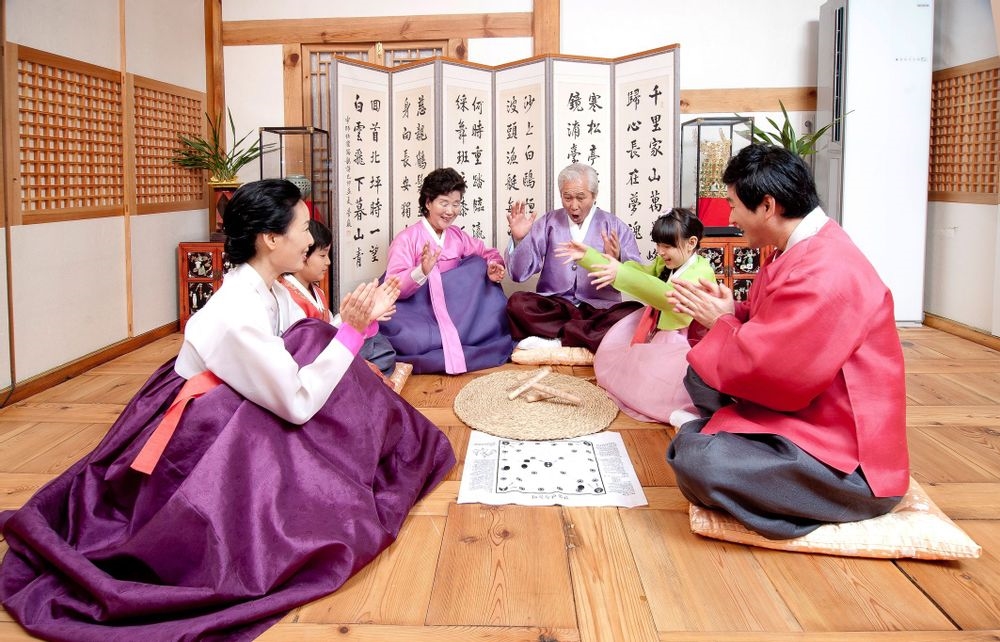 South Korea is a nation that places great importance on etiquette. This is reflected in a culture of refined conduct, which consistently emphasizes respect for elders and those with more seniority
4. People within relationships
The primary and most enduring network surrounding an individual is the family. Within the framework of Korean Confucianism, human beings do not simply emerge from a void; rather, they serve as a link in a chain extending from their ancestors, while simultaneously acting as a foundation for future generations. Consequently, the concept of filial piety is elevated to the status of an ultimate religion. During the Joseon Dynasty, an individual’s identity was defined entirely by their family lineage. This mindset remains deeply rooted even today. A child does not grow up living solely for their own dreams; their personal success or failure is inextricably linked to the honor of their entire clan. When a South Korean succeeds, it brings glory to their family; when they fail or make a mistake, it leaves a stain that resonates all the way back to their ancestors. This dissolution of the individual self forges an incredibly strong communal bond, yet it also imposes an invisible, heavy burden upon every person from the moment they are born.
In order to govern a society composed of interconnected individuals, Korean Confucianism established a rigid hierarchy based on age and social status. The most distinctive consequence of this process of localization is the very structure of the Korean language. When two Koreans meet for the first time, the go-to question is always: “What year were you born?” This is not an act of intrusive curiosity, but rather an instinctive, Confucian-rooted reflex. They need to immediately establish their respective positions within the web of social relations who is the senior and who is the junior. This distinction determines which level of honorifics within the complex grammatical system of the Korean language, one must employ. A linguistic system in which one cannot even begin to speak without first establishing one’s own social standing relative to the person being addressed serves as clear evidence that, for the Confucian-influenced people of Korea, the “self” does not exist in isolation.
When living within a network, the most vital human capacity is not the expression of one’s own personality, but rather the ability to integrate and maintain harmony. Koreans have a unique term for this skill: “nunchi” - the capacity to gauge the emotions of others through observation. It is the art of watching, listening, and empathizing with the surrounding atmosphere to discern how to behave appropriately, ensuring that one’s actions do not disrupt the collective interest. A person with good “nunchi” knows how to restrain their ego, show deference to those in positions of seniority, and navigate relationships smoothly. This mindset has fostered a highly cohesive and disciplined society in South Korea. In times of national crisis, this Confucian-rooted network ignites a spirit of unity and collective resolve much like the way citizens once lined up to donate their gold to help the nation during the 1997 financial crisis. Conversely, the fear of being excluded from the network, along with the exhaustion that comes from constantly looking over one’s shoulder to live up to the expectations of others is the very root of the dark, depressive depths found in modern society.
2. The path to personal self-perfection
Korean Confucianism chooses a path that is entirely engaged with the world, a journey of self-cultivation aimed at refining one’s character to become a junzi (a person of exemplary virtue). This is not merely a dogmatic theory confined to paper, but rather a rigorous, disciplined process of self-cultivation that continues to exert a profound influence on contemporary Korean society.
The primary element in the Confucian ideal of character cultivation in Korea is the elevation of the concept of reverence (kyŏng) to the very core of all self-cultivation.
Initiated and brought to its zenith by the philosopher Yi T’oegye, the concept of “Gyeong” (reverence/seriousness) is not merely about showing respect to others; rather, it represents a psychological state of absolute inward focus. In order to cultivate one’s character, ancient Koreans believed that the human mind must remain in a state of constant alertness and solemnity, entirely free from any improper or deviant thoughts. The practice of Gyeong (reverential mindfulness) requires individuals to engage in constant self-examination, moment by moment. It is precisely this rigorous moral self-discipline that forged generations of Joseon-era scholars, men of unwavering integrity who would rather face death than compromise with evil, a quality that Koreans refer to as the “scholar’s spirit”.
If the concept of Reverence acts as an inner flame that quietly tempers one’s character, then “Propriety” serves as the external framework for behavior. In Korean Confucianism, the study of propriety is elevated into a highly nuanced and rigorous behavioral science, known as “Governance through Propriety”. Traditionally, Koreans believed that if natural human emotions, the “seven emotions” were left unchecked and indulged without restraint, they would inevitably lead to chaos. Therefore, they employed “ritual propriety” to regulate and aestheticize all aspects of daily life. The four major rites in a person’s life, the coming-of-age ceremony, the wedding, the funeral and the ancestral rites were carried out with absolute precision and solemnity. Through the repeated practice of rituals from one’s manner of walking and the use of honorifics in speech, to the way one lifts a teacup, individuals gradually refine their raw, selfish instincts, aligning themselves with the civilized order of the community. In this context, such rituals are not mere affectation; rather, they serve as a lens through which one can examine and cultivate one’s own character, day by day.
In modern Korean society, the Confucian pursuit of self-perfection is most clearly manifested in the nation’s intense fervor for education. Today, Korean students throw themselves into an academic race staying up all night at private tutoring academies and navigating the grueling university entrance examinations with an iron will. That is the direct inheritance of the spirit of hard work and examination in the past. Besides, the spirit of self-cultivation and constant self-improvement also explains why modern Koreans tend to be extremely strict with themselves and those around them, especially public role models. A minor moral lapse can ruin the entire career of a major star, as society unconsciously demands that they be paragons of virtue with an impeccable character, in line with Confucian standards.
3. Conclusion
The Confucian conception of the human being in Korea represents a unique phenomenon in the history of human thought. It transforms the individual from a natural being into a self-aware moral subject, one who continuously refines their character to attain harmony with both the cosmos and the community. The Korean people have pushed these theories to the absolute limit of their conceptual purity through profound scholarly debates on Li (principle) and Qi (vital energy). In the twenty-first century, the Confucian-influenced Korean individual stands at a crossroads of transformation. Values such as filial piety, a sense of communal responsibility and a reverence for knowledge remain invaluable spiritual assets. However, for sustainable development, South Korean society must undergo an ideological overhaul: sifting through its heritage to discard authoritarian patriarchalism and extreme hierarchical discrimination, while integrating modern values of human rights and individual freedom. Only then can the Confucian legacy truly serve as a vibrant, internal source of strength that nourishes the human spirit in the land of the “morning calm”.
* Van Lang University, Ho Chi Minh city
References
1. Yi T’oe-gye (Ly Thoai Khe) and Ki Ko-bong (Ky Cao Phong) (16th century debate), “Letters Exchanged Regarding the Four Beginnings and the Seven Emotions” (Sudan chiljeong wangnae seo).
2. Nguyen Kim Son, (2012), Korean Confucianism: History and Characteristics, Vietnam National University Press, Hanoi.
3. Phan Thị Thu Hien (2011), Korean Culture, Vietnam National University Ho Chi Minh city Publishing House.
4. Nguyen Tien Dung (2015), On the Debate Concerning the “Four Beginnings” and “Seven Emotions” in Korean Confucianism, Journal of Philosophical Research, No. 8.
5. Tran Thi Thu Luong (2018), The Transformation of Confucian Values in the Modern Korean Family, Journal of Northeast Asian Research, No. 4.
6. Phan Thi Thu Hien (2014), The Seonbi (Scholar-Official) Spirit and the Path of Character Cultivation Among Koreans, Proceedings of the International Conference on Korean Research in Vietnam, University of Social Sciences and Humanities, Ho Chi Minh city.
7. Tu Weiming (Do Duy Minh) - translated by Luong Van Hong (2010), Confucian Traditions in the Modernization of East Asia, National Political Publishing House.
