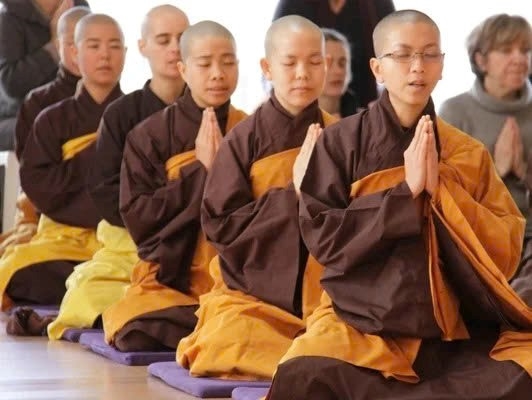
 Gender equality in Buddhism is not about leveling the playing field in terms of form, but about recognizing the right of every individual to access the absolute truth
Keywords: Gender equality; Religion; Buddhism; Catholic; Islam; Feminist theology; Spiritual culture.
1. Introduction
In modern religious studies, the relationship between spiritual beliefs and gender equality has always existed in a paradoxical dilemma: Religion, while serving as a cradle for nurturing fundamental human values is also considered the most formidable obstacle to women’s liberation. From the perspective of their origins, major religious systems, when first established, were often revolutionary, breaking the unjust shackles of contemporary society. In this respect, religion served as a foundation for human dignity, providing a spiritual space where gender was no longer a measure of holiness or intelligence. However, a paradox arises when these systems undergo institutionalization. When religion blends with patriarchal political and cultural structures, it inadvertently becomes a barrier due to biased interpretations. Classical texts, inherently allegorical, were often interpreted literally or distorted by male religious leaders to maintain the old social order. Women were often marginalized within these power structures, restricted from ordination as priests or preachers or from holding core spiritual leadership positions. This contradiction has created a centuries-long struggle. Religion provides the language for people to demand justice, but it also creates deeply ingrained spiritual mindsets. Therefore, to understand gender equality in religion, it cannot be viewed as an immutable constant, but rather as a continuously recurring process. The current struggle is to liberate core human values from the dust of historical prejudices in order to rediscover the original equality inherent in each faith.
2. Buddhism and equality in enlightenment
In the Buddhist philosophical system, the idea of gender equality stems from a profound ontological foundation: emptiness. This is the key to deciphering the Buddhist perspective on gender, taking the issue beyond the limitations of physical form to touch upon the core essence of liberation.
According to Madhyamaka philosophy and Mahayana scriptures, all phenomena arise from causes and conditions; there is no independent and eternal nature. Gender, male or female, is essentially just a temporary collection of the five aggregates (form, feeling, perception, volition, consciousness). When viewed through the lens of emptiness, all distinguishing characteristics of gender become illusory. In the Vimalakirti Sutra, a famous dialogue between Sariputta and a celestial maiden illustrates this idea. When Sariputta doubted the ability of women to attain enlightenment, the goddess used her divine power to transform him into a woman and vice versa, then asked him: Where is that feminine appearance now? The answer lies in the realization that: Appearance is only temporary, while character has no male or female nature. If a person still clings to the image of a male or female, that person has not yet truly grasped the ultimate truth.
The second core principle reinforcing equality in Buddhism is the doctrine of Buddha-nature. Siddhartha Gautama Buddha (Thich Ca Mau Ni) affirmed this after his enlightenment: “All sentient beings possess the virtues and wisdom of the Tathagata”. The phrase “all sentient beings” excludes no one based on gender, race or caste.
Unlike many contemporary ideologies that viewed women as less fortunate or incapable of attaining the highest spiritual attainment, early Buddhism and especially Mahayana Buddhism, opened a path to enlightenment for nuns. The appearance of female Arhats in the “Verses of the Elder Nuns” is the most vivid evidence. These poems not only speak of the suffering of women in a patriarchal society, but also express the joyful exclamation of spiritual freedom when breaking free from the shackles of greed, anger and delusion - things that inherently have no gender.
However, a historical fact cannot be denied: although the supreme doctrine affirms equality, in practice and monastic structure, nuns are often subject to stricter regulations than monks through the existence of the “Eight Respectful Rules” (eight rules that require nuns to unconditionally respect the monastic community). However, when facing the modern era, the idea of emptiness becomes an endogenous resource for Buddhism to self-adjust. Contemporary Buddhist feminist movements, from the revival of the nun tradition in Theravada countries to the promotion of the role of female practitioners in the West are all based on the premise that if wisdom is the essence of enlightenment and wisdom has no male or female form, then gender discrimination in spiritual practice is an ignorance that must be eradicated.
In short, gender equality in Buddhism is not about leveling things out formally, but about recognizing every individual’s right to access absolute truth. Gender is merely a means, while the ultimate goal is complete liberation from all dualistic opposition. This perspective has made Buddhism one of the most progressive systems of thought regarding gender, placing the value of human beings in their capacity for transformative consciousness rather than their limited biological characteristics.
3. Catholicism and human dignity
In Catholic theology, the concept of gender equality is deeply rooted in the revelation of God's creation. In order to understand the depth of this issue, it is necessary to analyze the relationship between ontology and vocation through the lens of Scripture and Church tradition.
The most fundamental starting point lies in the Book of Genesis: “God created man in his own image, in his own likeness; he created them male and female” (Gt 1,27). The phrase “image of God” is the charter of human dignity in Catholicism. Here, the image lies in reason, free will and the capacity to love. More importantly, the Bible affirms that God created humankind, male and female as a unified whole. This implies that both men and women reflect the attributes of God fully and equally. This equality is essential equality, an inherent value, inviolable and independent of any social institution. Men are no more like God than women, and women are not a secondary or subordinate version of themselves in terms of spiritual dignity.
One of the outstanding contributions of modern Catholic theology, particularly through the thought of Pope John Paul II in his treatise on the Theology of the Body, is the recognition of gender differences not as a separation or hierarchy, but as a gift that fosters communion. Women and men are created for each other. Their sexual and psychological differences lead to a complete and fulfilling giving.
In the encyclical Mulieris Dignitatem (On the Dignity of Women), the Church emphasizes that women possess a unique vocation and inherent capacity to receive, protect, and nurture life. Equality here is understood as two entities, different in function and characteristics, yet both striving towards a common goal: love and holiness. Mary’s position in Catholicism is a practical testament to respect for women. She is not only a mother in the biological sense, but also the new Eve, representing humanity in saying “Yes” to God. The special veneration given to Mary in the liturgy and the life of faith affirms that: In the kingdom of God, greatness is not measured by administrative power but by the degree of union with grace. The image of the woman “clothed with the sun and with the moon under her feet” in the Book of Revelation is the most radiant symbol of the power and dignity that God bestows upon women.
One of the most debated aspects of Catholic gender is the reservation of sacred offices (priest, bishop) exclusively for men. However, from a theological perspective, the Church explains this as a matter of symbolism and revealed tradition, rather than a denial of women’s leadership potential. Priests are seen as acting in the person of Christ, and Christ is male; therefore, this distinction is more sacramental than class-based. The Church is striving to separate administrative authority from sacred office, aiming to open the way for women to participate more deeply in papal councils, parish administration and theological teaching. Equality within Catholicism, therefore, is shifting from ontological theory to the realization of justice within ministerial structures.
In short, gender equality in Catholicism is the absolute respect for the image of God in each individual. Human dignity in Catholicism is a dualistic dignity - men and women together rule the earth, together bear responsibility for history and together are called to share in eternal life. It is the richness of the sexes that makes the picture of humanity a more accurate reflection of the splendor of the Creator.
4. Islam and fairness in justice and law
Islam is often the subject of the most prejudice regarding gender issues. However, a deeper examination reveals a unique system of equality, where the concept of fairness is prioritized over mere homogenization. Islam does not view men and women as two opposing or completely identical entities in terms of social function, but rather as two complementary halves within a unified moral system guided by Allah.
The first foundation of gender equality in Islam lies in the origin of creation. The Quran affirms that all human beings are created from a single soul. Islam holds that both Adam and Eve are equally responsible for their mistakes and are equally forgiven by Allah. Spiritually, there is no distinction between men and women in accessing grace. The Quran states: “Both submissive men and submissive women, both men and women who believe and women who believe... Allah has prepared for them forgiveness and a great reward" is a declaration of absolute equality between the individual and God, where virtue is the only measure, not gender.
One of the most revolutionary aspects of Islam in the 7th century was the granting of legal rights to women. Sharia law was an early signatory to recognizing women as independent property owners. About inheritance, modern Islamic legal scholars explain it as fairness in the distribution of responsibilities rather than inequality in value. In the Islamic family structure, men have a legal obligation to provide for the entire living expenses of their wives, children, and sometimes other female relatives. Conversely, women have the right to keep all of their assets, including dowry and personal income, separate without the obligation to contribute to household expenses; therefore, the difference in inheritance figures is essentially an economic compensation mechanism aimed at ensuring the stability of the dependent social structure.
Islam views marriage not as an unchangeable sacrament, but as a civil contract. In this agreement, the woman’s consent is a prerequisite for the marriage to be valid. In Islam, wives retain their surnames after marriage, demonstrating their independent legal identity and preventing them from being absorbed into their husband’s family. Although divorce procedures differ between men and women, the core spirit of Islamic law is to protect women's rights in cases of divorce. Reforms in family law in many modern Islamic countries are increasingly focusing on empowering women to proactively end unhappy marriages, based on legal precedents from the early days of the religion.
A famous quote from the Prophet Muhammad: “The pursuit of knowledge is the duty of every Muslim (men and women alike)”. This teaching broke down barriers preventing women from accessing intellectual knowledge. In Islamic history, Aisha, the wife of the Prophet, was one of the greatest scholars, who preserved and taught thousands of sacred teachings.
In summary, the Islamic concept of gender equality is built on the principle of balance. Instead of promoting a formal equality through the exchange of positions, Islam establishes a system of justice based on inherent differences to achieve social harmony. The dignity of Muslim women is protected through specific legal regulations, transforming them into sovereign entities spiritually, economically and legally within a God-centered world order.
5. Facing modern challenges and trends
As we enter the era of globalization and human rights revolutions, religions no longer operate within isolated oases of faith but must confront new secular moral standards head-on.
The greatest challenge today is the existence of invisible but ingrained barriers. Although the core doctrines of Buddhism, Catholicism and Islam all affirm equality of dignity, religious power structures remain largely in the hands of men. These barriers don't just come from the scriptures, but often from the blending of religion and local culture. So, instead of rejecting religion, women scholars like Amina Wadud in Islam or Elizabeth Schüssler Fiorenza in Christianity are conducting textual archeology to seek to reread the classics through a woman's lens, emphasizing forgotten or misinterpreted passages of the past. This trend is not aimed at changing doctrine but at restoring the original spirit of equality. Within Islam, feminists are using independent thinking to demonstrate that rules about inheritance or dress should be understood within their historical context rather than being applied rigidly and discriminatoryly in modern society. In Buddhism, the learning and practice of meditation by women in the West is blurring gender boundaries, where wisdom is recognized as a non-sexual entity.
Another important trend is a shift in mindset. Currently, pressure from the United Nations Sustainable Development Goals (SDGs) has prompted religious organizations to recognize the role of women in public spaces and leadership. This represents a shift from viewing women as passive recipients of protection to active participants in spiritual missions.
6. Conclusion
Modern religion is facing a new paradise of understanding, where holiness is no longer divided by gender, but is measured by each individual’s commitment to justice and compassion. Gender equality in religion is a continuous process. Gender discrimination does not originate from God or enlightened beings, but from a deficiency in human understanding. Moving towards genuine equality requires a sincere dialogue between spiritual beliefs and modern human rights values.
References
1. Armstrong, K. (2011), A History of God, World Publishing House (Nguyen Nhuan translation), Quotes on the evolution of the concept of gender in monotheistic religions.
2. Political Bureau (2020), Resolution No. 06-NQ/TW on women’s affairs in the new situation.
3. Dalai Lama (2009), The Universe in a Single Atom. Harmony, An analysis of the equality of all beings in Buddhist philosophy.
4. Wadud, A. (1999), Qur’an and Woman: Rereading the Sacred Text from a Woman’s Perspective. Oxford University Press, A pivotal book on feminism in Islam.
5. Le Thi Nham Tuyet (2002), Women and Religion in Vietnam, Social Sciences Publishing House.
