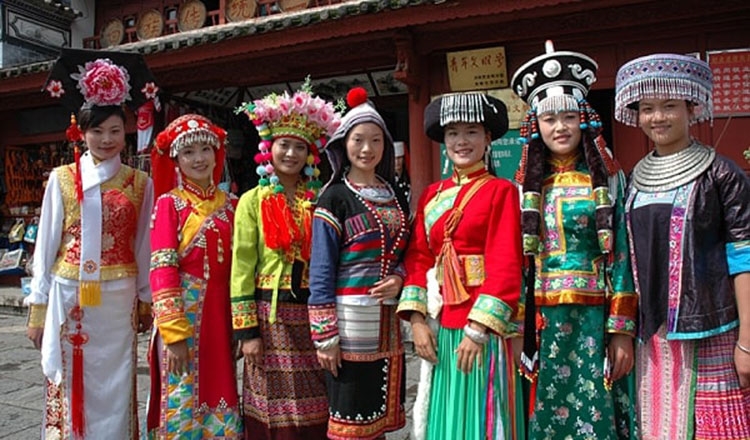
 Traditional clothing of some ethnic minorities in China
Keywords: Ethnicity; Ethnic policy; China.
1. China and ethnic groups in China
China has a long history - one of humanity’s ancient civilizations, about 5,000 years ago. The Han people first established their kingdom during the reigns of Yao and Shun on the Yellow River (present-day Hebei Province), followed by subsequent dynasties along with territorial expansion: Xia Dynasty (2205-1776 BC), Shang Dynasty (1776-1122 BC), Zhou Dynasty (1122-256 BC), Qin Dynasty (221-210 BC), Han Dynasty (210 BC-265 AD), the Jin Dynasty (265-420), the Sui Dynasty (581-618), the Tang Dynasty (7th, 8th and 9th centuries), the Song Dynasty (10th-12th centuries), the Yuan Dynasty (1279-1368), the Ming Dynasty (1368-17th century), the Qing Dynasty (17th-1911 centuries), the Republic of China (1911-1949) and the Socialist People’s Republic of China (1949 to present).
Currently, China, with an area of 9,597,000 km2, shares land borders with 14 countries. China established a People’s Republic of China in 1949, with a unicameral (National People’s Congress) system since 1954. Administratively, China currently has 22 provinces, 5 autonomous regions, 4 municipalities directly under the central government and 2 special administrative regions (Hong Kong and Macau). Since implementing the “Reform and Opening Up” policy, China's economy has developed rapidly, becoming the world’s second-largest economy. Per capita income increased from 203.3 USD in 1982 to 4,550 USD in 2010 and is projected to reach 13,306 USD in 2024.
China is among the top 10 countries with the largest number of ethnic groups. Currently, China has 56 ethnic groups, including 55 minority groups. The total population of the country is 1.324 billion people, of which the Han Chinese make up the majority with over 91% and the remainder are other ethnic groups. In terms of language, the ethnic groups in China today are very diverse, encompassing language groups belonging to five major language families: Sino-Tibetan, Altai, Tai-Kadai, Mong-Myanmar and South Asian. Specifically, the population of each ethnic group is as follows: Zhuang: 19.6 million, Uyghur: 11.7 million, Hoi-Hui: 11.3 million, Mong - Miao: 11.1 million, Man-Manchu: 10.4 million, Loloyi: 9.8 million, Di-Dy is 9.8 million, Tujia is 9.5 million, Tang-Zang is 7.1 million, Mongolian is 6.2 million, Buyi is 3.6 million, Dong-Dong is 3.5 million, Dao-Yao is 3.3 million, Bach-Bai is 2.1 million, Korean is 1.7 million, Hani is 1.7 million, Kazakh is 1.6 million, Le-Li is 1.6 million, Thai-Dai is 1.3 million,… Ethnic groups with populations under 50,000 include: Pumi (45,012), Achang (39,555), Nu (36,575), Jing (33,112), Ewenki (30,875) and Lang-De’ang (22,354). Jino is 26,025, Baoan is 20,074, Yugu is 14,706, Uzbeks is 12,742,…
The ethnic minorities in China have characteristics that warrant attention. Firstly, regarding their geographical location, these minorities often reside in border regions in the Northwest, North, Northeast, South and Southwest - areas that were later conquered and expanded by the Han Chinese. Over time, some ethnic groups coexisted with the Han Chinese, but the majority of ethnic groups developed their own distinct territories as a result of historical processes. These minority groups possess their own unique cultures, lifestyles and customs, which have been formed and preserved for generations, creating a distinct identity for each ethnic group. Some ethnic groups, having been incorporated into China a long time ago, have been “Sinicized”, retaining only a few distinctive cultural features associated with their beliefs. The majority of these minority ethnic groups have lower living standards and educational levels compared to the general population; some even maintain backward lifestyles with outdated customs. For various reasons, both historical and present, some ethnic minorities also harbor separatist ideologies and engage in activities that destabilize political stability and social order.
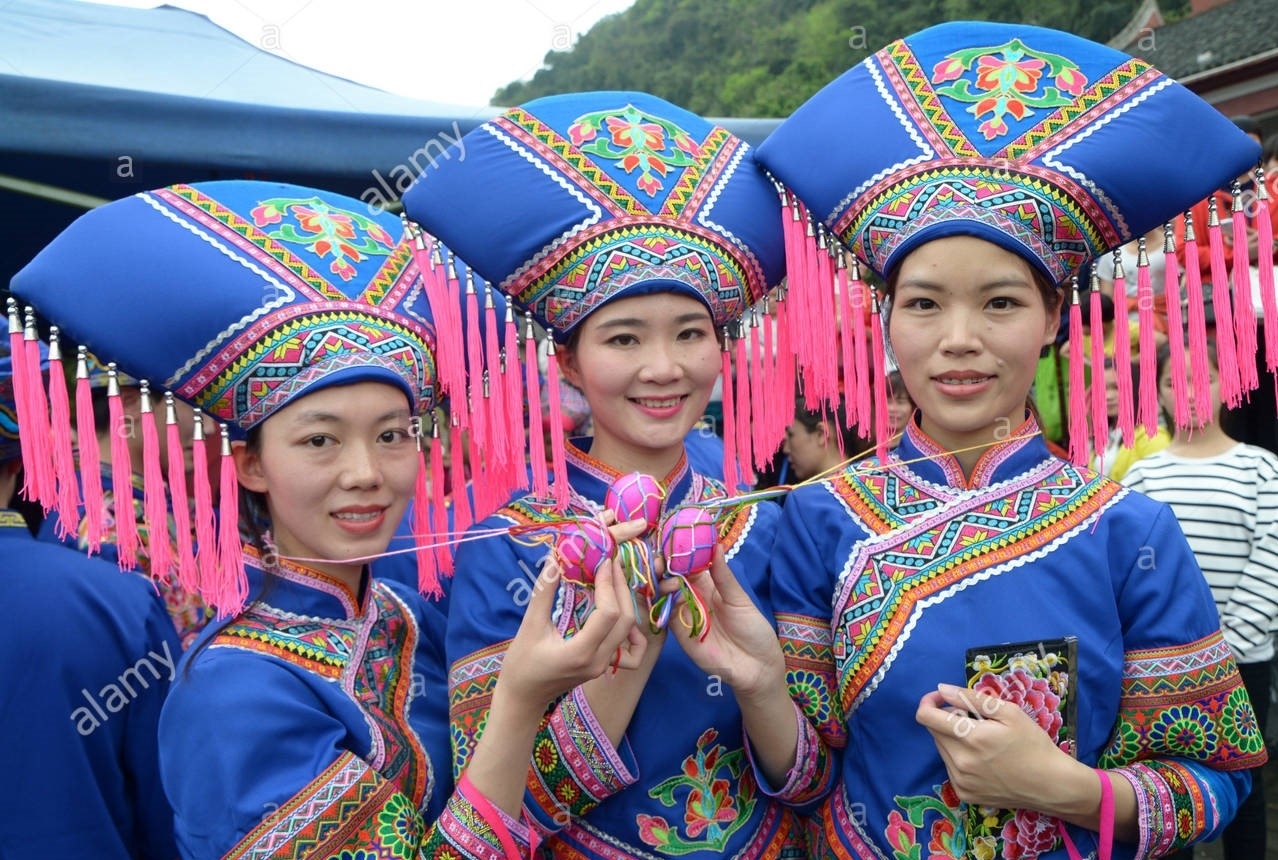 Zhuang ethnic women in China
2. National policy and its implementation in China
After its founding (1921), during the revolutionary movement, the Chinese Communist Party paid attention to the national question. In November 1931, when drafting the Outline of the Constitution of the Chinese Soviet Republic, the Chinese Communist Party included provisions on the national question in Articles 13 and 14, which emphasized: “Within the Soviet administration, workers, peasants, Red Army soldiers, and all impoverished working masses and their families, regardless of gender, race or religion, were equal and were Soviet citizens”. Subsequently, documents issued by the Chinese Communist Party in 1936, 1939, 1941, 1942 and other years contained provisions related to ethnic policy.
Following the civil war between the Communist Party and the Nationalist Party in 1949, the People’s Republic of China was established. The Communist Party and the Chinese government also paid close attention to the national question. In September 1949, the Platform of the Chinese People’s Political Consultative Conference included provisions on nationalism. The first Constitution of the People’s Republic of China in 1954, followed by amendments in 1975 and 1978, all contained provisions on ethnic policy. Particularly during the period of "Reform and Opening Up," the 1982 Constitution, later amended in 1993, 1999, 2004 and 2018, emphasized constitutional principles for the nation. Specifically: All ethnic groups have equal rights; the State guarantees the legitimate rights and interests of all ethnic groups; discrimination and oppression of ethnic groups are prohibited; and autonomy is established for areas with a high concentration of ethnic groups (Article 4). In addition to the principle of nationality, the Chinese Constitution contains provisions related to nationality. Specifically, it states: “All ethnic groups have the right to freely use and develop their own languages and writing systems; they all have the right to freely maintain or change their customs and traditions...”. “Citizens of the People’s Republic of China who are 18 years of age or older, regardless of ethnicity, race, gender, social background, religion, beliefs, educational level, economic status or length of residence, have the right to vote and run for office; however, those who are deprived of political rights by law should be excluded” (Article 34),…
Of great concern, for ethnic regions with specific historical, cultural, and ethnic characteristics, the Chinese Government established autonomous regions. Specifically: Inner Mongolia Autonomous Region was established in 1947 in the North, bordering Mongolia and Russia with steppe terrain. The Xinjiang Uygur Autonomous Region, established in 1955 in northwestern China, is the largest autonomous region with a desert landscape. The Guangxi Zhuang Autonomous Region, established in 1958 in southern coastal Guangxi, has the largest ethnic minority population. The Ningxia Hui Autonomous Region, established in 1958 in northwestern Tibet, is home to a large Muslim population. The Tibet Autonomous Region, established in 1965 on a plateau, has a very distinctive Tantric Buddhist culture. Perhaps because the Hmong people, despite their large and concentrated population, have unique historical, cultural, psychological and ethnic characteristics, the Chinese government has not granted them autonomy like some other ethnic groups.
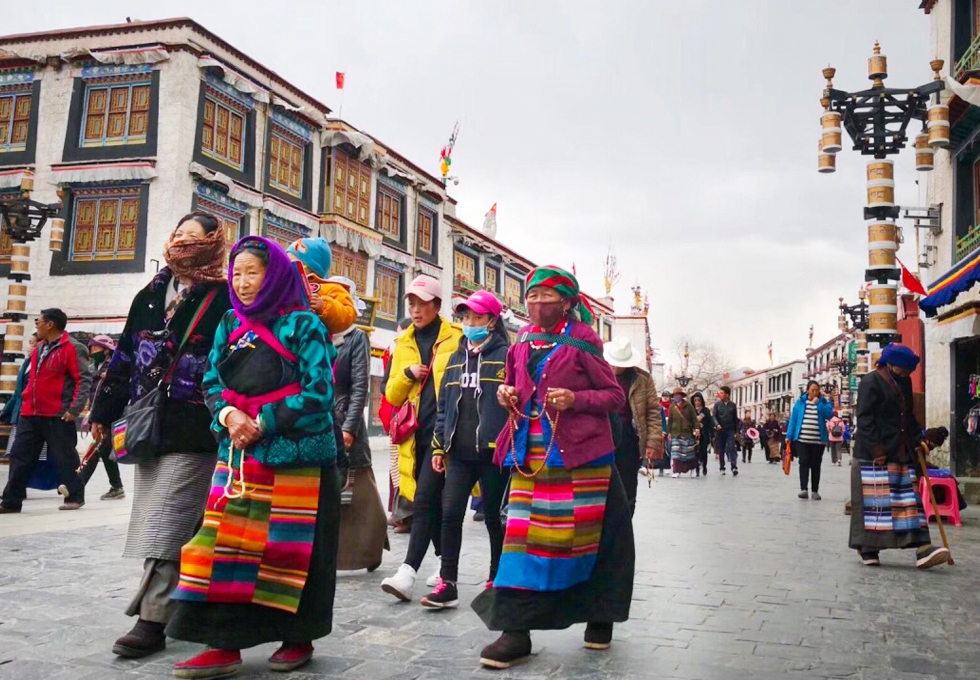 The vibrant traditional clothing of the Tibetan people in China
After the establishment of autonomous regions, the Chinese Constitution (Articles 112 to 122) stipulated in detail the structure, functions and powers of the administrative apparatus at all levels of the autonomous regions in the fields of health, finance, culture, education, language, writing, religion, customs, traditions,... Along with the Constitution, China enacted the Law on Autonomy in 1984 (amended in 2001). The Law on Autonomy concretized the principles of the Constitution with regulations on the conditions for establishment, scope, organizational structure, functions and powers of administrative levels and the decentralization of management between the central government and autonomous regions,... In support of the Law on Autonomy, China has specialized legal regulations related to ethnic policies, such as: the Law on Education (1995, amended in 2015), the Law on Protection of Intangible Cultural Heritage (2011), the Law on Basic Healthcare (2019), the Law on Organization of Local Government (2015),...
Ethnicity and religion are two issues with many unique characteristics, but they differ in perception and approach from the perspective of the governing body. If it's a religious issue, most countries have laws to regulate religious activities, while ethnicity involves policies to ensure ethnic equality and improve the living standards and educational levels of the people. Regarding religion in China during the “Reform and Opening Up” period, in 1994, China issued the Decree on the Management of Registration of Religious Establishments; subsequently, on November 30th, 2004, it issued the Regulations on Religious Affairs. Regarding ethnic issues, besides the aforementioned documents, the Chinese government only issues documents for organizing and supervising implementation, especially plans and programs for economic, cultural and social development for ethnic groups in general and for specific ethnic regions, particularly autonomous regions. Along with regulations on ethnic policy, Chinese law includes provisions to sanction violations of the law related to separatist activities, incitement of ethnic hatred, ethnic division, insulting the culture and customs of other ethnic groups and activities related to terrorism,...
Implementing ethnic policies is a crucial issue that China pays close attention to and requires a specialized agency. This is the Nationalities Commission under the State Council (Government), a ministerial-level agency with specific functions such as: researching and advising on ethnic policies; Inter-sectoral coordination with relevant ministries and agencies; Inspection, examination and supervision of the implementation of ethnic policies; Training of ethnic minority cadres,... In provinces, autonomous regions, districts, continents, and even communes with ethnic issues, there is an Ethnic Committee, which is the functional agency of the government in implementing ethnic policies. Like other monolithic countries under the leadership of the Communist Party, China has a mechanism for leading, guiding, and directing ethnic policies and implementing ethnic policies with the motto “The Party comprehensively leads ethnic affairs”. The Party’s ethnic affairs agency is the Central Committee for Ethnic Affairs and Party committees at all levels.
With specific ethnic policies, under the leadership of the Party and the Government, and with specialized agencies coordinating with relevant sectors and localities, ethnic policies in China have achieved very important results. Entering the period of “Reform and Opening Up”, China has focused on investing in infrastructure, transportation, budget subsidies, and poverty reduction support,... This is especially true for programs related to resource exploitation, labor restructuring, and urbanization in autonomous regions such as Tibet, Xinjiang, Inner Mongolia, and Yunnan,… Thanks to specific policies implemented recently, the living standards of ethnic minorities in China have changed significantly. The per capita income index in many ethnic minority areas has risen compared to the general average. In recent decades, specific social policies have been implemented for ethnic communities, especially in autonomous regions, such as education, health care and culture... Along with economic, cultural, and social programs, the Chinese government has focused on propaganda and the implementation of national unity based on mutual interests and national reconciliation, maintaining relations between ethnic groups and between ethnic groups and the state. It can be said that during the “Reform and Opening Up” period, the living standards and educational levels of the ethnic groups in China have changed significantly in a positive direction.
The Chinese government pays close attention to religious policy in ethnic minority areas, aiming to preserve the traditional religions of each community while creating favorable conditions for religious activities, such as: religious activities of believers, religious activities of dignitaries, training of dignitaries, publishing scriptures, building and repairing places of worship,... have helped national relations develop in a positive direction.
Despite the achievements made, China is facing challenges in implementing its ethnic policy. These include ongoing discrimination and inequality against ethnic minorities in areas such as employment, education, training and social relations. This model of “autonomy within unity” is, in some cases, merely a formality, especially regarding legislative power, finance, and leadership at all levels. This includes excessive economic development and resource exploitation that negatively impacts the environment in ethnic minority regions, along with the migration of Han Chinese to these areas,... One of the complex issues facing China is religion in ethnic regions, linked to extremist separatist tendencies. Specifically, in the first decade of the 21st century, Jihadist groups in South Asia and the Middle East, including IS, issued statements supporting Xinjiang’s secession from China and integration into global Islam. Some Uyghurs joined Taliban and Al-Qaeda terrorist groups, even declaring they would return to “redden China”,... The Chinese government has employed various measures to address the issue, but these have not yielded the desired results.
3. Conclusion
China is a country with a large ethnic minority population. Although the proportion of ethnic minorities is low compared to the total population, for many reasons, both historical and current, they receive great attention from the Chinese Communist Party and the Chinese government. During the period of “Reform and Opening Up”, the Chinese Communist Party and government issued many specific policies on all aspects of ethnic affairs, adapting to the new stage of development, these policies yielded significant results, but the policies and implementation of ethnic affairs in China still need appropriate adjustments.
* Ho Chi Minh National Academy of Politics
References
1. Liu Peng, Religion and the Rule of Law in China, Chinese Academy of Social Sciences, translation of Journal of Religious Research, No. 3, 2007.
2. Albert P. Blaustein, Jay A. SiglerConstitutions that Made History, National Political Publishing House, Hanoi, 2013.
3. Le Hai Dang - Pham Minh Phuc, Ethnic and religious conflicts in some countries in recent years, Social Sciences Publishing House, Hanoi, 2020.
4. Le Giang, Chinese Dynasties, Encyclopedia Publishing House, Hanoi, 2008.
5. Dinh Quang Hai (Editor), Land Border Relations between China and Neighboring Countries, Social Sciences Publishing House, Hanoi, 2022.
6. Tang Jie, An Overview of the Process of Religious Legislation in China, Journal of Religious Reseach, No. 3/2013.
7. Faculty of Law, Vietnam National University, Hanoi, Collection of Constitutions of Several Countries, Hong Duc Publishing House, Hanoi, 2012.
8. Hoang Thi Lan, Solving the issue of ethnicity, religion and ethnic-religion relations in China and references for Vietnam, Journal of Theoretical Information, No. 1/2023.
9. F.M. Savina, History of the Miao People - Histoire des Miao, Nazareth Printing House, Hong Kong, 1930. 10. Mai Ly Quang, 252 Countries and Territories of the World, The Gioi Publishing House, Hanoi, 2010.
