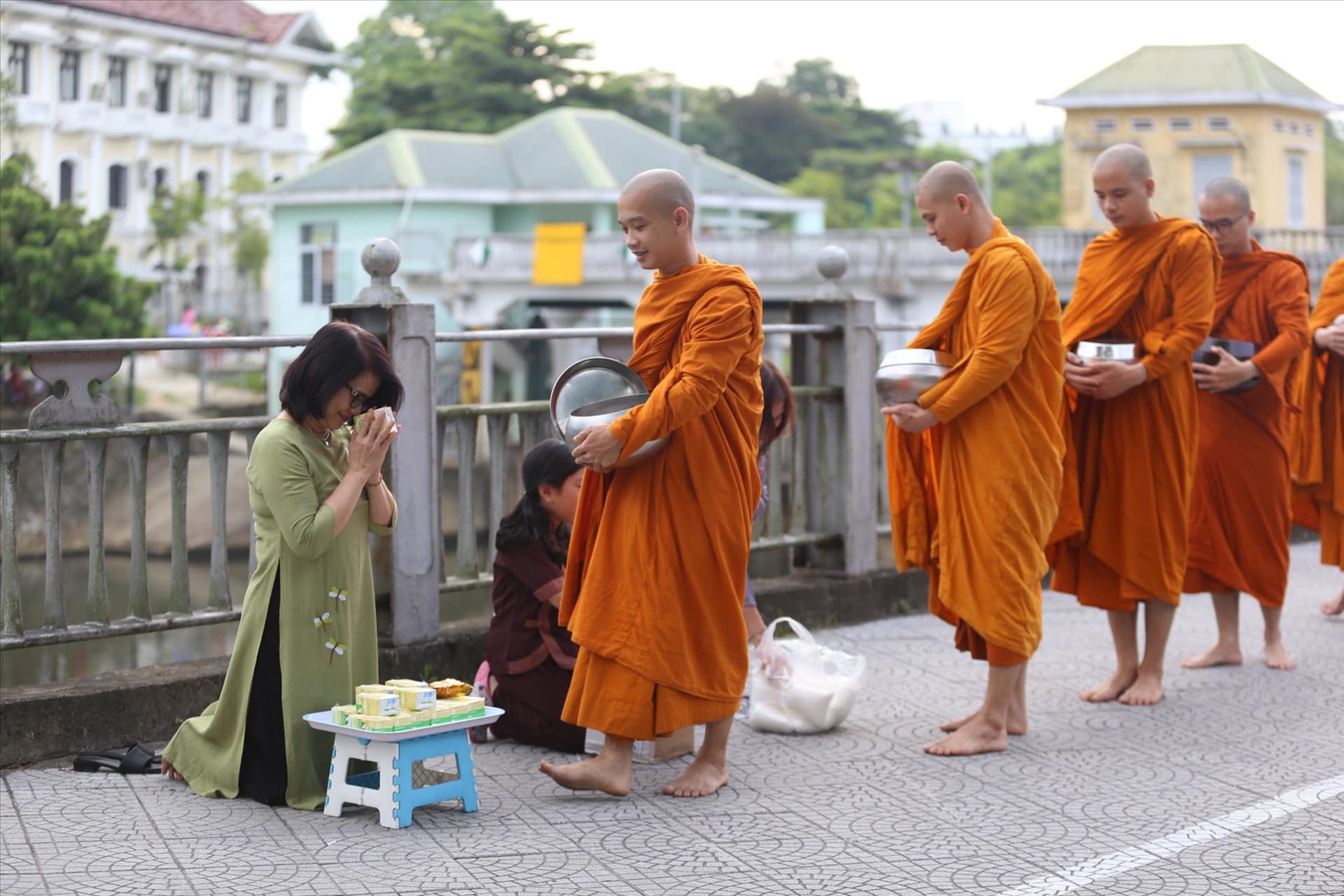
 A proper offering is when the giver, the offering and the recipient are all in harmony, merging in an emptiness of ego yet filled with mindfulness
Keywords: Offering; Buddhism; The three wheels are empty and silent; Religious ethics; Righteousness.
1. Introduction
In the flow of contemporary spiritual and cultural life, the concept of offering presents a troubling paradox: the prevalence of the act is inversely proportional to the depth of understanding. From a sociological perspective, religion represents a significant disconnect between its original philosophical nature and the pragmatic practices of the masses. Making offerings, originally a practice for inner transformation, purifying cravings and cultivating respect for noble values, is now often reduced to a form of bartering spiritual transaction.
This misconception stems from equating offerings with mere financial donations. When an individual places money on an altar with the intention of seeking greater material gain, they are no longer practicing detachment but are actually reinforcing their greed. At this point, offerings no longer serve as a means of connecting with the sublime, but become tools for bargaining with the deities. This deviation not only diminishes the moral value of the action but also creates a fog that obscures the core of the doctrine, which is selflessness and altruism.
Nowadays, many people tend to view offerings as a way to assert social status, through offering luxurious items or hoping to have their names inscribed on stone tablets or golden plaques, forgetting that, in the view of enlightened beings, the value of an offering lies not in the quantity of material things but in the purity of the intention. A single bowl of rice offered with utmost sincerity and reverence can bring far greater spiritual merit than huge contributions driven by calculation and pride. It’s important to understand that making offerings is the beginning of a journey to free oneself from the attachment to material possessions. When the understanding of offerings is returned to the right path of gratitude and self-cultivation, it becomes a miraculous spiritual therapy, helping people find true peace amidst a turbulent world.
2. The nature of offerings
In order to fully understand the act of making offerings, it is necessary to analyze it from its linguistic surface to its philosophical core. Semantically, “offerings” is a corrupted form of the Sino-Vietnamese phrase “providing sustenance”, implying the provision of material goods and spiritual nourishment. n the Sanskrit tradition, this concept is viewed through two lenses: Pūjā (respect) and Dāna (giving). This combination creates a holistic act: we are not simply giving away an item, but offering it with humility and gratitude. This is the essential difference between offerings and ordinary almsgiving. If almsgiving is sharing from top to bottom for difficult people, then offering is an upward direction, an action towards virtuous people and the values of truth - goodness - beauty.
From an ontological philosophical perspective, offering is a direct way to combat the ego. Humans inherently have a possessive tendency, considering everything around them as their own and their ego as their own. Attachment to possessions is the greatest shackles preventing inner freedom. When a person makes an offering, they are undertaking a process of depossession. Each offering is like a scissor cut severing the thread of greed. Here, the object is merely a means, while the ultimate goal is the transformation of consciousness. Buddhist philosophy emphasizes that offerings are not meant to provide material possessions for saints or ancestors, as enlightened beings no longer have a need for material gain, rather, it is an opportunity for practitioners to sow the seeds of detachment in the field of merit within their own hearts.
The core of the philosophy of offering lies in the concept of the Three Wheels of Emptiness, meaning three “nothings” (not seeing the giver, not seeing the receiver and not seeing the offering) and this is a continuous, unending cycle. A truly complete act of offering, from a philosophical perspective, occurs when the giver, the object (the gift) and the recipient are all viewed through the lens of “emptiness” (śūnyatā). The giver doesn't see themselves as benefactors, the gift doesn’t see it as valuable property, and the receiver doesn’t see it as an indebted subject. When the “I” and “mine” are completely absent from the action, the offering becomes a pure act, a natural flow of energy between entities in the universe. At this point, the act of offering sacrifices is no longer limited by space or time, no longer a rigid religious ritual, but becomes a state of being. Thus, from a tangible act of devotion, offering has been elevated into a philosophy: Life is about giving and nurturing awakening within oneself and humanity.
3. The system of classifying offerings
In Buddhist thought and East Asian religious philosophy, the system of classifying offerings is divided into three main pillars: Offering of material things, offering of the Dharma, and offering of fearlessness. Each level represents a step forward on the path to human moral and intellectual perfection. Firstly, material offerings are the most basic and common form, serving as a foundational building block in the practice of renunciation. These offerings are further divided into two branches: Inner talent and outer talent. Inner talent is a higher level of sacrifice, which is the dedication of effort, time, intellect or even a part of the body such as blood donation, organ donation… for a noble cause. External offerings refer to the giving of material things such as food, medicine, clothing, money or other means to sustain the existence of the monastic community and spiritual institutions. his is the most direct way for practitioners to confront the attachment to material possessions. Offerings not only have religious value but also carry profound social significance, helping to redistribute resources and alleviate material suffering in the community. However, the value of giving lies not in the commercial value of the item but in the purity of its origin and the giver’s selfless attitude.
ranscending material values is the offering of Dharma, considered the highest and most valuable of all offerings. According to Buddhist scriptures, “Of all offerings, the offering of Dharma is supreme”. This means that living and acting according to the teachings of morality and truth is the most precious gift one can offer to enlightened beings. The offering of the Dharma does not require financial resources, but rather a strong personal commitment. It is an individual's effort to improve their character, abandon bad habits, and practice patience, compassion and wisdom in their daily lives. When a person lives an honest life, spreading positive values and helping others understand morality, they are making a living offering. The inner transformation of a practitioner is the most vivid proof of the power of the Dharma and it is the most meaningful reward for spiritual masters. The practice of offering Dharma is enduring, not subject to the ravages of time, and independent of the economic circumstances of the giver.
Finally, a deeply humane yet often overlooked form of offering is the offering of fearlessness (the giving away of fear). In a world rife with insecurity, anxiety and pressure, bringing peace, faith and protection to others is a noble act. Fearless giving is not only about helping people in distress, but also about adopting a tolerant and non-aggressive attitude, creating a safe environment for all living beings around us. A timely word of encouragement, a quiet presence beside someone in distress or the defense of justice and righteousness all fall under this category. This is a profound psychological offering that helps people connect with each other through the bonds of trust and compassion.
In short, the offering classification system shows a roadmap from the outside in: from letting go of external material things, to perfecting the internal personality and finally spreading peaceful energy to the surrounding environment. These three forms are not separate but complement each other. A practitioner who follows the Dharma correctly will not prioritize one form over another; on the contrary, they will use their talents to nurture the Dharma and use the Dharma to elevate themselves to fearlessness. The seamless integration of this system transforms the act of giving into a comprehensive tool for building a mindful society, where giving is no longer a burden but a source of inherent happiness for each individual.
4. What constitutes a proper offering?
For the act of offering to transcend the nature of a spiritual bargain or an empty ritual, it must be performed on a foundation of wisdom and mindfulness. From the perspective of religious studies, a proper offering is not measured by the scale of the offerings or the grandeur of the altar, but rather by the convergence of three pure elements: The giver, the thing given and the recipient. This is the structure of the Three Wheels concept of non-death in Buddhist ethics, where the act of giving becomes a means to liberation from the ego.
Firstly, the most crucial element of a proper offering lies in the mindset of the giver. A proper act must originate from a joyful heart, reverence and without expectation of reward. Joy is not only present at the moment of giving but must be present throughout: joy in preparation, peace in execution, and serenity after completion. This non-existence represents a profound psychological transformation. Normally, people give with the hope of receiving some benefit in return, such as peace, wealth or status. However, if offerings are made with the mindset of investing for profit, then the act is tainted by greed. Proper offering is when the giver no longer sees themselves as a benefactor, nor as someone accumulating merit for personal gain. When the giver eliminates their arrogant ego, the act of offering truly becomes immeasurable.
Secondly, there is the purity of the offerings. From an ethical perspective, offerings must be pure in both material and monetary form. This means that the property or item must be created through honest labor, without violating the law or ethics. In order to offer money obtained through deception, oppression, or dishonest business practices as a donation to the Three Jewels or for charity is a spiritual pretense. Besides their origin, offerings must also be appropriate to the needs of the recipient and the actual circumstances. Proper offerings discourage waste, ostentation or items that harm the environment and health. A cup of clean water, a fragrant flower offered with devotion and purity, can sometimes hold greater spiritual value than elaborate feasts lacking meticulousness and sincerity.
Thirdly, there is the correspondence of the recipient (the person receiving the offering). In Buddhist teachings, the recipient is likened to a field of merit. Good soil will help the seed sprout and bear sweet fruit. If the recipient of the offering is a virtuous person who uses the offerings to uphold the Dharma, help sentient beings, and cultivate wisdom, then the merit of the giver will be multiplied many times over. However, “proper” here also means that the donor should not develop excessive discrimination between the recipient, whether rich or poor, between large or small pagodas. Excessive discrimination leads to a mentality of choice and calculation, undermining the equality and compassion inherent in behavior. In advanced practice, the giver sees the recipient as an opportunity to practice detachment, thereby developing gratitude towards the recipient for giving them the chance to sow seeds of goodness.
Ultimately, the connection of these three elements creates the state of the Three Wheels of Emptiness. This is when the giver reaches the level of seeing through the true nature of things, seeing no self in giving, no self in receiving, and no object as private property. Everything is merely a cycle of dependent origination. When one reaches this state, offering becomes a formless act, leaving no trace of the ego. This is the most righteous path, not only helping to maintain religious values but also directly breaking the chains of greed, bringing people closer to true liberation and freedom. In that case, each act of offering is a step into the world of wisdom and compassion, where giving is the greatest spiritual reward.
5. The path to practicing proper offerings
In order to transform theory into practical values, the path of practicing proper offerings needs to be undertaken as a disciplined spiritual process, progressing from adjusting one’s thoughts to perfecting one’s actions. This process doesn’t begin with preparing offerings, but with observing and purifying the motives. Before performing any offering, one must clearly identify distracting thoughts such as the desire for good fortune, praise or to atone for past mistakes. A proper motive serves as a guiding principle, preventing actions from deviating into pragmatic distortions.
Next is the stage of choosing the method of offering wisely. Instead of chasing after lavish or mass forms, practitioners should aim for practicality and sustainability. This means prioritizing the offering of Dharma and the offering of fearlessness in daily life. When making offerings, one should consider the usefulness of the items to the recipient and the purity of how those items were created. Moderation and meticulousness in the way offerings are made, whether it's just a cup of tea or a simple meal, should be prioritized over material extravagance.
Finally, the most important and also the most difficult step in this process is the practice of letting go after the offering. After the item has been given away, the practitioner needs to learn to forget about their merit. In religious psychology, clinging to the notion of “I am the giver” creates a false sense of self, which grows larger with the amount of material offerings. The proper path requires practitioners to vow to share all the merit gained from their actions with the well-being of all beings, instead of keeping it for themselves. Only when the mind is no longer attached to the given object, the recipient, or the self in action can it attain the state of the Three Wheels of Emptiness.
6. Conclusion
Offering is not about giving away superfluous material things. A proper offering is when the giver, the offering, and the recipient are harmoniously united in an emptiness of ego, yet filled with mindfulness. Proper offerings are not about lavish feasts or gilded plaques of honor, but about the convergence of wisdom and compassion. A complete act of offering is achieved when one reaches the state of the Three Wheels of Emptiness, where the giver, the offering and the receiver merge in a pure emptiness of the ego. At that time, giving becomes as natural and pure as the fragrance of a flower; such an act not only provides support for religion but also contributes to building a peaceful world where people connect with each other through respect and noble altruism. That is the ultimate meaning and the eternal beauty of the act of offering.
References
1. Thich Nhat Hanh (2012), The Heart of the Buddha, Hong Duc Publishing House, Hanoi.
2. Thich Thanh Tu (2005), First Steps in Learning Buddhism, Religious Publishing House.
3. Narada, M. T. (1998), The Buddha and Buddhism, Religious Publishing House (Translator: Pham Kim Khanh).
