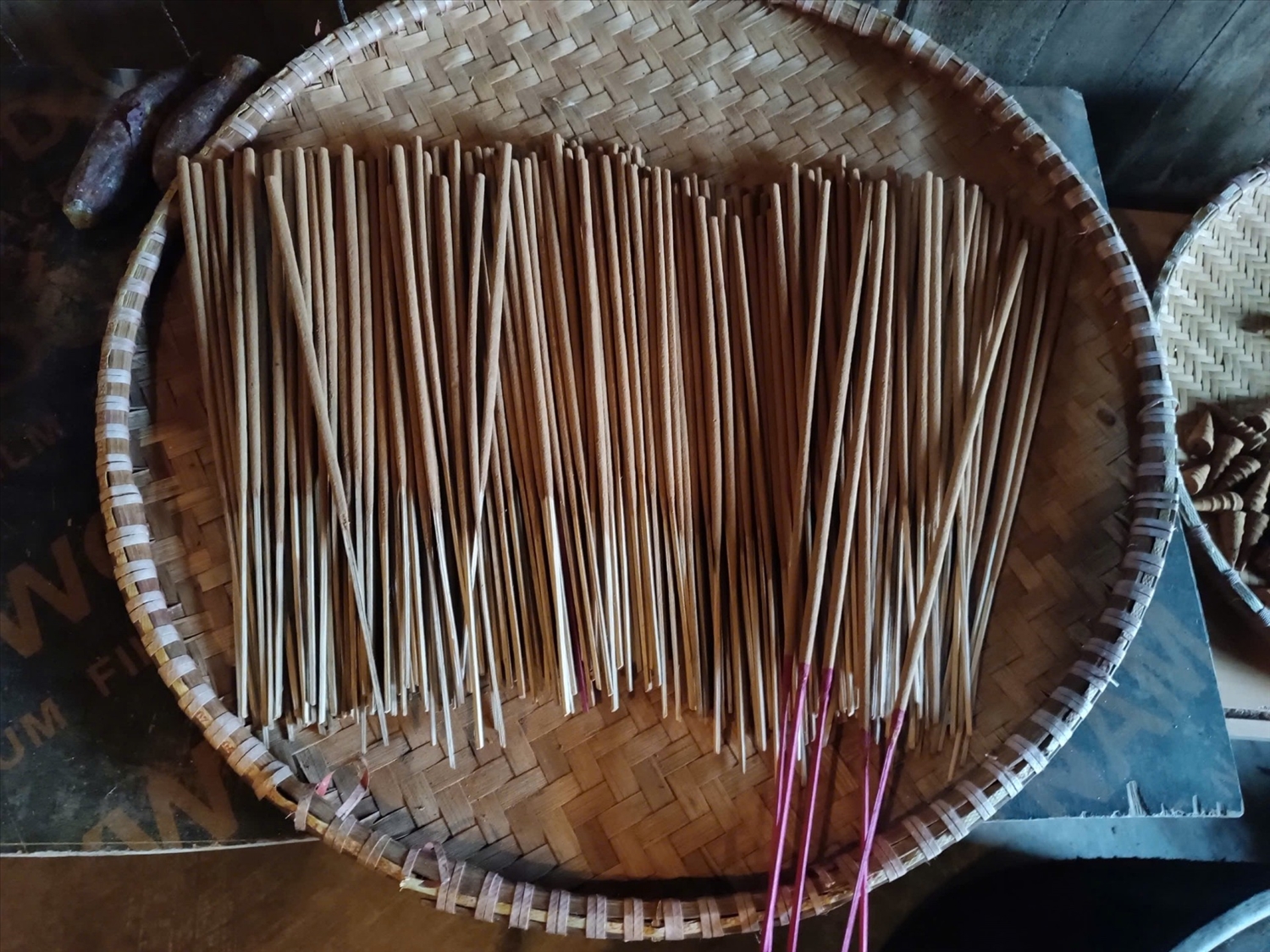
 The finished incense sticks
For the Giay ethnic group in Ta Van (Lao Cai province), incense serves as a medium connecting humans with their ancestors and the spirits. During festivals, Tet and rituals for the village or the home, a fragrant stick of incense carries the people’s sincere reverence and gratitude, while also conveying their prayers for the ancestors and spirits to continue bestowing blessings for a better life.
Given this profound significance, the Giay ethnic group always prioritizes sincerity of heart when making incense. The raw materials for the incense including cinnamon bark, star anise, black cardamom, camphor bark, Machilus wood, Angelica sinensis, Gynostemma pentaphyllum and patchouli are harvested from the wild, thoroughly dried and finely ground; they are then mixed with a binding agent derived from the bark of the Sterculia tree, using a specific ratio known only to seasoned artisans.
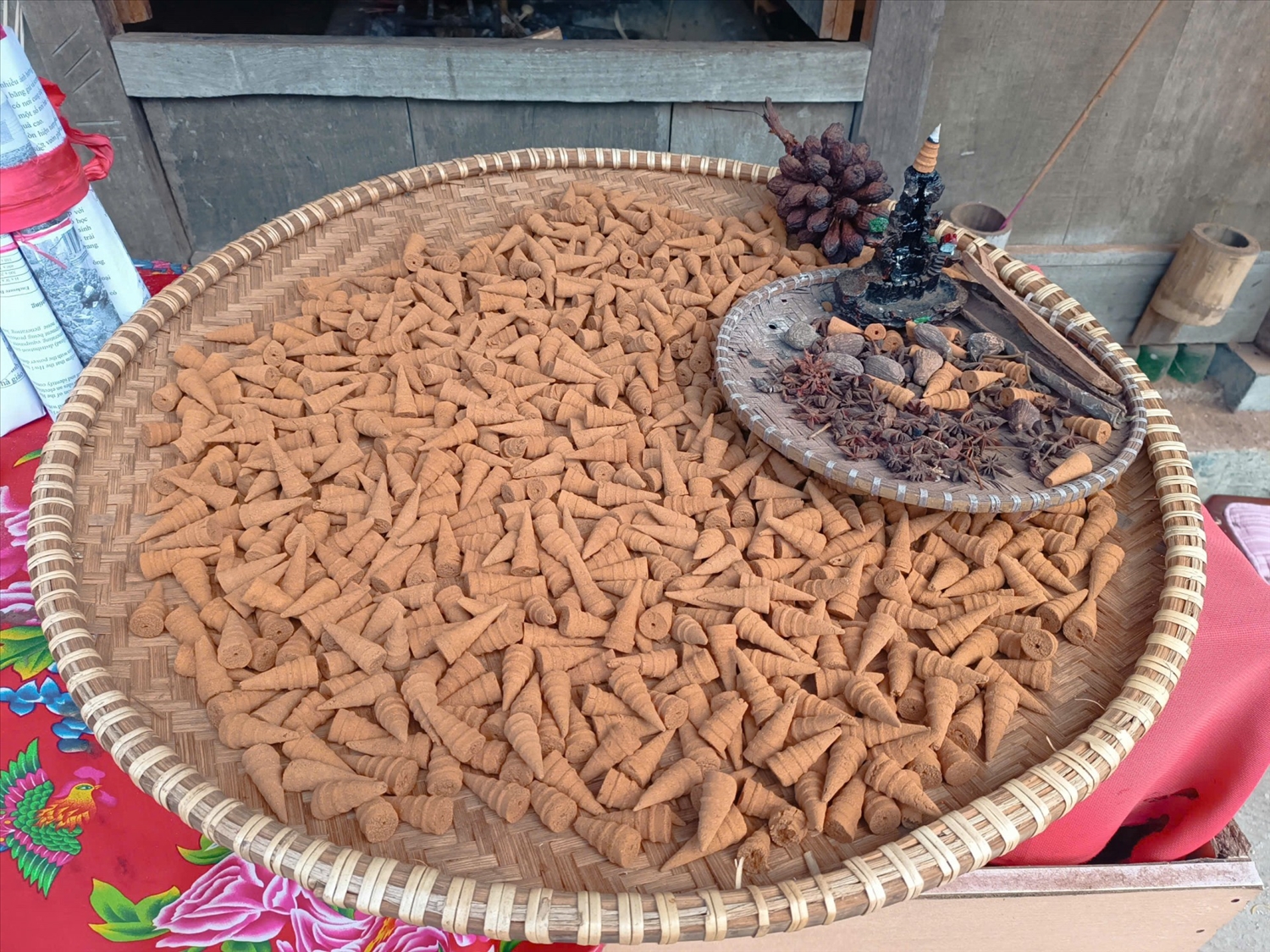 Agarwood cone
The challenge of this craft lies in achieving the right balance: the raw powder mixture must be fine and properly moist, and the hand-rolling pressure consistent. These factors ensure the finished product neither cracks nor warps, allowing the incense to burn evenly and slowly while releasing a fragrance that is gentle, deep and long-lasting. The bamboo used for the incense sticks must be thoroughly soaked for two months, then boiled and dried to prevent termite infestation. Each incense stick is handcrafted through a multi-step process: dipping in water, coating with powder, rolling evenly and sun-drying. Creating a finished stick requires applying the herbal powder five or six times to ensure it evenly coats the bamboo core. The Giay ethnic group in Ta Van produces two types of incense: stick incense and cone incense. Incense cones typically come in the shape of a tower, lotus bud, or cone and are commonly used to aid meditation, relieve stress and purify the air. Incense sticks are large and long, featuring a yellowish-brown coating and a bright red base. Incense sticks, commonly used in rituals to express the Giay ethnic group’s reverence for their ancestors and deities are crafted with great care and attention to detail. A shoddy product, one that burns too quickly or emits a burnt odor will drive customers away. Consequently, the Giay ethnic group in Ta Van do not prioritizes quantity at all costs, nor do they accept adulterating their products with chemicals to cut expenses. In a market saturated with mass-produced industrial incense, the Giay ethnic group’s steadfast commitment to preserving their traditional craft is a choice that is both challenging and worthy of respect.
Ta Van is no longer an isolated village tucked away amidst the deep green mountains. Tourism has drawn a steady stream of visitors from far and wide to the area. Amidst this ceaseless flow of life, the Giay ethnic group’s traditional incense-making craft has also embarked on a new journey. Agarwood incense, once produced solely to meet local village needs, has now evolved into a tourism product, a cultural narrative of the Giay ethnic group. Many families have transformed their incense-making areas into experiential spaces where visitors can sit down, try their hand at rolling the incense sticks, and listen to the hosts share stories about selecting forest leaves and bark, as well as the journeys undertaken to gather these raw materials… Some people clumsily snapped the incense sticks, while others burst into laughter as the powder coated their hands. Yet, in the end, everyone took home a small bundle of incense, a cherished memento of their time in Ta Van.
Making incense is both a livelihood and a way for the Giay ethnic group to preserve their cultural heritage. For visitors, the chance to experience this traditional craft offers a rare moment of tranquility amidst an increasingly hectic life, allowing them to connect with the peaceful rhythm and cultural depth of an ethnic group that has long been rooted in the highlands. As visitors begin to take an interest in the origins, production methods and significance of each incense stick, the value of this traditional craft will be properly positioned within the economic-cultural value chain, opening up opportunities for its long-term, sustainable survival.
In Ta Van today, amidst the bustling crowds of tourists, Giay ethnic women still sit at wooden tables, patiently rolling individual incense sticks and molding incense cones. A lingering scent drifts on the breeze, carrying the essence of the forest and the earth, along with the traditional knowledge that the Giay ethnic group quietly preserve and pass down amidst the rhythms of modern life./.
