Keywords: Economic development; Central Highlands region; Ensuring national defense and security.
1. Introduction
Linking sustainable socio-economic development with ensuring national defense and security in the Central Highlands region is becoming a strategic requirement in the context of increasingly deep international integration. The Central Highlands is not only a region with a strategically important geopolitical position, serving as a “frontier” of the country, but also a living space for many ethnic communities with unique ecosystems and abundant resources. However, the integration process and the impact of non-traditional challenges such as climate change, resource depletion, spontaneous migration and the involvement of external forces place new demands on regional development models. Therefore, research closely linking sustainable development and strengthening national defense and security is crucial to ensuring long-term stability in the Central Highlands region.
2. Research results
2.1. Theoretical and practical basis
The theoretical basis for linking sustainable socio-economic development with ensuring security and national defense in the Central Highlands stems from the viewpoints of Marxism-Leninism, Ho Chi Minh Thought, and the Party’s guidelines on the dialectical relationship between development and national defense. Accordingly, economic development is the material foundation of national defense and security, while strong national defense and security is a condition for ensuring a stable environment for sustainable development. Modern theories on non-traditional security, human security, and sustainable development governance also provide an analytical framework for integrating socio-economic, environmental and security factors into a single overall strategy. Furthermore, regional development theory, particularly for strategically ecological spaces, affirming the importance of multi-level governance, regional linkages and the participation of local communities in development processes.
From a practical perspective, the Central Highlands is a region of particularly important geopolitical significance, being both the “roof of Indochina” and a strategic area in Vietnam-Laos-Cambodia relations. The region possesses a rich forest ecosystem, abundant water resources and natural resources, at the same time to be also home to many ethnic minority communities with unique cultural values. However, recent years' development has placed the Central Highlands under numerous pressures: deforestation and water resource depletion, resource conflicts, spontaneous migration, the impact of climate change and ethnic and religious issues. In terms of national defense and security, the vast border area, rugged terrain, cross-border criminal activity, and the involvement of external factors necessitate enhanced coordination between development and protection.
The aforementioned theoretical and practical factors demonstrate that the close connection between sustainable development and strengthening national defense and security is not only an objective requirement but also a prerequisite for ensuring long-term stability in the Central Highlands region in the context of deep integration today.
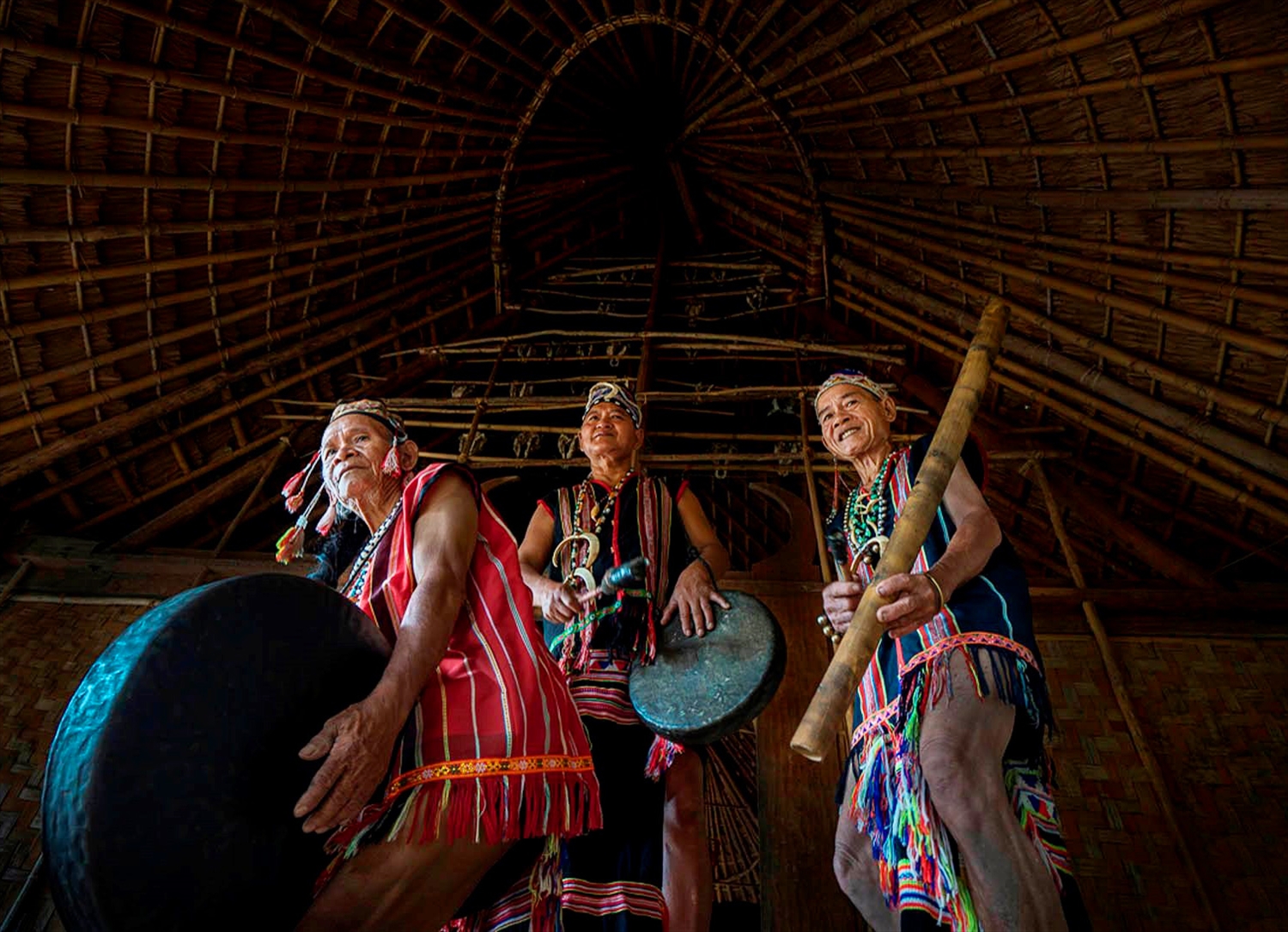 Preserving and promoting traditional national culture is an important foundation for building a stable social environment and sustainable development
2.2. The current situation of linking socio-economic development with ensuring security and national defense in the Central Highlands
In recent years, the process of integrating socio-economic development with ensuring security and national defense in the Central Highlands has achieved many important results, but limitations still exist that need to be fully identified. Overall, the region's economic growth rate has remained relatively high, with the economic structure shifting towards an increased proportion of industry and services and a reduced reliance on traditional agriculture. Key economic sectors such as coffee, rubber, pepper, ecotourism, and renewable energy have become new drivers of growth. Improved transportation, urban and social infrastructure have facilitated regional connectivity and enhanced the quality of life for the people. These results contribute to strengthening the material foundation and stable social environment, thereby directly supporting national defense and security tasks in this strategic area. Socially, ethnic and social welfare policies have been implemented relatively synchronously and the poverty rate among ethnic minorities has decreased significantly. Significant achievements have been made in education, healthcare, and rural development, contributing to improved living standards and reducing the risk of exploitation by malicious elements. However, development disparities between population groups and localities remain large; some people lack stable livelihoods and are easily incited and manipulated. This poses a challenge to the task of maintaining political security and social order.
In terms of national defense and security, the grassroots political system has been strengthened, the people’s national defense posture linked with the people’s security posture is becoming increasingly perfected. The armed forces proactively maintain a presence in their localities, participate in socio-economic development, and support the people, especially in border areas. Border management and the fight against transnational crime have been strengthened, contributing to maintaining the sovereignty and security of the Vietnam-Laos-Cambodia development triangle region. However, the vast area, complex terrain, and long border make control difficult; spontaneous migration, drug trafficking, smuggling and activities exploiting ethnicity and religion still pose potential risks to stability. One noteworthy issue is the lack of synchronization between economic development and national defense and security in some areas. Many development projects have not been adequately assessed for their security, environmental, and cultural impacts; while the coordination mechanisms between the government, businesses and armed forces are not yet truly effective. Strategic forecasting, risk management, and response to non-traditional security challenges remain limited. Overall, despite many notable achievements, the integration of sustainable development and strengthening national defense and security in the Central Highlands region still faces many challenges, requiring solutions that are systemic, long-term and adaptable to the context of increasingly deep integration.
2.3. Requirements arising in the context of integration
The context of deep international integration is posing new, complex and multifaceted demands on the task of linking sustainable socio-economic development with ensuring security and defense in the Central Highlands region.
Firstly, the increasing participation of international investment, trade, and technology flows requires the Central Highlands to innovate its growth model towards a green economy and circular economy, at the same time simultaneously enhancing the competitiveness of its key economic sectors. This necessitates the development of effective, transparent and globally compliant regional coordination institutions that ensure a balance between attracting investment and safeguarding national defense and security, especially in strategically sensitive areas.
Secondly, integration enhances the openness of the economic space, bringing with it many non-traditional security challenges such as climate change, forest ecosystem degradation, water depletion, cross-border labor migration and high-tech crimes. The Central Highlands, with its unique ecological and cultural characteristics, requires the development of integrated risk management capabilities that combine economic development, resource management, and environmental security. This also necessitates the improvement of inter-sectoral coordination mechanisms to ensure effective responses to complex situations.
Thirdly, strategic competition among major powers and external interference necessitate increased vigilance and the firm protection of territorial sovereignty, border security and internal political stability. This is a particularly important requirement for the Central Highlands - the nation's strategic “frontier” region. Along with this, it is necessary to enhance the capacity for mass mobilization, strengthen the unity of ethnic groups and preserve local cultural values, considering these as the social foundation for resolving potential conflicts and divisions.
Fourthly, the integration context requires strengthening the link between development and protection through integrating defense and security goals into socio-economic strategies; promoting the role of the community, businesses and armed forces; at the same time, promoting international cooperation in the Mekong region and the development triangle of Vietnam - Laos - Cambodia. This is an urgent requirement to ensure the Central Highlands develops sustainably and maintains stability in the long term.
2.4. Development perspective
The development perspective for the Central Highlands in the context of integration needs to be established on the foundation of ensuring harmony between the goal of sustainable socio-economic growth and the task of strengthening national defense and security.
Firstly, development must place people, especially ethnic minority communities, at the center, considering them as the subjects and driving force of the innovation process. This requires increased access to education, improved quality of human resources and the preservation of local cultural values as an “endogenous resource” for development and a factor contributing to social stability, thereby minimizing the risk of exploitation by negative elements.
Secondly, the socio-economic development of the Central Highlands must be based on a green growth model, efficiently utilizing forest, land and water resources, prioritizing ecological economy and high-tech agricultural economy. This perspective calls for improving the quality of regional planning, closely linking economic development with ecosystem protection, biodiversity conservation, and climate change adaptation. This not only creates a foundation for sustainable growth but also strengthens environmental security - a crucial component of national security in the new era.
Thirdly, development must always be linked to building a solid national defense and people’s security posture. Economic activities, especially investments in sensitive areas, need to be thoroughly assessed for their impact on national defense and security. At the same time, the role of the armed forces must be promoted in participating in socio-economic development, building a strong political foundation and strengthening border management and protection, especially in cooperation with Laos and Cambodia.
Fourthly, the development perspective of the Central Highlands in the context of integration must prioritize regional linkages and international cooperation. Promoting economic and infrastructure connectivity between the Central Highlands provinces and the Central Coast and Southeast regions, along with expanding cooperation within the Mekong region and the Vietnam-Laos-Cambodia development triangle, will create conditions for expanding markets, sharing resources and strengthening overall power. This is an important guideline to ensure the sustainable and stable development of the Central Highlands and its effective adaptation to changes in the regional and global environment.
2.5. Main solution
In order to closely link sustainable socio-economic development with ensuring security and defense in the Central Highlands in the context of integration, it is necessary to implement a comprehensive system of strategic, interdisciplinary and long-term solutions, such as:
Firstly, it is necessary to finalize regional development planning towards a multi-sectoral integration approach, ensuring the rational exploitation of land, forest, and water resources, while strictly controlling investment projects in environmentally and security-sensitive areas. Economic development in the Central Highlands must be linked to a growth model transformation based on a green economy, renewable energy, high-tech agriculture and sustainable forestry, thereby leveraging comparative advantages while reducing pressure on the ecosystem.
Secondly, it is necessary to improve the quality of human resources, especially within ethnic minority communities. This includes expanding educational and vocational training opportunities, promoting entrepreneurship and strengthening community governance capacity. Human development not only creates momentum for growth but also contributes to strengthening social stability and preventing the risk of being incited or manipulated by malicious forces.
Thirdly, strengthening the all-people national defense posture in conjunction with the people's security posture is a key task. The armed forces need to continue to stay close to the grassroots, participate in supporting infrastructure development, stabilizing the population and building a strong grassroots political system. Border management must be strengthened through the application of science and technology, promoting trilateral international cooperation between Vietnam, Laos, and Cambodia, and improving the effectiveness of combating cross-border crime, drug trafficking, smuggling and illegal migration.
Fourthly, strengthening regional linkages is a groundbreaking solution to optimize resources and enhance the competitiveness of the Central Highlands. Connecting transportation infrastructure, logistics, energy and markets between the Central Highlands and the Central Coast and Southeast regions will create a broader space for development. At the same time, it is necessary to strengthen international cooperation in the Mekong region, access sustainable development models, forest governance and climate change adaptation.
Fifthly, strengthening communication, mobilizing the masses, preserving culture, and consolidating national unity are important foundations for building a stable social environment, a key factor for sustainable development linked to national defense and security in the Central Highlands region.
3. Discussion
The integration of sustainable socio-economic development with ensuring security and defense in the Central Highlands demonstrates the organic and mutually reinforcing relationship between these two national strategic goals. In practice, despite many achievements, the level of coordination between development and protection remains not truly synchronized, particularly in resource planning, investment management and addressing non-traditional security challenges. The challenge lies in approaching the Central Highlands as a unique economic, ecological, cultural and security entity, requiring a stronger inter-sectoral and inter-regional governance model. Furthermore, institutional capacity, the quality of human resources, and the participation of ethnic minority communities play a decisive role in ensuring harmonious and sustainable development. Strengthening national defense and security relies not only on specialized forces but also on social consensus and local cultural values. Therefore, the discussion revealed the need to continue innovating development thinking and integrating the security dimension into all socio-economic decisions to ensure a stable future for the Central Highlands in the current context of integration.
4. Conclusion
Linking sustainable socio-economic development with ensuring national defense and security in the Central Highlands region is a long-term strategic requirement in the context of increasingly deep international integration. Experience shows that development is only sustainable when it is placed within the framework of ensuring political stability, social security and territorial sovereignty; at the same time national defense and security are only strong when based on economic growth and social consensus. Therefore, the Central Highlands needs to continue innovating its growth model towards ecological and humanistic approaches, strengthening the national defense posture, enhancing risk management, promoting regional linkages. This is the foundation for building the Central Highlands into a sustainable, stable and effectively integrated region in the new era.
References
1. Phan Hoa (2024), Bringing the Central Highlands to breakthrough, comprehensive, sustainable development and ensuring national defense and security, https://nhandan.vn/dua-tay-nguyen-phat-trien-but-pha-toan-dien-ben-vung-va-bao-dam-quoc-phong-an-ninh-post798071.html
2. Pham Xuan Hoang, Pham Thi Nham Anh (2023), Socio-economic development and ensuring national defense and security in the Central Highlands region in the new context, https://www.tapchicongsan.org.vn/web/guest/quoc-phong-an-ninh-oi-ngoai1/-/2018/827461/phat-trien-kinh-te---xa-hoi-va-bao-dam-quoc-phong---an-ninh-vung-tay-nguyen-trong-boi-canh-moi.aspx
3. Nguyen Thi Thuy Mai (2025), Development of science and technology and innovation in socio-economic development, ensuring national defense and security in the Central Highlands region in the new context, https://www.quanlynhanuoc.vn/2025/07/24/phat-trien-khoa-hoc-cong-nghe-va-doi-moi-sang-tao-trong-phat-trien-kinh-te-xa-hoi-bao-dam-quoc-phong-an-ninh-khu-vuc-tay-nguyen-trong-boi-canh-moi/
4. Resolution No. 23-NQ/TW, dated October 6th, 2022, of the Politburo, “On the direction of socio-economic development and ensuring national defense and security in the Central Highlands region until 2030, with a vision to 2045”.
