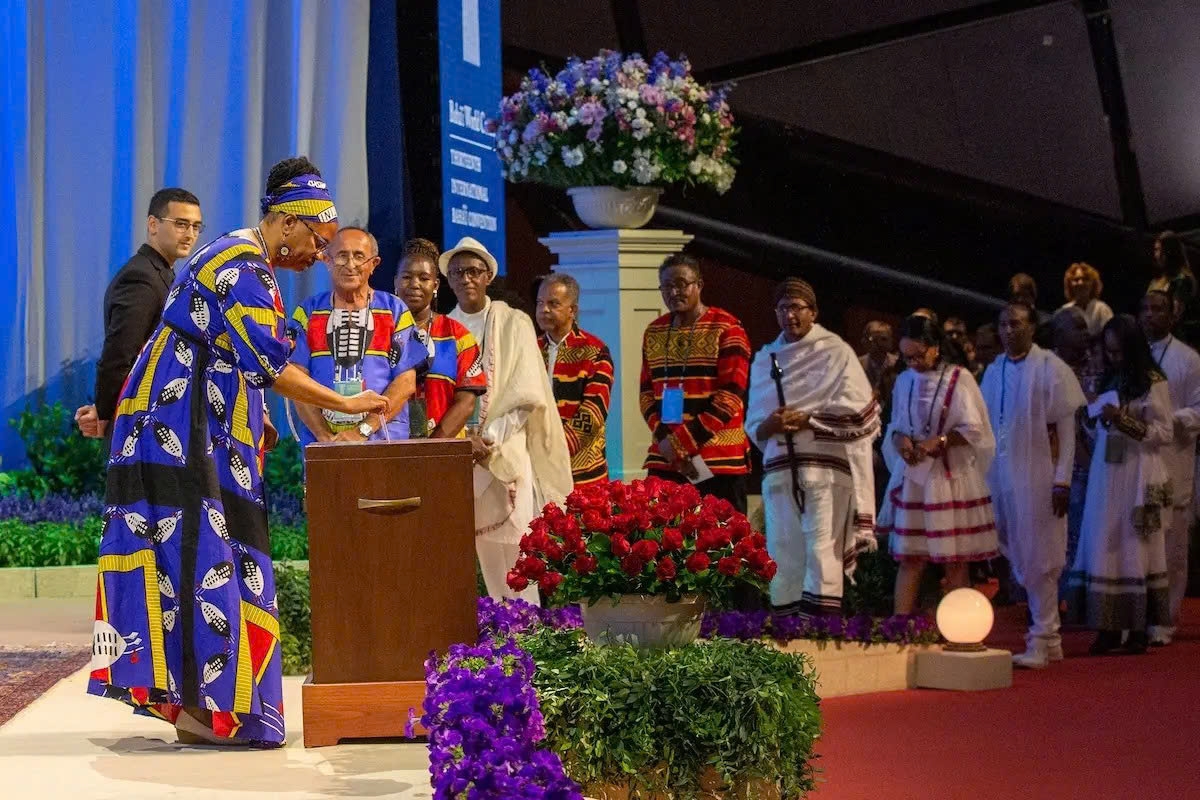
 Representatives of the Baha’i faith from 176 countries voted to elect a member of the International Court of Justice (April 29th, 2023)
Keywords: Moral values; The religious teachings; Baha’i religion.
1. Introduction
Baha’i is a religion that developed from the Shi’ite branch of Islam, originating in 1844 in Shiraz, Persia (now Iran). The Baha’i faith was professed by a young Iranian merchant who took the name Bab. He considered himself a successor in the lineage of the prophets Moses, Jesus Christ and Muhammad. Baha’i emerged amidst profound changes in the economic, social, cultural and religious life of Persia between the 18th and the first half of the 19th centuries. Persia fell into economic decline and crisis, leading to social unrest. Beginning with the Qajar dynasty (1781-1925), the capital was established in Tehran. Faced with the rapid progress of Europe, parts of Persia’s territory were gradually lost. Furthermore, the two wars between Russia and Persia made the country’s situation even more difficult. The people’s lives were extremely miserable, moral decay was rampant and robbery and murder were widespread in society... These were the direct causes of the social and religious reform movements. Originating from the influence of the Babis religious movement, the Baha’i religion quickly attracted the attention of a large number of Persians. As a religion oriented towards peace and spiritual harmony, promoting interreligious thought, the moral values in Baha’i doctrine, propagated by the manifestations of God Baha’i and compiled in the Baha’i Bible, not only contributed to building a spiritual and moral foundation for the turbulent society of the time but also held profound contemporary significance.
2. The biblical text conveys the religious teachings of the Baha’i
The entire doctrinal content of the Baha’i religion is emphasized in the writings of Baha’u’llah - considered the “Word of God”, the interpretations of the Baha’i faith by Abdu’l Baha, Shoghi Effendi and the laws of the Universal Court of Justice. The Baha’i religion possesses a rich and extensive system of sacred texts. Baha'i views each prophet who founded the major religions of the world as an embodiment of the name and attributes of God (Manifestations of God). That being said, it doesn’t mean that Baha’i inherited the entirety of the scriptures of the major religions to form its own canon. Even the ideas of the Bab - the founder of Baha’i are considered only a precursor to the ideas of Baha’u’llah. Baha’i believed that the greatness of this era required the emergence of two great religious figures and in this sense, the Bab shared the same stature as Christ, Muhammad, Baha’u’llah and all the founders of the world’s religions. Therefore, he was the founder of his own religion with its own scriptures and laws. The writings of the Bab are considered divine revelation.
Bab wrote many works (around 100 volumes), some of which have been lost, and only a small fraction of his works circulated widely among his followers. Bab wrote in both Persian and Arabic. Among the works of Bab, the most famous and widely circulated is “Qayyum ul-Asma” (The Enduring Life of the Prophets), proclaimed in 1844 in Arabic. This work deals primarily with theology and is often referred to by the Baha’i as “the Quran of Babis”. In early 1848, he wrote the “Bayan”, a collection of theological, social and legal teachings. In this book, he referred to the “One whom God will reveal” who was about to come. Another work by Bab was “Seven proofs”, in which he presented evidence of his mission.
In the Baha’i canon, the writings of Baha’u’llah are of particular importance, as they constitute “revelation”, the Word of God. These works include: His letters to European emperors, the Pope, the King of Persia, the United States Government and other individuals such as believers and fellow believers, as well as several books he wrote during his imprisonment and exile are all included. As a canonical religion, Baha’i places great emphasis on and only accepts and adheres to, written texts. Oral traditions, although they exist, are not considered reliable by Baha’i. Most of the works of Baha’u’llah are a blend of Arabic and Persian. There are some works that are purely in Persian or Arabic. All of the works of Baha’u’llah are considered by the Baha’i to be divine revelation. The most important of these is Kitab-i-Aqdas (Holy Book).
The works were written over time, coinciding with Baha’u’llah’s life in exile and captivity. His early works written in Baghdad include: Kitab-i-Iqan (Book of Testimony); a Book of spiritual and moral maxims, hidden words; two mystical treatises, seven valleys; four valleys and numerous mystical poems. While Baha’u’llah was in Edirne, he wrote several works, as well as a series of letters to kings and rulers of the world, declaring his mission, explaining his teachings and urging these leaders to take the first steps toward world peace: “This book is the Holy Book of God, of divine inspiration from heaven. It is the Bible of salvation, the sublime Gospel. It is the mystery of the kingdom and the light of God. It is the divine reward, the sign of the guidance that God reveals”.
Most of Baha’u’llah’s writings date from his Akka period, particularly his later years in Bahji. “The most important book, Kitab-i-Aqdas (The Holy Book), dates from the early Akka period (1873) and contains laws, theology, social doctrines and guidelines relating to Baha’i institutions. Following this were numerous writings (short works) on social teachings and proposed reforms for the world. These works became popular after his death and the designation of Abdu’l Baha as his successor”. The Baha’i Bible plays a particularly important role in the life of the Baha’i community. Baha’i sacred texts include: 1. The writings of the Bab and Baha’u’llah, considered apocalyptic; 2. The writings of Abdu’l Baha, recognized as sacred; 3. Scriptures of other religions, including the teachings of their founders, such as: Buddha, Moses, Jesus, and Muhammad are also considered divine revelations; 4. The Quran, the Bible and Zoroastrian scriptures are considered reliable.
In Baha'i worship, in addition to the mandatory adherence to beliefs and practices, and the reading of the Baha’i Bible, believers are perfectly permitted to read the scriptures of other religions as part of their Baha’i devotion. This is because Baha’i religious education always aims for fairness, avoiding religious discrimination and division and desires believers to always be aware of religious harmony in the global world. Furthermore, according to the Baha’is, each religion in their scriptures demonstrates its history and laws or teachings appropriate to its own era.
3. Some ethical values in the Baha’i religious teachings
Baha’i teachings emphasize belief in God and the manifestation of faith, as well as continuous revelation, and principles of equality, education and religious harmony. Baha’is believe in the mystery of God, who is the one and only supreme being, manifested through past prophets and the present-day Baha’u’llah. According to the Baha’i, God is a being whose nature is unknowable. This means that no matter how intelligent or wise a person may be, they cannot comprehend His true nature. God is the Creator of the universe and all things within it, including humankind. Mankind was created by God out of His love. Baha’u’llah teaches his followers that: “To every clear and enlightened mind it is clear that God, the Unknown Being, the Heavenly One, is infinitely greater than all human attributes, such as physical existence, rising and falling, forward and backward. His glory is so immense that no tongue is capable of adequately offering His praise and no soul can comprehend His unfathomable mystery. He was and still is enshrined in His eternal and ancient essence and will remain forever hidden in His reality from the eyes of mankind. No vision can contain Him, yet He understands all visions; He is the Subtle One, the Omniscient One”.
Emerging in the context of modern society, the teachings of the Baha’i religion differ from traditional religions in that they do not emphasize the role of the Creator through miracles and myths about this creation. Instead, Baha’i teachings encompass stories of humanity’s religious history. Baha’i views world history as being marked by the emergence of sacred figures. These are the founders of religions around the world. They are spiritual and moral guides for humanity in each stage of human social history. In the Baha'i faith, God is manifested as “special entities that communicate His word and will to humanity. Listening to these beings is listening to the call of God. Some of the previous manifestations of God include: Buddha, Jesus Christ, Muhammad... and Baha’ullah are the manifestations of God in the present time, the founders of the Baha’i religion.
Through his writings, Baha’u’llah tells of past prophets associated with specific spiritual messages. The Kitab-i-Iqan (Book of Testimonies), cites the stories of many prophets in the Bible. Prophets were messengers of God, carrying His revelations about goodness and justice to all the suffering masses. Therefore, they were always oppressed and their religious leadership role was denied by the ruling powers in exploitative societies. The true spiritual essence of religion lies in guiding believers to the very nature and value of liberation, not merely in outward forms or appearances. Reaching the true essence of spirituality, achieving spiritual reality means achieving harmony between humanity and God’s message in all ages. Believers must always wisely choose harmony, following the traditions and customs of their ancestors while simultaneously seeking spiritual guidance from true, contemporary religious leaders that person being Baha’u’llah.
Baha’i teachings hold that, due to continuous revelation, all religions share a common divine origin. The enduring covenant in the Baha’i Bible indicates that God continually guides and educates humanity through a series of His divine messengers, also known as divine manifestations, such as: Krishna (Hinduism), Moses (Judaism), Zoroaster (Zeros), Buddha (Buddhism), Christo (Christianity), Muhammad (Islam), Bab (Babis religion) and Baha’u’llhah (Bahá’i religion). “The Messengers of God are the first and principal teachers. Whenever the world becomes dark, filled with disagreement and indifference, God will send one of His divine Messengers”. Because according to Baha'i, the Prophets are educators not only in life but also in faith and spiritual life for people: “The Prophets of God are the first educators. They bestowed a universal education upon humanity, elevating humankind from the lowest, most savage level to the highest peak of spiritual development”. The appearance of prophets in different periods of history, with their divine words given to humanity to transform and improve human nature, is a continuous process, which the Baha'i call “continuous revelation”. Revelation has been a continuous phenomenon throughout history and will never cease. Baha’u’llah, the founder of Baha’i, also prophesied that over 1,000 years after Baha’i, another manifestation of God would come to humanity to lead human civilization to even greater heights.
Baha'i people firmly believe that all major religions originate from a single God. The doctrines of each religion are inherently divided into two parts: a spiritual and a social aspect. The spiritual aspect is eternal, while the social aspect and rituals are temporary and dependent. Their teachings “originated from a single source, rays of the same light. What differed among them was their response to the needs of the times in which they appeared”. But fundamentally, the common foundation of all religions is still manifested in the unity of spirituality. Believers need to be aware of, understand and have continuous revelation within the Baha’i faith. Because that is a crucial element in creating harmony, a link, a bridge between religions, fostering unity and genuine mutual affection among religions worldwide in the new era. The major religions of humanity have always coexisted in peace, friendship, and mutual complementarity. “Each religion plays an important role in the evolution of humanity, driving human civilization forward continuously, to achieve the common goal of unity, universal brotherhood and world peace”.
Everyone belongs to one family, the human family, for we are all children of God: Baha’u’llah in the Scriptures points out that humankind is the creature whom God has set apart and given the noble power to know Him and worship Him: “In creating the world with all that lives and moves within it, through the direct action of the supreme and limitless will, God chose to bestow upon humanity the unique discernment and capacity to know Him and love Him - a capacity that must be considered the driving force and primary purpose of all creation…”. Humans also have souls, and the soul will endure forever. Life on earth is only a short existence, the beginning of this eternal life. Therefore, people should not fear death, but should always cultivate faith and a spirit of anticipation for the endless afterlife in the realm of the dead. Therefore, the death of the body is like the very life, the birth of the soul in a new stage of existence: “The progress of the human soul does not end with death. But it progresses in a new direction. The Baha’u’llah taught that immeasurable potential awaits the soul in the afterlife. Spiritual progress in that realm is limitless and no one, while still alive on this earth, can fully comprehend its power and scope”.
Baha’i believe that the purpose of spiritual progress in life is the development of the qualities necessary for continuous progress towards the perfection of personal life. In order to achieve this, Baha’i teachings also advise followers to always uphold justice and help others, to always be honest and upright, without discrimination based on religion, ethnicity or class: “Be unjust to no one, and be utterly humble toward everyone. Be a lamp to those who walk in darkness, a joy to those who are sorrowful, an ocean to those who are thirsty, a refuge to the afflicted, a support and protector to the oppressed. May honesty and integrity mark all your actions. Be a home for strangers, a remedy for the afflicted, a strong tower for those who hide. Be eyes for the blind and a lamp to guide the lost”.
Baha’i teachings also emphasize a spirit of morality, goodness and truth, with each believer as a seed of life responsible for protecting the planet, the earth and all living things, blending with nature and light to have a truly meaningful life: “Be an ornament for the face of truth, a crown on the forehead of righteousness, a pillar of the temple of integrity, the lifeblood of the human body, the banner of the army of justice, a star on the horizon of virtue, a dewdrop on the soil of the human soul, a boat on the ocean of knowledge, a sun in the heaven of compassion, a jewel on the crown of wisdom, a radiant light in the sky of your generation, a fruit on the tree of humility”. The teachings of Baha’i serve as a model for the lives of believers and as the foundation for religious unity, harmony and human harmony. This is the ultimate goal and eternal truth that each believer must seek for themselves: “Man must seek the truth himself… so that by the light of truth he may dispel the clouds and darkness. Truth is one: Truth does not accept pluralism or division”. Baha’i teachings also teach that human life belongs to the soul, and the soul needs daily nourishment to continue to grow. It is the duty of believers to pray and read the scriptures to cultivate goodness and blessedness in the soul: “Every morning and evening, recite the Words of God from memory. Anyone who does not recite the Words is unfaithful to the Covenant of God and in this day and age, anyone who strays from this has clearly strayed from God long ago”.
4. Conclusion
As a religion founded with the purpose of transforming individual lives, revitalizing Persian society, and thereby leading to unity, solidarity, interreligious harmony and the protection and respect for world peace, it aims for a progressive society, a world of universal brotherhood, filled with light and love among people, where humanity is no longer divided by religion, belief, ethnicity or nationality. The ethical values of the Baha’i religion guide followers towards a peaceful and tolerant life for a sustainable world based on the principles of respect for equality, solidarity and humanity. Baha’i teachings also foster a lifestyle of continuous learning, a unified spiritual community oriented towards scientific truth, eliminating superstition and prejudice and promoting the formation of genuine faith. Religious beliefs have always gone hand in hand with science, forming the foundation for a civilized and progressive society. Baha’i teachings also guide followers towards a life of equality in all aspects, including opportunities, rights and privileges between men and women, the aim is to promote universal education, eliminate wealth inequality, enhance the spirit of service, and provide believers with a modern lifestyle to adapt to the changes of the new era.
Religious beliefs have always gone hand in hand with science and form the foundation for a civilized and progressive society. Baha’i teachings also aim for a life of equality in all aspects, including opportunities, rights and privileges between men and women, advocating for universal education, eliminating wealth inequality, fostering a spirit of service and providing a modern lifestyle for believers to adapt to the changes of the new era.
* Academy of Public Administration and Management
References
1. Baha’i Spiritual Council of Vietnam (2012), General Introduction to the Baha’i Religion, Religious Publishing House, Hanoi.
2. Vietnam Baha’i Spiritual Assembly (2020), Day Break: Questions answered from many Baha’i book sources, Internally circulated documents, www.bahai.org.vn.
3. Esselmont, E. J. (1987). Baha’u’llah and the new era, Ho Chi Minh, Vietnam: Translated and published by the Saigon Baha’i Local Spiritual Council.
4. Baha’i Spiritual Council of Vietnam (2020), Hidden Words of Baha’u’llah (Hidden words - English - Vietnamese bilingual), Internal circulation document, www.bahai.org.vn.
5. His Holiness the Baha’ullah (2021), The most sacred scriptures revealed after the Holy Scripture, published by the Baha’i Spiritual Council of Vietnam.
6. International Court of Justice (Compiled, 2020), Pearls of Wisdom: The Importance of deepening Our knowledge and understanding of the right path, Baha’i Spiritual Council of Vietnam.
7. Baha’i Spiritual Council of Vietnam (2020), Testament and Covenants of Abdul Baha, Internal circulation document, www.bahai.org.vn.
8. Baha’i Spiritual Council of Vietnam (2020), The Teachings of Baha’u’llah on Spiritual Reality - Excerpts from the scriptures of Baha’u’llah, the Bab, Abdul Baha, Shohi Effendi, Internal circulation document, www.bahai.org.vn.
9. Baha’i Spiritual Council of Vietnam (2020), Baha’i Prayer, Internal circulation document, www.bahai.org.vn.
10. Baha’i Spiritual Council of Vietnam (2020), The Most Sacred Scripture Kitab-i-Aqdas, Internal circulation document, www.bahai.org.vn.
11. Baha’i Spiritual Council of Vietnam (2020), Kitab-I-Iqan, Internal circulation document,, www.bahai.org.vn.
