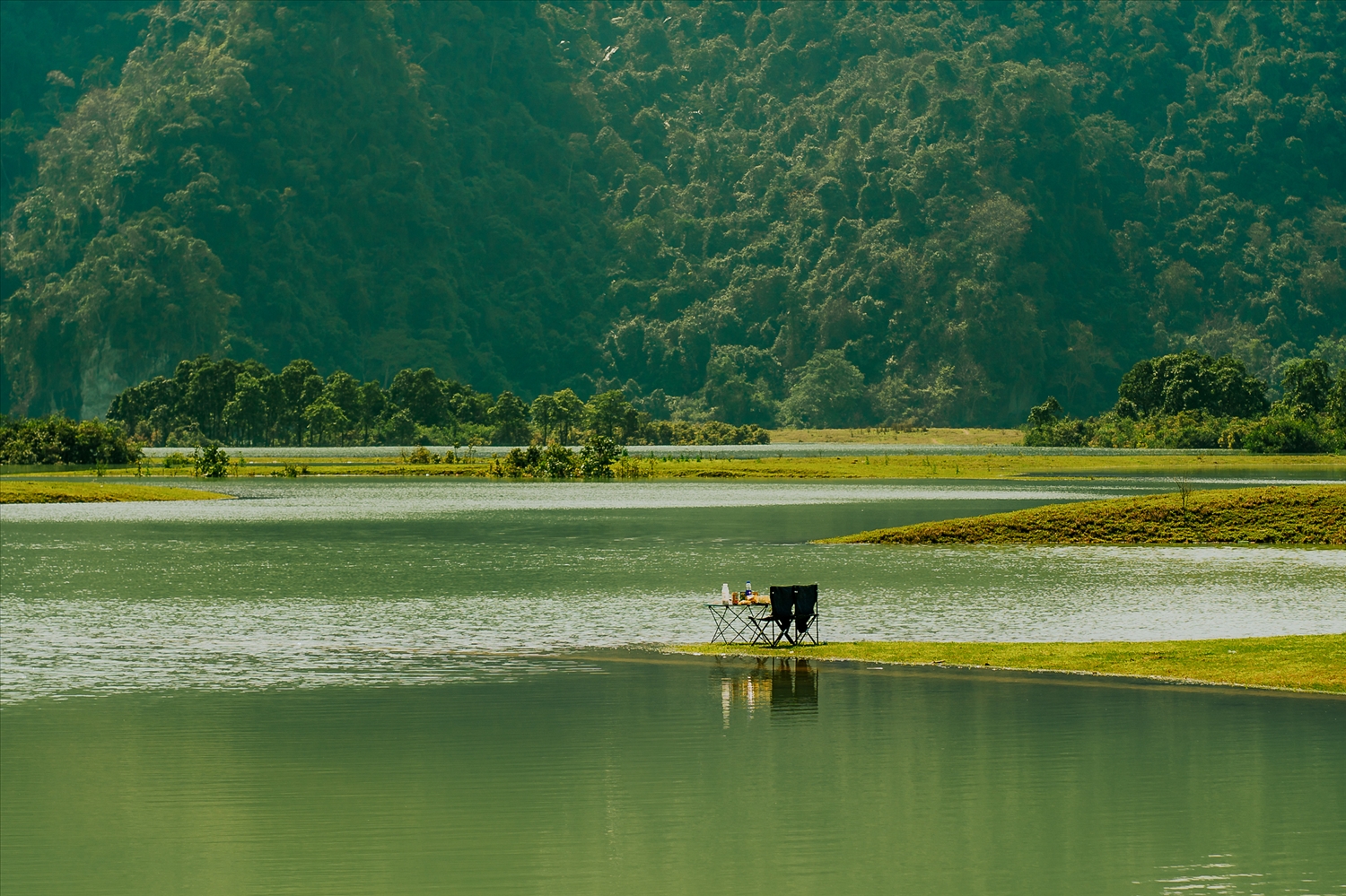
 Dong Lam - the “Painter” named after water
In Dong Lam, water is known as the “artist”. Each year, this artist completes only two paintings: one in the green of the grass, the other in the azure of the water. During the dry season, amidst a vast expanse of limestone peaks, the Dong Lam grassland, spanning hundreds of hectares reveals a surprisingly soft beauty. Sweaths of green grass stretch all the way to the foot of the mountains, where herds of horses graze leisurely in the early morning sunlight. Occasionally, one would lift its head to look around before suddenly breaking into a gallop, dragging the entire herd along as they raced across the green grass. The sound of hooves and the jingle of bells rang out, then quickly faded into the wind, leaving behind only the scent of fresh grass and the vast, towering blue sky...
In the distance, herds of buffalo and cattle graze leisurely. There are no dividing fences, no concrete structures encroaching upon the pasture, only the open expanse of nature, with a horizon framed by rolling, craggy mountain ranges. Visitors arriving at Dong Lam at such a time might well believe it to be nothing more than a vast, peaceful meadow. Yet... nature holds another secret…
As early summer arrives, the rains begin to return. Water from mountain crevices and subterranean streams quietly converges, steadily rising day by day... This marvel stems from Huu Lien’s distinctive karst landscape. Limestone massifs, millions of years old, embrace the valley, forming a natural basin. Then, quite suddenly one morning, the meadow vanishes. The waters have painted a new scene over the grassy slopes that were, just yesterday, a tender green. The entire meadow has suddenly transformed into a tranquil lake. Only the crowns of the fig, jambolan and voi trees remain visible above the surface. Rocky peaks cast their reflections upon the crystal-clear water and even the white clouds seem to drift lower to gaze at themselves in the valley’s giant mirror…
Early in the morning, the bamboo raft departed the landing while the water was still veiled in mist. The gentle dip of the oar created small ripples that spread outward before fading into the quiet. The old farmer used his pole to guide the raft slowly across the vast expanse of water; his movements were so practiced and silent that they did not disturb the travelers, who sat immersed in the beauty of the surrounding nature.
That serene moment defines the very essence of Dong Lam. In recent years, the flood season has emerged as a new local tourism product; yet, for generations, it has been an integral part of the residents’ lives. Yet, for generations, it has been an integral part of the local residents’ way of life. During the flood season, locals would travel by raft to tend their fields, harvest fruit, fish and transport agricultural produce long before the area became a renowned and beloved destination for tourists.
It is difficult to say exactly which season reveals Dong Lam at its most beautiful. While the season of receding waters is a symphony of wind and lush green grass, the flood season is a solo performance of silence. One season echoes with the sound of galloping hooves; the other, with the gentle dip of an oar. One season is awash in the lush green of sweeping grassy expanses; another features the crystal-clear waters of the lake embracing the mountain's base. All these transformations at Dong Lam are the work of Mother Nature, the “artist” painting two distinct landscapes upon the very same stretch of land.
Surrounding Dong Lam are the forests of the Huu Lien Nature Reserve, home to a distinctive karst ecosystem and a wealth of rare flora and fauna. It is these very forests that retain water, regulate the flow and quietly sustain the valley’s natural cycle. Water nourishes the grasses of the grasslands, and the grass sustains the livestock. The flood season brings abundant aquatic resources, while forests provide timber and medicinal plants, creating livelihoods for the local communities. With their livelihoods secured, these people are all the more committed to preserving the landscape. This cycle has endured through generations of the Tay, Nung and Dao peoples living at the foot of the mountains. They inhabit this landscape and are an integral part of it; today, they continue to preserve their traditional stilt houses, farming practices and harmonious way of living with nature.
Late afternoon. The day’s last sunlight slanted across the mountainside. A herd of horses made their way back at a leisurely pace. In that moment, one suddenly realized that the source of this land’s vitality was its capacity for self-renewal. Nature is in a constant state of flux, yet this change unfolds within the inherent order of land, water and humanity. Amidst this ceaseless motion, water assumes the role of a gifted “installation artist”.
After each season, the “painter” known as water quietly puts away the old picture to begin painting a new masterpiece. And year after year, Dong Lam patiently awaits nature lovers who come to appreciate every brushstroke of water across the grassland…/.
