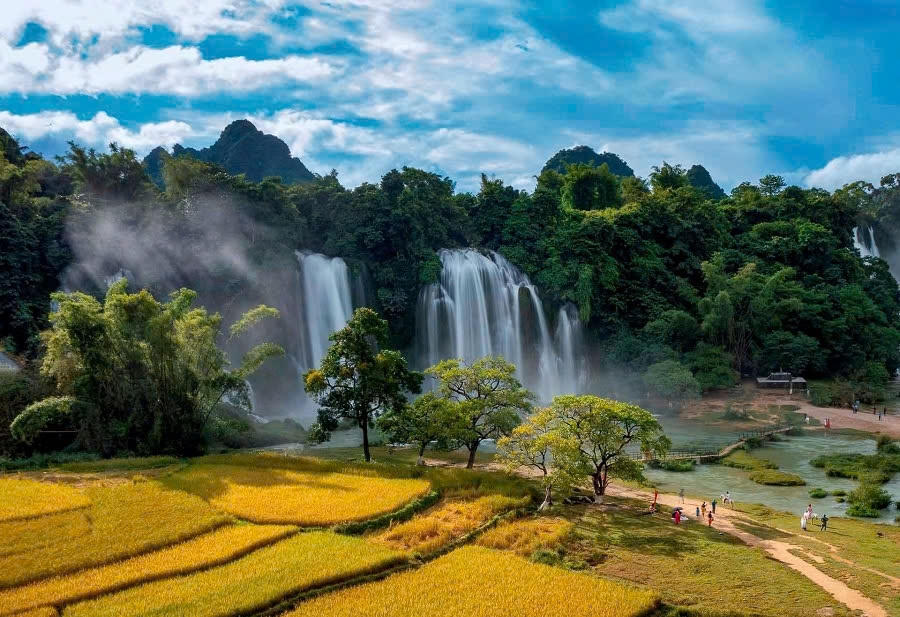
 The beauty of an autumn afternoon at Ban Gioc Waterfall (Cao Bang province)
Keywords: Community tourism; Tourism potential; Ethnic minorities; Ca Thanh Commune; Cao Bang Province.
1. Introduction
Cao Bang has long been known as a land rich in tradition, outstanding with its rich culture, history and system of scenic spots and majestic natural landscapes. With this advantage, community-based tourism is identified as a strategic direction to exploit heritage values and create sustainable livelihoods for local people. However, development requires specific studies to realize its potential. In June 2025, in accordance with Resolution No. 1657/NQ-UBTVQH15 of the Standing Committee of the National Assembly on the rearrangement of commune-level administrative units, Ca Thanh commune was established based on the merger of the entire area and population of Yen Lac and Ca Thanh communes (formerly belonging to Nguyen Binh district). This event created a new, larger administrative unit, promising to integrate diverse tourism resources, from unique local culture to ecological landscapes. Despite possessing outstanding characteristics, the potential for community-based tourism development in Ca Thanh commune has not yet been exploited to its full potential. This article suggests answering the core question: What is the potential for developing community-based tourism in Ca Thanh, and how can it be exploited effectively and sustainably?
2. Potential and limitations for community-based tourism development in Ca Thanh commune
Natural tourism resources
Strategic location and trading foundation: After the merger, Ca Thanh commune possesses a relatively favorable transportation location, connected by National Highway 34 and the Provincial Highway. This route not only promotes domestic trade but also opens up important regional linkage opportunities, especially with the former Nguyen Binh district center and neighboring communes with experience in developing ecotourism such as Thanh Cong, Phan Thanh, and even expanding into Thai Nguyen province (from the former Bac Kan territory). This connectivity is a major advantage, allowing Ca Thanh commune to quickly integrate into the region's ecotourism chain, minimizing geographical barriers in attracting tourists. The local economy is primarily based on agriculture and forestry; in addition to growing food crops such as corn and rice, Ca Thanh also has distinctive economic flora such as bamboo, rattan and ginger. This provides a foundation for developing ecotourism tours that combine agriculture and exploration.
Diverse ecological and agricultural resources: Ca Thanh’s great potential lies in its majestic landscape and the diversity of its pristine high-altitude ecosystem. The area boasts impressive natural destinations such as Khang Ky Waterfall (a cascading waterfall during the rainy season), along with a system of unexplored streams and caves such as Lung Lech Cave and Lung Sung Cave. Besides, the traditional agricultural and forestry economy has created typical economic products such as bamboo poles, galangal trees and arrowroot. This is an ideal dual resource, allowing Ca Thanh commune to develop thematic eco-tours, combining landscape exploration and sustainable agricultural experiences.
Potential human resources but limited in skill level: Ca Thanh has the advantage of a large young workforce with proficient agricultural production experience, a crucial factor in ensuring community participation in community-based tourism. However, this is also one of the biggest challenges: the level of trained labor is very low (less than 1%). The shortage of professional skills and foreign language proficiency is a major obstacle to the application of science and technology, improving service quality and meeting modern tourism standards. Therefore, transforming population potential into high-quality tourism human resources requires a systematic and timely training and capacity building strategy.
Infrastructure and power grid limitations: Despite having major transportation routes running through it, the technical infrastructure remains a core weakness hindering the development of community-based tourism in Ca Thanh commune. The rural transportation network is underdeveloped, consisting mainly of muddy dirt roads during the rainy season, making transportation and travel difficult for tourists. More importantly, the lack of coverage from the national power grid directly impacts the quality of accommodation and basic living conditions. Furthermore, the dependence on a gravity-fed water supply is also a weakness, highlighting the need for early and comprehensive investment in infrastructure as a prerequisite for opening up tourism.
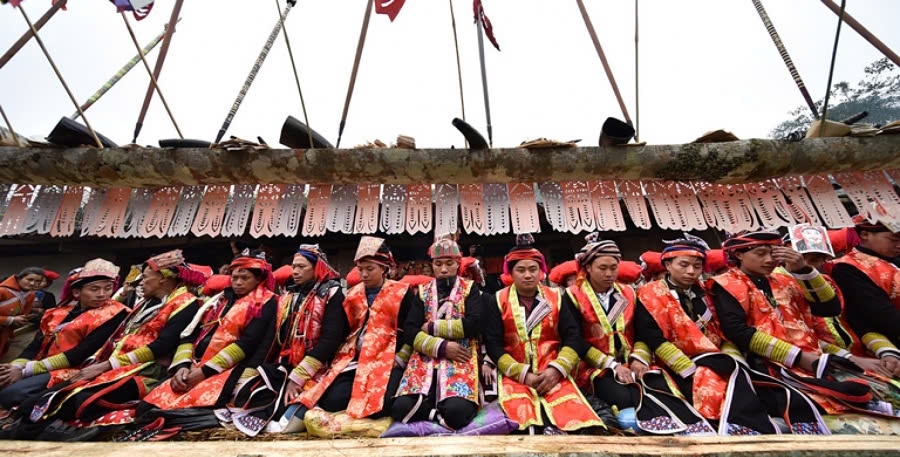 The Dao people’s coming-of-age ceremony is not only a cultural heritage but also an attractive tourism product
Humanistic tourism resources
Ethnic identity and community cultural potential: Ca Thanh commune stands out with the main presence of two ethnic Dao (accounting for 70.8%) and Mong (29.2%), distributed in 12 hamlets. This population diversity is a valuable and irreplicable human resource for cultural tourism. The ethnic identity has been preserved almost intact by the community, creating a solid foundation for community-based tourism. This concentration of population and distinct culture makes it easy for Ca Thanh commune to develop homestay models and provide in-depth cultural experiences, completely different from mass tourism destinations, affirming its position as a living heritage destination.
Unique rituals and traditional crafts: The core cultural potential lies in life cycle rituals and distinctive traditional crafts. Prominent rituals such as the Dao people’s coming-of-age ceremony and traditional weddings are not only heritage but also potential experiential tourism products, requiring strict control and respect. In addition, the Long Tong festival and folk games such as throwing the ball, tug-of-war, and stick pushing are factors that attract tourists during holidays and festivals. Especially, the traditional craft of making handmade paper has been passed down through many generations, creating a foundation for the development of handicraft workshops linked to experiential activities.
Architecture, cuisine and product transformation potential: In terms of architecture, the traditional houses of the Dao people, mainly wooden stilt houses or rammed earth houses are an important highlight for cultural homestay services. Furthermore, the rich local cuisine, including many unique dishes, can be developed into a culinary tourism product (Food Tour). Overall, Ca Thanh commune possesses a comprehensive system of human resources, from architecture and cuisine to customs. Successfully transforming these cultural elements into experiential tourism products will be key to creating sustainable income for the community, at the same time making a positive contribution to heritage preservation.
Limitations and challenges
Despite its potential, the development of community-based tourism in Ca Thanh commune faces many major challenges. The core issue is the underdeveloped tourism infrastructure, especially the rural transportation network, which hinders access for tourists. Limited initial investment capital makes it difficult for the community to renovate accommodation facilities. In addition, uneven community awareness of tourism and language barriers (due to the high proportion of Dao and Mong people) also hinder communication and service provision. Managing environmental and ecological issues as tourism develops is also a challenge requiring preventative solutions.
Although the community is willing to participate, the people have not received formal training in tourism hospitality and service skills. In terms of management, the local government has not issued a specific resolution on tourism economic development, indicating a lack of support mechanisms and clear strategic direction for community-based tourism in the commune.
3. Proposing typical community tourism products and recommend some solutions
SWOT analysis of the development position of community tourism in Ca Thanh commune.
SWOT analysis reveals that Ca Thanh commune has a strategic location and is rich in resources, but faces serious internal obstacles.
Strengths (S): Outstanding potential lies in human and cultural resources (S1), especially ethnic identity preserved through unique rituals (coming-of-age ceremony, traditional houses) and traditional crafts (paper making). In terms of nature (S2), the commune possesses magnificent landscapes, economically important vegetation (bamboo, ginger) and pristine tourist attractions (Khang Ky waterfall, Lung Sung cave), along with an abundant young workforce.
Opportunities (O): Favorable geographical location (QL34) allows Ca Thanh to easily connect with neighboring communes that already have experience in ecotourism (Thanh Cong, Phan Thanh) (O1). The commune merger event (O2) creates opportunities for restructuring and integrating scattered resources.
Weaknesses (W): The biggest challenge is the underdeveloped technical infrastructure (W1) - rural roads are unpaved, and water resources are not readily available. In addition, the workforce lacks proper training (W2), experience in welcoming tourists and the absence of specific government resolutions (W3) hinders coordinated management and development.
Threats (T): The aforementioned weaknesses increase the risk of insufficient investment capital (T1) and create language barriers (T2) in communication with tourists. Uncontrolled tourism development also threatens environmental/ecological issues (T3).
Thus, Ca Thanh commune has a competitive advantage in terms of its pristine nature and unique cultural identity (S-O Strategy), positioning itself as a destination for in-depth experiences. However, to successfully exploit this, priority should be given to mitigation strategies (W-T Strategy), focusing on investing in connectivity infrastructure and providing professional training for the community to transform potential resources into profitable tourism products.
Proposing distinctive community-based tourism products
1) Unique cultural and heritage tourism products
This product line delves deeply into the almost perfectly preserved intangible cultural identity of the Dao and Mong ethnic groups. The core product is the Coming-of-Age Ceremony Experience and several life cycle rituals - a themed tour that allows visitors to observe and learn about important, deeply spiritual ceremonies. At the same time, tourists will have the opportunity to directly participate in cultural homestay activities in traditional wooden stilt houses or rammed earth houses. The focus here is on traditional handicraft workshops, where tourists can learn to make handmade paper by the Dao people in Tan Pa and Lung Ot villages and embroider and weave brocade in Mong and Dao villages. These experiences not only create unique souvenirs but also ensure the preservation of heritage linked to community livelihoods, transforming cultural strengths into sustainable income sources.
2) Ecotourism, agricultural tourism and exploration products
This product group focuses on exploiting the pristine natural resources and distinctive economic flora of the Ca Thanh mountain region. The main tours will be exploring pristine waterfalls and caves, leading visitors to lesser-known spots such as Khang Ky waterfall and the Lung Sung cave system with professional guidance from local people. Combined with trekking or cycling routes through bamboo forests, this forms an eco-tourism product. Tourists will experience agritourism by participating in the process of cultivating ginger or harvesting upland rice, thereby gaining a better understanding of the production cycle, cuisine and local agricultural life. Strict control over visitor numbers and adherence to conservation regulations will be key to preserving the pristine nature of the landscape and minimizing environmental challenges.
3) Regional linkage products and community capacity building
In order to overcome weaknesses in infrastructure and management capacity, Ca Thanh needs to develop products and activities that promote regional linkages and training. A proposed program, “Cao Bang Heritage Journey”, linking Ca Thanh commune (as a center for in-depth cultural experiences) with neighboring communes that already have experience in ecotourism, such as Thanh Cong and Phan Thanh. This collaboration helps share operating costs and expand the market. Internally, it is necessary to organize intensive training packages on hospitality skills and basic foreign languages for the community, especially for direct business owners. Simultaneously, familiarization trips for major travel agencies will help position products and attract external investment. The goal is to transform human resource and management barriers into competitive advantages, ensuring clearly defined and highly sustainable tourism development.
4. Conclusion
This article provides a comprehensive assessment of the potential for community-based tourism development in Ca Thanh commune, Cao Bang province, through in-depth analysis of resource, infrastructure and community capacity factors. The results identified two core potential groups: (1) Unique cultural and human resources (such as initiation ceremonies, traditional paper-making, traditional houses of the Dao, Mong people) and (2) Pristine natural and ecological resources (waterfall systems, unexploited caves, bamboo landscape). Despite these advantages, the article also points out the major obstacles: weak infrastructure (lack of electricity, poor transportation) and very low tourism management/service capacity within the community.
The article has affirmed its contribution by filling a gap in in-depth research at the micro level within a newly established administrative unit. More importantly, the study proposed a strategic solution framework and characteristic community-based tourism product models (ceremonial heritage tourism, forest product ecotourism) along with specific recommendations on policy and human resource training, providing a solid scientific basis for making decisions on sustainable tourism development at the local level.
* Vietnam Women’s Academy
References
[1] Ca Thanh Commune Party Committee. (2025). Political report of the Commune Party Executive Committee submitted to the 1st Commune Party Congress, the term of 2025- 030, taking place on August 13th and 14th, 2025.
[2] Exploiting tourism potential, Journal of Ethnic Groups and Times, No. 42, 2022.
[3] Duong Thi Loan, Nguyen Thi Thu Giang. (2022). Potential for community tourism development in Cao Bang, Journal of Culture and Arts, No. 500, June 2022.
[4] Pham Hong Long, Dao Vu Huong Giang, Ngo Viet Anh. (2023). Sustainable tourism development in Cao Bang province: The impetus from the Cao Bang Geopark, Journal of Sustainable Regional Development Research No. 1, 2023.
[5] Ngoc Mai. (2024). The story of online homestay business in a 400-year-old stone village, Journal of Information and Communication, No. 1+2, January 2024.
[6] Nguyen Thi Tam. (2023). Preservation and development of traditional crafts associated with tourism in the Cao Bang Geopark area: Current situation and challenges, Journal of Social Science Information. No. 7 (2023).
[8] Pham Thi Cam Van. (2023). Preservation and development of the Nung people’s paper-making craft village in Cao Bang province: Opportunities and challenges, Journal of Sustainable Regional Development Research, No. 2 (6-2023).
