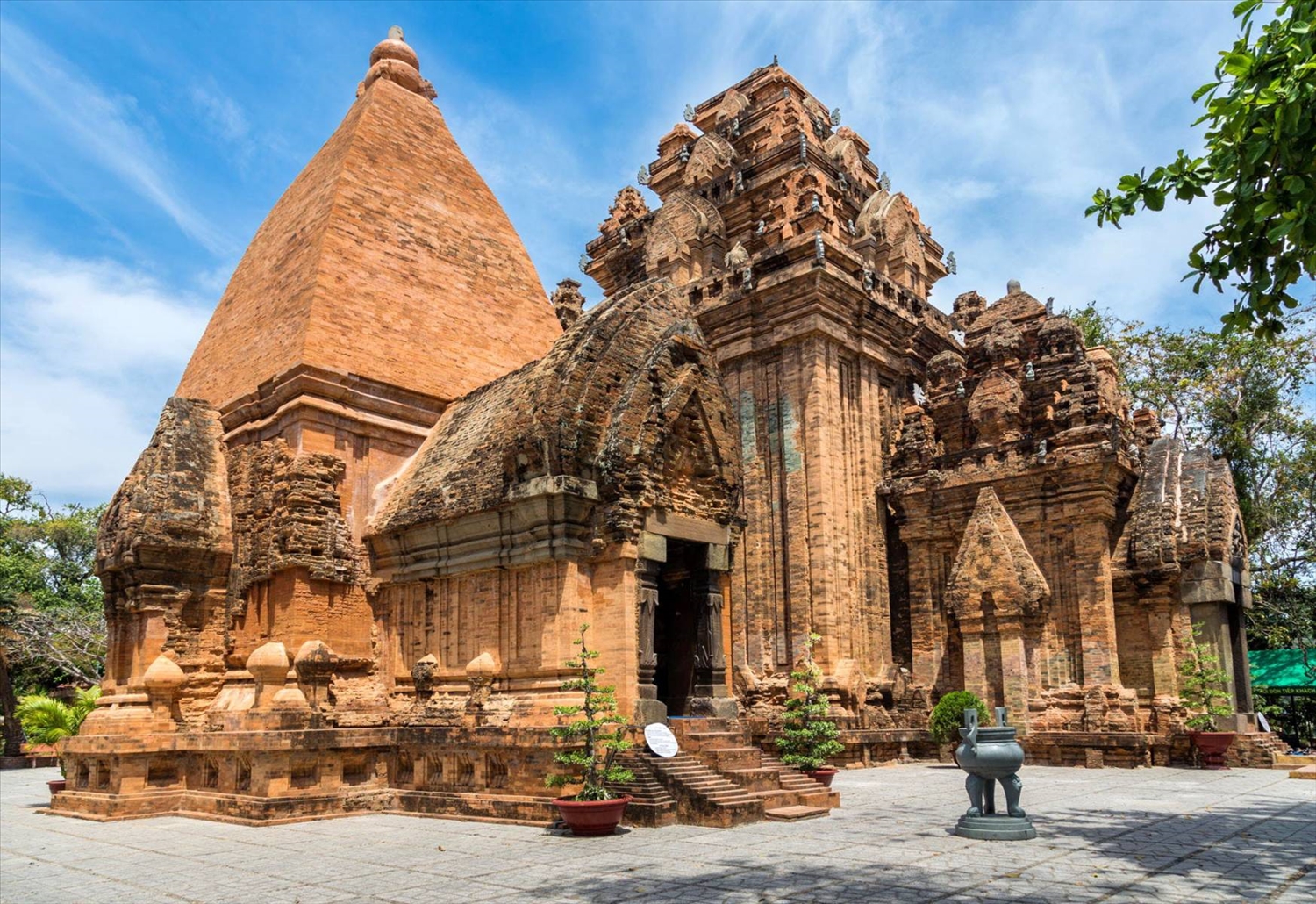
 Ponagar Cham Towers (Lady Tower)
Keywords: Cham culture; Cultural heritage; Cultural tourism; Khanh Hoa Province; Sustainable development.
1. Introduction
In the context of economic development linked to the preservation of national cultural identity and sustainable tourism growth, leveraging traditional cultural heritage values has become a significant trend in many localities across Vietnam. Khanh Hoa Province is not only renowned as a major coastal tourism hub but also as a region that preserves the distinctive cultural heritage of the Cham people, one of the ancient cultures of the South Central Coast.
Over centuries of formation and development, the Cham community in Khanh Hoa province has left behind a rich cultural heritage, comprising architectural and religious sites, traditional festivals, sculptural art and distinctive folk knowledge… Most notable is the Po Nagar Cham Towers complex, a Special National Architectural and Artistic Monument which annually attracts hundreds of thousands of visitors, researchers and pilgrims. In addition, traditional festivals and the worship of Thien Y A Na (Po Inu Nagar), a form of Mother Goddess worship distinctive to the people of Central Vietnam, along with various other intangible cultural values, have contributed to shaping the unique cultural identity of Khanh Hoa province.
However, driven by urbanization, globalization, and the commercialization of tourism, many Cham cultural values face the risk of fading away and are not being leveraged in a manner commensurate with their inherent potential. Meanwhile, cultural tourism has emerged as a high-value-added product segment, contributing to enhanced destination competitiveness and the creation of sustainable livelihoods for local communities.
Given this context, researching the preservation and promotion of Cham cultural values in conjunction with tourism development in Khanh Hoa province holds significant importance from both theoretical and practical perspectives. This approach not only serves as a means to preserve ethnic cultural heritage but also contributes to creating distinctive tourism products, thereby fostering local socio-economic growth and sustainable tourism development in the current period.
2. Research results
2.1. The role of Cham culture in tourism development in Khanh Hoa province
Cham culture is a vital part of Vietnam’s cultural heritage and a distinctive humanistic resource that contributes to the unique identity of tourism in Khanh Hoa province. Throughout millennia of history, the Cham community has bequeathed a wealth of tangible and intangible cultural assets of profound significance regarding history, art, architecture, beliefs and social life. These assets are not only vital for preserving the community’s cultural identity but also play a crucial role in the sustainable development of cultural tourism.
Firstly, Cham culture contributes a distinctive appeal to Khanh Hoa province's tourism products. While most visitors know Khanh Hoa province primarily for its coastal and island tourism, the system of Cham cultural heritage sites adds a layer of cultural depth to the destination. A prime example is the Po Nagar Cham Towers complex, one of the Cham architectural sites in Vietnam that remains relatively intact. It is not only a Special National Historical-Cultural Relic but also a cultural and spiritual destination that attracts a large number of domestic and international visitors each year.
Beyond their architectural significance, traditional Cham festivals particularly the Po Nagar Tower Festival have become distinctive cultural tourism products for the province. The festival not only reflects the spiritual life of the local community but also offers visitors the opportunity to experience folk rituals, Cham dance, traditional music and community cultural activities. These elements contribute to enriching the visitor experience and extending the duration of their stay.
Furthermore, Cham culture plays a significant role in the development of community-based and experiential tourism. Intangible cultural assets such as traditional crafts, folk knowledge, folk performing arts and Cham cuisine represent resources with great potential for creating distinctive tourism products. The judicious leveraging of these values not only contributes to the diversification of tourism products but also creates livelihoods, boosts incomes and encourages direct community participation in heritage conservation. In the context of sustainable tourism development, Cham culture serves not merely as a tourism resource but also as a vital foundation for building a cultural brand for Khanh Hoa province. Effectively preserving and promoting Cham cultural values will contribute to enhancing the competitiveness of the local tourism industry, at the same time ensuring harmony between economic development and the preservation of ethnic cultural identity amidst the process of integration and development.
2.2. Preserving and promoting Cham cultural heritage values for tourism development in Khanh Hoa Province
Khanh Hoa province is one of the long-standing settlement areas for the Cham community in the South Central Coast region. Currently, the Cham people are primarily concentrated in various communes and wards across areas such as Nha Trang, Ninh Hoa, Dien Khanh, Cam Lam, Phan Rang, Ninh Phuoc, Ninh Hai, Ninh Son, Thuan Bac, Thuan Nam and Bac Ai, as well as other localities within Khanh Hoa province. Although their population is small compared to other ethnic groups, the Cham people have left a profound mark on the history and culture of Khanh Hoa province through their distinctive architectural monuments, beliefs, festivals, folk arts and local knowledge. These constitute a valuable cultural resource for local tourism development.
In recent years, efforts to preserve Cham cultural heritage in Khanh Hoa Province have yielded positive results. Most notable is the preservation and promotion of the Ponagar Cham Towers, one of the exemplary Cham architectural structures in Vietnam that remains relatively intact. The relic site not only receives regular investment for restoration and enhancement but has also become a compelling cultural and spiritual destination in Khanh Hoa Province. Every year, Ponagar Tower attracts hundreds of thousands of domestic and international visitors for sightseeing, research and pilgrimage, making a significant contribution to local cultural tourism revenue. Alongside tangible heritage, the intangible cultural values of the Cham people are also being preserved and leveraged for tourism. The Ponagar Tower Festival, held annually from the 20th to the 23rd of the third lunar month, has become one of the major festivals in the South Central Coast region. The festival not only preserves traditional religious rituals but also provides a stage for performances of Cham dance, traditional music, ceremonial singing and unique forms of folk performance. It is a cultural tourism product that holds great appeal for both domestic and international visitors.
Furthermore, Khanh Hoa province has gradually integrated Cham cultural values into tourism promotion programs, cultural heritage tour routes and community cultural education activities. Programs showcasing Cham art, displays of Champa archaeological artifacts and thematic exhibitions on Cham culture are frequently organized at museums and tourist sites. These efforts contribute to raising public awareness of the value of Cham cultural heritage and enhancing the appeal of local cultural tourism.
However, practical experience also reveals certain limitations in the preservation and promotion of Cham culture, such as: (i) Some intangible cultural values are at risk of fading away due to a dwindling number of artisans and limited opportunities for the younger generation to access and practice traditional culture. (ii) In many locations, the exploitation of heritage for tourism remains fragmented and lacks connectivity, failing to generate a significant number of Cham cultural tourism products that offer deep, immersive experiences. (iii) Direct participation by the Cham community in tourism activities remains limited, resulting in socio-economic spillover effects that do not yet match the sector’s potential.
Overall, the achievements in preserving and promoting Cham cultural values have significantly contributed to diversifying tourism products, enhancing the destination image of Khanh Hoa province and safeguarding ethnic cultural identity. However, to further leverage this distinctive cultural resource, it is essential to maintain focus and conduct research while implementing comprehensive strategies and solutions. These should aim to closely integrate heritage preservation with tourism development and strengthen the role of the Cham community as active participants in the sustainable development process.
2.3. Solutions to preserve and promote Cham cultural heritage values for tourism development in Khanh Hoa province
In the context of developing sustainable tourism and transforming Khanh Hoa province into a high-quality tourism hub for the South Central Coast, the preservation and promotion of Cham cultural values must be regarded as a strategic task, one that simultaneously safeguards national cultural heritage and effectively leverages cultural resources to drive socio-economic development.
Firstly, it is necessary to continue refining the mechanisms and policies for preserving Cham cultural heritage by closely linking preservation with development. Preservation efforts should not focus solely on tangible heritage sites like the Ponagar Cham Towers; greater attention must also be paid to intangible cultural values, such as traditional festivals, folk performing arts, beliefs and the indigenous knowledge of the Cham community.
Secondly, efforts should be intensified to develop distinctive Cham cultural tourism products. Beyond sightseeing at historical sites, it is essential to develop programs that offer experiences involving festivals, folk arts, traditional cuisine and Cham cultural spaces, thereby enhancing the visitor experience. Experience from various localities demonstrates that tourism products based on cultural heritage often yield high added value and contribute to extending tourists’ length of stay.
Thirdly, enhance the application of digital transformation in heritage preservation and promotion. Digitizing artifacts, building digital databases and utilizing virtual reality technology and digital media platforms will help expand access to Cham cultural heritage for a broad domestic and international audience.
Fourthly, promoting the role of the Cham community as the central agents in the process of preserving and leveraging heritage for tourism. The community is not merely a guardian of culture but must also directly benefit from tourism activities through their participation in providing services, performing cultural acts and producing traditional products.
The synchronous implementation of the aforementioned solutions will contribute to the effective preservation of Cham cultural values, creating momentum for the development of distinctive cultural tourism and simultaneously fostering sustainable socio-economic development in Khanh Hoa province in the new phase.
3. Discussion
The aforementioned points demonstrate that Cham culture is a distinctive cultural resource, playing a significant role in diversifying tourism products and enhancing the appeal of Khanh Hoa province as a destination. Unlike natural tourism resources that risk being exploited to their limits, Cham cultural values, if preserved and promoted in the right direction can both help safeguard national cultural identity and drive sustainable tourism development. This perspective aligns with theories of heritage-based tourism development and UNESCO recommendations regarding the integration of conservation and development.
Practice in Khanh Hoa province shows that preserving and exploiting the value of Cham heritage has achieved remarkable results, especially through promoting the value of the Ponagar Tower relic area and the Lady Tower Festival (Thap Ba Festival)... However, relative to their inherent potential, the exploitation of Cham cultural values for tourism development remains focused primarily on sightseeing at historical sites and spiritual tourism. Many intangible cultural assets such as folk performing arts, traditional knowledge, traditional crafts and community culture have not yet been effectively transformed into highly competitive tourism products.
This is particularly true regarding the relationship between conservation and tourism exploitation. If economic goals are prioritized at the expense of heritage protection measures, the risk of commercialization and the alteration of authentic cultural values becomes inevitable. Conversely, focusing solely on conservation without integrating tourism development and community livelihoods limits the resources available for preservation efforts.
Therefore, building a sustainable model of Cham cultural tourism development, taking the community as the center, taking heritage as the foundation and taking tourism as the driving force for development is the appropriate direction for Khanh Hoa province today. This serves not only as an effective solution for preserving Cham cultural values but also contributes to enhancing competitiveness and establishing a distinctive identity for Khanh Hoa province’s tourism in the context of integration and development.
4. Conclusion
Cham culture is a vital part of Khanh Hoa province’s cultural heritage, embodying distinctive values regarding history, architecture, beliefs, festivals and folk knowledge. Research findings indicate that preserving and promoting Cham cultural values not only contributes to safeguarding national cultural identity but also creates a vital resource for the sustainable development of cultural tourism. The utilization of heritage sites such as the Ponagar Tower and the Ponagar Tower Festival has contributed to enhancing the appeal of Khanh Hoa province as a destination. Moving forward, it is essential to continue linking heritage conservation with tourism development, accelerate digital transformation, leverage the role of the Cham community and create distinctive cultural tourism products to boost the economic, cultural and social value of the heritage in the current context of integration.
* Hung Vuong University Ho Chi Minh city
** Journal of Ethnic and Religious Research
References
1. Diep Anh (2025), Developing cultural industries in conjunction with sustainable tourism - An essential step toward forming new value chains, https://baochinhphu.vn/phat-trien-cong-nghiepvan-hoa-gan-voi-du-lich-ben-vung-buoc-di-tat-yeu-dehinh-thanh-chuoi-gia-tri-moi-102251030134304533.htm
2. Government (2020), Vietnam Tourism Development Strategy to 2030, Hanoi.
3. Hong Hieu (2025), Leveraging the cultural values of the Cham people for sustainable tourism development, https:// dantocmiennui.baotintuc.vn/khai-thac-gia-tri-van-hoadong-bao-cham-trong-phat-trien-du-lich-ben-vungpost361446.html
4. Nguyen Trung Khanh (2023), Developing tourism in conjunction with the conservation and promotion of cultural values and environmental protection to foster sustainable development in the new context, https://www. tapchicongsan.org.vn/web/guest/kinh-te/-/2018/828175/ phat-trien-du-lich-gan-voi-bao-ton%2C-phat-huy-cac-giatri-van-hoa%2C-bao-ve-moi-truong%2C-thuc-day-su-phattrien-ben-vung-trong-boi-canh-moi.aspx
5. Su Van Ngoc (2010), Traditional Village Culture of the Cham People in Ninh Thuan Province, Dan Tri Publishing House, Hanoi.
6. Minh Thu (2025), Ninh Thuan boosts sustainable tourism development, https://dantocphattrien.vietnamnet. vn/ninh-thuan-day-manh-phat-trien-du-lich-benvung-1749726406810.htm
7. Dong Viet (2025), Sustainable tourism development, https:// nhandan.vn/phat-trien-du-lich-ben-vung-post859220.html
8. Khanh Hoa Department of Culture and Sports (2024), Report on Cultural Heritage Conservation in Khanh Hoa Province, Nha Trang.
9. Ba Minh Truyen (2018), Preservation and exploitation of Cham cultural festivals in Ninh Thuan province for sustainable tourism development, in Proceedings of the 2018 National Ethnology Conference: Selected issues regarding ethnic groups and ethnic policy in Vietnam today, Institute of Ethnology.
