Keywords: Promoting; Beliefs; The Village Guardian Deity; Northern Vietnam.
1. The origins of the belief in worshipping the Village Guardian Deity in the Northern Delta region
The Village Guardian Deity is the supreme deity of the village. The custom of worshipping this deity originated in the 15th century, coinciding with the emergence of the village-commune model following the dissolution of the feudal estate system of the Tran dynasty. The village tutelary deity is typically worshipped in the communal house (dinh), though in some villages, worship may take place in a separate shrine (nghe), depending on local characteristics [5]. This form of worship is rooted in the village community and stems from the tradition of wet-rice agriculture; consequently, inhabitants of the Northern Delta revere a supernatural entity believed to ensure favorable weather and bountiful crops, while also protecting and blessing the community with a prosperous and well-fed life. Consequently, in many villages, residents chose to worship deities associated with water, rivers, clouds and rain; in some instances, the specific nature of the settlement led to the emergence of the Village Guardian Deity cult. Villages situated near rivers typically worshipped water deities, while those on mountain slopes worshipped mountain deities,... Many villages worship a Village Guardian Deity often a national hero or a historical figure credited with pioneering the settlement and aiding the villagers. In short, for members of the village community, these Village Guardian Deities are extraordinary figures, distinguished by their strength, capabilities and even their physical presence... For villagers, the Village Guardian Deity is revered as a sacred figure. Each village has its own deity: just as a village beats its own drum, it worships its own patron saint. Under the various dynasties, the Village Guardian Deity was regarded as an “official” representing the imperial court and the monarch, tasked with overseeing and caring for a specific village; this “official” was appointed to the village by the monarch through a formal decree known as a royal decree of conferral (or imperial decree conferring deification or a title upon a deity) [4; p.98]. The Village Guardian Deity worshiped by the people has a combination of real and imaginary elements, boldly expressing faith and aspirations for a better future. Worshiping and worshiping the Village Guardian Deity is both a spiritual belief need, an indispensable spiritual support and a traditional cultural beauty of the people of the Northern Delta since ancient times.
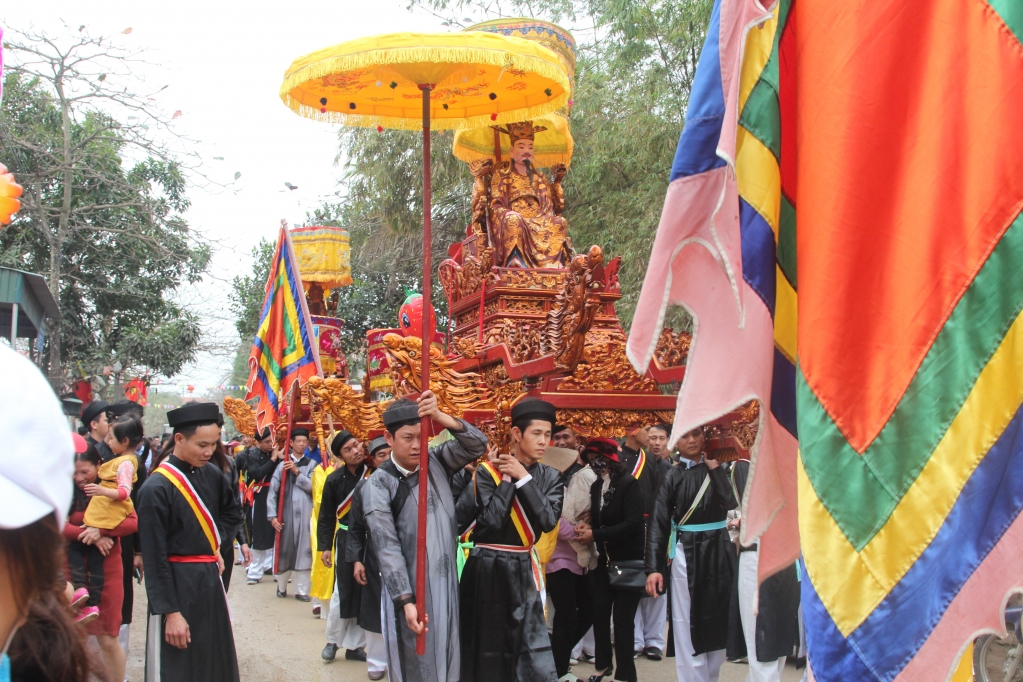 The worship of the Village Guardian Deity has become a beautiful, emblematic cultural feature of many localities in Northern Vietnam
2. The value of the village Guardian deity worship belief in the Northern Delta
A source of steadfast spirit support
The village communal house is a significant cultural and religious symbol in the village life of the Vietnamese people. It is “recognized as possessing a uniquely multifaceted nature encompassing religion, social affairs, executive, judicial and legislative functions, leisure, economics and rites of passage (weddings and funerals), a phenomenon unique to Vietnam” [2; p.239]. Traditionally, villagers regarded the Village Guardian Deity as the supreme spirit governing the community, possessing the power to assist and bless their productive activities and improve their lives: “For the villagers, the Village Guardian Deity serves as a spiritual anchor and a repository of faith, helping them overcome the hardships of a turbulent life” [4; p.100]. People often face the vicissitudes and hardships of life such as natural disasters, man-made calamities or illness and consequently often turn to supernatural forces; seeking divine protection serves as a spiritual remedy that instills the faith needed to overcome difficult times. “Villagers collectively designated and worshipped their own Village Guardian Deity as a tutelary spirit, primarily to ensure favorable weather and bring peace to the community” [2; p.60].
Maintaining and preserving traditional cultural values
The worship of the Village Guardian Deity among the people of the Northern Delta embodies the nation's traditional moral principle of “drinking water, remembering its source”, a deep sense of reverence and gratitude toward ancestral generations who rendered great service to the community by reclaiming land, establishing settlements, defending against invaders, aiding villagers and imparting trades or education. Most villages worship a tutelary deity, with the choice based on varying origins and merits; this practice stems from the villagers’ gratitude toward those who have rendered significant service to the community. In many parts of Northern Vietnam, village communal houses are dedicated to a Tutelary God, a figure associated with educating and saving the people. A prime example is the renowned scholar Chu Van An, who is primarily worshipped in Thanh Liet and Tam Hiep communes (formerly in Thanh Tri District, Hanoi); he is also venerated as a Village Guardian Deity in the former Hai Ba Trung District. Some villages worship national heroes such as the Trung Sisters, Lady Trieu, Duong Dinh Nghe and Ly Thuong Kiet,... In addition, many localities in the Red River Delta demonstrate their worship practices and express gratitude to the Tutelary Gods who taught their crafts to the villagers, such as: Nguyen Cong Truyen, the founding ancestor of the bronze casting craft in Dai Bai village (Gia Binh commune, Bac Ninh province); Lo Ren Communal House at 1 Lo Ren Street, dedicated to the patron saint of blacksmithing; Dong Xam Village Communal House (Hong Thai commune, Kien Xuong district, former Thai Binh province), dedicated to Nguyen Kim Lau - the village’s founding ancestor of the silver-carving craft; Bat Trang pottery village (Hanoi), which honors Hua Vinh Kieu, the founding ancestor of the pottery craft;...
The worship of the Village Guardian Deity also stems from a commitment to upholding the rules and traditional customs of the village community. Every traditional Vietnamese village possesses its own distinct practices and habits, which have evolved into established village customs. In the collective consciousness of the people of the Northern Delta, the Village Guardian Deity is a supreme spiritual figure who oversees and bears witness to every aspect of village life, protecting the inhabitants and blessing them with good health and prosperity. The Village Guardian Deity serves as the supreme spiritual leader of the village, overseeing not only the spiritual realm but also, to some extent, the material lives of the villagers. The worship of this deity is closely linked to village conventions and regulations; consequently, the practice dictates much of how people conduct themselves within the community and significantly influences individual behavior toward the village collective. Therefore, the worship of the village tutelary deity serves as a bond uniting the village community; honoring this deity is, in essence, an act of honoring the community’s rules, conventions and customs for “the worship of the village tutelary deity is, ultimately, the worship of village regulations and established local traditions” [3; p.95].
The role of connecting the community
The worship of the Village Guardian Deity plays a significant role in fostering community cohesion, serving as a focal point for the shared spiritual and cultural values of the villagers. This deity bears witness to the activities and life changes of every community member, bestowing blessings upon those who perform good deeds while punishing the wicked. The shrine dedicated to the Village Guardian Deity serves as the shared spiritual heart of the community; there, under the deity’s watchful gaze, the people consistently observe the village’s unique, long-standing customs and local regulations. While the worship of ancestors serves as the foundation binding family members together, the worship of the Village Guardian Deity unites the members of the village community; it fosters a democratic, egalitarian way of life characterized by collectivism, solidarity, and mutual support, while underpinning a lifestyle that values emotional bonds, a beautiful aspect of Vietnamese social conduct.
Preserving the beauty of traditional festivals, culture and arts
Much like other religious and spiritual activities, the practice of worshipping the Village Guardian Deity beyond honoring the merits of the deities is also expressed through festivals. Typically, festivals associated with the worship of the Village Tutelary God in the Northern Delta take place during the Lunar New Year or early spring. These festivals feature traditional rituals steeped in folk culture, alongside various cultural and artistic activities and folk games such as singing contests, swing competitions, wrestling matches, cockfighting, duck catching and crossing the pontoon bridge… In recent years, villages in the Northern Delta have actively revived local festivals. For instance, every early spring, Dong Ky Village (in Dong Quang Commune, Tu Son, formerly Bac Ninh Province) holds a festival to honor the merits of its Supreme Guardian Deity, the renowned general Thien Cuong from the era of the Hung Kings, featuring a solemn firecracker procession. In the jubilant atmosphere of the fireworks procession, villagers and tourists from everywhere have the opportunity to exchange and enjoy the unique cultural and spiritual values here, thereby contributing to preserving the good customs and habits of each village and promoting the traditional cultural and artistic values of the nation.
3. Several issues arise in preserving and promoting the cultural and religious values of worshipping the tutelary deity of the village today
In some localities, the practice of worshipping the village tutelary god has become distorted; individuals exploit these spiritual and cultural spaces for commercial gain, engaging in the “trafficking of deities and spirits” and conduct superstitious activities that inflict material, physical and mental harm upon the public. Village tutelary god festivals have turned into profit-driven, commercialized activities designed to generate revenue for those managing and organizing them. Certain individuals exploit superstition to swindle money through practices such as fortune-telling, rituals to avert misfortune, prayers for good luck and exorcisms, particularly during the festival season at the start of the year. Worship rituals intended to express gratitude to the spirits have increasingly come to be measured by monetary value, with excessive emphasis placed on elaborate and lavish offerings. This ostentatious display driven by a desire to assert the village’s prestige has eroded the pure, time-honored spiritual and cultural values bequeathed by our ancestors. The restoration and reconstruction of communal houses and shrines dedicated to village guardian deities in certain villages across the Northern Delta, resulting in structures that are excessively grand and massive lead to the wasteful expenditure of both state and public funds; furthermore, these projects destroy much of the ancient architectural beauty that embodies the cultural heritage of traditional Vietnamese villages.
Certain outdated practices associated with the worship of the Village Guardian Deity have yet to be eliminated, while many beautiful cultural aspects and traditional folk arts inherent in this worship have fallen into oblivion. Some local village festivals still retain outdated customs that are largely or entirely unsuited to modern conditions, yet significantly impact the mindset of contemporary people; examples include the pig-slaughtering ritual in Duyen Tuy Village (Hong Thai Commune, formerly Phu Xuyen District, Hanoi) and the Giong Temple Festival in Soc Son, which features a chaotic “scramble for offerings” that leads to unseemly scenes of people trampling one another in the rush to seize the sacred gifts… The spiritual essence of the village tutelary deity cult has become distorted; a segment of the population, driven by blind faith, squanders time and money on rituals, believing that merely offering abundant gifts to the deity will secure blessings of health, career success and prosperity. Falling victim to scams and suffering financial ruin and debt driven by a superstitious zeal to perform offerings is one of the typical negative consequences associated with the worship of the Village Guardian Deity in contemporary spiritual and cultural life. Traditional folk games and song-and-dance performances at festivals honoring the Village Guardian Deities are gradually fading away, increasingly supplanted by market-driven activities such as betting, gambling, lotteries and bingo games. Consequently, the cultural value and beauty of these festivals risk being lost and failing to be passed down to future generations. Furthermore, issues regarding traffic safety and public order during these festivals require management authorities to implement remedial solutions. With a certain extent, the village worship of a Village Guardian Deity fosters village autonomy and self-governance while maintaining local order and decorum; however, it also gives rise to tendencies toward forced egalitarianism, a reluctance to offend others, and a behavioral pattern that prioritizes sentiment over reason. A significant number of people exploit this practice to hinder efforts to educate the public and raise legal awareness. The power of emotional bonds, particularly those based on blood ties, community, or deep-seated gratitude has at times transcended the boundaries of reason, moral norms, and even the law [1; p.18].
4. Conclusion
The worship of the Village Guardian Deity in the Northern Delta is a form of folk belief with a long history, dedicated to honoring deities revered by villagers, as well as individuals who rendered meritorious service to the community and the nation, or who taught trades to the local people… It is evident that in the beliefs of the local inhabitants, the Village Guardian Deity is the sacred deity presiding over the village, a force that offers protection and assistance, while also serving as a spiritual anchor for the entire community. Rooted in profound religious conviction, the worship of the Village Guardian Deity has exerted a significant influence on the spiritual life of the Northern Delta people, shaping various aspects such as their worldviews and ideologies; ethics and lifestyles; arts and culture… However, the downsides of the market economy and the erosion of moral values are currently impacting religious and spiritual life. Negative trends have emerged within the worship of the Village Tutelary God, diluting traditional national values and local cultural identities, while backward customs incompatible with modern values persist. Therefore, it is essential to implement a comprehensive set of measures, ranging from raising awareness through education and establishing relevant policies and mechanisms to fostering economic and human development, thereby promoting the value of the Village Guardian Deity worship and enriching the tapestry of a progressive Vietnamese culture deeply imbued with national identity.
References
1. Tran Thi Ha Giang, Ho Chi Minh National Academy of Politics, Doctoral Dissertation Abstract: The influence of Village Guardian Deity worship on the spiritual life of residents in Hanoi’s suburban areas today, Hanoi, 2020.
2. Tran Dang Sinh (Editor-in-Chief), The principle of when drinking water, remembering the source”: Philosophical foundations and values in national history, Education Publishing House, Hanoi, 2017, p.239, 60.
3. Nguyen Thi Tho (Editor-in-Chief), The social ontology of filial piety in contemporary Vietnam, Social sciences Publishing House, Hanoi, 2017, p.95.
4. Tran Quoc Vuong (Editor-in-Chief), Fundamentals of Vietnamese culture, Vietnam Education Publishing House, Hanoi, 2014, p.98, 100.
5. https://baothanhhoa.vn/van-hoa-giai-tri/net-dep-tin-nguong-tho-thanh-hoang-lang/148310.htm.
