Keywords: Law on Belief and Religion of 2026; Article 14; Residential community; Religious or belief-based foundation; Distorted rhetoric; Struggle and rebuttal.
1. Introduction
Beliefs and religions represent a spiritual need for a segment of the population and constitute an integral part of Vietnam’s traditional culture. Places of worship such as communal houses, temples, shrines, and sanctuaries serve as spiritual spaces and enduring symbols that foster cohesion within village communities. The Party and the State of Vietnam have consistently upheld a policy of respecting and protecting the right to freedom of belief and religion, while continuously refining the legal framework in this domain. In 2026, the 16th National Assembly enacted a new Law on Belief and Religion, designed to address practical requirements, promote decentralization, simplify administrative procedures and establish a clear legal mechanism for self-governance by the people. In this context, Article 14 which addresses the representatives and management boards of places of belief holds particular significance. Taking advantage of the process of standardizing these new regulations, hostile elements have selectively edited and distorted the essence of Article 14, alleging that the authorities are crudely interfering in the internal affairs of folk religious sites. Identifying and dismantling these arguments is a matter of urgency for upholding the sanctity of the law and maintaining social stability.
2. The core content of the provisions regarding residential communities in Article 14 of the 2026 Law on Belief and Religion
In order to establish a solid scientific and legal basis for refuting erroneous arguments, it is first necessary to gain a correct and comprehensive understanding of the spirit and content of Article 14 of the 2016 Law on Belief and Religion.
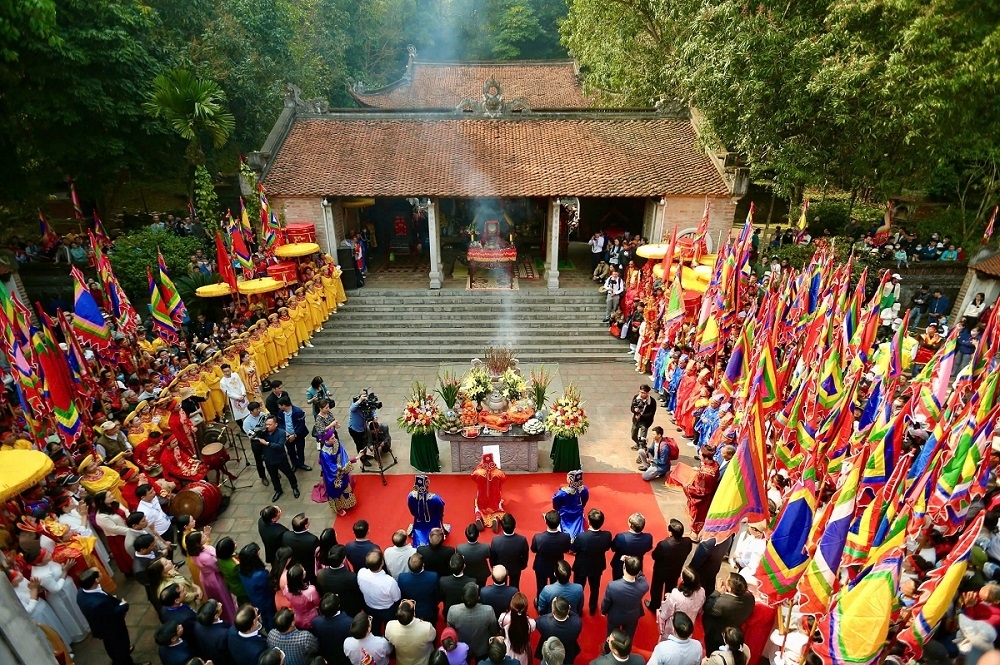 Religious sites such as communal houses, temples, shrines and sanctuaries serve as spiritual spaces and symbols that have long fostered cohesion within village communities. (Pictured: The 2025 Ba Trieu Temple Festival at the Ba Trieu Temple - a site designated as a special national-level historical and architectural-artistic relic in Thanh Hoa province)
Compared to the 2016 Law, Article 14 of the 2026 Law has undergone comprehensive amendments and additions, establishing a clear and coherent framework for grassroots democratic processes, as well as the self-governing, decisive role of the local community regarding its own places of worship. Specifically, the legal structure of Article 14 encompasses the following core elements:
Firstly, affirm the right to self-governance and the promotion of grassroots democracy for local communities with regard to grassroots-level regulations
Clause 1 of Article 14 stipulates that a religious or belief-based site must have a representative or a management board to bear legal responsibility for the activities taking place at that site. Notably, the term of office, responsibilities and powers of these positions are not imposed by state authorities; rather, they are determined by the local community itself through the site’s operational regulations. This reflects the State’s absolute respect for the long-standing, positive local customs, conventions, and village regulations known as village regulations and convention concerning the management of communal property and the veneration of ancestors and village tutelary deities.
Secondly, standardize personnel criteria for the common good of the community
Clause 2 of Article 14 sets out specific criteria for representatives or members of a management board, including: being a Vietnamese citizen with permanent residence in Vietnam; possessing full civil legal capacity; enjoying a good reputation within the local community; and not currently being subject to administrative or criminal sanctions most notably, having no prior convictions for offenses against national security. This regulation protects religious sites themselves from the risk of being manipulated by ill-intentioned individuals, criminals, or those who exploit religious authority and doctrine for personal gain or to disrupt public order and security within the community.
Thirdly, the formalization of democratic principles through electoral and recognition mechanisms
Clauses 3 and 4 of Article 14 clearly delineate the authority to organize [activities] and recognize results, based on the scope of the religious site or facility.
For a place of worship located within a commune, the commune-level People’s Committee shall coordinate with the corresponding Vietnam Fatherland Front Committee to organize the election of a representative by the local community. Subsequently, within 05 working days, the commune-level People’s Committee shall issue a decision granting recognition.
For religious sites of significant influence that span multiple communes, wards or special zones within a province, this authority rests with the provincial-level People’s Committee, in coordination with the provincial-level Vietnam Fatherland Front Committee.
This regulation represents a significant shift in line with the spirit of the 2026 administrative reform: it completely eliminates the intermediate authority of the district level to facilitate a streamlined management model, promotes the direct delegation of powers to the grassroots (commune) level to ensure closer engagement with the public, and minimizes the processing time for applications to just five working days.
From a legal perspective, the essence of an official recognition by the authorities is not the granting of power or an encroachment upon the freedom of belief, but rather a procedure to establish the legal status of a representative. Through this recognition, a representative or a management board acquires the legal standing necessary to act on behalf of the community conducting civil transactions, safeguarding the assets and land of a religious or belief-based site and organizing traditional festivals in a safe and compliant manner.
3. Identifying distorted claims regarding the provisions on residential communities in Article 14
Based on the monitoring and collection of information from cross-border social media platforms, as well as biased annual reports on religious freedom issued by certain international organizations, it is possible to categorize and identify distorted narratives that primarily center on the following three groups of fallacious arguments:
The first argument, falsely claims that the State is subjecting folk belief establishments to administrative control and state ownership
Reactionary elements argue that the 2026 Law which mandates that religious or spiritual sites elect representatives and obtain official recognition from the commune- or provincial-level People’s Committee within five days, effectively transforms these spiritual venues into an extension of the administrative apparatus. This interpretation completely departs from both the letter and the spirit of the legal framework. Since religious and spiritual beliefs are voluntary and pertain to the people’s inner spiritual lives, why should the management of temples and shrines require an administrative decision from the authorities? In effect, the State is deliberately installing its own appointees to oversee these sites, transforming self-governing management committees into state-run bodies in order to control charitable offerings and steer worship-related activities in line with its own political agenda.
This is an extremely dangerous line of reasoning, which deliberately conflates the state’s management of legal order with interference in internal spiritual or religious affairs. In reality, any civilized nation in the world requires organizations or institutions that host large gatherings and hold collective assets to have a legally recognized representative. Without official administrative recognition, who would step forward to engage with authorities or the courts to protect the community’s interests in the event of land disputes, the loss of artifacts, or a fire at a place of worship? The provision requiring the government to issue a recognition decision within five working days is, in fact, a breakthrough in administrative reform; it compels state agencies to act expeditiously preventing them from stalling on files or creating difficulties for the public rather than serving as an additional technical barrier.
The second argument, the State strips local communities of their autonomy
This line of argument deliberately misinterprets the provisions of Clauses 3 and 4, Article 14, which concern the coordination between the commune-level People’s Committee and the corresponding-level Vietnam Fatherland Front Committee to organize the election or selection process by the local residential community where a place of worship is located... Exploiting the phrase “coordinated organization”, certain ill-intentioned individuals claim that local authorities hold absolute power, imposing personnel choices based on their own subjective preferences rather than allowing for any genuine freedom of election by the people. They distort the facts by alleging that the Fatherland Front and commune-level People’s Committees will use their authority to vet, manipulate, or eliminate individuals who hold independent views such as respected village elders who happen to be out of favor with the authorities replacing them with more compliant, submissive figures.
This line of reasoning completely ignores the actual operation of the grassroots democracy mechanism in Vietnam. The role of the People’s Committee and the Fatherland Front in this context is one of support and assurance: they provide legal assistance, facilitate the necessary space, ensure security and public order, and bear witness to the impartiality of the election, they have absolutely no authority to interfere with the voting intentions or the choices made by the local community. The specific operational regulations and selection criteria remain based on conventions established by the community itself. The involvement of the Fatherland Front, the body representing the great national unity serves as a mechanism to ensure democracy and fairness. It guarantees that all members of the community possess equal rights and obligations, while preventing any specific group or prominent clan from manipulating or monopolizing the village’s shared religious or spiritual sites for their own private use.
The third argument, exploiting the ambiguity surrounding the concept of a “local community” to incite ethnic and religious conflict, as well as disputes over property
Article 14 of the 2016 Law on Belief and Religion focuses on the residential community where a place of worship or religious site is located. Exploiting this provision, certain extremist organizations abroad, particularly those attempting to revive the so-called “Degar Protestantism” in the Central Highlands or “Khmer Krom Buddhism” in the Southern region have put forward highly distorted interpretations. They argue that the legal concept of a “residential community” serves as a tool for the State to implement a policy of cultural assimilation. They incite local ethnic minorities by claiming that the authorities use this provision to allow ethnic Kinh people who arrive from other regions to join these residential communities, thereby gaining the right to vote, manage and ultimately seize control of the local people’s traditional temple complexes, traditional community houses and sacred forests.
This is an unfounded inference, an intentional attempt to reframe a provision that is purely civil and cultural in nature as an issue of ethnic conflict. The 2016 Law on Belief and Religion clearly defines the concept of a community in relation to the living space and historical origins of a specific place of worship or religious site. Regarding sites associated with the cultural characteristics of ethnic minority groups, the State consistently respects their customary laws, as well as the roles of village elders, community leaders, and respected traditional religious or cultural figures. Nothing in Article 14 permits the appropriation or dilution of local cultural identity. On the contrary, by formalizing the role of local communities, it provides ethnic minority groups with a robust legal instrument to prevent private enterprises or individuals driven by a desire for profit from encroaching upon or commercializing the spiritual aspects of their sacred heritage spaces.
4. The nature of and the motives behind distorted narratives
In order to engage in an effective struggle, we must see through the true nature and malicious schemes underlying the media smear campaigns directed at the provisions of Article 14 of the 2016 Law on Belief and Religion. These arguments do not stem from a constructive spirit or a desire to protect the rights of the people; rather, they are part of an overarching political strategy aimed at the following objectives:
Firstly, they seek to undermine Vietnam’s diplomatic standing on the international stage. By repeatedly leveling false accusations that Vietnam violates religious freedom and stifles the autonomy of religious communities, citing provisions such as Article 14 reactionary organizations deliberately disseminate one-sided, inaccurate information to foreign diplomatic missions and international human rights bodies. Their objective is to have Vietnam placed on special monitoring lists (such as the “Countries of Particular Concern” or CPC list), thereby creating a pretext to exert economic and political pressure during the country’s international negotiations in 2026 and beyond.
Secondly, they seek to detach spiritual sites from State oversight in order to create a legal vacuum. Their underlying motive in demanding that religious and belief-based institutions be entirely independent and autonomous, free from any administrative recognition by the authorities is to transform these locations into zones that lie beyond the reach of the law. Once religious or belief-based sites become “void zones”, lacking proper oversight or legitimate leadership, hostile forces can easily exploit them as hubs for illegal mass gatherings, repositories for obscene or reactionary materials, or even as sanctuaries and operational bases for terrorists and extremists who incite riots under the guise of benign spiritual activities.
Thirdly, they incite discontent and undermine the great national unity. By selectively editing statements and taking isolated incidents such as local disputes over the management of temple or shrine property and mischaracterizing them as systemic flaws inherent in the legal framework, these individuals seek to sow doubt, foster a sense of unease and provoke confrontation between the general public and local authorities. This severely undermines the deep, organic bond between the people and the Party and State, and directly sabotages the effort to build a great national unity.
5. Solutions for countering and refuting distorted narratives and enhancing the effectiveness of law enforcement
In order to safeguard the integrity of the law and enhance the effectiveness of its enforcement, the following measures should be implemented:
Firstly, innovating communication and outreach efforts
Leveraging digital transformation by converting the content of Article 14 into graphic materials (infographics) and short-form videos (Shorts/TikTok) for distribution via social media and smart broadcasting systems. This will help citizens clearly understand election regulations and recognize that appointing representatives serves to protect their own legitimate property rights.
Secondly, implementing legal procedures in an open and transparent manner
Commune-level People’s Committees must provide guidance, receive applications, and issue recognition decisions diligently within five working days; they are strictly prohibited from imposing any additional, unauthorized conditions. The Fatherland Front shall effectively fulfill its supervisory role to ensure the election is conducted in an equitable and objective manner.
Thirdly, the struggle in cyberspace
Use modern scanning technology to early detect distorted information. Article 14. Promptly fight and remove harmful information and strictly handle individuals who intentionally share distorted information to incite and cause trouble according to the provisions of the Law on Cyber Security and the Penal Code.
Fourthly, leveraging the role of intellectuals and influential individuals
Encouraging scientists to write in-depth articles in specialized journals such as the Journal of Ethnic and Religious Research, the Communist Journal, the Journal of Religious Research... to clarify the progress of the Law. Enlist the voices of village elders, village chiefs and intellectuals to affirm the reality of freedom and self-governance at the grassroots level in order to destroy distorted rhetoric from the outside.
6. Conclusion
The provisions regarding residential communities in Article 14 of the 2026 Law on Belief and Religion represent a legal highlight, harmoniously balancing state administration with the democratic self-governance of the people. Distorted narratives are, in reality, political ploys employed by hostile forces to undermine the great national unity. Proactively identifying these attempts, strictly enforcing the law, and engaging in direct struggle across all fronts are essential, ongoing tasks, vital for safeguarding the peace of the people and ensuring the sustainable development of the nation.
References
1. Bui Thanh Ha, Innovating Legislative Thinking in the Realm of Belief and Religion in Contemporary Vietnam, Journal of Religious Research, No. 3/2026.
2. Do Quang Hung, The Religious Policy of the Communist Party and the State of Vietnam: From Theory to Practice, National Political Publishing House, Hanoi, 2025.
3. Ho Chi Minh National Academy of Politics, Curriculum for Training in State Management of Religious Affairs in the New Situation, Political Theory Publishing House, Hanoi, 2026.
4. Nguyen Hong Duong (2024), The Relationship Between Villages and Folk Beliefs in the Northern Delta: Issues for Management, Journal of Anthropology, No. 5/2024.
5. National Assembly of the Socialist Republic of Vietnam, Law on Belief and Religion (Law No. 07/2026/QH16), Hanoi, 2026.
6. Government Committee for Religious Affairs, Report on Practical Review and Implementation Guidelines for the Law on Belief and Religion in the Digital Era (2026), internal circulation document, Hanoi, 2026.
