Keywords: Religion; Distorted rhetoric; Hostile forces; Counter-argument; Freedom of belief and religion; Peaceful evolution.
1. Introduction
Throughout human history, religion has been more than just a sacred belief in a supernatural realm; it has served as an integral component shaping the culture, morality, and way of life for many communities. In Vietnam, a multi-religious nation with over 27.7 million adherents, accounting for approximately 27% of the total population, religious and spiritual practices are vibrant and deeply intertwined with patriotism and the spirit of national unity. The Party and the State of Vietnam consistently respect and protect the freedom of belief and religion of all citizens, viewing this as a legitimate spiritual need of a segment of the population.
However, the sensitive nature of religion, its capacity to easily sway beliefs and rapidly mobilize the masses has made it a fertile ground that hostile and reactionary forces, both domestic and foreign, continuously target. They view religion as a spearhead in their “peaceful evolution” strategy, thoroughly exploiting gaps in social management or isolated local incidents distorting and exaggerating them into claims of systemic human rights violations. Accurately identifying and deeply analyzing the true nature of these distortions, while proactively refuting them, is not only an urgent task for safeguarding national security but also an essential requirement for preserving the purity and integrity of the religions themselves in Vietnam.
2. Identifying common distorted narratives used by hostile forces regarding religious issues
Through monitoring and analyzing the "dark" media ecosystem including non-objective reports from certain international organizations (such as the United States Commission on International Religious Freedom, or USCIRF) and reactionary social media platforms, the tactics used to distort the reality of religion in Vietnam can be summarized into three primary categories of rhetoric:
2.1. Making false allegations that the Vietnamese State suppresses and stifles religious freedom
This is the most frequently repeated slanderous narrative. Hostile forces often employ provocative terms, such as “confining religion within a legal cage”, “imposing strict control over spiritual practices” and “discriminating between religious and non-religious individuals. When an individual or a religious figure violates criminal law such as by committing fraud to misappropriate property or abusing democratic freedoms to infringe upon the interests of the State, reactionary organizations immediately orchestrate a narrative, claiming that the authorities arrested the person for religious reasons rather than for their unlawful conduct. They deliberately blur the line between legitimate religious activities and the exploitation of religion to oppose the government, thereby fostering a distorted perception within the international community that Vietnam lacks freedom and democracy.
2.2. New methods and tricks of hostile forces in cyberspace
In the boom context of the digital era, hostile forces have rapidly shifted their subversive tactics from traditional forums to cyberspace, turning cross-border platforms such as Facebook, YouTube, and TikTok into channels for disseminating fake news concerning religion. A sophisticated tactic currently employed involves the calculated exploitation of social media algorithms to create “filter bubbles” of harmful or malicious content, specifically targeting young people and communities in remote or isolated areas.
They employ techniques such as editing and manipulating short videos to distort routine local administrative actions. For instance, when authorities clear land for economic development in cases where the site happens to house an unauthorized, illegal place of worship, these actors immediately sensationalize the event, framing it as an act of religious persecution or forced suppression of faith. Notably, they actively promote the trend of “online religion” or non-institutionalized belief systems, inciting followers to break away from established, mainstream religious organizations and join clandestine online groups. Through live broadcasts, these individuals weave in extremist views, inciting separatist and autonomous ideologies under the guise of defending inherent religious freedoms. They also establish ad hoc online charitable funds, which, in reality, serve as illicit financing channels for anti-government elements within the country, thereby transforming the genuine spiritual beliefs of the public into a tool for their own political agendas.
2.3. Distorting the Law on Belief and Religion and state management efforts
When the 2016 Law on Belief and Religion came into effect, hostile forces focused their attacks on the provisions regarding the registration of activities and the official recognition of religious organizations. They argued that the State’s requirement for religious organizations to register constitutes a “permit-based” system, a form of crude interference in the internal affairs of religious institutions that strips individuals of their inherent human rights.
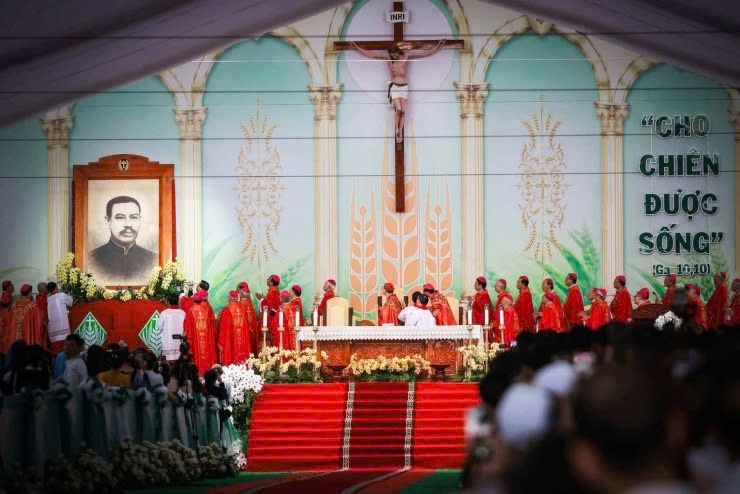 The beatification ceremony for Father Francis Truong Buu Diep, held at the Tac Say Church in Ca Mau province, serving as one of many vivid demonstrations of religious freedom in Vietnam
The purpose of this rhetoric is to incite unrecognized religious groups, particularly new religious movements characterized by superstition or profiteering to refuse cooperation with the authorities, thereby creating flashpoints for legal conflict in strategically sensitive regions such as the Northwest, the Central Highlands and the Southwest
2.4. Promoting independent religious phenomena to undermine the great national unity
Another sophisticated tactic involves promoting so-called “independent” religions, self-proclaimed organizations that operate outside the scope of the law and have broken away from legitimate, state-recognized religious institutions. These groups smear established religious bodies, such as the Vietnam Buddhist Sangha or the Catholic Bishops’ Conference of Vietnam, by labeling them as “state-run” or mere tools of the government; they then use this narrative to lure followers into joining illegal organizations that they themselves control from behind the scenes.
The essence of this rhetoric lies in establishing a state within a state, transforming spontaneous places of worship into hubs for assembling opposition political forces, in preparation for scenarios involving riots or subversion should the opportunity arise.
3. Scientific, legal and practical grounds for refuting distorted claims
In ordre to dismantle distorted narratives, researchers and practitioners must rely on three solid pillars: scientific theory, a framework of domestic and international law and irrefutable empirical evidence.
3.1. About the theoretical and scientific basis
No country in the world grants absolute religious freedom that exists outside the legal framework. Even Western nations, which take great pride in their commitment to freedom, impose strict limits to safeguard national security and public morality. Religion exists within the fabric of society, firstly, a believer is a citizen of the state.
Therefore, state management of religion is a perfectly legitimate activity aimed at ensuring social order and preventing the exploitation of religious authority or doctrine for personal gain or the promotion of cult-like practices that cause public alarm and inflict harm on the health and property of the people.
3.2. About the legal framework
Vietnam’s legal system is fully compatible with international conventions on human rights. Article 24 of the 2013 Constitution affirms:
Everyone has the right to freedom of belief and religion, and the right to follow or not to follow any religion. All religions are equal before the law. The State respects and protects the right to freedom of belief and religion.
The 2016 Law on Belief and Religion provides clear and transparent procedures and shortens the probationary period for the official recognition of religious organizations from 23 years to 5 years, a change that reflects greater openness and transparency. The registration of religious activities is not intended to impose restrictions; rather, it serves as a legal basis for the State to provide protection for places of worship and to safeguard the legitimate rights of believers against any acts of infringement. At the same time, Article 18 of the International Covenant on Civil and Political Rights (ICCPR) to which Vietnam is a party, stipulating that the right to freedom of religion may be restricted by law when necessary to protect public safety, order, health or morals. Vietnam’s actions are entirely in accordance with international law.
This legal framework has been further strengthened and elevated through the National Assembly’s adoption of the Law on Belief and Religion of 2026 (Law No. 07/2026/QH16). This represents a groundbreaking legal advancement designed to meet the requirements of national governance in the digital era. A fundamental innovation of the 2026 Law is the formal introduction of a comprehensive legal framework governing belief and religion-related activities within cyberspace and the online environment. The law establishes a clear identification mechanism, requiring organizations and individuals to comply with legal regulations when engaging in religious activities online. It also strictly prohibits the use of technology and artificial intelligence (AI) for spiritual profiteering or acts that compromise national security. By formalizing the legal framework for the digital space shifting from a system of prior authorization to one based on registration and notification, while strengthening post-activity oversight, the law provides a robust legal foundation. This effectively refutes any distorted claims that the government seeks to suppress or stifle the inherent religious freedom of its citizens. Vietnam remains proactive and transparent, ensuring its conduct is fully aligned with international legal standards.
3.3. About vivid, real-world evidence
The vivid reality in Vietnam serves as a sharp rebuke to these slanderous claims:
Significant growth in numbers: Up to now, the State has officially recognized and granted operating registration to 43 organizations representing 16 different religions. The number of places of worship, clergy and adherents has continued to grow over the years.
Vivid reality serves as the most accurate gauge of Vietnam’s religious policy, effectively refuting any distorted claims. Regarding international religious engagement, Vietnam’s successful hosting of the 4th United Nations Day of Vesak in Ho Chi Minh City in May 2025 stands as an undeniable testament. The event brought together thousands of delegates, heads of state, and Buddhist scholars from over 100 countries and territories, affirming both the country’s open policy on religious freedom and the extensive international integration capacity of the Vietnam Buddhist Sangha. Furthermore, the historic turning point in diplomatic relations between Vietnam and the Holy See marked by the official upgrade to the status of a Resident Papal Representative in Vietnam and the establishment of a stable, functioning Representative Office demonstrates the goodwill, mutual respect and understanding that exist between the Vietnamese authorities and the global Catholic Church.
In strategic regions such as the Northwest, the Central Highlands, and the Southwest, the spiritual life of ethnic minority communities is prioritized and safeguarded through concrete actions. The State has provided maximum facilitation for the printing and publication of millions of religious texts in the languages of these ethnic groups. Bibles and Buddhist publications in languages such as Khmer, E-de, Gia-rai and Bahnar are legally and widely circulated throughout villages and pagodas, fully meeting the spiritual needs of the people in these highland and remote areas. Major holidays such as the Khmer people’s Chol Chnam Thmay, as well as Christmas and Easter for the Catholic and Protestant communities, consistently receive maximum support from local authorities regarding security and public order, ensuring they take place in a solemn and joyful atmosphere. This reality thoroughly refutes the allegations of cultural assimilation or the suppression of religion in highland regions claims frequently propagated by reactionary groups in exile.
4. Strategic solutions for effective prevention and counteraction in the new context
The struggle to refute distorted narratives regarding religion is a long-term, arduous undertaking that requires a proactive and sharp mindset. In order to achieve high effectiveness, the following measures should be implemented in a synchronized manner:
Firstly, continuing to refine and strictly implement the legal framework concerning religion
The State needs to continue reviewing, supplementing, and specifying sub-legislative documents to ensure the Law on Belief and Religion is consistent, clear, and easy to implement. It is essential to refine both qualitative and quantitative criteria for identifying and addressing acts of exploitation or distorted practices carried out under the guise of spirituality as well as the abuse of religion to violate the law so that local law enforcement agencies can act with clarity and confidence, while also preventing external forces from finding pretexts to engage in misrepresentation.
Secondly, innovating and taking a proactive stance on the front of information, communication and cyberspace.
Instead of merely waiting for events to unfold before offering explanations, it is essential to proactively establish official, multilingual communication channels to present an accurate picture of religious freedom in Vietnam to the international community. Furthermore, a highly skilled cyber-operations force should be developed utilizing technological tools to promptly identify, flag and remove content such as videos or articles that defame or distort information regarding religion on cross-border platforms like Facebook, YouTube and TikTok.
Thirdly, leveraging the role of established religious organizations and respected religious leaders
Respected religious dignitaries and clergy serve as the most effective ambassadors for refuting distorted narratives. It is essential to create conditions that allow religious institutions to fully realize their guiding principles of accompanying the nation, while actively participating in social welfare, healthcare and educational initiatives. When followers perceive genuine care and respect from both the authorities and their religious institutions, they will naturally develop a robust resilience against the enticements and solicitations of hostile organizations.
Fourthly, strengthening dialogue and diplomatic engagement both bilateral and multilateral to advance one’s position
Vietnam should continue to maintain and expand annual human rights and religious dialogues with international partners, such as the United States and the European Union. It should also remain open to hosting delegations of foreign lawmakers, journalists, and international religious scholars, inviting them to visit and conduct on-site assessments in strategic regions so they may witness firsthand the peaceful and vibrant religious life of the Vietnamese people. Objective truth serves as the most potent weapon to dismantle any attempts to impose external agendas or interfere in the country’s internal affairs.
5. Conclusion
Identifying and refuting the distorted narratives propagated by hostile forces regarding religious issues is not merely a matter of managing media crises; rather, it is a persistent struggle to uphold the truth, safeguard the legitimate rights of the people and maintain the political stability essential for the nation’s development. By closely integrating the refinement of legal frameworks, the socio-economic development of regions inhabited by religious communities, the leveraging of the internal strengths of legitimate religious organizations and the enhancement of external relations, Vietnam will undoubtedly continue to thwart any schemes that seek to exploit religion to sow ethnic division or undermine the nation. Religion in Vietnam will forever remain a positive cultural and spiritual current, harmoniously blending into the great national unity of the entire people in this new era.
References
1. Dang Nghiem Van, Theory of religion and the religious situation in Vietnam, National Political Publishing House, Hanoi, 2003.
2. Nguyen Thanh Xuan, Religion and religious policy in Vietnam, Religious Publishing House, Hanoi, 2014.
3. National Assembly of the Socialist Republic of Vietnam, 2013 Constitution, Publishing House. National politics Truth, Hanoi, 2013.
4. National Assembly of the Socialist Republic of Vietnam, Law on Belief and Religion (Law No. 02/2016/QH14), Hanoi, 2016.
5. National Assembly of the Socialist Republic of Vietnam, Law on Belief and Religion (Law No. 07/2026/QH16), Hanoi, 2026.
6. Ho Chi Minh National Academy of Politics, Curriculum on religious affairs in the current period, Political Theory Publishing House, Hanoi, 2021.
