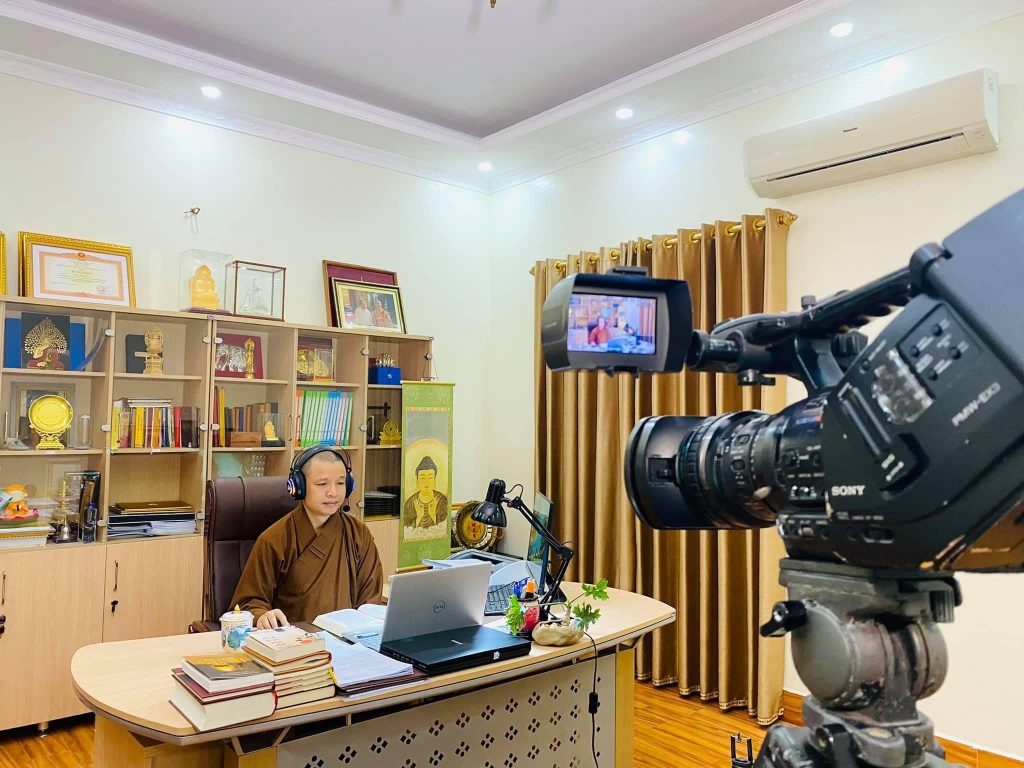
 Buddhist lecturers frequently use technology in their lectures
Keywords: The 4.0 industrial revolution; Religious practice; Digital space; Vietnam; Religious adaptation.
1. The shift of sacred space from reality to digital space
In the context of the Fourth Industrial Revolution, the concept of sacred space, traditionally defined as tangible physical entities such as temples, churches and shrines, is undergoing a major shift. This is not simply about bringing religious activities online, but rather a profound restructuring of the epistemology and faith behavior of modern man.
Vietnamese religious tradition has always emphasized the importance of being in place. A truly sacred space must encompass several elements: distinctive architecture, the serene scent of incense, the sounds of bells and gongs, the physical presence of the community of believers. However, the emergence of digital spaces has transformed the location into a point of connection.
When a devotee attends a prayer service via Facebook livestream, their geographical location might be their living room, office or even a bus, but their spiritual coordinates are directed towards the source of the broadcast. At this moment, the smartphone becomes a spiritual gateway, blurring the lines between the mundane aspects of everyday life and the sacredness of the ritual. The sacred space is no longer limited but expands according to bandwidth and transmission speed.
The pinnacle of this shift is the application of virtual reality (VR) and augmented reality (AR) technologies. In Vietnam, the trend of digitizing religious sites is allowing devotees to undertake digital pilgrimages. Instead of traveling hundreds of kilometers, pilgrims can simply wear VR glasses to stand in the main hall of an ancient temple, observing the intricate carvings and listening to chanting from multiple directions. This is a state of assumed presence, where, although the physical body does not move, the nervous and emotional systems react as if in a truly sacred space. This shift is highly humane, allowing the elderly, the sick and Vietnamese living abroad to still connect with the spiritual space of their roots.
In the physical world, sacredness is often centered around central locations such as altars and pulpits. But in the digital world, sacredness is decentralized. Each personal device becomes a separate center of worship. Believers are no longer passive observers from afar but become actively interacting entities, such as liking, commenting and sending prayers directly on their screens while the ceremony is taking place. This interaction creates a virtual sacred community; although they cannot touch each other, thousands of people watching a ceremony online still generate a powerful energy flow, fostering a more democratic form of religion where the sacred space belongs to anyone with an internet connection.
It is evident that the shift from the physical world to the digital space in Vietnam is creating a dual sacred space structure. People are not abandoning traditional temples or churches, but they are expanding their spiritual lives into the digital realm to seek convenience and instant connectivity. The biggest challenge today is how to ensure that the digital space does not turn religion into a superficial entertainment product, while still preserving the role of faith in a data-driven world.
2. Digitizing acts of faith
In the process of adapting to the Fourth Industrial Revolution, religious life in Vietnam is changing not only spatially but also profoundly at the behavioral level. The digitization of religious practices refers to the transformation of rituals, duties and interactions between believers and the divine into digital operations. This shift brings about a new, highly convenient aspect but also sparks heated debates about the nature of reverence.
The most significant breakthrough in the digitalization of religious practices in Vietnam is the emergence of offerings and donations via e-wallets and QR codes. Instead of the image of donation boxes overflowing with small change, which pose risks of theft or detract from the aesthetics of places of worship, believers can now perform acts of merit with just a tap on their phones.
This convenience extends beyond saving time or geographical distance. From a governance perspective, digitizing religious funds helps religious institutions achieve financial transparency. Data from bank transactions creates an unalterable electronic accounting system, dispelling societal concerns about the misuse of donations. This is a significant step in integrating religion into the modern governance standards of a digital society.
Modern acts of faith are also expressed through the use of specialized applications. Catholic believers may use apps to remind them of confession appointments or to read the Bible daily; Buddhists may use apps to count prayer beads digitally or listen to Dharma talks suggested by AI algorithms based on their mental state.
The emergence of AI in religion, such as morally advisory chatbots, has created a new form of practice: digital self-reflection. When individuals face difficulties, instead of waiting to meet a religious leader in person, they interact with AI to receive advice from scripture. This behavior allows religion to be present 24/7 in personal life, transforming lofty philosophies into practical solutions to everyday problems or existential crises.
However, many argue that faith requires asceticism and personal experience. Lighting a real incense stick, feeling the smoke and heat, or kneeling on a cold stone floor creates a mind-body connection that a like or donate button cannot replace. Excessive convenience risks turning faith into a kind of spiritual fast food. When things become too easy, reverence and sacredness easily fade. Furthermore, the digitization of faith practices leads to superficiality. A person might order food online while listening to scripture, browse social media and attend a service online all at the same time. This fragmentation of attention undermines single-mindedness, the core of all spiritual practice. There are concerns that, as acts of faith become algorithmized, people will gradually lose the ability to connect deeply with the real community and with mystical spiritual experiences that cannot be encoded in data. This debate is essentially a process of finding balance. Digitizing acts of faith is a powerful tool to maintain a connection with religion in a busy world, helping moral values spread faster and wider.
It is evident that the practice of religion in Vietnam in the 4.0 era is currently in a testing and selection phase. Formal and cumbersome practices will be discarded by the convenience of technology, but core values related to direct human-to-human experiences and the connection between humanity and the absolute, will remain a space that digital technology cannot yet fully penetrate.
3. Changes in religious communication and education
In the context of the Fourth Industrial Revolution, religion in Vietnam is no longer a closed system but has become a dynamic communication entity. This transformation is not only reflected in changes to communication tools but also in a complete shift in the methods of faith education, from the traditional monologue model to a multi-directional dialogue model in the digital space.
Previously, religious media power was concentrated in the hands of religious leaders during live sermons. Teachings were transmitted vertically, from top to bottom. Today, the explosion of social media platforms like Facebook, YouTube, and TikTok has decentralized this power structure. Every clergy member, and even every believer, can become an independent media channel. The rise of religious KOLs in Vietnam is the clearest evidence of this. Young, tech-savvy monks have transformed short-form video platforms into virtual lecture halls. Instead of hours-long sermons, they convey philosophy through 60-second clips, using Gen Z language, incorporating trendy background music and recreating everyday situations. This approach helps break down the barriers of religious law’s dryness, making religion a part of lifestyle rather than just a set of rigid doctrines.
Religious education in Vietnam in the era of Industry 4.0 is witnessing the rise of e-learning systems and personalized spiritual paths. Online doctrinal courses, applications for learning Sanskrit, Chinese, or Buddhist scriptures are being systematically designed with interactive quizzes, scoring systems and digital certificates. Most notably, the role of Big Data is significant; religious organizations can use data to analyze the interests of their followers. If algorithms detect a large number of young people experiencing mental health crises, teachings on meditation and spiritual therapy will be prioritized. This creates an on-demand education system that allows religions to respond promptly to the changing realities of society. AI is also beginning to assist in the translation and interpretation of scriptures, making the vast and complex body of religious knowledge more accessible to the general public.
The digital environment has transformed religious education from a solitary academic process into a communal experience. Private groups on Facebook or Telegram channels have become vibrant forums for doctrinal discussion. There, learners not only receive knowledge from their teachers but also engage in debates and share personal experiences. Real-time interaction through live Q&A sessions instantly addresses questions about faith, creating a sense of closeness and connection that traditional educational methods struggle to achieve on a large scale.
However, this transformation also presents significant challenges. The entertainment-oriented approach to religious teachings, aimed at attracting views, risks trivializing the profound values of religion. When content is fragmented to suit algorithms, the systematic nature and consistency of religious education are easily undermined. Furthermore, freedom in digital media also leads to misinformation, where people lacking integrity or qualifications can still claim to be preachers, causing distortions in the beliefs of believers.
The transformation in religious communication and education in Vietnam under the impact of the Fourth Industrial Revolution is a revolution in approach, helping religion integrate into the flow of digital life. For this transformation to bring sustainable value, a combination of technological speed and intellectual depth is needed. Technology can deliver teachings to millions of people in a second, but only genuine practice and teaching can transform people’s consciousness.
4. Challenges and consequences
As the light of the Fourth Industrial Revolution shines on the hidden corners of spiritual life, it brings convenience but also gives rise to complex consequences. The biggest challenge is the decline of the sacred experience. Religion is inherently based on the separation of the sacred and the profane. However, when rituals are performed via phone screens - the same devices used for watching movies, playing games or working - this boundary is blurred. Attending an online ceremony while resting or eating deprives one of the necessary asceticism and concentration. Furthermore, excessive digitization leads to the entertainmentization of religion. Dharma lectures or sermons are often edited and sensationalized to attract views on TikTok or YouTube. When faith is transformed into a fast-moving consumer commodity, the value of transforming consciousness is replaced by fleeting emotional satisfaction. This creates a generation of spiritual surfers who are mostly knowledgeable about religious information but lack depth in their practical experience and inner understanding. Another fact is that cyberspace is an ideal environment for the spread of misinformation. Social media recommendation algorithms inadvertently create information echo chambers, where followers only access content that aligns with their preconceived notions, leading to extremism.
In Vietnam, the emergence of online fortune tellers, digital psychics, and groups claiming to be religious but operating on a multi-level marketing model for profit is becoming increasingly common. These groups use Big Data to identify individuals experiencing psychological crises, then use manipulative media tools to lure them in. Controlling harmful content disguised as spirituality on the internet is a huge challenge for both mainstream religious organizations and government agencies. The Fourth Industrial Revolution has also created a new divide: inequality in access to spirituality. While urban youth have easy access to modern religious apps, the majority of the followers are the elderly, the poor, or those living in remote areas are marginalized from digital religion. This disconnect is not just a technological issue, but also a cultural one. As religious activities shift to the virtual space, direct connections at village temples and parishes weaken. Real-world community values risk being replaced by loose online relationships. This erodes the social bonding function that has traditionally been a strength of religion in Vietnam.
Finally, the issue of data security and privacy in religious practice is a newly emerging consequence. When believers make offerings via QR code, declare information on religious apps or share their innermost pains with AI-powered priests, where does this sensitive data go? Data about the beliefs and psychology of millions of believers could be exploited for other purposes.
5. Conclusion
The Fourth Industrial Revolution does not eliminate religion; on the contrary, it provides new tools for religion to renew itself. In Vietnam, the adaptation of religions to Industry 4.0 technology is a testament to the dynamism and resilience of the nation’s spiritual life. However, the practice of religion in Vietnam in the context of Industry 4.0 is currently caught between two opposing forces: On one hand, there is the powerful spread of information thanks to technology; on the other hand, there is the risk of the degeneration of sacred values. Technology is merely a means, a bridge that can bring people closer to the truth, but it can also be a wall separating them from profound empirical experience. In the future, the hybrid religious model, combining physical and online elements, will be the dominant trend. Religion 4.0 in Vietnam needs to uphold its core principles of ethics and compassion while leveraging the power of artificial intelligence to move towards a peaceful and civilized society.
References
1. Dang Nghiem Van, (2001), Theory of religion and the religious situation in Vietnam, National Political Publishing House, Hanoi.
2. Nguyen Hong Duong, (2018), Religion in relation to culture and development in Vietnam, Social Sciences Publishing House, Hanoi.
3. Hoang Thi Lan, (2021), The impact of the Fourth Industrial Revolution on religious life in Vietnam today, Journal of Religious Research, No. 5 (209), p.15-32.
4. Bui Huu Duoc, (2020), Religion and state management of religion in Vietnam, National Political Publishing House, Hanoi.
