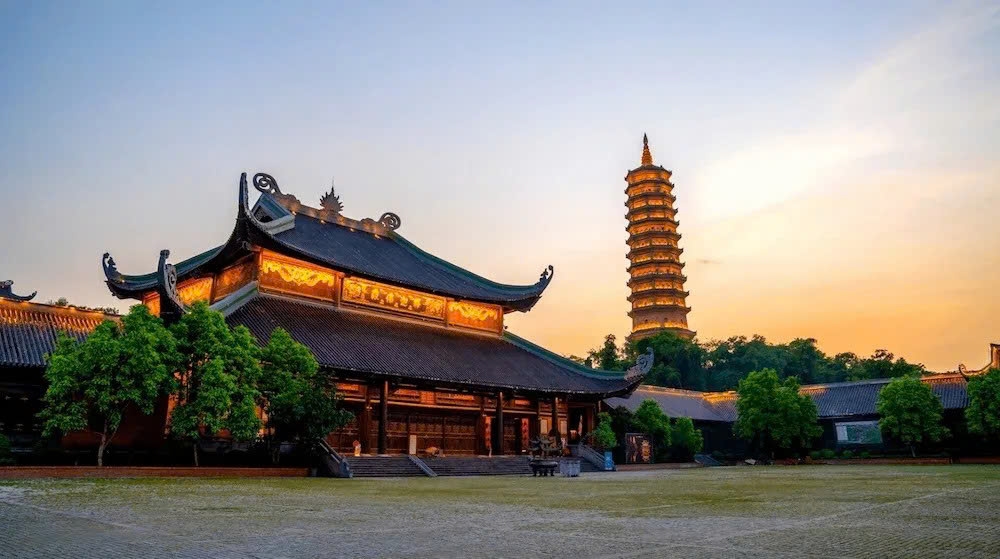
 Bai Dinh Pagoda - Trang An (Ninh Binh province) is a prime example of combining spiritual and ecological tourism
Keywords: Spiritual tourism; Economy; Religion; Beliefs; Heritage.
1. Introduction
With its rich history spanning thousands of years and its vast cultural and religious heritage, Vietnam is presented with a golden opportunity to position itself on the international tourism map through spiritual tourism. However, the question is how to sustainably unlock this “gold mine” in an ‘era of uncertainty” - where economic crises, epidemics and the explosion of digital technology are completely changing tourist behavior. Spiritual tourism is no longer confined to simple pilgrimages; it has evolved into a complex economic ecosystem encompassing wellness retreats, meditation, and heritage preservation. In Vietnam, complexes such as Trang An - Bai Dinh, Tam Chuc and Yen Tu have demonstrated immense appeal, contributing significantly to the local tourism GDP. However, the reality shows that current development still faces many paradoxes: Overexploitation puts pressure on heritage; Commercialization obscures original values; high seasonality means that economic resources are not optimized. In the post-pandemic era and amidst geopolitical uncertainties, people are increasingly turning to spiritual values as a spiritual refuge. This is a crucial time for managers and businesses to shift their strategies.
2. Research results
The 21st century has witnessed a paradox: people are becoming wealthier materially but poorer in terms of inner peace. According to the World Health Organization (WHO), depression and anxiety are becoming the most common illnesses globally. This context has created a huge customer base for spiritual tourism.
Spiritual tourism is tourism associated with religious needs, beliefs, worship, pilgrimage, seeking peace, or experiencing sacred spaces and rituals. This form of tourism exists in many countries: the Camino de Santiago in Spain, Varanasi in India, Mecca in the Islamic world, or meditation centers in Japan, Bhutan, South Korea,...
Contrary to the outdated notion that spiritual tourism is only for the elderly or devout, the current trend is towards younger travelers. Millennials and Gen Z are willing to spend thousands of dollars on a meditation retreat in Bali, a pilgrimage walking tour of Santiago de Compostela (Spain), or a journey to Buddhist sites in India and Nepal.
According to a report by the World Tourism Organization (UNWTO), spiritual and religious tourism is estimated to attract around 300-330 million visitors annually, with global revenue reaching approximately 18 billion USD and a stable growth rate of 5-10% per year. However, if complementary services such as wellness retreats are included, this number could be many times higher.
From a modern economic perspective, spiritual tourism is not just about selling tickets to visit temples and pagodas. It is a complex economic ecosystem that includes:
Core services: Sightseeing, pilgrimage, ritual practice, meditation retreats.
Supporting services: Accommodation (from budget guesthouses to 5-star Zen-style resorts), food (especially vegetarian/macrobiotic cuisine), transportation.
Value chain: Souvenirs, feng shui items, books and magazines, healthcare services (yoga, therapy).
The shift from “passive sightseeing” to “active experiences” has transformed spiritual tourism into a true money-making machine, where visitors come not only to “see” but also to “live” and “absorb”.
2.1. Vietnam - the new sanctuary of spiritual tourism in Asia
In Vietnam, spiritual tourism is closely linked to the religious life of the community: ancestor worship, mother goddess worship, Buddhism, Confucianism, Taoism, folk beliefs and traditional festivals. This forms the foundation for the unique identity of Vietnamese spiritual tourism - a blend of religious and local cultural elements.
Vietnam possesses one of the richest “spiritual resources” in Southeast Asia. With a history spanning thousands of years, the intermingling of the Three Religions (Buddhism, Taoism and Confucianism), along with the Mother Goddess worship system (a representative intangible cultural heritage of humanity) and ancestor worship, every inch of Vietnamese land holds mysterious stories.
Statistics show that Vietnam currently has over 40,000 historical sites and scenic spots, including approximately 3,000 national-level sites, and thousands of festivals taking place throughout the year. This is an invaluable source of raw materials for building a spiritual tourism economy. If in the past, spiritual tourism in Vietnam was spontaneous, small and seasonal, then the past 10 years have witnessed the participation of “leading cranes” - large economic corporations with methodical investment thinking.
The Bai Dinh - Trang An model (Ninh Binh province): A prime example of the combination of spirituality and ecology. This complex has transformed Ninh Binh from an unremarkable stopover point into a northern tourism hub, attracting millions of international visitors.
The Legend of Yen Tu (Quang Ninh province): Tung Lam Group and investors have elevated Yen Tu from merely a place where King Tran Nhan Tong practiced asceticism, to an international-class resort destination with the Legacy Yen Tu project - where 13th-century Tran Dynasty architecture is subtly recreated, catering to affluent customers seeking tranquility.
Sun World Cable Car System: At Fansipan (Lao Cai province) or Ba Den Mountain (Tay Ninh province), the investment in cable car systems and giant Buddha statues has solved the access problem. Ba Den Mountain peak, once only for those with the physical fitness to climb, now welcomes tens of thousands of visitors every day, turning Tay Ninh province into a new tourism phenomenon in the South.
2.2. Economic efficiency and social impact
Spiritual tourism has the potential to create a powerful economic ripple effect. According to economic experts, every dollar of revenue from entrance tickets/cable car rides will generate 3-4 dollars of revenue from other services.
Overcoming seasonality: This is the biggest advantage. While beach tourism is only “hot” in the summer, spiritual tourism in Vietnam is most vibrant in the spring (festival season) and remains stable in the remaining months thanks to summer retreats and meditation tourism in the winter. This helps local revenue flow continuously without interruption.
Stimulating the local economy: In the areas surrounding Huong Pagoda (Hanoi capital) or Ba Chua Xu Temple (An Giang province), an entire micro-economy has formed around the historical sites. Thousands of families thrive thanks to services such as boat rowing, selling offerings, guesthouses, motorbike taxis and food.
Spiritual and Historical Tourism (Con Dao, Quang Tri): Trips to historical sites, visiting the tomb of General Vo Nguyen Giap or other heroic martyrs, have created a stable flow of tourists year-round, contributing to the economic development of these regions that once suffered greatly.
Souvenir and OCOP product market: Spiritual tourists have a mentality of “buying blessings”. Products such as incense, scented candles, Buddha statues or local specialties labeled as “sacred blessings” often have very strong sales.
Spiritual sites are often located in high mountainous, remote areas (Yen Tu, Bai Dinh, Fansipan, Sam Mountain...). The development of tourism in these areas brings financial resources from large cities to rural regions, creating local jobs, contributing to poverty reduction and transforming the face of rural areas much more effectively than many subsidy packages.
The economy is not just about money, but also about national branding. Through spiritual tourism, Vietnam exports its culture, philosophy of life and image of a peaceful country to the world. Events such as the United Nations Vesak Celebration held in Vietnam have positioned the country as a new Buddhist center in the region, attracting the attention of the international community.
2.3. Existing challenges
Despite its enormous potential, the economic landscape of spiritual tourism is not entirely rosy. Rapid development has revealed serious shortcomings that need to be frankly acknowledged.
Commercialization and “Spiritual BOTs”
The terms “spiritual BOT” or “BOT pagodas” have emerged as a sarcastic reference to the commercialization of sacred places. Some projects construct grandiose spiritual structures that lack soul, with the primary purpose being to sell tickets and collect money. The practice of blocking access to historical sites, erecting toll gates, and charging exorbitant prices for services has caused significant resentment. The consequence is an erosion of tourist trust. When spirituality is measured by profit, its sacredness disappears. Visitors may come once out of curiosity about the grandeur, but they will not return due to a lack of spiritual connection.
Superstition and cultural distortion
The line between belief and superstition is very thin. Under economic pressure, many superstitious activities such as fortune-telling, widespread burning of votive papers, offering star offerings at huge costs... have been exploited by profiteers. This not only wastes social resources but also distorts the image of Vietnamese culture in the eyes of international tourists.
Pressuring on the environment and heritage
The massive influx of visitors to spiritual sites in a short period (especially at the beginning of the year) creates tremendous pressure on infrastructure and the environment. The consequences are: Garbage overflows after each festival; Noise and incense smoke cause local air pollution; the encroachment of reinforced concrete structures into the core natural heritage area (as in the controversial case at Ma Pi Leng or the heritage buffer zone).
3. Discussion
Many experts have commented on this issue. Dr. Nguyen Manh Hung, a cultural researcher, stated: “We are exploiting heritage like mining coal, meaning we are maximizing our resources without much thought about regeneration. Spiritual heritage is a non-renewable resource; once its sacredness is lost due to commercialization, it is very difficult to restore it”.
Deputy Minister of Culture, Sports and Tourism Hoang Dao Cuong, Vice Chairman of the Vietnam National Committee for UNESCO at the International Scientific Conference “Protecting and promoting the value of World Heritage: The conference “Community-Based Approaches for Sustainable Development”, held in Hanoi on May 21st, 2025, stated: Not all heritage sites are effectively preserved, and not all localities exploit and promote the value of heritage in a harmonious and sustainable way. In some places, rapid tourism development has led to overcrowding, pollution and erosion of the original value of the heritage. In some places, local people, those living amidst heritage sites, are not truly heard, involved or fairly benefiting from conservation and development policies.
Analyzing the reasons why spiritual tourism has not yet attracted international tourists, Pham Hong Long, Head of the Tourism Department at the University of Social Sciences and Humanities (Vietnam National University, Hanoi) stated that spiritual tourism products in localities still have overlaps and are seasonal. Local coordination and planning in promoting spiritual tourism destinations to visitors are still very weak” (according to the article “Spiritual tourism: Great untapped potential” on New Hanoi online newspaper, March 5th, 2026).
Accordingly, experts also suggest that a strategy for the future is needed: from “tourism” to “transformative journeys”.
For the sustainable development of spiritual tourism, Vietnam needs a “revolution” in management and operational thinking, shifting from quantity to quality, focusing on the following tasks:
Firstly, the Awakened Tourism” model
It’s time to move beyond the “burning incense - praying - donating money to the charity box” phase. The future belongs to in-depth tourism products.
Retreats: Combining meditation, yoga, listening to Dharma talks, and volunteer work. The Plum Village model (of Zen Master Thich Nhat Hanh) is a prime example of this model worldwide.
Macrobiotic cuisine: Developing a chain of high-end vegetarian restaurants, using local organic ingredients, elevating vegetarianism to an art form of enjoyment.
Healing: Combining spiritual tourism with traditional medicine, hot spring baths, and psychological therapy.
Secondly, the digital model and virtual reality experience
Industry 4.0 technologies need to be applied to solve the problem of overload and improve the user experience:
Using VR/AR (Virtual Reality/Augmented Reality) to recreate the history of the temple, allowing visitors to admire national treasures without touching the artifacts.
The multilingual audio guide system helps international visitors gain a deeper understanding of the philosophy behind the architecture, rather than simply admiring it.
Crowd management: Utilizing Big Data to forecast visitor numbers, regulate traffic and implement electronic ticketing to reduce congestion.
Thirdly, transparent planning and management
The state must have a clear legal framework for the socialization of investment in historical sites and the source of donations must be transparent. Donations must be audited and reinvested clearly in the community and for the preservation of historical sites. Strict architectural planning ensures that new buildings harmonize with the natural landscape, avoiding unsightly concrete structures.
Fourthly, training specialized human resources
Personnel for spiritual tourism need not only tourism-related skills (waiter, bartender, room attendant) but also knowledge of culture, history and a specific service attitude (gentle, respectful, knowledgeable about rituals). There is a need for specialized training schools for tour guides focusing on religious culture to accurately convey the message.
4. Conclusion
The spiritual tourism economy, after all, is a “business based on peace”. This is a special economic industry, where “customers” come not to buy an item, but to find themselves. Vietnam is facing a golden opportunity to become the “kitchen of the world” and the “meditation center of humanity”. In order to achieve this, we need to shift from an “exploitation” mindset to a “service” mindset. When businesses and localities do tourism with a pure mind, respecting heritage and nature, the spirit of Vietnamese tourism will be raised and wealth (economic profit) will automatically come as an inevitable and sustainable consequence. Transforming heritage into assets is an art. And that art requires “artists” with ethics, intelligence, and a long-term vision.
* Logistics Academy
References
1. Ministry of Culture, Sports and Tourism (2020), Vietnam Tourism Development Strategy to 2030.
2. Nguyen Van Tuan (2020). Management of spiritual tourism destinations in Vietnam: Current situation and solutions. Vietnam Tourism Magazine.
3. Pham Trung Luong (2018). Developing unique tourism products in the Red River Delta region: An approach from the perspective of spiritual and cultural heritage. Social Sciences Publishing House.
4. Tran Thuy Anh (2015). Spiritual tourism: Theoretical and practical issues. Vietnam Education Publishing House.
