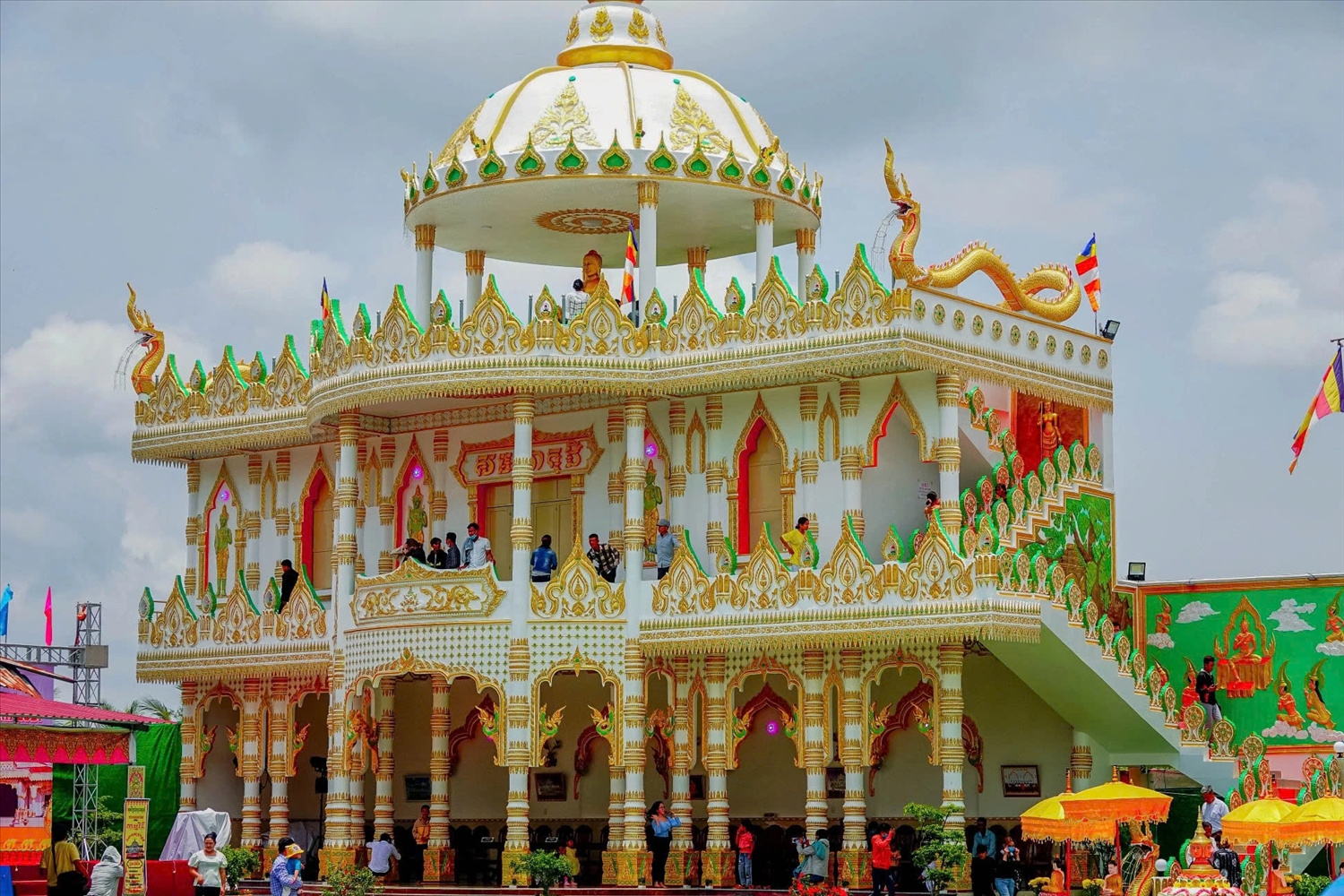
 Peam Buol Thmay pagoda in Soc Trang Ward, Can Tho city
Keywords: Cultural values; Theravada Buddhism; Khmer people in the Southern Vietnam.
1. Introduction
Throughout its two millennia of introduction and development in Vietnam, Buddhism has become a major religion with a profound influence on the general public. It has consistently operated in a spirit of accompanying the nation, striving toward the shared goal of a “prosperous people, strong country and a democratic, equitable and civilized society”. Various religious organizations currently exist throughout Vietnam, with many sects making significant contributions to the causes of the Party, the State and the Vietnam Buddhist Sangha as a whole including Southern Theravada Buddhism. Southern Theravada Buddhism has flourished and maintains a deep, close bond with the Khmer people of the Southern region. Theravada Buddhism has also created a valuable system of tangible and intangible cultural heritage that warrants study, preservation and promotion. It is evident that, with the guiding principle of: By unifying will and action, as well as leadership and organization; at the same time respecting and upholding sectarian traditions, along with the Dharma-aligned practices and skillful means of cultivation”, Southern Theravada Buddhism possesses the necessary foundation to grow stronger and make even greater contributions to Vietnam’s national cause.
2. The history of Theravada Buddhism
Theravada Buddhism was introduced to Vietnam via maritime routes by Indian missionaries. The path of transmission extended from India through Myanmar, Thailand, and Cambodia, specifically the Mekong River region before entering the provinces of the Mekong Delta in southern Vietnam, such as present-day Vinh Long and neighboring areas. This region is also home to a large Khmer population. Theravada Buddhism characterized by its simplicity and approachability gradually took root among the local Khmer people, becoming deeply intertwined with their lives. Widely embraced by the community, it has effectively become the signature faith of the Khmer people, often referred to as “Khmer Theravada Buddhism”. Evidence of this is found in the many ancient statues preserved to this day, demonstrating how Buddhism entered the provinces of Southern Vietnam via the Mekong Delta.
Furthermore, historical records indicate that as early as the 4th century, various pagodas such as Tropangveng and Ta Lon (in Vinh Long province) were constructed, alongside hundreds of others. Thus, it can be broadly stated that Theravada Buddhism established a presence in the Mekong Delta at a very early stage, inextricably linked to the survival and development of the Khmer people. This region is also a place where Theravada Buddhism has flourished nationwide. Theravada Buddhism is considered a form of original Buddhism due to its strict monastic code and the practice of chanting and reciting texts primarily based on the five early collections of scriptures.
3. The fine cultural values of Khmer Theravada Buddhism
Beliefs and doctrines
Khmer Theravada Buddhism is very close to Theravada Buddhism, carrying within it pure and practical cultural and religious values for the peaceful and peaceful life of people. This sect does not absolutize the role of mystical supernatural beliefs, which can easily lead people to mistakenly believe in the otherworldly power of deism, giving rise to superstitious variations. However, as Vietnamese culture is influenced by Indian and Chinese polytheistic beliefs and given that shifting social realities often drive people to seek spiritual solace in religion, some individuals have adopted extreme or superstitious attitudes, viewing the Buddha as an omnipotent deity capable of altering their lives by dictating fortune and misfortune, good and evil. This tendency has detracted from the authentic cultural beauty of Buddhism.
The flourishing of Theravada Buddhism within the Khmer community and across the Southern region more broadly stands as a testament to its enduring vitality and the genuine ideological value it holds for the Vietnamese people, serving as a bridge for conveying the teachings of Shakyamuni Buddha (Duc Phat Thich Ca). This enables Buddhist monks and lay followers to realize the truth within real life and recognize that the true purpose of human existence is peace and happiness, while also discovering the correct path to liberation from delusion, ignorance and the afflictions of hatred and greed.
Theravada Buddhism specifically follows the teachings of Theravada Buddhism as expressed through the teachings of the Four Noble Truths and the Noble Eightfold Path. Among them, “the most prominent is the Four Foundations of Mindfulness meditation method, which returns to illuminate one’s own body and mind in the process of interacting with the outside world, here and now, like a clear mirror and faithfully reflecting all things, full of characteristics, inside and outside in a comprehensive and unbiased way”. Today, Theravada Buddhism through the preservation and dissemination of its original teachings makes invaluable contributions to Vietnamese Buddhism and to the ethical, cultural way of life not only of monks but also of the Khmer community and the general public across the country, as they pursue a path of spiritual practice leading to enlightenment and inner peace.
Attire of Theravada Buddhism
The attire of Khmer Theravada monks embodies the culture of Theravada Buddhism. Modern robes are designed to resemble a patchwork of rice fields featuring a grid of horizontal and vertical segments of varying lengths, in order to suit the individual physique of each monk. Specifically, the robes are categorized into 5-strip, 7-strip, 9-strip and 11-strip versions, depending on the wearer’s height. In terms of color, there are mainly two colors: opaque yellow and saffron yellow. When going out, the monks' clothes must not expose their shoulders and arms, but are covered by the hem of their cassock and the manner in which they wear their clothes. Besides wearing robes, Theravada Buddhist monks also carry jars and bowls. These are considered emblematic items and essential components of the monastic life. The robes serve to cover the body, while the alms bowl is the simplest, most unadorned vessel used by monastics for alms-gathering.
Today, the sight of Theravada Buddhist monks from the Khmer community in Southern Vietnam, clad in their saffron robes and adhering to traditional monastic practices evokes an image that is at once familiar, simple and transcendent, much like the life of the Buddha himself in ancient times. Its humble, earth-like golden hue evokes a sense of serenity and nobility, helping to soothe the soul, ward off the cravings of greed, hatred and delusion and foster a more compassionate and benevolent way of life. Theravada monks wear robes, beg for alms with a vase - bowl just to maintain their body’s life, daily giving up money and material things to cultivate their minds to follow Buddhism, a spirit of guidance that shows the core cultural nature of Buddhism is all for the peaceful life of humanity. Due to the evolving nature of modern social life, the practice of alms-mendicancy today may often appear to be merely a matter of outward form; nevertheless, it plays a significant role in affirming the monk’s wholehearted commitment to following the Buddha's teachings, preserving the true Dharma and bringing peace and serenity to the world.
Ceremony
Theravada Buddhist rituals have endured and flourished in close association with Khmer culture. Major ceremonies such as Vesak (Buddha’s Birthday), ordination, the beginning and end of the rains retreat and the robe-offering ceremony are conducted with great solemnity. Furthermore, Theravada Buddhist rites are integral to various Khmer festivals and cultural events, including ancestral worship ceremonies, boat races, the Moon-worshipping festival and sand-mound building rituals… This demonstrates the intertwining and mutual integration of Buddhist culture and the culture of the Southern region’s inhabitants. Consequently, the Khmer people of Southern Vietnam hold Theravada Buddhism in high regard, embracing it as their own faith while preserving and passing on its cultural beauty to future generations. Theravada Buddhism emphasizes a simple, unpretentious lifestyle and places little importance on elaborate rituals; however, this school attaches great significance to the observance of precepts and specific practices—such as showing respect and exchanging greetings based on seniority (years of ordination) without the overly formal reception styles of the feudal era and adhering to dietary guidelines that include abstaining from eating after noon and following the “threefold purity” rule regarding meat consumption. hanting: Performed without the use of bells or wooden fish; simple to recite and easy to listen to. No melodic or drawn-out chanting styles. Veneration and worship are directed solely toward Gautama Buddha (the Supreme Buddha). Offerings are limited to incense and flowers as a sign of reverence; no food offerings are made. There are no rituals to appease baleful stars, no elaborate sacrificial ceremonies, and no fortune-telling or selection of auspicious days. When going on alms rounds, no money is accepted, only cooked food voluntarily offered by donors; one never solicits alms or uses persuasive speech to induce others to give”.
egarding the daily rituals at Khmer Theravada pagodas, there are two sessions of chanting and paying homage to the Triple Gem - one in the morning and one in the afternoon. Contemporary Theravada offering rituals are characterized by a proactive approach; they are conducted with solemnity and conciseness, upholding the sect’s cultural traditions while remaining compatible with the lifestyles of the people and modern society.
The aesthetic architecture of Khmer Theravada Buddhist pagodas
Most Khmer settlements in Southern Vietnam, whether a village (soc) or a smaller hamlet (phum), several of which make up a soc, featuring a pagoda, serving as a vital spiritual and cultural space for the local community.
The pagoda’s architecture represents a unique and impressive tangible cultural heritage of Theravada Buddhism, with its most distinctive features concentrated in the main sanctuary. The pagoda complex is expansive; beyond the main sanctuary, it encompasses various areas such as the entrance gate, the sala (pavilion), the stupa, the cremation pavilion and residential quarters for monks, nuns and lay Buddhists… The architectural designs of many pagodas are diverse, eschewing fixed templates, and are regarded as exemplary works of art thanks to their intricate sculptural craftsmanship and meticulous decorative details. Pagoda gates are often designed on a grand scale featuring massive towers and intricate decorative patterns, as seen at Phuon Pagoda, while the railings flanking the gate are carved with seven-headed serpents, echoing the style of Angkor temple gateways. Some pagodas feature a depiction of Rahu on the gate, flanked by images of Naga serpents or carvings of people racing Ngo boats - a Cham cultural tradition. Beyond the gate lies the main hall, considered the most important space within the pagoda complex. ccording to the beliefs of the Khmer people in Southern Vietnam, the Buddha once faced East to deliver sentient beings from suffering; consequently, the main hall of the pagoda is constructed to face East. Inside the hall, the central position is occupied by the altar of Shakyamuni Buddha, with the base adorned by a lotus pedestal, a symbol of Buddhism shared by humanity. power and wisdom, as well as His virtuous compassion. The walls of the main sanctuary are adorned with paintings depicting the life of the Buddha from his birth to his enlightenment, while the ceiling often features scenes such as battles between celestial maidens and demons, celestial beings performing rituals, and Apsaras offering flowers; these details are rendered in striking, vibrant colors. In general, the architecture of contemporary Khmer Theravada Buddhist pagodas is simple yet deeply imbued with the distinctive cultural and artistic identity of the Theravada tradition as seen in pagodas such as Ky Vien and Buu Thang (Ho Chi Minh city), Tam Bao (Da Nang city), Thien Lam and Huyen Khong (Hue city), Phuoc Hai (Vung Tau), Thien Quang (Long Thanh), and Buu Duc (Dong Nai city). Notably, the Theravada tradition has also established the Thich Ca Phat Dai (Shakyamuni Buddha Platform), a renowned and impressively scaled landmark”.
The Southern Khmer people hold a deeply profound devotion to Theravada Buddhism, a faith clearly reflected in both their beliefs and daily lives. Today, Khmer boys around the age of 12 or 13 are typically sent to the pagoda to practice monastic life for a period of time ranging from a short stint to a lifelong commitment. The pagoda’s doors always remain open to welcome Khmer people for study and spiritual cultivation. The doors of the pagoda are always open to welcome Khmer people for study and spiritual cultivation. According to the local community, they engage in this practice to show reverence to the Buddha, fulfill their filial duties toward their grandparents and parents, acquiring the moral values and knowledge needed to navigate life in the wider world. Here, individuals who have spent time practicing monastic life and subsequently returned to lay life may still come back to continue participating in the pagoda’s religious rituals and practices. For the Khmer people, men who have spent time living in the temple are held in higher regard and are better positioned to pursue their life goals and aspirations with greater ease and success.
In the Khmer Theravada Buddhist tradition, unlike the custom requiring men to enter the pagoda for monastic research, women do not observe this practice. Nevertheless, through family traditions and the lifestyles of the men in their households, Khmer women are deeply influenced, shaped and educated by Buddhist philosophy, doctrine and ethics. This is reflected in traditional Khmer rituals deeply imbued with Theravada Buddhist beliefs such as the Chol Chnam Thmay festival (akin to the Lunar New Year), ceremonies involving the offering of robes and other items to the clergy and the offering of meals to monks, all of which demonstrate the merit-making and charitable spirit of the Khmer people,... At ceremonies and festivals of pagodas and Khmer people, we see many interwoven Buddhist rituals such as the teachings of monks, everyone entering the pagoda, reading scriptures, releasing lanterns,...
Theravada Buddhist temples and monks hold a position of great significance and exert a profound influence on the mindset and daily lives of the Khmer people. These temples serve not only as places of religious practice for monks and the vast majority of the Khmer community but also as unique hubs for their regular cultural and spiritual activities. The pagoda also serves as a place for imparting knowledge and life philosophies to children, a repository for significant artifacts of the Khmer people, and a site for honoring deceased family members. The local people deeply revere and cherish the monk's teachings. The daily lives of the Khmer community are intertwined with Buddhist beliefs; Theravada Buddhism is deeply ingrained in the mindset, sentiments and way of life of the Khmer people in Southern Vietnam.
4. Conclusion
The profound and enduring influence of Theravada Buddhism in the Southern Delta region has permeated the local Khmer community, shaping a unique cultural identity. It can be said that Theravada Buddhism is truly the major religion of the Khmer people; indeed, to speak of the Khmer community is to speak of a population consisting overwhelmingly of Theravada Buddhist monks, nuns and lay followers. Theravada Buddhist culture, alongside the Khmer people, embodies a traditional culture that is resilient against the influence, distortion or erosion caused by external factors. Conversely, the local spiritual culture and way of life demonstrate enduring vitality and mutual interdependence, while powerfully radiating their values to the nation’s broader Buddhist landscape. Therefore, in today’s modern life, exploring, preserving and promoting religious and spiritual cultural values holds great significance for the development of the Vietnamese people and the nation.
* Academy of Journalism and Communication - Hue City Campus
References
1. Chau Dat Quang, Du Ky, Nguyen Van Sau, An Initial research of Vietnamese Theravada Buddhism, p.14, Religious Publishing House, 2007.
2. Charter of the Vietnam Buddhist Sangha, 6th Amendment, Religious Publishing House, Hanoi, 2018.
3. Thien Minh, Brief history of Vietnamese Theravada Buddhism, Hong Duc Publishing House, 2017.
4. Le Huong, People of Khmer Origin in Vietnam, Van Dan Publishing House, 1969.
