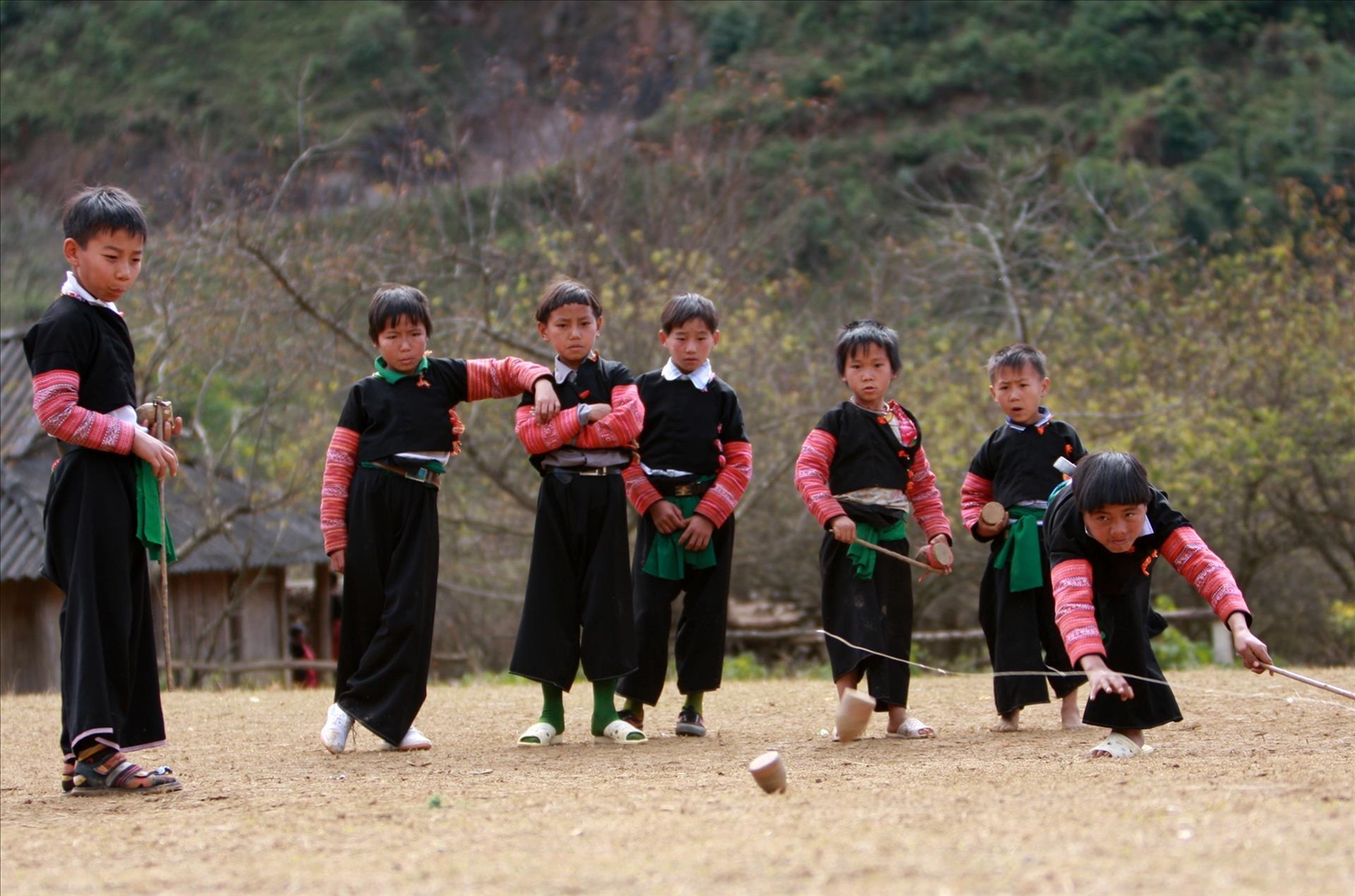
 Mong ethnic children in Van Ho commune (Son La province) play the spinning top game during Independence Day
The Mong people in Vietnam number over 1.5 million and are concentrated in the northern mountainous provinces. In their cultural life, alongside the traditional ethnic festival held about a month before the Lunar New Year, Independence Day is considered one of the year’s major celebrations.
According to many elders, ever since President Ho Chi Minh read the Declaration of Independence on September 2nd, 1945, the Hmong people have regarded this event as a milestone marking the beginning of a new life; they hold the day in special esteem, embracing its full significance as an occasion for reunion, festive celebration and connecting with their roots.
As a community with a long history of migration that cherishes the spirit of freedom and the aspiration for autonomy and having endured centuries of life in harsh, high-mountain environments alongside layers of colonial and feudal oppression, the Mong people deeply appreciate the value of independence. For them, it marked the beginning of a new life, one of peace and freedom, where they could receive an education, take charge of their own destiny, and enjoy opportunities for development on equal footing with other ethnic groups. Consequently, the Mong people celebrate National Day with deep gratitude and pride, a commemoration that has gradually evolved into what is known as the “Independence festival”.
Festival (Tet) is a time for a jubilant and spirited atmosphere. In regions with large Hmong populations, the holiday is a unique cultural festival featuring bustling markets, the melodious sounds of the panpipe (khen), courtship ball-throwing (pao) games, and a succession of folk games that continue for days on end.
One of the most jubilant places to celebrate Independence Day is Son La province. In Son La province, the Mong ethnic group accounts for about 15% of the population. During the Independence Day, localities organize very exciting cultural and sports activities. The most fun is in Moc Chau ward - a famous tourist destination. People from even the most remote villages eagerly descended from the mountains, flocking to the festival grounds. Everyone was dressed in beautiful traditional attire, beaming with radiant smiles and exchanging warm greetings; they played the panpipe (khen) and sang and danced amidst a sea of red flags with yellow stars, expressing their joy and creating a remarkably vibrant cultural tableau.
The enduring vitality of the Independence Festival is also sustained by the Mong people's strong sense of community cohesion. Over the past two decades, the Mong Independence festival in Moc Chau ward has attracted visitors from the Viet Bac region, Thanh Hoa province, Nghe An province and even Laos, who come to socialize and forge friendships. People from the Thai, Muong, Kinh, Dao and Kho-mu ethnic groups in neighboring villages also flock here to celebrate the holiday together. Over time, Independence Day has evolved into a shared festival, deeply imbued with the spirit of solidarity among the highland ethnic communities. For the younger generation, it is also a celebration of love, an occasion where the melodies of the panpipe (khen) and the tossing of balls (pao) serve as bridges for new romances to blossom.
Meanwhile, on this day in Thanh Hoa province, families slaughter buffaloes, pigs and chickens to offer as sacrifices to President Ho Chi Minh and their ancestors. In many villages, residents also pool food to host celebratory feasts, accompanied by singing and dancing that strengthen community solidarity and bonds, said Mr. Lau Minh Po from Pu Nhi Commune.
Across the Mong villages today, deeply moving songs still resound: “Here, amidst the mountain forests and high passes, the Mong people sing; beneath the shining stars, they offer gratitude to the Party. After generations of a life of poverty and hardship, the Mong people now see a bright future. We cherish the Party’s guidance, which has brought us prosperity and warmth; no longer must we burn fields and homes only to wander in lifelong destitution. From this day forward, the Mong people live united, our villages filled with the joyful sounds of the panpipe (khen), forever grateful to the Party”, so goes the song “The Mong People’s Gratitude to the Party” by composer Thanh Phuc. That melody embodies the heartfelt sentiments of a people who always turn their hearts toward the Party and Uncle Ho whenever the nation celebrates the blossoming of independence and the fruition of freedom.
Mong culture is a distinctive highlight of the series of cultural and artistic activities organized by localities to mark the 81st anniversary of National Day (September 2nd). In Moc Chau ward, Son La province, the event features a mass cloth ball (pao) throwing performance involving approximately 200-250 participants, alongside activities such as Mong rice cake pounding (giay cake), shuttlecock kicking, stick wrestling, the “dragon brooding its eggs” game and various other folk games… In Lai Chau province, the cultural space of the Hmong people shines alongside those of the Thai, Dao and Kho-mu ethnic groups through demonstrations of traditional crafts, culinary experiences, folk games and cultural activities. Meanwhile, Dien Bien province is bustling with the International Folk Dance Festival, featuring spectacular street carnival performances…
|
