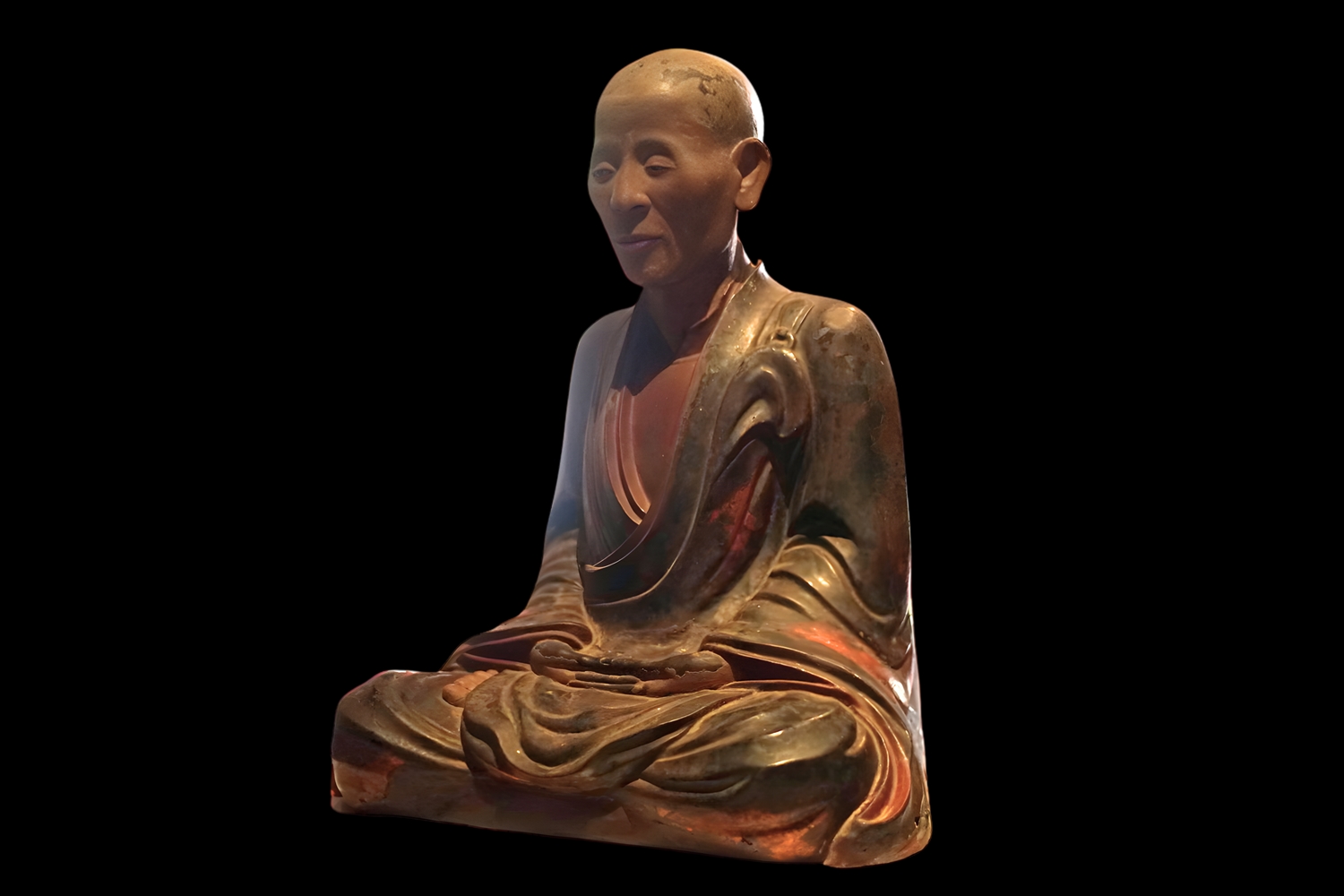
 Wooden statue of the Founding Patriarch, lacquered in red and gilded with gold, dating to the 19th century; housed at the Ho Chi Minh city Museum of History
“Patience” signifies endurance and forbearance and is also understood as patient endurance of humiliation (nhan nhuc). The humiliation (nhuc) refers to submission or the shame associated with lowliness. Patient endurance of humiliation (Nhan nhuc) is considered synonymous with patience, steadfastness, perseverance and the determined, enduring capacity to withstand hardship.
In Buddhism, the concept of patience or kṣānti (Sanskrit)/khanti (Pali) is elevated to the highest significance. It refers to maintaining a tranquil mind in the face of insults or harm. This virtue is discussed extensively throughout Buddhist scriptures.
The Vimalakirti Sutra (Kinh Duy Ma Cat) speaks of three types of patience, endurance and equanimity regarding body, speech and mind: enduring torment, illness and extremes of heat and cold (body); refraining from harsh words when humiliated or mistreated (speech); and harboring no hatred or resentment within (mind).
The Yogācārabhūmi-śāstra outlines three characteristics of patience: not becoming angry, not harboring enmity, and not holding ill will in one’s heart. The Saṃdhinirmocana-sūtra distinguishes three meanings of patience: not resenting those who harm us (patience regarding harm), enduring all difficulties, suffering and torment (patience regarding suffering) and clearly perceiving the true nature of phenomena (patience regarding the nature of reality).
The Mahāprajñāpāramitā-śāstra distinguishes between two types of patience: accepting without anger and while maintaining love for all those who cause one harm (patience toward sentient beings); and accepting the principle that all phenomena are neither arising nor ceasing, thereby keeping the mind unperturbed.
The Bodhisattva-bhūmi Sutra (Kinh Bo - Tat Dia Tri) delineates two types of patience: enduring physical sufferings such as illness and torment (patience in enduring suffering), and contemplating the emptiness and illusory nature of all phenomena, thereby maintaining a mind of serenity and ease (patience in contemplating the nature of phenomena).
The Dharma-samgraha (Kinh Phap Tap) clearly outlines the meaning of patience, as well as the six powers possessed by a practitioner of patience:
Remaining calm in the face of verbal abuse, harboring no resentment or animosity.
Remaining calm while being beaten and tormented.
Remaining calm in the face of oppression and malicious schemes, without any desire for revenge.
Remaining calm in the face of others’ anger.
Remaining at peace amidst gain and loss, praise and blame, honor and disgrace, suffering and happiness.
Untainted by afflictions.
The Ekottarika-āgama (Kinh Tang Nhat A-ham) enumerates eight types of power, among which the power of a śramaṇa is patience. The perfection of patience is absolute wisdom, the realization of emptiness and the nature of non-arising. Forbearance is a spiritual practice and a virtue of the Bodhisattva who has attained the perfection (paramita); it transcends the distinction between self and other, manifesting solely as an expression of great compassion and the profound vow to liberate all sentient beings.
It is difficult to recount all the examples of forbearance found in Buddhist scriptures. The Jataka tales, for instance, narrate numerous stories illustrating the patience of the Buddha in his past lives such as the time he was a prince who endured having his eyes gouged out, his flesh carved away and his limbs severed without a word of complaint, all to transform the evildoer.
The Lotus Sutra tells the story of Bodhisattva Never Disparaging, who would bow in reverence and offer praise to everyone he met, regardless of being mocked or driven away, eventually attaining unimpeded wisdom and successfully guiding all beings.
The Samyukta Agama (Kinh Tap A-ham), Majjhima Nikaya and Theragatha all recount the story of the Venerable Punna asking the Buddha for permission to go and preach the Dhamma in the land of Sronaparanta, a region inhabited by people who were still primitive and fierce. The Venerable One was willing to endure verbal abuse, stoning, and beatings and even to sacrifice his life to the sword. Ultimately, he succeeded in transforming the people of that land.
Closest to us is the example of forbearance set by Bodhisattva Thich Quang Duc, who immolated himself for the sake of the Dharma; he remained serene as the flames engulfed him without a single movement or word of complaint against the Ngo Dinh Diem administration, which discriminated against Buddhism.
The practice of forbearance has long been observed across the globe. Forbearance exercised with positive, virtuous intent cannot be dismissed as cowardice or passivity. In Buddhism, as previously noted, forbearance is an expression of wisdom and compassion, as well as a testament to the stages of liberation that lead to the ultimate goal of Nirvana (Niet ban)./.
