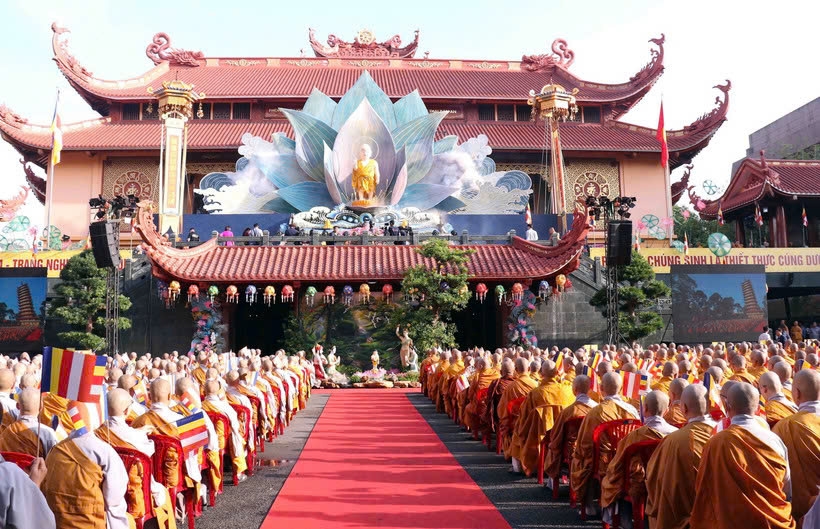
 The spiritual values of Buddhism are an important resource for strengthening national unity and building a peaceful and prosperous country
Keywords: Buddhism; Defending the Fatherland; Vietnam Buddhist Church; Walking alongside the nation.
1. Introduction
Currently, there are approximately 20 million Buddhists nationwide, with tens of millions of people having faith in and reverence for Buddhism. Within the total population, the large proportion of the workforce with Buddhist beliefs provides a favorable condition for leveraging the human and material resources of believers in the construction and development of the country. From its inception, the Vietnam Buddhist Sangha (VBS) has clearly defined itself as an organization that inherits and needs to quickly adapt to and strongly promote the tradition of social, charitable and humanitarian activities of Vietnamese Buddhism. Leveraging human and material resources; promoting the value of Buddhist cultural heritage, contributes to the building and development of the country.
2. Promoting resources and materials
Buddhism participates in socialization activities in health, education, social protection, vocational training and charity affairs
Buddhism has helped alleviate the burden on society by joining hands to help those in difficult circumstances overcome challenges and stabilize their lives through social welfare affairs such as: Free medical examinations and treatment are provided at temples and monasteries nationwide, along with free vocational training and job placement assistance for thousands of students. The Church has: over 165 Tue Tinh clinics, more than 600 traditional medicine treatment rooms, over 10 Western medicine clinics and combined Eastern and Western medicine clinics operating effectively, providing free examinations and medication to tens of thousands of patients with expenses reaching tens of billions of VND; over 1,000 charity classes; 36 facilities for daycare, orphanage and care for children with disabilities,... with over 20,000 children; over 20 nursing homes provide care for more than 1,000 elderly people; approximately 10 free vocational schools have trained and placed thousands of students in jobs.
The Church is always present and provides timely relief to people affected by natural disasters and floods and actively participates in supporting the poverty alleviation movement and caring for those who have rendered meritorious service to the country. This includes distributing charitable gifts, building bridges and roads, providing wheelchairs, donating blood, contributing to scholarship funds and supporting soldiers defending the Hoang Sa and Truong Sa islands of the Fatherland… In areas recently affected by natural disasters such as storms, floods, epidemics and environmental pollution, causing severe economic damage, Buddhist organizations led by monks and nuns have visited, encouraged and provided gifts to affected families to help them overcome difficulties and quickly stabilize their lives.
Social charity work is a positive and pure ethical Buddhist activity that reflects the compassionate spirit of Buddhism and alleviates suffering, it is one of the central tasks of the Buddhist Sangha. Therefore, all work related to social charity is given deep attention by the Sangha. The Venerable monks, nuns, Buddhist followers and member pagodas and monasteries all regularly, continuously, and promptly carry out charitable affairs. Beyond material gifts, the compassionate spirit of Buddhism also brings noble spiritual values to people, such as giving empathy, love, pure faith and compassionate energy.
Buddhism participates in environmental protection and climate change response
The planet’s environment is changing, with numerous natural disasters, global warming and environmental pollution occurring continuously in recent years, hundreds of people have lost their lives due to storms, floods, landslides and industrial waste destroying ecosystems on a large scale. Vietnam is one of the countries predicted to be most severely affected by environmental changes and climate change. Contributing alongside the State, social organizations have demonstrated their responsibility, and the Vietnam Buddhist Sangha is one of the organizations actively responding to and participating in environmental protection and climate change adaptation. Propagating and explaining the importance of limiting the killing of animals, refraining from hunting wild animals… avoiding deforestation while increasing reforestation and greening barren hills and empty land.
The Buddhist theory of dependent origination posits that life is a reciprocal relationship between all species and things; nature is an integral part of the human body, and humans cannot exist without an environment. If the environment is severely polluted, the physical body of humans or human life itself, will be destroyed. Protecting the environment is also protecting human life. Buddhism respects the lives of all living beings and encourages maintaining friendly relationships and living in harmony with nature and the universe as a condition for protecting life. Faced with the current problem of environmental degradation, the engaged role of Buddhism in environmental protection is primarily demonstrated by encouraging Buddhist followers to practice vegetarianism. Vegetarianism, in addition to protecting the health of the vegetarians themselves, is also the most effective way to protect the environment; and by organizing meditation retreats with rich and diverse content, in which environmental protection is emphasized. Simultaneously, education should raise awareness of the close relationship between humans and nature and the environment, especially guiding people to practice a way of life based on Buddhist ethics, which is about goodness and respect for the lives of all beings; encouraging believers to live in harmony with the environment, immerse themselves in nature, and minimize direct impacts on the environment. Avoiding the indiscriminate exploitation of natural resources for personal gain, which leads to numerous natural disasters and causes suffering for humanity.
3. Promoting the value of cultural heritage
Promoting the humanistic values of Buddhist philosophy and worldview, Buddhism is a religion of practice, of education and of guiding people towards goodness
Today’s society faces many contemporary problems such as school violence, and the moral decline of a segment of young people who live pragmatically, act impulsively, show disrespect to adults, parents and teachers, and lack compassion for others, leading to an increase in social ills in recent years. Not remaining indifferent to these phenomena, the Vietnam Buddhist Church has, over the years, undertaken practical activities to contribute to reducing moral decay among young people. From the central Church to local temples, monasteries, and meditation centers, many retreats for young people, youth summer camps and Buddhist activities have been organized. Through this, we educate children to understand etiquette, right and wrong, filial piety, karma, sin and merit, gratitude, repaying kindness, showing gratitude to parents and teachers, etc., so that they can have a healthy and civilized lifestyle, be grateful to their ancestors and grandparents, and be responsible to the community.
Promoting the cultural heritage, scenic spots, and landmarks of Vietnamese Buddhism
Buddhism was introduced to Vietnam very early and was quickly localized. Throughout its history, Buddhism has left the nation with many valuable and distinctive material and spiritual cultural legacies. This heritage site encompasses a system of spaces, temple and pagoda architecture, sculptures, Buddhist paintings, horizontal plaques, couplets, religious artifacts, musical instruments, and other values related to Buddhist thought, ethics, culture, music and various rituals. Throughout history, Buddhist culture, with its characteristics of humility, simplicity, harmony and balance has been both suitable for the spiritual space and organically integrated with the surrounding landscape. Every architectural element, every statue, painting, and religious artifact in the temples is a masterpiece of art. Vietnamese Buddhist cultural heritage has made a worthy contribution to the rich and unique cultural treasure of the nation.
4. Promoting spiritual values in building national unity
The Church is a member of the national unity bloc. For over 40 years, in the process of building and developing the organization, the Vietnam Buddhist Church has directed the Church at all levels to guide Vietnamese monks, nuns and Buddhists in activities of “serving religion and loving the country”. In their sermons and religious activities, the clergy and monks of the Church have consistently encouraged Buddhist followers to effectively implement the Party's guidelines and policies, and the State’s laws and regulations regarding social security and order and to actively participate in the nationwide movement for building a cultured life in residential areas, now known as the nationwide movement for building new rural areas and civilized urban areas.
Inheriting the tradition of unity and harmony of Buddhism from the time of the Buddha, he taught the four assemblies of practitioners to practice together like water and milk. Continuing the tradition of Vietnamese Buddhism always accompanying the nation, the Vietnam Buddhist Sangha, through its provincial and city Buddhist associations nationwide, regularly encourages monks, nuns, and Buddhists in their localities to successfully complete movements that benefit the country and its people, protect the homeland, protect the environment, build a civilized and cultured lifestyle in their residential areas and participate in social organizations and activities for the benefit of the country and the nation. Many religious leaders and clergy members are trusted by the people and elected as representatives to the National Assembly and People’s Councils at all levels; the special role of monks and nuns in mobilizing the masses to build cultural, economic, and social life in residential areas is increasingly enhanced. Buddhist monks and nuns continue to promote the spread of Buddhism in remote areas, border regions, and islands, so that the spirit of Buddhism continues to spread in the frontiers of the Fatherland.
5. Conclusion
By the above actions, the Vietnam Buddhist Sangha has actively and effectively contributed to the cause of building and developing the country. In the coming period, based on the Church’s inherent strength and with the support of relevant State agencies, the Vietnam Buddhist Church will certainly make more effective and practical contributions to the building and development of a more civilized, prosperous and beautiful country.
References
1. Nguyen Lang. (1992). A Historical Essay on Vietnamese Buddhism. Literature Publishing House - Hanoi Book Distribution Company. Volume II.
2. Vietnam Academy of Social Sciences. (1998). Complete Chronicle of Dai Viet. Volume II. Social Sciences Publishing House. Hanoi.
3. Nam Trieu Cong Nghiep Dien Chi (2001). Ngo Duc Tho introduced, translated and annotated it as Trinh Nguyen Dien Chi, Volume I, published by the Department of Culture and Information, Hue. Cited from History of Buddhism in Hue, Thich Hai An, Ha Xuan Liem. Ho Chi Minh City Publishing House.
4. Dai Nam Thuc Luc Chinh Bien (1963). First Chronicle III. Hanoi Historical Publishing House.
