Keywords: Buddhism; Defending the Fatherland; Vietnam Buddhist Sangha; Walking alongside the nation.
1. Introduction
Currently, the country is home to approximately 20 million Buddhists, alongside tens of millions of people who hold faith in and revere Buddhism. The fact that a significant portion of the workforce adheres to Buddhism creates a favorable environment for mobilizing the human and material resources of the faithful toward the cause of national construction and development. Since its inception, the Vietnam Buddhist Sangha has clearly defined itself as a successor organization, committed to rapidly aligning its operations and vigorously upholding the Vietnamese Buddhist tradition of social, charitable and humanitarian activities. It seeks to mobilize human and material resources and leverage Buddhist cultural heritage to contribute to national construction and development.
2. Promoting material resources
Buddhism participates in socialized activities regarding healthcare, education, social welfare, vocational training and charitable work
Buddhism has helped alleviate the burden on society by joining hands to assist those facing significant hardships, helping them overcome their difficulties and stabilize their lives through social welfare initiatives such as providing free medical care at pagodas and monasteries nationwide, as well as offering free vocational training and job placement services to thousands of trainees. The Church operates over 165 Tue Tinh clinics, more than 600 traditional medicine clinics and over 10 facilities offering Western medicine or integrated Eastern-Western medical care, all functioning effectively to provide free examinations and medication to tens of thousands of patients at a cost of tens of billions of dong. Additionally, it runs over 1,000 charity classes; 36 facilities providing day-care, orphan care, and support for children with disabilities serving more than 20,000 children; and over 20 nursing homes caring for more than 1,000 elderly people. It also maintains approximately 10 free vocational training schools that have trained thousands of students and helped them secure employment.
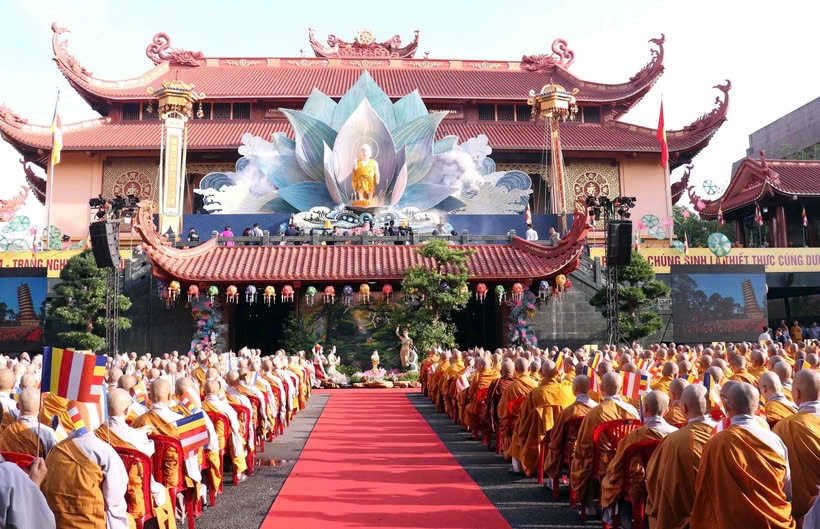 The spiritual values of Buddhism serve as a vital resource for strengthening the great national unity and building a peaceful, prosperous country
The Church has always been present and timely in providing relief to those affected by natural disasters and floods, and actively participates in supporting the poverty alleviation movement and caring for those who have rendered meritorious service to the country. Distributing charity gifts, building bridges and roads, providing wheelchairs, donating blood, supporting education promotion funds and backing the soldiers standing guard over the nation’s waters in the Paracel and Spratly archipelagos... In areas recently struck by natural disasters such as storms and floods as well as disease outbreaks and environmental pollution that caused severe economic damage, Buddhist groups led by monks and nuns have visited and offered encouragement and gifts to affected families, helping them overcome their hardships and stabilize their lives.
Social charity work consists of positive and pure Buddhist activities that embody the spirit of compassion and the alleviation of suffering inherent in Buddhism; it is one of the core missions of the Sangha. Consequently, the Sangha pays deep attention to social charity activities. Venerable monks and nuns, lay Buddhists and member pagodas and monasteries consistently and promptly carry out charitable work. Beyond material gifts, the Buddhist spirit of compassion also bestows noble spiritual values upon people offering empathy, love, pure faith, and a source of compassionate energy.
Buddhism’s participation in environmental protection and response to climate change
The planet’s environment is undergoing profound changes; in recent years, there has been a continuous succession of natural disasters, global warming, and environmental pollution. Hundreds of lives have been lost to storms, floods and landslides, while industrial waste has devastated ecosystems on a massive scale. Vietnam is one of the countries projected to be most severely affected by environmental changes and climate change. Alongside the State, social organizations have demonstrated their sense of responsibility, the Vietnam Buddhist Sangha is one of the organizations actively responding to and participating in environmental protection and climate change response efforts. Raising awareness and explaining the significance of limiting the killing of living beings and refraining from hunting wild animals; avoiding deforestation while actively promoting afforestation and greening barren land and hills.
The Buddhist theory of dependent origination posits that life is a web of interdependence among all species and things; nature is essentially an extension of the human body and human existence is impossible without the environment. If the environment suffers severe pollution, the human physical body and human life itself will be destroyed. Protecting the environment is also protecting human life. Buddhism respects the lives of all beings and encourages the maintenance of friendly relationships and sustainable harmony between humanity and all things, nature and the universe alike as a prerequisite for safeguarding life. In the face of current environmental degradation, Buddhism’s engaged approach to environmental protection primarily involves encouraging followers to adopt a lifelong vegetarian diet, a practice that not only safeguards personal health but also serves as the most effective way to protect the living environment and organizing retreats featuring diverse programs that place a strong emphasis on environmental conservation. At the same time, education clearly recognizes that humans have a close relationship with nature and the living environment, especially guiding people to practice a lifestyle based on the Buddhist ethics of being good and respecting the lives of all species; Encourage believers to live close to the environment, mingle with nature and minimize direct impacts on the environment. Avoiding the indiscriminate exploitation of natural resources for profit and personal gain, as this leads to natural disasters and human suffering.
3. Promoting the value of cultural heritage
Upholding the humanistic values of Buddhist philosophy and its worldview, Buddhism is a religion of practice, education and the cultivation of goodness
Modern society faces numerous contemporary issues, such as school violence and the moral decline of a segment of the youth characterized by a materialistic mindset, impulsive thinking and behavior and a lack of respect for elders, parents and teachers, as well as a lack of compassion for others, all of which have contributed to a rise in social ills in recent years. Not remaining on the sidelines of these trends, the Vietnam Buddhist Sangha has for years undertaken practical initiatives to help curb moral decline among the youth. From the central leadership down to local levels, pagodas, monasteries and meditation centers have organized numerous retreats, summer camps and Dharma-related activities specifically for young people… Through this, children are educated to understand proper etiquette, right and wrong, filial piety, the law of cause and effect, the nature of merit and demerit, and the importance of gratitude and repaying kindness including honoring their parents and teachers. This fosters a healthy, civilized lifestyle, instills gratitude toward ancestors and grandparents, and cultivates a sense of responsibility toward the community and society.
Promoting the cultural heritage and scenic landscapes of Vietnamese Buddhism
Buddhism was introduced to Vietnam at a very early stage and was rapidly indigenized. Throughout its history of development, Buddhism has bequeathed to the nation a wealth of tangible and intangible cultural heritage of unique value. This heritage complex encompasses a system of spaces and pagoda-tower architecture, along with devotional sculptures, Buddhist paintings, horizontal lacquered boards, parallel sentences, ritual objects and musical instruments as well as philosophical, ethical, cultural and musical values and numerous Buddhist rituals. Throughout history, Buddhist culture characterized by humility, simplicity, harmony and balance has proven itself both suited to spiritual spaces and organically integrated with the surrounding landscape. Every architectural element, statue, painting, and ritual object within these pagodas is a magnificent work of art. Vietnam’s Buddhist cultural heritage has made a significant contribution to the nation’s rich and unique cultural treasury.
4. Promoting spiritual values in building the great national unity bloc
The Sangha is a member of the great national unity bloc; over the past four decades of organizational development, the Vietnam Buddhist Sangha has directed its chapters at all levels to guide Vietnamese monks, nuns and lay Buddhists in activities that embody the spirit of “serving the Dharma and loving the country”. During Dharma talks and religious activities, the Church’s dignitaries and monastics have consistently encouraged Buddhist followers to effectively observe the Party’s guidelines and the State’s policies and laws regarding social security and order, as well as to actively participate in the movement of “All people uniting to build a cultural life in residential areas”, now known as the movement of all people uniting to build new rural areas and civilized urban areas.
Upholding the Buddhist tradition of unity and harmony that dates back to the time of the Buddha who taught the fourfold assembly to practice together in perfect harmony, like milk blending with water. Upholding the Vietnamese Buddhist tradition of standing in solidarity with the nation, the Vietnam Buddhist Sangha through its provincial and municipal executive boards nationwide, regularly encourages local monks, nuns and lay Buddhists to actively participate in movements that benefit the country and the people. These include initiatives for national defense, environmental protection, the cultivation of a civilized lifestyle within communities and engagement in civic organizations and social activities for the greater good of the nation. Many religious dignitaries have been trusted by the public to serve as deputies in the National Assembly and People’s Councils at various levels; meanwhile, the pivotal role played by monks and nuns in mobilizing the community to foster cultural, socio-economic, and civic development continues to grow in significance. These monastics persist in propagating the Dharma across remote, mountainous, border and island regions, ensuring that the spirit of Buddhism continues to spread throughout the nation’s frontier areas.
5. Conclusion
Through the aforementioned activities, the Vietnam Buddhist Sangha has made active and effective contributions to the cause of national construction and development. In the time ahead, building upon its own internal strength and with the support of relevant state agencies, the Vietnam Buddhist Sangha will undoubtedly make even more effective and practical contributions to the endeavor of building and developing a country that is increasingly civilized, prosperous and beautiful.
References
1. Nguyen Lang. (1992). A History of Buddhism in Vietnam. Literature Publishing House - Hanoi Book Distribution Company. Volume II.
2. Vietnam Institute of Social Sciences. (1998). Complete Annals of Dai Viet. Vol. II. Social Sciences Publishing House. Hanoi.
3. Nam Trieu Cong nghiep Dien chi. (2001). Introduced, translated and annotated by Ngo Duc Tho as Trinh Nguyen Dien chi (Vol. I); published by the Department of Culture and Information, Hue. Cited in history of Buddhism in Hue by Thich Hai An and Ha Xuan Liem; published by Ho Chi Minh city Publishing House.
4. Veritable Records of Dai Nam: Main Compilation. (1963). First Era III. Hanoi: Historical Publishing House.
