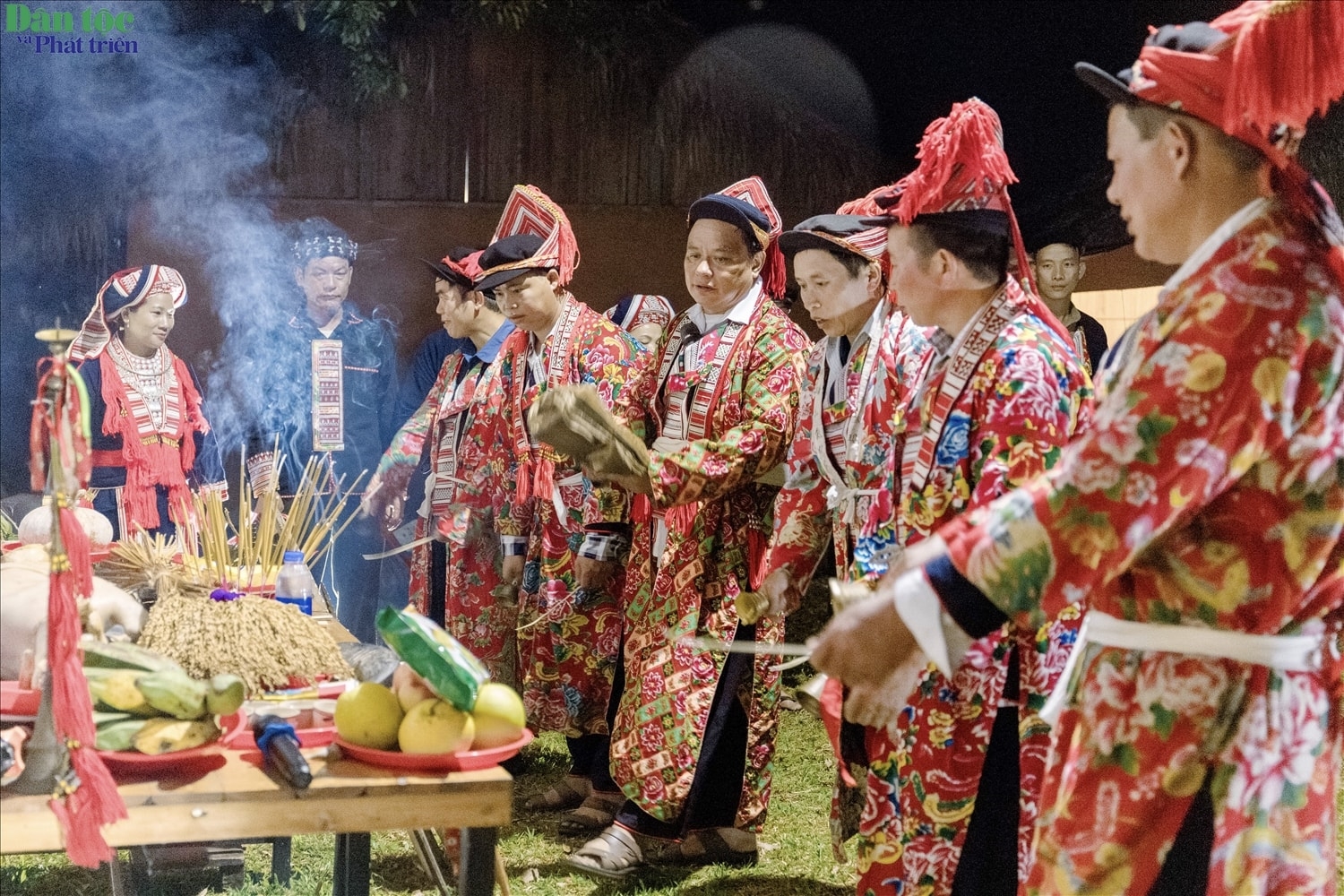
 The Ban Vuong worship ceremony of the red Dao people in Tuyen Quang province
Keywords: Ritual practice; Red Dao people; Long-robed Dao people; Tuyen Quang province.
1. Introduction
According to the aggregated data from the survey on the socio-economic situation of 53 ethnic minority groups in 2024, the Dao ethnic group has 929,716 people (Ministry of Ethnic and Religious Affairs, 2025), distributed throughout most of the mountainous and midland provinces of Northern Vietnam, with Tuyen Quang province being one of the concentrated residential areas. Here, the Dao people live scattered in many localities, concentrated in communes such as Vi Xuyen, Bac Quang, Hoang Su Phi, Bac Me, Yen Minh, Quan Ba, Xin Man, Meo Vac, Dong Van, Tuyen Quang province.
Using ethnographic fieldwork methods (participatory observation and in-depth interviews), this research surveys the ritual practices of the Long-robed Dao and red Dao people in Tuyen Quang province, including family rituals and community rituals. The results show that rituals are still regularly maintained in daily life as well as on important personal and community occasions. In the contemporary context, communities tend to increase their awareness of preserving and practicing rituals, at the same time making adjustments in form, including separating some rituals into independent practices, such as the Ban Vuong worship ceremony of the red Dao people in Ho Thau commune. Therefore, this article focuses on clarifying the perspective and interpretation of those “involved” regarding the practice of rituals in the current context.
2. The role of ritual practices in the life of the Dao people
Researcher Ly Hanh Son, in his study of the Dao people's initiation ceremony, stated: “The Dao people’s initiation ceremony is maintained sustainably thanks to its connection with spiritual elements, customs and the psychology of the Dao ethnic group, the basis of which is the concepts that have been formed and maintained from generation to generation” (Ly Hanh Son, 2002). This observation was further confirmed through fieldwork conducted among the Red Dao and Long-Robed Dao communities in Tuyen Quang province.
The Dao people’s belief in the spiritual world is not only expressed through the initiation ceremony, but also permeates their entire system of important rituals, including life cycle rituals (birth, initiation, marriage, funeral) and ancestor worship. The root of this belief lies in the concept of the parallel existence of supernatural forces, including deities, ancestors, and various kinds of “ghosts” (benevolent and malevolent) - entities believed to have the ability to influence human life.
Field data shows that this belief is still maintained in current practice. Trieu La C. (born in 1997, Ho Thau commune), a red Dao teacher, said: “Nowadays, if someone in a family is sick, they take the sick person to the hospital, but they still perform rituals at home”.
Such experiences contribute to strengthening the community’s belief in the effectiveness of rituals and the role of supernatural forces. Even with access to modern medicine, many families still combine medical treatment with ritual practices at home. For them, illness or misfortune is not simply a natural phenomenon, but also a warning sign of behavioral deviations. Therefore, the practice of rituals is not only aimed at seeking help from deities, but is also linked to the process of self-adjustment of individual behavior, in order to avoid greater risks in the future. Based on that, the rituals were not abandoned but adapted to suit specific circumstances, thereby continuing to be maintained in community life.
In the practice of rituals, shamans play a central role as intermediaries communicating with the supernatural world and possessing ritual knowledge. The profession of shaman is not only a means of livelihood but also involving social responsibility, reflecting in the ethical rules in the process of teaching and practicing the profession.
In the current context, along with socio-economic changes, ritual practices have also undergone certain adjustments. On the one hand, the younger generation, with better access to education has a tendency to critically evaluate and choose practices that they consider inappropriate. On the other hand, community institutions contribute to orienting and adjusting ritual activities in a direction more suitable to the new context.
3. Voices from “insiders”
In the contemporary context, the ritual practices of the Dao people are undergoing notable adjustments from within the community, manifested through the role of self-governing institutions, changes in ritual organization and concerns about a decline in the depth of their knowledge.
The Association of Folk Artists is an institution that regulates cultural practices.
In recent years, traditional religious practices and rituals have been restored and maintained more regularly by the Dao community in Tuyen Quang province. However, this process has also raised issues such as increased ritual costs, prolonged duration of ceremonies or the emergence of deviations from established norms. These factors not only affect people's economic lives but also necessitate adjustments to cultural practices to suit the new context.
In the red Dao community of Ho Thau commune, these issues were identified early on by influential individuals within the community. However, prior to 2006, there was no sufficiently effective mechanism to address them. The turning point came in 2006 with the establishment of the Folk Artists Association.
After its establishment, the Association proceeded to develop conventions to regulate ritual practices and customs within the community. The Association's operating principle is “selective”, maintaining elements considered valuable while adjusting or eliminating those that are no longer appropriate. Specifically, the Association has contributed to reducing the bride price, from the very high levels previously to a level more appropriate to local economic conditions; providing guidance on calculating the age for marriage according to legal regulations; requiring shamans to only perform wedding ceremonies for eligible couples; introducing sanctions for violations. These regulations are not merely advisory but are also linked to a community monitoring mechanism. Non-compliance can result in penalties, thereby creating social pressure to maintain discipline in ritual practices. According to Mr. Q., a shaman in Cao Bo commune, violations such as excessively high dowry demands, holding weddings before reaching the legal age or shamans receiving unreasonable fees can all be detected and dealt with by the community.
The Association of Folk Artists can be seen as a “filter” in ritual practices, allowing the community to proactively select and adjust cultural elements. From a broader perspective, it is an intermediary institution that helps connect tradition with the demands of the contemporary context.
The Ban Vuong worship ceremony: from family rituals to community rituals.
In the traditional life of the red Dao people, the worship of Ban Vuong is usually practiced within the family or clan, associated with other rituals such as the initiation ceremony. However, in recent years, this ritual has undergone a transformation, being celebrated on a community scale. This transformation has involved many stakeholders, including local authorities, artisans and the community. The ritual has been developed into a community activity and is gradually being standardized in terms of its organizational form. The Ban Vuong worship ritual of the red Dao people in Ho Thau commune, recognized as a national intangible cultural heritage (in 2021) has contributed to promoting this process.
However, from the community’s perspective, views on this transformation are not entirely uniform. Some shamans believe that organizing rituals on a community scale is a new phenomenon, more of a performance than the traditional family practice. Changes in space, scale, and some formal elements suggest that the ritual has been adapted and reshaped to suit the current context. Nevertheless, those who initially expressed reservations still participate in the ritual's organization, indicating a process of negotiation and adaptation within the community. Rituals, therefore, are both a continuation of tradition and the result of a process of selection and reshaping within a contemporary context, at the same time contributing to the creation of a shared cultural space for the community.
Paradoxes in ritual practice; expansion of form and the risk of diminishing depth.
Alongside the trend of expanding in scale and form, the Dao community also expressed concerns about the risk of losing the “depth” of their ritual practices. “Deepness” here encompasses the knowledge system associated with ancient books, Chinese characters, ritual symbols and their cultural and historical significance.
In practice, the ownership, reading, and use of these ancient books were primarily reserved for shamans and sorcerers. In many places, possessing a complete set of ritual books was even a criterion for being recognized by the community as qualified to practice the profession. As Mr. Dang Van T. (born in 1960, a shaman from Cao Bo commune) said: “Here, if you lack books, people will laugh... only if you have enough books will they say you know how to be a shaman”. The current generation of older shamans are largely still able to read, write and understand the content of books. Thanks to this, they can perform rituals fully and accurately.
Meanwhile, continuing the tradition among the younger generation faces many difficulties due to the complex and lengthy learning requirements and competition with other livelihood options. Young shaman Dang Van L. (born in 1999, Cao Bo commune) said: “I haven’t finished reading the book yet... I have to learn step by step; if I don’t understand it, I can’t do it. Learning to perform rituals is too difficult; making sweet soup is easier”. Many cases show that young people may be able to perform the rituals at a basic level but do not fully understand the meaning of the texts and symbols. Nevertheless, older shamans are still striving to maintain the cultural “depth” through copying books, opening classes to teach Chinese characters, and directly passing on their knowledge to the next generation. These efforts demonstrate that the individual role in preserving and transmitting ritual knowledge remains very important.
The system of altar paintings, which reflects the cosmology of the Dao people (Ly Hanh Son, 2002) is also an important component of the “depth” of the ritual. However, in some localities, traditional altar paintings are gradually disappearing, forcing the community to use alternative forms. In some areas, such as Cao Bo commune, traditional altar paintings have almost disappeared. According to Mr. Dang Van M. (born in 1958, Cao Bo commune), in the past, altar paintings were bought up, leading to the current rituals having to be replaced by writing the names of deities on paper and pasting them onto the altar. This replacement partly reflects the decline of the material elements associated with traditional rituals. The use of transcribed versions of prayer texts instead of the original Chinese texts also reflects an adaptive solution in the context of a shortage of knowledgeable individuals.
In Ho Thau commune, although the red Dao community still preserves some ritual books, the situation of “knowing how to perform rituals but not being able to read” is becoming more common. According to Mr. Trieu Choi Q, many young shamans today mainly use transcribed versions, while their ability to deeply understand the content of the rituals is limited. Compiling transcribed versions is a temporary solution to maintain the practice of rituals in conditions of a shortage of people who know Chinese characters.
From a community perspective, the cause of this situation largely stems from changes in social life. Today’s younger generation often leaves the community to study and work, and has fewer opportunities to regularly participate in cultural activities and rituals. As Trieu Ta P. shared: “Nowadays, children grow up and go to boarding school, they spend less time at home... after school they go to work, where do they find the time to learn about religious rituals?” The disruption of the traditional teaching environment has made the continuation of ritual knowledge difficult. In addition, the risk of losing ancient texts has also been identified by the community. Some families, even though they still possess the books, are unable to read them, leading to the possibility that these documents will be sold in the future. This is not only a material loss, but also a disruption of cultural knowledge associated with the rituals.
Thus, from the perspective of those “involved”, a paradox becomes clear: while ritual practices are maintained, and even expanded in scale and form, their “depth”, expressed through knowledge, meaning and symbolic systems, is in danger of disappearing. Individual and community efforts in preserving and transmitting ritual knowledge are commendable. However, questions remain about long-term sustainability, especially in the context of the rapidly changing social landscape today.
4. Conclusion
The ritual practices of the Dao people in Tuyen Quang province in the contemporary context not only reflect the continuation of tradition, but also the result of adaptation, negotiation and cultural creation by the community itself. On the one hand, rituals continue to be maintained as a means of expressing spiritual beliefs, providing moral education, and strengthening community bonds. On the other hand, community institutions such as the Folk Artists Association demonstrate the proactive role of the community in adjusting and guiding ritual practices towards greater suitability to current socio-economic conditions.
However, concerns about the erosion of the ritual’s “depth” highlight the complexity of the cultural transformation process. In this context, identifying and listening to the voices of “insiders” not only helps clarify the ongoing changes but also raises issues that require further research, particularly in balancing the preservation, promotion and maintenance of the depth of ritual practices. This shows that ritual is not an immutable entity that needs to be preserved in its original state, but rather a living cultural process, always actively adjusted and shaped by the community within specific historical and social contexts.
References
1. Pham Van Duong, (2009), Dao shaman in Lao Cai province (case study of Mr. Ban Van Siem). Journal of Ethnology. No. 4, p.14-23.
2. Ministry of Ethnic and Religious Affairs (2025), “Announcement: Update and review of survey results and information collection on the socio-economic situation of 53 ethnic minority groups in 2024”, http://www.cema.gov.vn/thong-bao/ thong-bao-cap-nhat-ra-soat-ket-qua-dieu-tra-thu-thap thong-tin-ve-thuc-trang-kinh-te-xa-hoi-cua-53-dan-toc thieu-so-nam-2024.htm
3. Pham Van Duong, (2003a), The Tam Nguyen altar paintings of the Dao Ho people - Meaning and value. In Folk Culture Bulletin 2002. Social Sciences Publishing House. p.22-43.
4. Pham Van Duong. (2003c). Dao Ho Shamans in Lao Cai (A Study of Several Specific Cases). [Master’s Thesis in Folklore. Institute of Folklore Research. Hanoi].
5. Pham Van Duong. (2009a). Religious life of the Dao Ho people in Lao Cai province. Journal of Culture and Arts, No. (301), p.15-20.
6. Pham Van Duong. (2009b). The role of shamans in the spiritual and cultural life and development of the Dao Ho people in Lao Cai province. Journal of Religious Research, No. (73-74), p.57-64.
7. Pham Van Duong. (2009c). Dao Ho Shaman in Lao Cai province (Case study of Mr. Ban Van Xiem). Journal of Ethnology, No. 4, p.14-22.
8. Be Viet Dang, Nguyen Khac Tung, Nong Trung, Nguyen Nam Tien. (1971). The Dao people in Vietnam. Social Sciences Publishing House. Hanoi.
9. Le Sy Giao. (1998). The Dao people’s coming-of-age ceremony and its educational aspect. In The socio-cultural development of the Dao people: present and future (Proceedings of the International Conference on the Dao people, held in Thai Nguyen in December 1995). Hanoi. p.159-166.
10. Phan Ngoc Khue. (1998). Ancestral paintings of the Dao ethnic group in Northern Vietnam. In The socio-cultural development of the Dao people: Present and future (Proceedings of the International Conference on the Dao people, held in Thai Nguyen province in December 1995), Hanoi, p.135-146.
11. Ly Hanh Son. (2002). The initiation ceremony and Dao cultural identity. Journal of Ethnology, No. 3, p.13-23.
12. Tran Huu Son, Tran Thuy Duong. (2009). Ancient books of the Dao people - an important source of information for understanding the history of the Dao ethnic group. Journal of Ethnology, No. 3, p.4-14.
13. Dang Nghiem Van. (1998). The role of ethnic religion in unifying the consciousness of the Dao community. In Socio-cultural development of the Dao people: Present and future (Proceedings of the International Conference on the Dao people, held in Thai Nguyen in December 1995). Hanoi. p.126-134.
14. Tran Quoc Vuong. (1963). Through research on Binh Hoang Khoan Diep, let’s discuss the origin of the Dao people (Man people). Journal of Ethnology, No. 40, p.46-51.
15. Tran Quoc Vuong. (1963). An attempt to discuss the origins of the Dao people. Journal of Ethnology, No. 41, p.42-46.
