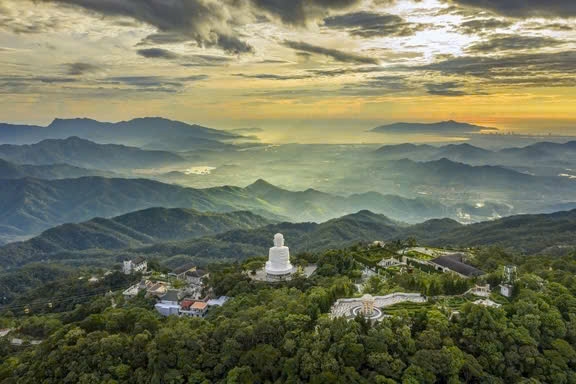
 Linh Ung pagoda, Ba Na
Throughout the history of Vietnamese Buddhism, the concept of pagodas built on famous mountains (danh son kien tu), selecting majestic mountains as sites for temple construction has become a defining characteristic of the traditional monastic landscape. Renowned Buddhist centers such as Yen Tu, Huong Son and Ba Vi serve as prime examples of the harmonious blend between natural landscapes and spiritual life. The development of the Buddhist complex atop Ba Na mountain in modern times represents a continuation of this cultural ethos. Between a rolling sea of clouds and the verdant expanse of primeval forest, the soaring, upturned eaves of traditional roofs emerge and recede from view; they not only enhance the magnificent landscape but also create a serene sanctuary, far removed from the pace of urban life.
The most prominent Buddhist landmark here is Linh Ung pagoda on Ba Na. In the spiritual life of the people of the Quang Nam - Da Nang region, this pagoda together with Linh Ung pagoda on marble mountains (Ngu Hanh Son) and Linh Ung pagoda at Bai But (Son Tra) forms a spiritual triangle symbolizing peace and protection. The pagoda is designed according to the traditional Northern Vietnamese Buddhist architectural style. At the entrance stands a “three-arched” gate featuring a roof of yin-yang tiles and gracefully curved eaves adorned with restrained dragon and phoenix carvings, maintaining an air of humility and elegance. The entire pagoda grounds are paved with flat stone, while structures such as the front hall, main sanctuary and ancestral hall are meticulously arranged in a traditional symmetrical layout.
The spiritual centerpiece of the complex is a statue of Shakyamuni Buddha seated in meditation on a lotus pedestal. Standing 27 meters tall, the statue is constructed from reinforced concrete designed to withstand the harsh weather conditions and high humidity of the mountain environment. Despite the use of modern materials, the structure achieves a high level of artistic refinement consistent with traditional sculptural aesthetics: The statue bears a majestic yet benevolent countenance, with eyes gently downcast upon all sentient beings. On days shrouded in mist, the base of the statue is veiled in white fog while its summit rises against the blue sky, creating an ethereal visual effect that evokes a sense of reverence among Buddhists and visiting admirers alike.
In addition to Linh Ung pagoda, the spiritual landscape of Ba Na has been further expanded and enhanced by the Linh Chua Linh Tu temple complex, along with ancillary structures such as the bell tower and Linh Phong Tower. Linh Chua Linh Tu temple is dedicated to the worship of Mau Thuong Ngan - the Mother Goddess who governs the mountainous forests within the Vietnamese Mother Goddess worship tradition. The establishment of a Mother Goddess temple alongside Buddhist structures authentically reflects the “Buddha-Mother” dual-worship model, embodying the profound integration of Buddhism and folk beliefs.
In terms of architectural artistry, the spiritual structures on Ba Na demonstrate strict adherence to traditional aesthetic principles through the use of a predominantly natural color palette: the brown of wood, the deep red of fired tiles and the elegant gray of stone. The system of columns, beams and purlins is skillfully joined, while the wood carvings, depicting the Four Sacred Animals, lotus flowers and swirling clouds, possessing high aesthetic value and conveying metaphors rooted in Buddhist philosophy. The bell tower has a bronze bell weighing several tons hanging in mid-air. Every time the beat rings, the deep sound of the bell resonates through the ravines and blends with the sound of the wind, acting as a therapy to awaken the mind and bring a strange sense of peace to the soul.
The magnificence of the Vietnamese pagodas atop Ba Na lies not only in their scale or prime location but also in their value for cultural preservation. Although they are contemporary structures built amidst challenging terrain and harsh weather conditions, they fully embody the spirit and essence of traditional national architecture. This place not only meets the spiritual needs of a vast number of monks, nuns, Buddhists, and visitors from near and far, but also contributes to honoring and promoting the model of spiritual tourism linked to the preservation of Vietnamese cultural heritage to the international community.
Amidst the ever-changing times, the curved rooflines stand serenely firm amidst the clouds of Ba Na, serving as a peaceful spiritual anchor. It is a place where people return to listen to their inner selves, contemplate the philosophy of impermanence, and sense the profound beauty of the Vietnamese soul in every roof tile and eaves-corner of this sanctuary./.
