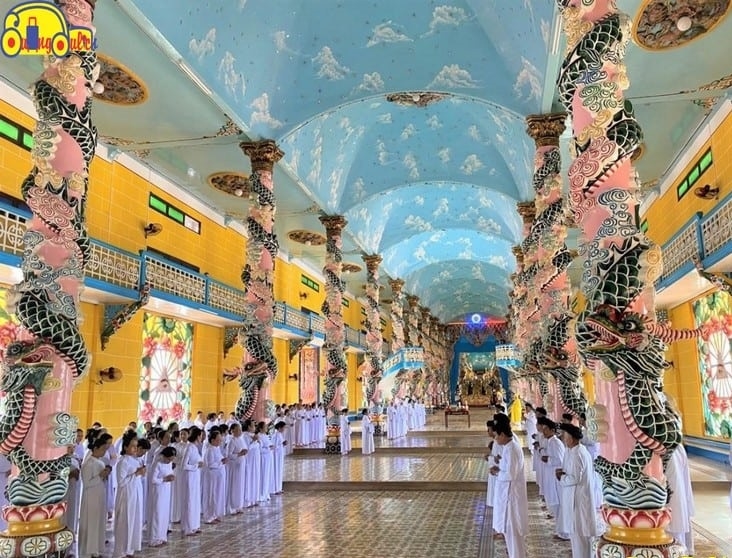
 Caodaism is founded on the principle of “Triangle of Unity, Five Branches United”, taking love as its foundation and righteousness as its guiding principle
Keywords: Cao Dai religion; Religious unity; National unity; Building and defending the Fatherland.
1. Introduction
Throughout the Vietnamese revolution, the Party and State have consistently affirmed that religion is a spiritual need of a segment of the population and that religious unity is a crucial element in consolidating national unity. In the current context, where hostile forces are increasingly exploiting religious issues to sow social division, promoting the positive role of religions in social life has become even more urgent.
Cao Daiism is a religion that originated in Vietnam in 1926, founded by prominent figures such as Ngo Minh Chieu, Pham Cong Tac, Le Van Trung, Vuong Quan Ky, Cao Quynh Cu, Cao Hoai Sang, etc. Initially, Cao Daiism was a unified religious organization with a holy site in Tay Ninh province, but after a period of time, it formed many different religious organizations. Cao Dai Buddhism builds on the principle of “Three teachings return to the source, Five branches conquer one”, taking love as the foundation, taking humanity as the motto of practice, taking serving sentient beings as action, taking the salvation of spiritual beings as the goal, in order to build a moral and peaceful society with the spirit of love for fellow believers. Since 1995, the State has recognized the religious organization of the Cao Dai religion, building the organization of the Cao Dai religion with two levels: at the Central level is the Church, at the grassroots level is the religion, in provinces and cities with many religions there is a Provincial and City Representative Board.
Human life has many needs that must be satisfied, among which the need for faith is almost constant, essential, and indispensable. In reality, humans primarily need to solve the problems of food, shelter, clothing and means of living, but even more important is faith. How can one live without faith? Therefore, people of all social classes need a point of support to believe in and to live on, and that is primarily self-confidence.
Religion has always emerged to meet these pressing needs. However, the issue of religion is becoming increasingly important; it is both widespread and deeply impacts people’s spiritual lives. In some places, it makes people virtuous, but at times, not a few people use religion as a pretext for evil deeds, disrupting spiritual life, social order and the peace of the nation and humanity.
Truth is one and the same, but the philosophies of each religion regarding truth can sometimes differ to the point of being irreconcilable, leading to discrimination and division in some places, creating negative consequences for human life, both mentally and physically.
In response to this reality, the Great Way of the Three Periods of Universal Salvation (Tam Ky Pho Do) was born to resolve this issue and to guide humanity towards a life of universal peace and harmony, leading people towards ultimate goodness, truth, and perfection. The formation and development of Caodaism has contributed to religious unity in the current cause of building and protecting the nation.
2. The guiding principle and purpose of Caodaism is religious unity and national unity
When Cao Daiism emerged, the nation's sovereignty was under French colonial rule. The French authorities used a divide-and-conquer strategy, dividing Vietnam into three regions, like three separate countries, with the aim of weakening the nation and prolonging their rule. The Cao Dai leader, seeing this harm, clearly taught:
“From now on, our race will no longer be divided into three,
The teacher unites you all as one family,
North and South together, then go abroad,
I alone possess the true sovereignty of the Dao”.
The spirit of national unity was clearly demonstrated from the beginning. When the Cao Dai religion was founded, religious divisions were very evident, leading to national divisions. Therefore, Cao Dai put forward a very specific goal of unity: “The three religions return to their origin, the five branches unite as one”.
The three religions here refer to Buddhism, Taoism, and Confucianism returning to their original roots. The five branches unite from the Human Way, the Divine Way, the Saintly Way, the Immortal Way and finally the Buddhist Way, merging into one without further separation! The spirit of religious unity is strongly evident. With such principles, Caodaism implicitly resolves religious discrimination. The goal of this religion is to lead humanity to a life of universal peace and harmony.
The Cao Dai religion deeply saddened to see people divided and harming one another for religious reasons. With this profound principle, the religion was widely accepted. In just one year in Southern Vietnam, as many as 400,000 followers joined the religion and practiced its teachings.
For the Vietnamese people, the teacher clearly taught through the hymn calling for national unity:
“Regardless of whether we are of the same lineage or not, we are all from the same family,
We share one faith, which means one Father,
A righteous man must sacrifice his life to live to the fullest,
Let’s teach each other the meaning of harmony”.
Selected Sacred Sayings (TNHT Q1 1926)
Many people, upon hearing these teachings, awakened to live in harmony and love, working together to build and protect the nation, and thwarting the French’s divide-and-conquer schemes. The spirit of national and international unity was emphasized in many moral-teaching poems and essays of that time. This was a very correct worldview and philosophy of life in the direction of educating people and seeking enlightenment.
For the Vietnamese people, His Holiness Cao Dai clearly teaches about the country in the future when religion is enlightened in this Holy Land of Vietnam. Cao Dai taught:
“Good Southern country! Good Southern country!
The small nation has just begun to open the Nirvana Assembly.
Encountering Cao Dai to receive the Great Way,
It is a fortunate encounter for the Jade Emperor to reside in the mortal world”.
(TNHT Q1 1926)
Through this sacred poem, the Supreme Being Cao Dai clearly states that this is a good thing for Vietnam. When the nation lost its sovereignty and the country was plunged into a long night of slavery, the Supreme Being Cao Dai predicted:
“Few truly understand the mysterious workings of the machine,
From the very beginning, nothing in Vietnam could compare.
A small country among countless nations,
The day after becoming the new owner is the real surprise”.
After nearly 100 years since the Cao Dai religion was established, the Vietnamese people were freed from the yoke of slavery. Over time, Vietnam has achieved a worthy position on the international stage. This demonstrates the vibrant contribution of Cao Dai religion to religious and national unity.
What is particularly significant is that the Cao Dai religion is increasingly giving rise to many branches and twigs, bearing many fragrant flowers and sweet fruits. Due to differing perspectives, many people believe that the Cao Dai religion goes against the original principles taught by the Supreme Being, thus causing division. This was clearly taught by the Supreme Being from the beginning:
“The sacred throne blossoms with more flowers,
The branches eventually become one family.
Let us work together to cultivate morality,
Remain steadfast and loyal to Me”.
(TNHT Q1 1926)
Religion does not divide into factions or sects; the Cao Dai religion has many branches and sub-branches, but ultimately they all look to each other as originating from a single root. This is a very beautiful and natural development.
This was taught by the Supreme Being through a spiritual medium at the Minh Ly Altar in July 1927:
“The Jade Emperor wrote the Cao Dai religion for the South.
My children, listen carefully to my teachings. Do not quarrel with one another; be united in heart and mind to revive morality. Although there are many branches and sub-branches now, in the future there will be only one. Regardless of which side you belong to, love one another, like children of the same family; do not be jealous or criticize each other”. These teachings are so meaningful and profound.
Overall, the spirit of religious unity is clearly reflected in the tenets and teachings of Cao Dai. For the first time, Vietnam had an indigenous religion, meaning it was born within the nation, deeply rooted in national cultural identity, which truly contributed to religious unity within the nation and among humanity for the past 100 years and will continue to do so forever. This is clearly demonstrated in the two couplets from the founding and rectification periods of the religion:
“The supreme and noble path of peace and democracy
The monument dedicated to the worship of Tam Ky resonates with freedom and rights”.
Then came the period of religious reform:
“The Great Way is widely propagated, the Three Religions return to their origin, and it connects the four seas.
The Three Kingdoms unite the Five Branches in one global unity”.
The spirit of religious unity is manifested in Caodaism through its worship practices, way of life, and religious conduct throughout its history, from its founding to the present day.
3. The Cao Dai religion embodies the spirit of religious unity in the current cause of building and defending the nation
The Cao Dai religion has a new model of inter-religious exchange that has developed in the last decade or so. The emergence of this inter-religious exchange in Cao Dai originated from the Cao Dai Ban Chinh Dao Holy See’s celebration of the 60th anniversary of President Ho Chi Minh’s visit to the Cao Dai temple in Hanoi in 2006. On this occasion, a delegation of leading dignitaries from the Cao Dai religious sects paid a courtesy visit to President Nguyen Minh Triet. During the meeting, President Nguyen Minh Triet encouraged Cao Dai leaders to unite in their religious activities to gain greater strength and influence in the Cao Dai religion. Following the President’s directive, Cao Dai religious organizations and congregations have taken the initiative to establish a joint religious practice organization to support each other in their religious activities, social charity work, journalism and the training of religious leaders. This is a voluntary activity of Cao Dai religious organizations and congregations aimed at gradually addressing the necessary issues facing Cao Dai religion in the current period.
In that spirit, the Cao Dai Churches organized the first Inter-Cultural Conference at the Thien Canh Dan temple of the Cao Dai Minh Chon Dao Church in Ca Mau province, with the participation of 7 Cao Dai Churches and 5 Cao Dai organizations and nearly 200 delegates in attendance. The conference summarized the religious activities of the Cao Dai churches and some organizations since their legal recognition (1995-2008), focusing on organizational work, doctrinal study, restoration and construction of places of worship, charitable and social activities, poverty alleviation movements, patriotic emulation movements and compliance with state laws. At this conference, delegates proposed: holding an annual inter-sect Cao Dai conference; opening training courses for Cao Dai religious officials and functionaries; printing scriptures and publishing a Cao Dai magazine; and engaging in joint activities in the field of social charity. At the same time, the Conference agreed to establish a memorandum of understanding between the Cao Dai sects with specific contents for implementation, based on the principles of solidarity, respect for independence, autonomy and the characteristics of each organization, in order to help each other in religious practice, not to interfere in internal affairs and to treat each other equally.
Continuing to uphold the principles of the First Inter-Cultural Conference, subsequent conferences have been held, totaling 12 conferences to date. These conferences have gradually refined the organizational model and improved the quality of inter-cultural activities among Cao Dai churches and organizations. From the first conference with 12 participating organizations to the present day, the inter-religious exchange activities have witnessed significant organizational growth, bringing together 9 Cao Dai Holy Churches, 1 practice school, 5 independent Cao Dai organizations, and the Minh Ly Dao Tam Tong Mieu Holy Church. Specifically, the Cao Dai churches and organizations (excluding the Tay Ninh Cao Dai Church) have 995,987 followers, 8,378 officials, 9,582 clergy, and 690 places of worship, operating in 28 provinces and cities. Inter-religious activities have brought together the majority of Cao Dai churches and organizations, affirming the role of religious unity among religious organizations within the Cao Dai religion.
During the period of national defense, Cao Dai organizations engaged in inter-organizational activities to mobilize clergy and followers to participate in patriotic activities and resistance against foreign aggression. Based on traditional relationships and the spirit of unity: “Respecting the independence and autonomy of each organization, and not interfering in each other’s internal affairs”, the Cao Dai congregations and organizations worked in inter-organizational activities to fulfill their mission of being a center of morality and unity within the Cao Dai religion, operating in the fields of education, journalism and social charity. Over 11 years of inter-faith activities, the dignitaries and followers of Cao Dai religion have affirmed the truth that when people are united, all difficulties can be overcome. Entering the period of reform, the State recognized the legal status of Cao Dai organizations. After being recognized, Cao Dai organizations operate completely independently without any affiliation. Whenever a related event occurs, each Cao Dai organization is present and distinct in its own way. Since the establishment of inter-organizational activities, the Cao Dai churches and organizations have been closely linked, carrying out common community-based activities, unified as a representative collective. From small things like giving flowers, visiting relatives and friends, in order to social charity work and media coverage, everything is done under the common umbrella of the Cao Dai churches and organizations. Unity and solidarity help to gradually stabilize the organization and shape the methods of operation of the Cao Dai religion. Furthermore, whenever a Cao Dai church has an event, it is not only carried out internally but also receives support from the clergy and followers of other churches. This is how Cao Dai adapts to contemporary religious life.
During the current period of national construction and defense, Cao Dai religion has actively encouraged its followers to participate in local economic, cultural, social and charitable activities, abiding by the laws of the State and playing a role in religious unity in Southern Vietnam. Cao Dai congregations and organizations voluntarily cooperate with each other in several areas. This form of religious solidarity has existed since 2008 and continues to operate, attracting a large number of Cao Dai churches and organizations to participate. It has become a typical model for the spirit of religious unity, contributing to the formation of the community cohesion values of the Cao Dai religion.
More than ever in the current cause of building and defending the Fatherland, Cao Dai followers are fulfilling their civic duties well. Many have set shining examples in various social fields, especially in charitable work. As Cao Trieu Phat, the head of the Cao Dai Minh Chon religious order, taught: “There are many religious altars, but there is only one altar to the Fatherland”!
4. Conclusion
Caodaism inherits the essence of the Three Religions and Five Branches, combined with principles that align with the religious beliefs of the era, truly contributing to religious unity in general.
More than anyone else, Cao Dai followers understand that this religion, founded by the Vietnamese people and guided by the Supreme Being, is a religion that contributes to making Vietnam a brighter future. Cao Dai followers are determined to ensure that the religion truly benefits the nation and the people, in accordance with the spirit of the sacred hymn that guides them:
“The wall’s light shines brightly in the east,
The convergence of the three religions preserves the community.
Buddhist teachings encourage people to follow virtuous customs.
Confucianism, once restored, would enjoy its traditional customs.
The profound and true path of cultivation.
Bewitching evil schemes can lead to self-proclamation.
The world desires to know when the angels have arrived.
the Great Way of the Third Period of Universal Salvation (Tam Ky Pho Do) performed a great deed”. (1926)
With the spirit of universal harmony and divine liberation, Cao Dai religion has contributed to religious unity and served the cause of building and protecting the nation ever better.
* Ho Chi Minh National Academy of Politics
References
1. Regulations governing the exchange activities of churches and organizations within the Great Way of the Third Period of Universal Salvation at Cau Kho Tam Quan, Binh Dinh, April 8, 2012, page 1.
2. Government Religious Affairs Committee (2021), Religion and religious policy in Vietnam, National Political Publishing House.
3. Communist Party of Vietnam (2021), Documents of the 13th National Congress, National Political Publishing House.
4. Nguyen Quoc Tuan (Editor), Cao Dai Religion in Vietnam, Social Sciences Publishing House.
5. Ho Chi Minh (2011), Complete Works, National Political Publishing House.
