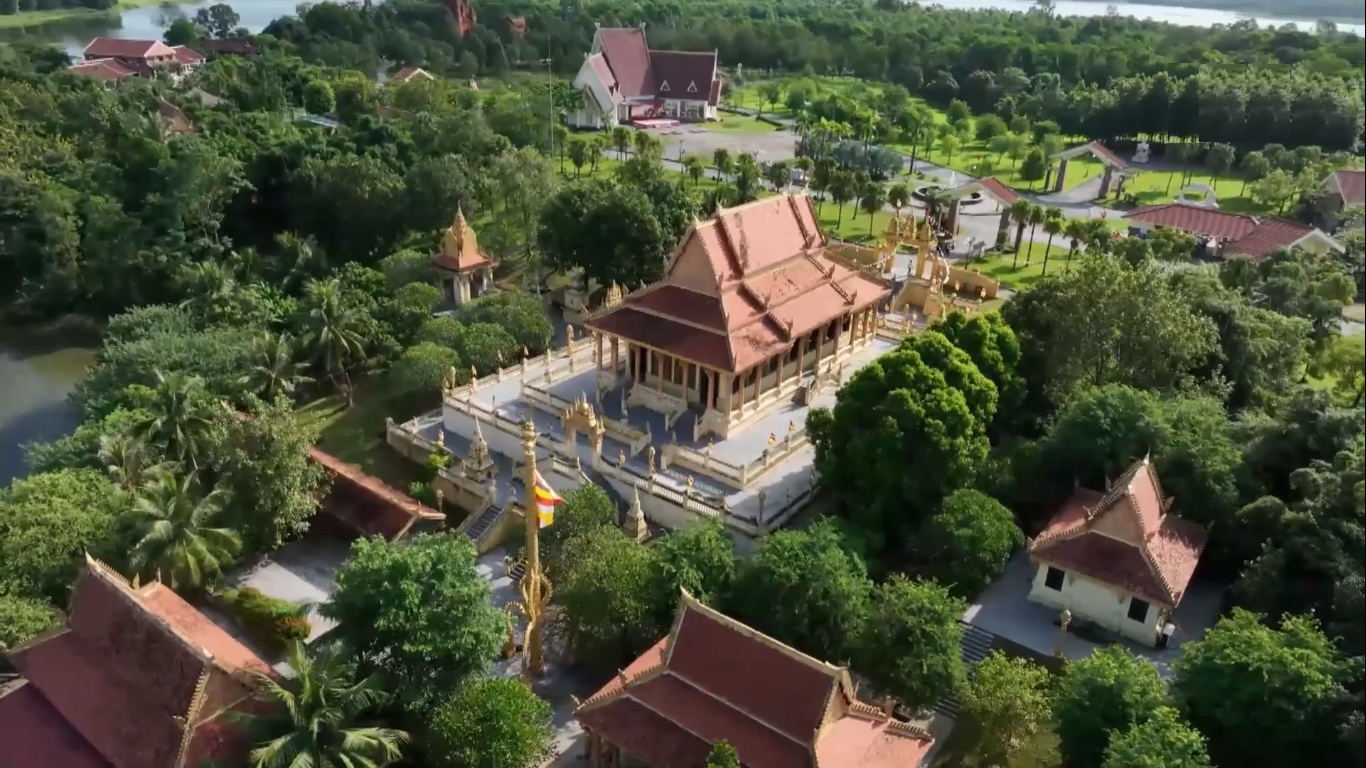
 Khmer pagoda complex at the Vietnamese ethnic culture and tourism village
Keywords: Cultural tourism; Ethnic minority and mountainous areas; Sustainable development.
Vietnam is a multi-ethnic nation characterized by unity, home to 54 ethnic groups, including 53 ethnic minority groups. Throughout a long historical process, ethnic minority groups have created and preserved a rich cultural heritage, manifested in their languages, writing systems, festivals, beliefs, folk knowledge, performing arts, traditional crafts and distinctive community living spaces. The cultures of these ethnic minorities create a unique cultural tapestry and remain an integral part of the unified yet diverse culture of Vietnam.
In the current context, the cultures of ethnic minority groups are viewed not only as heritage requiring preservation but also as vital resources for development, particularly in the tourism sector. As a multifaceted economic sector, tourism has the capacity to link natural resources, cultural values and society’s demand for experiences. For ethnic minority and mountainous areas, culture is the core element that shapes the identity, appeal and distinctiveness of tourism products.
Practical experience demonstrates that, when appropriately organized and managed, cultural tourism not only generates livelihoods, boosts incomes and improves the material and spiritual well-being of ethnic minority communities but also serves as a driving force for the preservation and promotion of traditional cultural values. Accurately identifying and studying the role of cultural tourism as a development resource for ethnic minority and mountainous areas is a requirement of both theoretical and practical significance.
2. The concept of culture and the culture of ethnic minorities
In 1988, the United Nations Educational, Scientific and Cultural Organization (UNESCO) provided an explanation: Culture reflects and vividly embodies every aspect of human life both past and present. Over the centuries, it has shaped a system of traditional values, aesthetics and ways of life through which each nation asserts its unique identity.
President Ho Chi Minh offered a classic definition, now widely used in cultural research theories stating: “For the sake of survival as well as the purpose of life, humanity has created and invented language, writing, morality, law, science, religion, art, tools for daily living such as food, clothing, shelter and the methods of using them. All such creations and inventions constitute culture. Culture is the synthesis of all modes of life and their manifestations that humanity has produced to adapt to the needs of life and the demands of survival” [1].
Approached under these concepts, it can be understood that "the culture of ethnic minorities is the entire tangible and intangible cultural values created by ethnic minority communities in the process of survival and development, associated with the natural and social environment; It reflects the characteristics of the mindset and creative labor of each ethnic group across various stages of development, encompassing information on both intension and extension that mirrors internal dynamics as well as cultural relationships at both ethnic and national levels” [3].
3. The concept of cultural tourism and the relationship between culture and tourism
Clause 17, Article 3 of the 2017 Law on Tourism defines: “Cultural tourism is a form of tourism developed based on the exploitation of cultural values, contributing to the preservation and promotion of traditional cultural values and the honoring of humanity’s new cultural values”.
Based on this definition, cultural tourism has the following fundamental characteristics:
Firstly, cultural tourism takes cultural values as core values. Unlike other types of tourism that rely mainly on natural resources or resort services, cultural tourism is formed and developed on the basis of exploiting cultural values, including both tangible and intangible culture. Culture is the defining factor for the identity, content and appeal of tourism products, offering visitors insights into and opportunities to discover the culture and history of a destination through experiences involving cultural and historical sites, traditional festivals, craft villages, customs and traditions, local knowledge and the local community’s cuisine.
Secondly, cultural tourism is closely linked to the goal of preserving and promoting the value of traditional culture.
In the spirit of the 2017 Law on Tourism, cultural tourism goes beyond mere exploitation for economic gain; it must simultaneously contribute to the preservation, safeguarding, and revitalization of traditional cultural values within contemporary life. This distinguishes cultural tourism from forms of cultural exploitation that are purely commercial in nature. “Enhancing the understanding and experiences gained by tourists participating in cultural tourism programs is inextricably linked to shifting their perceptions and behaviors, thereby fostering tangible contributions to the preservation and dissemination of the cultural and historical values of the destination. This constitutes both a key characteristic and a primary objective of cultural tourism development” [2].
Thirdly, cultural tourism is open in nature, oriented towards cultural acculturation and creativity.
The definition set forth in the 2017 Law on Tourism not only emphasizes the preservation of traditional values but also addresses “the honoring of new cultural values of humanity”. This indicates that cultural tourism is a two-way interactive process in which local culture is showcased and disseminated while simultaneously absorbing progressive and appropriate values from the outside.
Thus, culture in tourism is not merely a resource to be exploited but also a foundation that shapes the identity, appeal and sustainability of tourism products. In this study, cultural tourism is approached through its organic relationship with sustainable development, community-based tourism and ecotourism. Sustainable development requires balancing economic growth, environmental protection and the preservation of cultural identity. Community-based tourism emphasizes the central role of local residents in organizing, managing and benefiting from tourism activities. Ecotourism aims to utilize natural resources rationally while integrating environmental protection and fostering conservation awareness. For ethnic minority and mountainous regions, these three approaches are closely complementary, establishing a vital theoretical framework for the sustainable development of cultural tourism.
There is a close relationship between culture and tourism. Culture is the crystallization of history, living environments, local knowledge, and spiritual values accumulated and passed down through generations serves as a core resource for a nation’s development, including the tourism sector. As a multifaceted economic sector, tourism has the capacity to transform cultural values into products and services that generate socio-economic benefits. “Culture and tourism are inseparable and mutually reinforcing; culture serves as a vital resource for tourism development, at the same time tourism acts as the fastest vehicle for disseminating cultural values” [4].
When properly organized and managed, tourism not only helps promote and disseminate the cultural values of ethnic minority groups but also creates momentum for communities to proactively preserve their heritage, revive traditional crafts and safeguard festivals and local knowledge. Conversely, culture is the very element that provides distinctiveness, competitiveness and depth to tourism products.
4. Current state of resources and cultural tourism development in ethnic minority and mountainous areas
Clause 4, Article 3 of the 2017 Law on Tourism explains: “Tourism resources are natural landscapes, natural elements, and cultural values that serve as the basis for the formation of tourism products, tourism zones and tourist attractions to meet tourism demands. Tourism resources comprise natural tourism resources and cultural tourism resources”.
Natural tourism resources in ethnic minority and mountainous areas constitute a particularly important component of the national tourism resource system; comprising elements such as topography, geomorphology, climate, landscapes, ecosystems and biodiversity, these resources have been formed and preserved within a vast natural expanse covering three-quarters of the country’s total land area that remains largely unaffected by urbanization. The natural tourism resources of this region are distinguished by their diversity and uniqueness, manifested in high mountain ranges, plateaus, valleys, caves, waterfalls, rivers and streams, primary forests and special-use forests, alongside a variety of distinct climatic zones. It is precisely this diversity that creates a unique appeal for ecotourism, resort tourism, experiential tourism and adventure tourism.
Beyond their scenic value, the natural tourism resources in ethnic minority and mountainous regions are inextricably linked to the lives, livelihoods, and cultures of ethnic minority communities. The natural landscape serves not only as an environment for survival but also as the foundation for the development of indigenous knowledge, customs and distinctive cultural practices unique to each ethnic group manifesting in traditional village layouts, characteristic housing architecture and historical-cultural sites associated with the formation and evolution of each people. About intangible cultural heritage, notable elements include a wealth of traditional festivals, folk songs and dances, ethnic musical instruments, handicrafts, folk knowledge and forms of community cultural life. The interplay between cultural and natural elements, particularly the cultural diversity of the 53 ethnic minority groups has created a tourism landscape rich in identity across ethnic minority and mountainous areas.
In recent years, developing cultural tourism in ethnic minority and mountainous areas has become a strategic priority for the nation, the tourism sector, and localities with significant ethnic minority populations, aiming to transform cultural, historical and natural assets into resources for sustainable development.
At the national level, Project 6: “Preserving and promoting the fine traditional cultural values of ethnic minority groups in conjunction with tourism development”, part of the National Target Program for socio-economic development in ethnic minority and mountainous areas for the period of 2021-2025 has supported investment in the development and preservation of 48 exemplary ethnic minority villages and 69 outstanding tourism destinations. Preserving and promoting 124 traditional festivals of ethnic minority groups; support the activities of 695 folk culture clubs and 5,760 traditional performing arts troupes in ethnic minority and mountainous villages; organizing 08 cultural, sports, and tourism festivals for ethnic minority groups; implementing 33 programs to restore, preserve and develop the traditional cultural identities of ethnic minority groups with small populations...
At the local level, many provinces have successfully established ethnic minority cultural tourism as a pillar of their development strategies, creating destinations that appeal to both domestic and international visitors. In the northern mountainous region, the Dong Van Karst Plateau UNESCO Global Geopark (spanning Tuyen Quang province) has been honored by the World Travel Awards as “the World’s Leading Cultural Destination 2025”. The Dong Van Karst Plateau is home to 17 ethnic groups, boasting a rich cultural heritage including ancient rammed-earth houses, the Mong flute (panpipe) festival, highland markets and the Dao people’s maturity rituals that creates a distinctive identity blending nature, culture, and people, thereby establishing the province’s brand as the “Land of Blooming Rocks”. Lo Lo Chai Village, home to the Lo Lo ethnic community (in Lung Cu Commune), has been awarded the title of
“Best Tourism Village 2025” by the World Tourism Organization - an honor recognizing rural destinations that excel in cultural and natural preservation, sustainable tourism development and the enhancement of community livelihoods… In Quang Tri province, community-based tourism linked to exploring the cultures of the Bru - Van Kieu and Chut ethnic groups and combined with visits to the renowned Phong Nha - Ke Bang cave system and the historic Truong Son Trail - offers an appealing tourism product for international visitors.
Practical experience shows that community-based tourism and eco-tourism models linked to the cultures of ethnic minority groups represent a suitable direction for ethnic minority and mountainous areas. In this model, ethnic minority communities play a central role, directly participating in providing accommodation, culinary services, and cultural experience guidance; this not only boosts their income but also fosters a greater sense of responsibility for heritage preservation. Furthermore, heritage tourism linked to historical and cultural sites and traditional cultural spaces contributes to diversifying tourism products in ethnic minority and mountainous areas.
5. The impact of cultural tourism on the development of ethnic minority and mountainous areas
Firstly, about the economy, cultural tourism contributes to generating budget revenue for localities. For instance, in Lao Cai province, home to a diverse range of ethnic minority groups and cultural heritage sites, total tourism revenue is projected to reach approximately VND 46 trillion in 2025, making a significant contribution to the province’s socio-economic growth. Tuyen Quang province is set to achieve revenue of VND 10 trillion... Consequently, the economic structure in ethnic minority and mountainous areas is gradually shifting towards greater diversification, reducing reliance on traditional agricultural production. The growth of tourism has spurred investment in infrastructure including transportation, electricity, water supply and telecommunications, thereby creating favorable conditions for socio-economic development in these regions. Many households have engaged in tourism-related services such as accommodation, dining, the sale of handicrafts and folk art performances, thereby gaining new livelihood opportunities, jobs and sources of income.
Secondly, about the social aspect, cultural tourism contributes to strengthening community cohesion, fostering pride in national identity and raising public awareness of the value of traditional culture. Through interactions with tourists, ethnic minority communities have the opportunity to broaden their horizons, access new knowledge and gradually improve their skills in organization, management and service delivery. Cultural tourism also contributes to promoting gender equality by providing women and ethnic minority youth with increased opportunities to participate in socio-economic activities and assert their roles within their families and communities.
Thirdly, about culture, cultural tourism acts as a driving force for the preservation and promotion of traditional cultural values. Through tourism activities, numerous festivals, traditional crafts and folk art forms are being revived, maintained and passed on to the younger generation. Programs showcasing intangible cultural heritage invite artisans from ethnic minority groups to perform traditional arts such as Then singing, dance and instrumental music, thereby creating opportunities to widely promote these traditions and raise public awareness of their value in connection with local tourism products.
6. Conclusion
Cultural tourism is a vital resource that contributes to socio-economic development, the preservation and promotion of traditional cultural values and the enhancement of the material and spiritual well-being of people in ethnic minority and mountainous areas.
The rational exploitation of cultural values not only contributes to fostering economic growth and improving the lives of ethnic minority communities but also plays an essential role in preserving and promoting their cultural identities.
Amidst the current landscape of rapid integration and digital transformation, developing cultural tourism in ethnic minority and mountainous areas is not merely an economic matter; it is also a responsibility to preserve and pass on the precious cultural values of ethnic minority communities to future generations.
References
1. Dang Thi Minh Nguyet (2022). Some of President Ho Chi Minh's views on culture and elevating Vietnamese culture, accessed at: https://www.tapchicongsan.org.vn/van_hoa_xa_hoi/-/2018/826302/mot-so-quan-diem-cua-chu-tich-ho-chi-minh-ve-van-hoa-va-nang-tam-van-hoa-viet-nam.aspx
2. Pham Thi Hai Yen (2025). Spiritual-cultural tourism in Ninh Binh from the perspective of cultural industries, Proceedings of the International Scientific Conference “Cultural industries and sustainable tourism development in Vietnam”.
3. Le Ngoc Thang (Editor-in-Chief, 1997). General Ethnology, Volume II, Hanoi University of Culture.
4. Nguyen Thi Thu Trang, Nguyen Thi Lan Huong (2025). Developing cultural industries in conjunction with tourism: A new driver for the creative economy in Vietnam. Proceedings of the international scientific Conference “Cultural industries and sustainable tourism development in Vietnam”.
