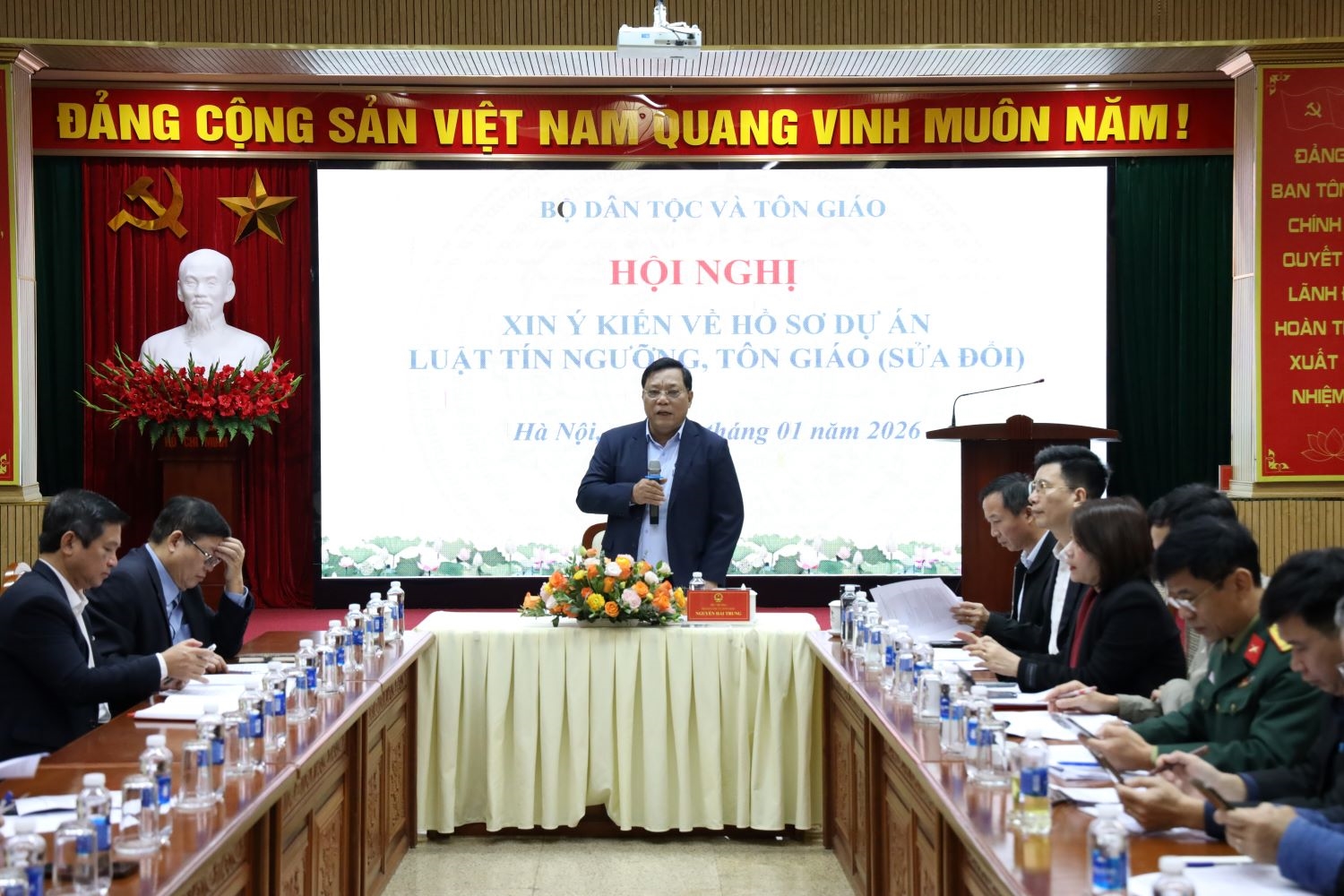
 Deputy Minister of Ethnic Minorities and Religion Nguyen Hai Trung chaired the conference to gather opinions on the draft Law on Beliefs and Religions (amended)
Keywords: Beliefs; Religions; Law on Beliefs and Religions.
1. Introduction
Freedom of thought, belief and religion is one of the human rights and a fundamental right of citizens, belonging to the group of civil and political rights enshrined in the Universal Declaration of Human Rights of 1948 and the International Covenant on Civil and Political Rights of 1966, to which Vietnam is a member: “Everyone has the right to freedom of thought, conscience and religion; this right includes the freedom to change one’s religion or belief and the freedom to express one’s religion or belief through teaching, practice, worship and ritual, either alone or with others, in public or in private”; “Everyone has the right to freedom of thought, belief and religion. This right includes the freedom to have or follow a religion or belief of their own choosing and the freedom to express their belief or religion alone or in public with others, in private or in forms such as worship, prayer, practice and teaching”.
Ensuring freedom of belief and religion is a crucial foundation, contributing to the healthy development of religious activities for the legitimate benefit of believers and religious organizations and for the common good of society as a whole, in the context of Vietnam accelerated integration and international exchange, national unity and building a life that is “good in this world and beautiful in the spiritual realm”.
2. Political basis for drafting the Law on Beliefs and Religions (amended)
Beliefs and religions have always been a focus of the Party's attention, with the viewpoint of “Ensuring the right to freedom of belief and religion and strictly enforcing the law on belief and religion” and “Beliefs and religions are a spiritual need of a segment of the population and will continue to exist alongside the nation in the process of building socialism in our country”, “Promoting the positive cultural and ethical values and resources of religions for the cause of national development”, “Combating activities that exploit beliefs and religions to affect political security, order and social safety”, “Timely prevention and countermeasures against the schemes of hostile forces that exploit issues of ethnicity, religion, democracy, human rights and incite ethnic division, oppose the Party, the State and the national unity bloc”, “Mobilizing, uniting and gathering religious organizations, dignitaries, officials, monks, and believers to live “good lives and beautiful faith”, in order to walk alongside the nation and actively participate in patriotic emulation movements launched by the Vietnam Fatherland Front and the government at all levels. Ensuring that religious organizations operate equally in accordance with the law and charters recognized by the State; paying attention to, creating conditions for and assisting in resolving the legitimate needs of religious followers in their religious, belief and spiritual activities. Respecting and encouraging the promotion of the positive cultural and ethical values and resources of religions for the cause of national construction and defense”. At the same time, the Party's resolutions also define the task of "Continuing to institutionalize and concretize promptly and fully the Party’s viewpoints and policies and the provisions of the Constitution on human rights, basic rights and obligations of citizens;... clearly define the responsibilities of state agencies in respecting, ensuring and protecting human rights and citizens’ rights. Upholding the principle that citizens are allowed to do everything that the law does not prohibit; citizens’ rights are inseparable from citizens’ duties and the exercise of human rights and citizens’ rights must not infringe upon national interests or the legitimate rights and interests of organizations and individuals”. “Need to focus on perfecting the legal system in all areas, promptly resolving difficulties and obstacles, unleashing and developing potential and human resources, creating new impetus for the rapid and sustainable development of the country, promoting democracy, ensuring and protecting human rights and civil rights,...; “Simplify administrative procedures, eliminate unnecessary procedures that cause inconvenience to citizens and businesses and hinder healthy competition; effectively apply online public services; Building a digital economy, a digital government, and a digital society”; “Promoting digital transformation, applying science and technology and innovation in the operations of agencies within the political system; Enhancing national governance efficiency and the effectiveness of state management in all fields, ensuring national defense and security”.
3. Legal basis for drafting the Law on Beliefs and Religions (amended)
The right to freedom of belief and religion is a right recognized and guaranteed by most countries in the world and Vietnam in the national legal system, in accordance with the socio-political situation of each country. The 2013 Constitution stipulates that everyone has the right to freedom of belief and religion, in order to follow or not follow any religion and that all religions are equal before the law. The State respects and protects the right to freedom of belief and religion. No one may infringe upon the freedom of belief and religion or exploit belief and religion to violate the law.
On June 16th, 2025, the National Assembly issued Resolution No. 203/2025/QH15 amending and supplementing a number of articles of the Constitution of the Socialist Republic of Vietnam and promulgated Law No. 72/2025/QH15 on the Organization of Local Government, creating a legal basis for the organization of two levels of local government. Furthermore, according to Clause 2, Article 11 of Resolution No. 190/2025/QH15 dated February 19th, 2025, of the 15th National Assembly on handling certain issues related to the reorganization of the state apparatus “authorized agencies and individuals must issue legal normative documents within their authority or submit them to competent authorities for issuance... to address documents affected by the reorganization of the state apparatus, ensuring completion before March 1st, 2027”. The Law amending and supplementing a number of articles of the Law on the Organization of the National Assembly No. 62/2025/QH15 stipulates: “The law only regulates issues of a stable nature, with long-term value, and policy contents of a principled and directional nature within the authority of the National Assembly; The regulations specify details related to human rights, citizens’ rights and obligations and issues that significantly impact social life. Regarding state management content in each sector, new issues with a developmental impact, and issues without practical experience, decentralization to the Government and agencies within the state apparatus should continue to concretize the provisions of the Law and implement decentralization in a manner consistent with the organizational capacity of each agency, organization and local government at all levels and promptly meet the requirements of socio-economic development in each stage; Essentially, it does not regulate administrative procedures, professional and technical standards or matters subject to high variability”.
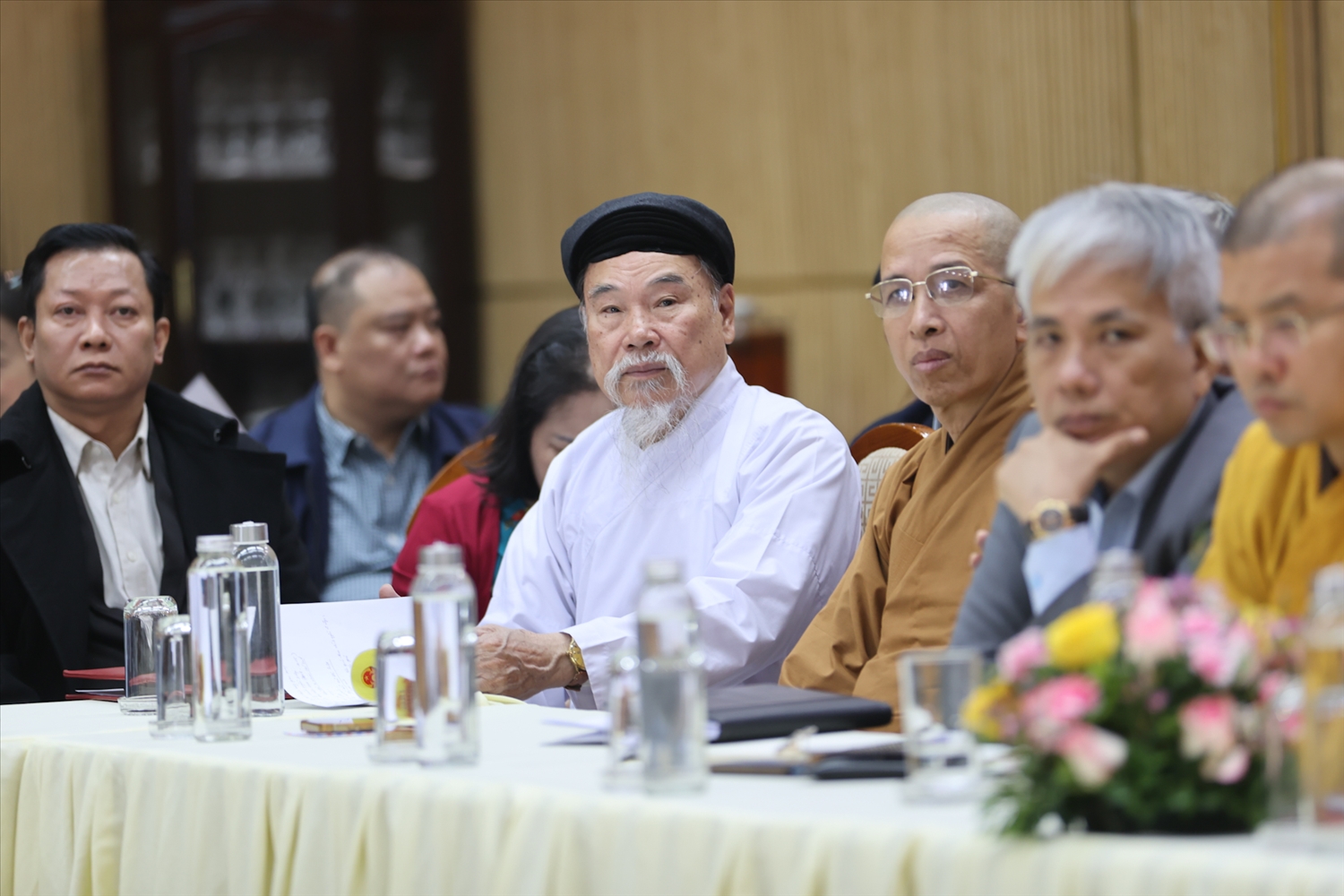 Religious leaders participated in a conference to gather opinions on the draft Law on Beliefs and Religions (amended)
4. Practical basis for drafting the Law on Beliefs and Religions (amended)
Over the past eight years of implementation, the 2016 Law on Beliefs and Religions has made a significant contribution to ensuring the freedom of belief and religion for individuals and organizations, at the same time enhancing transparency in the operations of state agencies. However, in response to the urgent need to streamline the state apparatus, drastically reform administrative procedures and methods, and promote the application of science and technology in state management, the Law on Beliefs and Religions of 2016 (effective from January 1st, 2018 to September 30th, 2025) has encountered some limitations and difficulties, specifically:
Firstly, the Law on Beliefs and Religions does not yet contain provisions on the principles and responsibilities of agencies, organizations and individuals when conducting religious activities in cyberspace.
Government Decree No. 95/2023/ND-CP dated December 29th, 2023, detailing some provisions and measures for the implementation of the Law on Beliefs and Religions (Decree No. 95/2023/ND-CP) has, to some extent, defined the forms of organizing religious activities, fundraising activities and receiving sponsorships in cyberspace through online methods or a combination of in-person and online methods. However, gaps and shortcomings still exist in the implementation process, specifically:
In terms of scope, Decree No. 95/2023/ND-CP only regulates the implementation of administrative procedures (changing the form of implementation from in-person to online or a combination of in-person and online) for religious activities, fundraising activities and receiving sponsorships. Regarding religious activities, the Law on Beliefs and Religions of 2016 and Decree No. 95/2023/ND-CP do not contain regulations specifically for religious activities.
Regarding the principles governing religious activities in cyberspace, Decree No. 95/2023/ND-CP has outlined several principles that must be followed when organizing religious activities, fundraising or receiving sponsorships online or in combination with online and in-person methods, however, these principles remain general and not specific enough, such as: compliance with the Constitution, the Law on Beliefs and Religions, regulations on information and communication, and other relevant legal provisions.
About the responsibilities of individuals and organizations engaged in religious activities in cyberspace, the 2016 Law on Beliefs and Religions does not yet contain provisions binding the responsibilities of individuals and organizations engaged in religious activities in cyberspace.
In the current context, religious activities in cyberspace are not only a new issue but also an inevitable reality in the digital age, posing urgent demands for the improvement of laws on religion and belief. This will create a legal framework that not only guarantees the right to freedom of religion and belief, ensuring that purely religious activities can operate smoothly and legally, meeting the diverse needs of the people, but also contributes to preventing acts of exploiting or using the name of religion and belief to violate the law, propagate superstition and infringe upon the interests of the State and the legitimate rights and interests of individuals and organizations. Therefore, it is necessary to fully and comprehensively regulate religious activities in cyberspace, not only through administrative procedures but also by officially recognizing in the amended Law on Beliefs and Religions the right of individuals and organizations to conduct religious activities in cyberspace; This regulation outlines the principles that individuals and organizations must adhere to when conducting religious activities in cyberspace, and the responsibilities of individuals and organizations engaging in religious activities in cyberspace; The responsibilities of competent state agencies and telecommunications enterprises in preventing, detecting, and strictly handling violations of laws on belief and religion in cyberspace.
Secondly, in order to operate the two-tiered local government organizational model, in the context of not yet being able to amend the Law on Beliefs and Religions of 2016, the Government issued Decree No. 124/2025/ND-CP dated June 11th, 2025, stipulating the decentralization and delegation of authority; defining the authority of the two-tiered local government in the field of ethnic affairs, beliefs and religions (Decree No. 124/2025/ND-CP). Of the total authority and responsibilities of the Government, ministries, and local authorities (provincial, district and commune People’s Committees) as stipulated in the Law on Beliefs and Religions of 2016 and Decree No. 95/2023/ND-CP, the powers and responsibilities have been decentralized and delegated to date; The division of authority includes 101 powers and responsibilities, of which the Ministry of Ethnic Minorities and Religion has 43; provincial People's Committees have 28; specialized agencies on ethnic minorities, beliefs and religions have 15; and commune People’s Committees have 15. Currently, the organizational structure and operation of the two-tiered local government system have led to some provisions of the 2016 Law on Beliefs and Religions related to the authority of the district-level People’s Committees becoming outdated, therefore, it is necessary to review, amend, and supplement the provisions of the 2016 Law on Beliefs and Religions to transfer the authority and functions of the district-level People’s Committees to provincial or commune-level agencies for appropriate implementation.
Thirdly, in the context of implementing the two-tiered local government organizational model, in order to promptly meet practical requirements and ensure continuity and smooth operation of the organizational structure, the Government has issued Decree No. 124/2025/ND-CP, which includes 56 administrative procedures at three levels (23 procedures at the central level; 24 procedures at the provincial level and 9 procedures at the commune level). Therefore, when amending the Law on Beliefs and Religions, the regulations on the responsibility for receiving and processing administrative procedures need to be adjusted accordingly and should not stipulate the responsibility of receiving and processing administrative procedures for the People’s Committees at the district level.
5. Conclusion
Based on the aforementioned political, legal, and practical foundations, it is necessary to conduct research to comprehensively amend the Law on Beliefs and Religions of 2016 in order to overcome the limitations and shortcomings in the implementation of the Law on Beliefs and Religions in the past, at the same time inheriting the still relevant provisions of the Law on Beliefs and Religions of 2016, creating more favorable conditions for individuals and organizations to exercise their right to freedom of belief and religion, continuing to promote the democratic and civilized values of humankind and socialism; Continue to implement decentralization and delegation of authority in the field of belief and religion; strengthen the application of information technology, digital transformation and simplifying administrative procedures in the field of belief and religion. This will contribute to further facilitating the work of individuals and organizations, ensuring that the system of agencies and competent authorities operates continuously, smoothly and without interruption, enhancing the effectiveness and efficiency of state management, in line with the policy on organizing the state management apparatus in the past and in the coming period.
* Head of the Government's Religious Affairs Committee
References
1. Resolution No. 24-NQ/TW dated March 12th, 2003, of the Central Committee of the 9th Party Congress on ethnic affairs in the new situation.
2. Resolution No. 25-NQ/TW dated March 12th, 2003, of the 7th Conference of the Central Committee of the Communist Party of Vietnam (9th term) on religious affairs.
3. Resolution No. 27-NQ/TW dated November 9th, 2022, of the 6th Plenum of the Central Committee of the 13th Party Congress on continuing to build and perfect the socialist rule of law state of Vietnam in the new period.
4. Resolution No. 43-NQ/TW dated November 24th, 2023, of the Eighth Conference of the Central Committee of the 13th Party Congress on continuing to promote the tradition and strength of national unity, building our country to become increasingly prosperous and happy.
5. Resolution No. 57-NQ/TW dated December 22nd, 2024, of the Politburo on breakthroughs in the development of science, technology, innovation and national digital transformation.
6. Resolution No. 66-NQ/TW dated April 30th, 2025, of the Politburo on reforming the work of drafting and implementing laws to meet the requirements of national development in the new era.
7. Directive No. 49-CT/TW dated October 20th, 2015, of the Party Central Committee on strengthening and renewing the Party’s mass mobilization affairs in ethnic minority areas.
8. Conclusion No. 65-KL/TW dated October 30th, 2019, of the Politburo on continuing to implement Resolution No. 24-NQ/TW of the Central Committee of the 9th Party Congress on ethnic affairs in the new situation.
9. Conclusion No. 121-KL/TW dated January 24th, 2025, of the 13th Central Committee of the Communist Party of Vietnam on summarizing Resolution No. 18-NQ/TW dated October 25th, 2017, of the 12th Central Committee of the Communist Party of Vietnam on some issues concerning the continued reform and restructuring of the political system's organizational apparatus to be streamlined, effective and efficient.
10. Conclusion No. 226-KL/TW dated December 11th, 2025, of the Secretariat of the Central Committee on rectifying working methods and improving the effectiveness of the political system.
11. Universal Declaration of Human Rights, 1948.
12. International Covenant on Civil and Political Rights of 1966.
13. The 2013 Constitution.
14. Resolution No. 203/2025/QH15 dated June 16th, 2025, amending and supplementing a number of articles of the Constitution of the Socialist Republic of Vietnam.
15. Law on Beliefs and Religions No. 02/2016/QH14.
16. Law amending and supplementing a number of articles of the Law on Organization of the National Assembly No. 62/2025/QH15.
17. Resolution No. 105/2025/QH15 dated September 26th, 2025, of the Standing Committee of the National Assembly on the Legislative Program for 2026.
18. Government Decree No. 95/2023/ND-CP dated December 29th, 2023, providing detailed regulations on a number of articles and measures for the implementation of the Law on Beliefs and Religions.
19. Government Decree No. 124/2025/ND-CP dated June 11th, 2025, stipulates the decentralization and delegation of authority; and the delineation of the authority of local governments at two levels in the field of ethnic affairs, beliefs and religions.
20. Decision No. 2352/QD-TTg dated October 24th, 2025, of the Prime Minister assigns the lead agencies for drafting and sets deadlines for submitting draft laws, ordinances and resolutions in the 2026 legislative program.
21. Directive No. 23/CT-TTg dated July 9th, 2023, of the Prime Minister on promoting administrative procedure reform for issuing criminal record certificates to facilitate citizens and businesses.
22. Report No. 3254/TTr-BDTTG dated December 31st, 2025, from the Ministry of Ethnic Minorities and Religions to the Government on the policy dossier of the Law on Beliefs and Religions (amended).
23. Report summarizing the implementation of the Law on Beliefs and Religions of 2016.
