Keywords: Buddhism during the Tran Dynasty; Tran Nhan Tong; Missionary work; The new time.
1. Introduction
In the historical development of Vietnamese Buddhism, the Tran Dynasty (1225-1400) was a glorious and brilliant period of development in the fields of military, politics, economics, culture, ideology, education and art,... During this period, the Tran Dynasty had talented kings and generals such as Tran Thu Do, Tran Thai Tong, Tran Thanh Tong, Tue Trung Thuong Si... and of course, we cannot fail to mention Emperor Tran Nhan Tong, a wise ruler and the founder of the Truc Lam Zen sect, which is deeply rooted in national identity. His thoughts and actions not only profoundly shaped the spiritual life of his time but also contained timeless values.
In the context of a rapidly changing modern society, applying the wisdom of Emperor Tran Nhan Tong to the work of propagating Buddhism has become extremely urgent. The application of his ideas, especially the spirit of engagement with the world (meaning participating in social life, integrating into society and contributing to the overall development of the nation and country), “living in the world while still finding joy in the Dharma” (meaning living in the world while still finding joy in the Dharma), the unity of religion and life, compassion and wisdom, from there, proposing creative application directions that are in line with the trends of the new time, aiming to spread the Dharma effectively and harmoniously.
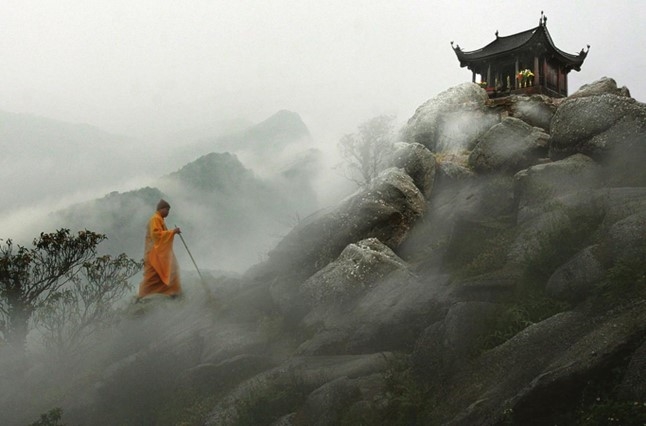 Dong Yen Tu Pagoda, where Emperor Tran Nhan Tong practiced Buddhism and attained enlightenment
2. Heroes fighting against foreign invaders
Tran Nhan Tong, whose real name was Tran Kham (1258 - 1308), he was the eldest son of Tran Thanh Tong, the second king of the Tran dynasty of Dai Viet and the former Empress Thanh Thien Cam. 747 years ago (almost 10 centuries ago), on October 22nd, Mau Dan year (1278), Tran Kham inherited the throne from his father. King Thanh Tong was honored as the Retired Emperor and ruled the country together with Nhan Tong until his death in 1290.
King Tran Nhan Tong ascended the throne at a time when the independence of Dai Viet was seriously threatened. This was because, in the North, the Yuan-Mongol army had almost completely conquered the Nam Tong dynasty and Dai Viet in the South was the next target. Immediately after his ascension to the throne, the Yuan emperor Kublai Khan sent General Chai Thung to use the pretext that Tran Nhan Tong had “usurped the throne without seeking permission” to force the Tran king to come to the imperial court.
The envoy Sai Thung was treated kindly by King Tran Nhan Tong, but resolutely refused to come to the royal court. Facing the threat of invasion from the Yuan-Mongol army, the emperor implemented numerous policies aimed at developing the economy and ensuring national stability and unity.
Because the envoy Sai Thung failed to persuade the Tran dynasty’s king and his court, so in February 1285, Prince Thoat Hoan, a military general ordered O Ma Nhi to lead troops and ships to invade Dai Viet. Under the brilliant leadership of the king and the fierce resistance of Tran Quoc Tuan, they defeated and repelled the Mongol-Yuan attack. In July 1285, King Tran Nhan Tong released the Champa prisoners of war (who had been captured by the Yuan army during Toa Do’s invasion of Champa in 1283) and allowed them to return to their country. The list of regular Mongol-Yuan prisoners of war was also released and allowed to return home in the spring of 1286.
With the ambition to invade Dai Viet once again, in December 1287, the Yuan dynasty divided its land and naval forces into three armies and advanced straight into Dai Viet. Not long after, on April 19th, 1288, the Mongol army was completely driven out of Dai Viet.
Historical records, as documented in the Imperial Annotated Comprehensive History of Vietnam stated: “At that time, the Nguyen dynasty had just risen to power and its arrogance was immense, the Tran dynasty was fortunate to have risen at that time and with emperors like Thai Tong and Thanh Tong and many talented civil and military generals, they were able to defeat the invaders and preserve the country, if they had faced other rulers, who knows what the outcome would have been”.
A memorable milestone in time was in the tenth lunar month of 1299, after abdicating the throne to his son, King Tran Anh Tong, King Tran Nhan Tong left the capital and went to Yen Tu Mountain (Quang Ninh province), taking the Buddhist name Huong Van Dai Dau Da and practicing the twelve ascetic practices (twelve acts of asceticism). He also used other religious names such as Truc Lam Dai Dau Da, Truc Lam Dai Si, and Giac Hoang Dieu Ngu.
The historical records continue, in the “History of Constitutional Classification” (the first encyclopedia of Vietnam, compiled by Phan Huy Chu from 1809-1819, comprehensively recording all aspects of history, society, culture, customs and institutions through the dynasties from the Hong Bang period to the late Le dynasty in a categorized form), Phan Huy Chu commented on King Tran Nhan Tong: “The king was benevolent, intelligent, compassionate towards the people and his benevolence united the people’s hearts”. During the king's reign, the Mongol army invaded twice. The king selected generals, trained troops and successfully repelled the major invaders. The restoration (meaning the recovery, revival of the nation’s prosperity and development) was more brilliant than before. After abdicating the throne, the king devoted himself to Buddhist scriptures, built the Thien Kien hermitage, casting the Pho Minh cauldron and worshipped Buddha very diligently. Later, he became a monk on Yen Tu mountain and died at Ngoa Van hermitage”.
3. King Tran Nhan Tong’s contributions to the legal system
After the complete victory over the Yuan-Mongol army, the government implemented a policy of general amnesty for the entire population, exempting all war-torn areas from taxes and reducing taxes for other regions across the country.
Having just gone through a period of war, King Tran Nhan Tong, the head of the Dai Viet nation at that time clearly understood the need to focus on rebuilding the country, stabilizing society, improving people’s lives and developing the nation. When the country was free from enemy forces, establishing and building a framework of laws became the basis and foundation for nation-building, with the motto of “putting the people first”, a principle thoroughly implemented by King Tran Nhan Tong in his legal system.
In the book, Dai Viet History Chronicle Complete Edition, it was written: “On February 27th, the king returned to the capital in the summer of April, 1288 (the year of Mau Ty), depending on the situation, he granted amnesty and varying degrees of punishment to those who surrendered to the enemy”. If a crime was punishable by the death penalty but the offender had to transport wood and stone to build a palace as atonement, officials who committed crimes were punished differently depending on the severity of the offense. In particular, the villages of Ba Diem and Bang Hang are noteworthy because, during the war against the Yuan-Mongol army, the people of these two places did not resist the invaders but quickly surrendered, allowing them to easily advance deep into our territory.
In a situation where the entire village was guilty of surrendering to the enemy, King Tran Nhan Tong cleverly and humanely punished them while maintaining the strictness of the law, he ordered the soldiers and civilians of the two villages of Ba Diem and Bang Hang to serve as soldiers, forbidding them from joining the ranks of officials, except for the chief minister (the highest official position in the feudal era, representing the king in governing national affairs), who was granted the title of imperial historian (Supreme Emperor).
Regarding the administrative apparatus, King Tran Nhan Tong reorganized it, believing that officials were like parents to the people, and had to love them as their own children, he devoted much effort to selecting civil officials for the provinces (administrative units in feudal of Vietnam under the Tran dynasty, to be a local organization level below the district and above the prefecture), governing the country according to law, thereby creating favorable conditions for production and a peaceful life, bringing justice to the people. For officials, the king established and promulgated inspection, auditing, and supervisory agencies to ensure an honest and clean bureaucratic system. When the king discovered that officials were abusing their power and position to harass and extort the people, leading to resentment and hardship, he also had ways of handling the situation that were both strict and skillful, opening the hearts of the people, correcting their ways to live virtuously and guiding them back to their honest nature. Because the king believed that greed was merely a temporary condition obscured by objective circumstances, overshadowing the inherent goodness of human nature, if it were detected in time, properly corrected, given the opportunity to amend their ways, people would be fully capable of restoring their virtue.
4. Fair and reasonable law enforcement wins the hearts of the people
In 1292, the case of Phi Manh, the An Phu official of Dien Chau, who was accused of embezzlement, to be recorded in the Complete History. The king ordered him summoned to the capital for punishment, where he was flogged, but he was later allowed to return to Dien Chau and retain his position. After that disciplinary action and punishment, official Phi Manh became famous for his integrity, to the point that a folk saying went: “The governor of Dien Chau is as pure as water”.
The king valued talented people and appointed several meritorious and virtuous individuals, such as Phung Si Chu, as Hanh khien (an official position in the royal court with the role of managing and supervising affairs); Tran Thi Kien served as An Phu of Yen Khanh province (Tran Thi Kien held the position of An Phu Su in Yen Khanh (or Yen Ninh), after being appointed as An Phu Su of Thien Truong prefecture). He was recommended by Hung Dao King and initially appointed to Thien Truong Palace, where the Tran kings’ royal residence was located, before being transferred to Yen Ninh Palace. As the state apparatus gradually returned to normal operation after the war, officials who were knowledgeable about the law and capable of organizing the people’s lives increasingly well were highly valued. The king’s use of talented people, especially those knowledgeable in law, legal matters, and administrative management, not only made administrative management smooth, transparent and efficient, but also guided the people to live in accordance with the law. The philosophy remains valuable to this day, the king'’ method of strict punishment is still a profound lesson, as he did not use the offender in the exact position where the offense occurred to rectify the situation (this lesson emphasizes that the application of law must be fair, without discrimination between classes or social statuses; this is a progressive aspect of the doctrine of rule of law compared to older concepts).
According to the book Dai Viet Su Ky Toan Thu, Chi Hau Cuc Thu (Chi Hau Cuc Thu was the name of a vassal, a general term for officials granted titles by the king, holding positions in the court during the feudal period in Vietnam, similar to the title of a high-ranking official or the head of a department, a division, an agency in the Tran dynasty court during the period of 1225-1400). Do Khac Chung had a younger brother named Do Thien Hu who once sued someone, although Do Thien Hu was in the wrong both morally and legally, but the judge presiding over the case showed favoritism towards him. The accused, seeing King Tran Nhan Tong walking outside the city, approached him to plead his case. The king’s assessment of the judge was: “That was due to fear and avoidance of Do Khac Trung, then the king immediately appointed Tran Hung Thao, Chief of the Imperial Secretariat and concurrently holding the position of Inspector of Justice to reinvestigate (Tran Hung Thao held the position of Imperial Secretariat - this informational position seems to be a mistake or lacks clear historical basis). The term Noi thu hoa” could be the name of an official position during the feudal era, while “kiem phap quan” refers to the function of judicial supervision), in the end, Do Thien Hu had to admit his mistake. This demonstrates the leadership's ability to govern effectively and more importantly to establish a foundation for the government when enacting and enforcing laws. Besides strictly adhering to the law, it is also necessary to have tolerance, giving offenders a chance to correct their mistakes, reform, and realize what is right and wrong, becoming useful members of society. Expanding compassion and using morality as the foundation for a strict yet compassionate legal system will build a well-ordered and disciplined nation, where laws are implemented voluntarily. This can be said to be the clearest evidence of the supreme guiding principle regarding judicial proceedings, demonstrating a humane approach that flexibly balances emotion and reason and discerning between genuine and fictitious emotional responses. The lesson learned is that King Tran Nhan Tong paid great attention to ensuring that no innocent person was wrongly convicted, but also that no one deserving of punishment was overlooked in the judicial process.
King Tran Nhan Tong’s contributions to the construction and development of the legal system of the Tran Dynasty are documented in numerous historical records, particularly in the Dai Viet Su Ky Toan Thu (Complete History of Dai Viet), these records passed down to posterity, highlight his immense contributions to the legal system of the Tran Dynasty, primarily through decrees, orders, edicts and proclamations, the main content of these documents is reflected in the laws found today in Criminal, Administrative and personnel organization Laws… that was the administrative action when he granted amnesty to the people and exempted them from taxes. That was the organizational law when he appointed officials knowledgeable in law to govern the provinces (which were large-scale local administrative units, ranking below administrative levels such as districts or towns, but before smaller units such as prefectures, counties, districts and communes); dealing with corrupt officials involves imposing strict penalties but also providing them with opportunities to correct their mistakes and become honest officials. After King Tran Nhan Tong retired to the royal palace as regent, he complained more than once to his son, King Tran Anh Tong (1276-1320), because this king appointed too many officials: “How can a country as small as the palm of a hand have so many official titles?” Furthermore, he enacted many anti-corruption laws, which were initially developed and perfected during the reign of Tran Anh Tong.
5. Established and founded the Truc Lam Zen sect
Despite his royal lineage, his character and demeanor were those of an transcendent being. From a young age, he disliked meat and fish, silk and brocade, worldly pleasures, as he grew older, he regarded palaces and royal chambers as mere worn-out sandals, which is why he attempted to flee to Yen Tu but failed and reluctantly ascended to the throne. He reigned for 13 years, including 6 years as the Retired Emperor, only then was he able to fulfill his ambition of becoming a monk, a mountain hermit, and eventually becoming the First Patriarch of Truc Lam Yen Tu, founding the Zen school of Buddhism in Vietnam. King Tran gracefully departed from that place as easily as shedding a summer robe. He ascended the throne out of filial piety towards his elderly father and a deep sense of responsibility towards his country. Setting aside personal feelings and placing the will of the people above his own, and not betraying his father, King Tran Nhan Tong brilliantly achieved glorious victories to protect the country through the two historic wars against the Yuan-Mongol invaders.
The sacred land and its people, imbued with the spiritual energy of the mountains and rivers, molded a king of dragon and fairy blood, invincible against all foreign powers, yet possessing a benevolent, tolerant, humane and compassionate heart in governing the country and ensuring the well-being of the people, he is like a shining star in the thousand-year-old cultural sky of our nation. Though history may turn a new page, his merits and contributions will forever endure in the hearts of the Vietnamese people.
And there was another invisible bloodline, the bloodline of Thich Tu Nhu Lai (the Buddha) silently flowing in the heart of Tran Nhan Tong, nurturing an aspiration and boundless wisdom. That bloodline served as a powerful driving force, propelling the king to the pinnacle of power, fame, and imperial achievement... but also fraught with the ups and downs of the ever-changing world (The phrase “ever-changing world” literally means the blue sea turning into a mulberry field, figuratively refers to the great changes and vicissitudes of all things, history and life, signifying the impermanence and unpredictable transformations of the world. This phrase refers to the immense, unpredictable changes in nature, making people feel that human life is small and short). It was this same bloodline that transformed the king from an ordinary human being, transcending worldly desires, into a Zen monk living a simple life with a lofty and tranquil will (A lofty and tranquil will refers to a strong, resilient will capable of overcoming all difficulties to achieve one’s goals. The term “noble serenity” can refer to a superior, steadfast state of mind, unshaken by challenges or the will to attain “nobility” and “tranquility” of soul after achieving a goal).
“In childhood, never truly understood form and emptiness
Spring arrives, flowers bloom, filling my heart with joy
The Lord of Spring has been discovered by us
A mat spread on the bed for meditation while gazing at rose petals”.
6. Applying the Buddhist missionary ideas of Emperor Tran Nhan Tong to current missionary work
The Buddha tirelessly and continuously taught for 45 years in the Southern tradition (Theravada Buddhism) and 49 years in the Northern tradition (Northern Buddhism), with over three hundred Dharma assemblies, approximately eighty thousand sermons, his main goal was to enable everyone to understand and apply Buddhist teachings to all aspects of life, to be liberated from suffering, in order to attain peace and happiness.
Dharma propagation (is the act of widely and deeply disseminating the teachings of the Buddha to all people, aiming to awaken wisdom and bring benefit and peace to sentient beings. The word “hoang” means great, expansive and “phap” means doctrine, the Buddhist path), it’s not just empty preaching or teaching, but must be exactly as the Buddha taught: “Go forth, monks, for the benefit and happiness of the many, out of compassion for the world, for the benefit and happiness of gods and men. Masters, go forth, but don’t go two at the same time; go each in a different direction and spreading the true Dharma”. Dharma propagation is the path, method, action that reflects the engaged spirit of the Truc Lam Zen school from ancient times to the present day. “Those who renounce worldly life and become monks, with their extraordinary nature and unconventional minds, propagate the sacred lineage, subdue demonic forces, repay the four great debts of gratitude and liberate the three realms of existence” (Those who renounce the world and become monks, taking one step towards the vast horizon, their form and soul are different from those of ordinary people, causing the sacred lineage to flourish, subduing demonic forces, repaying the four great debts above and relieving the suffering of the three realms below).
The Truc Lam Zen sect emerged to meet the demands of the times, during the Tran dynasty, Buddhism flourished and became the dominant ideology in the political life of our country at that time. With a spirit of adaptability, harmony with the world, finding joy in the mundane, and engaging in worldly affairs, Zen masters have emerged who are always oriented towards integrating with life and contributing to the nation and its people.
The philosophy employed by Tran Nhan Tong was the doctrine of “ten virtues and the observance of the five precepts”, primarily based on the idea that humanity and the mind are Buddha-like. Mind is Buddha, Buddha is Mind; this is the foundation for all reasoning, action, and realization: “Introspective Buddhism, which focuses on discerning the mind, to be Buddhism that is egalitarian and non-discriminatory, whether one lives in the world or in seclusion in the forest, it doesn't matter whether one lives at home or in a monastery, as a monk or a layperson; the only thing that matters is cultivating one’s mind. Turn around, look inward, and if can turn the light reflecting back into your own heart, you will see your true nature and attain Buddhahood that is, realizing your true nature and becoming a Buddha. This is Buddhism for everyone and everyone can practice it anywhere, anytime. That was the foundation that created the strength of Zen Buddhism during the Tran Dynasty”. The Way (Religion) must be practiced within the world; it cannot be isolated from the people, but must take the people as the object of service and the realization of the wisdom of the Way (Religion).
Today, the Truc Lam Zen sect is a synthesis of spiritual practice and social integration, from its organizational structure and guiding ideology to its training schedules and sermons, all of which are in line with current social conditions, harmonizing with the traditional values of Vietnam: “For knowledgeable and discerning people, the Truc Lam Zen school is very practical in its approach to human behavior. From actions, thoughts and words, one can recognize mistakes and change them, knowing this prevents causing suffering to others, thereby illuminating one’s own actions. That is the most distinctive and essential aspect”.
Today, with the continuous development of science, technology, digital technology and artificial intelligence. The work of spreading the Dharma has many advantages, but it also faces many challenges. Whether Buddhist or non-Buddhist, they may be intellectuals, scientists, psychologists, businesspeople,… possessing a high level of knowledge and awareness, can they understand whether a sermon or scripture delivered by a Buddhist monk is persuasive and highly applicable?
7. Conclusion
Emperor Tran Nhan Tong and the Truc Lam Zen sect are symbols of the harmony between spirituality and worldly life, between the ideal of enlightenment and social responsibility. This school of Zen Buddhism not only developed Buddhism in a way suitable for the Vietnamese people, but also played a major role in building a spirit of self-reliance, self-strength, and patriotism, contributing to shaping the national cultural identity throughout history.
The new time, with its constant changes, presents challenges but also opens up many opportunities. Applying the profound wisdom and boundless compassion of Emperor Tran Nhan Tong to modern methods of Dharma propagation brings practical benefits to the community and is an extremely necessary endeavor. We believe that, with continuous efforts, flexible creativity and fervent dedication to propagating the true Dharma, based on the philosophical foundation of Emperor Tran Nhan Tong, Buddhism will spread ever wider, contributing to building a peaceful, happy and sustainably developing society.
References
1.https://baomoi.com/chuyen-thuc-thi-phap-luat-thoi-tran-khi-quan-ao-xanh-lam-kiem-phap-r39015698.epi
2.https://giacngo.vn/phat-hoang-tran-nhan-tong-linh-hon-cua-thien-phai-truc-lam-post59856.html
3. https://ktcc.edu.vn/y-chi-la-gi/
4. https://phatgiao.org.vn/tu-dien-phat-hoc-online/phat-chung-k39894.html
5.https://tnti.vnu.edu.vn/su-nhat-the-cua-thien-lac-va-thi-hung-hay-tieng-hoan-hy-cua-tam-khong-luan-ve-ba-bai-tho-canh-chieu-ta-cua-tran-nhan-tong/
6.https://tapchinghiencuuphathoc.vn/ung-dung-tu-tuong-hoang-phap-cua-tran-nhan-tong-trong-giai-doan-hien-nay.html
