1. Introduction
Vietnam is a unified nation, yet it possesses a diversity of cultures, ethnicities, and religions. With 54 ethnic groups living together for generations, including 53 minority groups, comprising over 14 million people (approximately 14.7% of the country’s population), they live in communities, interspersed and mainly concentrated in the Northwest, Central Highlands, Central Coast and Southwest regions (Hau A Lenh, 2025). Furthermore, with over 27.7 million followers (Ha Anh, 2025) of various religions, this is not only a demographic characteristic but also a profound socio-cultural foundation that shapes the unique identity of our country. Throughout history, whether facing war, natural disasters or economic upheavals, the unity of ethnic groups and religions has been the strong bond connecting the people, maintaining national unity - a decisive factor in all the victories of the Vietnamese revolution.
Today, as the country enters a new stage of development, with higher demands for innovation in the growth model, deep international integration, and firm protection of national sovereignty, the cooperation of ethnic groups and religions is not only an essential requirement but also a strategic driving force for rapid and sustainable development. The practical, quiet, yet meaningful contributions of ethnic minorities and religious followers to the economic, cultural, social and national defense and security aspects of life over the years are vivid evidence of the spirit of “walking alongside the nation” in the new period.
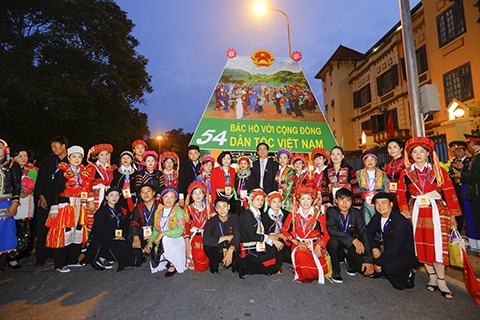 The diverse ethnic communities of Vietnam march forward under the banner of the Fatherland
However, alongside the achievements, significant challenges remain: the development gap between ethnic minority and mountainous regions and the plains; the risk of exploiting religion and ethnicity to divide national unity; distorted perceptions of freedom of religion among some people; and especially the increasingly sophisticated influence of hostile forces through cyberspace…
In this context, a thorough reassessment of the role, position, contributions, and potential of ethnic and religious communities in the current national development is essential. This is not only to accurately assess the current situation, but also to awaken and develop internal strengths, consolidate confidence and enhance national unity - the most important foundation for building a strong, prosperous, democratic, just and civilized Vietnam.
2. Research results
2.1. Ethnicity and religion: An integral part of the Vietnamese national community
The thousand-year history of nation-building and national defense of the Vietnamese people has proven a simple yet sacred truth: all victories of the nation stem from the strength of national unity. Within that unity, the communities of ethnic minorities and religions are not “an external part” or “different” from the national structure, but are an integral part, an inseparable element in the flow of history, culture and the very soul of the Vietnamese nation.
Vietnam - a country united in diversity, is home to 54 ethnic groups living in harmony, each ethnic group has its own language, customs and culture, but all share the same love for the country and the same heart towards their roots. From the northern mountains to the Mekong Delta, from the villages of the Central Highlands to the remote islands, everywhere one sees the strong bonds between the Vietnamese, Thai, Muong, Mong, Dao, Khmer, Cham, Tay and Nung communities… They work together, build together, share hardships together and make sacrifices together when the Fatherland is in danger.
Alongside this, religious and spiritual life is an indispensable part of the Vietnamese spirit. Buddhism, Catholicism, Hoa Hao Buddhism, Cao Dai, Protestantism… and many other religions not only exist as personal beliefs but also play an important role in shaping the system of moral values, social norms and national cultural identity. Wherever there are village temples, churches, majestic cathedrals, or folk shrines, there is also the sound of bells reminding us of compassion, tolerance, forgiveness and goodness, core qualities that nurture the spiritual life of the Vietnamese people.
Throughout history, when the country was invaded, it was the ethnic minorities and religious followers who did not stand idly by. During the resistance wars against the French and the Americans, countless people from the mountainous regions were ready to carry rice, shelter cadres and dedicate themselves to protecting the revolution. Countless religious followers rose up to fight for independence and patriotism, demonstrating both faith and action. Examples like Hero Núp (of the Bana ethnic group), Hero Cu Chinh Lan (of the Thai ethnic group) or Father Nguyen Van Vang - who was imprisoned by the French colonialists for harboring revolutionary cadres - will forever be powerful evidence of the enduring connection between ethnicity, religion and the destiny of the nation.
Currently, as the country enters a new period of development, ethnic and religious communities not only continue to live virtuous lives but also make practical contributions to the development of their homeland. They are charitable medical practitioners, ethnic minorities involved in community tourism and environmental conservationists. They are priests who encourage parishioners not to litter in the sea, Buddhist monks who care for orphans, and exemplary village elders who mediate disputes and maintain security in their communities. In them, religious ethics blend with national values, all working towards the same goal: building a better, more humane society.
It is undeniable that the harmonious blend of ethnic, religious, and patriotic traditions has created a unique soft power for Vietnam. This is the power of trust, community cohesion, of a culture that values loyalty and compassion, the spirit of “helping those in need”. It also serves as a “glue” that binds society together, especially valuable in the current context where human values are facing numerous challenges from the negative aspects of globalization, extreme individualism, and religious division and radicalization that many parts of the world are grappling with.
2.2. The consistent policy of the Party and the State: Ensuring freedom of belief and religion and to promote the strength of the community
Freedom of belief and religion is one of the basic human rights, recognized, protected and respected by the Vietnamese Constitution and law. During the process of leading the country, our Party and State have always determined that belief and religion are the spiritual needs of a part of the people. It is from this perspective that an increasingly comprehensive, synchronized, and humane system of policies and laws has been implemented to both ensure religious freedom and promote the positive role of religious organizations, clergy and followers in the cause of national construction and defense.
Firstly, the guiding principle throughout is: Respect - Guarantee - Unity - Development.
The 2013 Constitution and especially the 2016 Law on Beliefs and Religions have clearly established a comprehensive legal framework for the right to freedom of belief and religion. This is the first time Vietnam has had a specialized law that comprehensively regulates religious activities, clearly demonstrating the spirit of the rule of law and the State’s commitment to protecting human rights.
The law clearly states: “Citizens have the right to freedom of belief and religion; they have the right to follow or not follow any religion. All religions are equal before the law” (Law on Belief and Religion, 2016).
Based on this legal framework, a series of decrees and guiding circulars have been issued to specify the rights and obligations of religious organizations, creating a transparent and open legal environment, contributing to minimizing unnecessary administrative interference and enhancing the autonomy and responsibility of religious organizations.
Secondly, religion is not aloof - the Party and the State are not aloof from the people’s beliefs.
In practice, the correct policies of the Party and the State have created conditions for religions to develop healthily, contributing to political stability, social order and economic, cultural and moral development in the community.
Up to now, the country has a diverse and vibrant religious life, with over 95% of the population adhering to a religion or belief. 43 organizations belonging to 16 religions have been recognized and granted registration certificates, with over 27.7 million followers (Ha Anh, 2025) (accounting for approximately 27% of the population).
In particular, there are over 60,000 religious leaders and nearly 30,000 places of worship that are recognized as operating legally. All major religious organizations have their own training systems, facilities and spaces for worship and are protected by law.
Not only are religions given administrative support, but they also receive state support in charitable activities, healthcare, education, cultural heritage preservation, and participation in patriotic emulation movements. Particularly during the recent COVID-19 pandemic, the image of monks, priests and religious followers volunteering on the front lines left a beautiful impression on the people nationwide.
In many places, religious leaders are not only responsible for the spiritual well-being of their followers, but also serve as a reliable bridge between the Party, the government, and the people. Models such as “Parishes safe in terms of security and order”, “Temples with green, clean and beautiful landscapes” and “Religious followers living virtuous lives”… are proving effective, clearly demonstrating the community role of religions.
Thirdly, ethnic-religious solidarity: Not just a slogan, but a core value of development policy.
One of the distinctive features of religious policy in Vietnam is its close connection with ethnic policy, placed within the overall policy of national unity, a solid foundation for political stability and sustainable development.
In practice, ethnic minority and mountainous regions are also home to many religions that exist and thrive. Therefore, programs such as the National Target Program for Socio-Economic Development of Ethnic Minority and Mountainous Regions for the period of 2021-2030 are particularly important.
In many localities, the government has closely coordinated with religious leaders and influential figures to encourage people to abandon outdated customs, eradicate superstition, prevent illegal proselytizing activities, and simultaneously develop the economy and preserve cultural identity. As a result, many areas that were once “hot spots” regarding ethnicity and religion have become “bright spots” in building new rural areas, developing communities and ensuring security and order.
Fourthly, the policy must be correct, but it needs to be accompanied by vibrant practical implementation and lasting belief.
Although Vietnam’s policies on ethnicity and religion are increasingly recognized internationally as progressive and consistent with human rights standards, numerous challenges remain in their implementation at the grassroots level.
Therefore, in order for the policy to truly penetrate the hearts of the people, we really need companionship from many sides, such as: (1) The initiative of governments at all levels in listening, dialogue, and solving problems with understanding and reason; (2) Sharing, cooperation and social responsibility of religious organizations; (3) And most of all, it is the people’s belief that the State does not stand outside their beliefs, but always puts the legitimate rights of the People, no matter who they are or what religion they belong to - first.
2.3. Accompanying the Nation: The role and practical contributions of religious organizations and ethnic groups in the current period
In previous historical periods, ethnic minority communities and religious organizations were core forces accompanying the revolution in the struggle for independence, today, in a period of strong national transformation, deep integration and comprehensive reform, the role and contributions of religions and ethnic minorities are increasingly clear, practical and strategically significant for the sustainable development of the nation.
Firstly, contributing to strengthening national unity – the foundation of stability and development.
Secondly, playing an active role in socio-economic development and the construction of new rural areas.
Thirdly, contributing to maintaining security and order, building a cultural life and combating hostile forces.
Fourthly, contributing to cultural dialogue, social reconciliation and international integration.
Fifthly, unleash the inherent strengths and spirit of self-reliance and self-improvement within each community.
2.4. Building trust and strengthening national unity: A shared responsibility of the entire society
Throughout history, unity has always been a fundamental value, the “national essence”, and the greatest source of inherent strength for the Vietnamese people. From the Viet Bac war zone to the Dien Bien Phu campaign, from the National Liberation Front of South Vietnam to the comprehensive reform and international integration of today, every step forward for the country has been marked by the unwavering solidarity among all strata of the people, regardless of ethnicity, religion, region or social class.
National unity, as President Ho Chi Minh once affirmed, is the “top strategic priority” and the “most fundamental policy” for maintaining national independence, protecting the Fatherland, and building socialism. In the new era, when the country faces many opportunities for development but also numerous challenges, strengthening national unity is even more vital and must be identified as a shared, long-term and enduring responsibility of the entire political system and society.
Firstly, faith - the core of national unity.
There is no genuine unity without trust. No thriving community exists without mutual confidence. In the relationship between the State and the People, between the people and the government and between different ethnic groups, trust is the glue that binds them together, to be an invisible yet strong bridge.
That trust cannot be built solely from appeals, slogans, or political documents, but must be built through practical action: from correct, fair, and consistent policies; from listening to and respecting each other; from concrete results in socio-economic development, poverty reduction, ensuring human rights and freedom of religion; and from cultured and responsible behavior among all segments of society.
In orrder to build and maintain trust, the first step is to recognize religion and ethnic minorities not as “problems” to manage, but as “partners” to work together with. These are organized communities with their own values, significant social influence and most importantly, a desire to work together and contribute to the nation.
Secondly, the entire political system must get involved with concrete and practical actions.
The Party’s policies and the State’s laws on national unity, freedom of belief and religion, and development in ethnic minority areas are clear, consistent and progressive. However, these policies only truly come to life when implemented with the heart of the officials, with a proactive, responsible attitude and a spirit of “being close to the people, respecting the people and serving the people”.
Thirdly, religions and ethnic groups need to continue to play an active and responsible role towards the community and the country.
Building national unity is not only the responsibility of the government, but also the responsibility of every citizen and every social organization, in which religious organizations and ethnic minority communities need to be more proactive, creative and positive. This responsibility is demonstrated in: (1) Living a life of “goodness and virtue”, connecting religion with life and linking religious beliefs with civic duties; (2) Actively participating in patriotic emulation movements, building new rural areas and civilized urban areas; (3) Joining hands to protect the environment, prevent and combat natural disasters, support the poor and take care of social welfare; (4) Participating in moral education, preserving traditional culture, building happy families and united villages; (5) And most importantly, resolutely not allowing oneself to be exploited, not assisting in acts of ethnic division, religious distortion and extremism.
Fourthly, building trust and national unity is a long process that requires perseverance, persistence and sincerity.
There are no shortcuts to achieving social consensus. Nor is there a magic wand to resolve all conflicts and differences in beliefs, culture, and lifestyles. Only sincerity, patience and faith in human values, in the common ground of compassion and patriotism are the “golden key” to unlocking the door to unity and consensus. Therefore, we need to steadfastly pursue the goal of building a society where: (1) Every citizen, regardless of ethnicity, religion, or lack thereof, has the opportunity to contribute, develop and be respected; (2) Every religious organization and ethnic community is given the opportunity to develop healthily, closely connected with the community and with the State; (3) All conflicts and differences are resolved in the spirit of dialogue, understanding, and placing the common interests of the nation and people above all else.
3. Discussion
In the process of national development under the socialist orientation, arousing and promoting the strength of national unity, including the active participation of religions and ethnic minorities is not only an objective necessity but also a strategic choice for the stable and sustainable development of the nation. However, for this major policy to truly take root and become a driving force and internal strength of the country in the era of deep international integration, it is still necessary to objectively, frankly and comprehensively examine and discuss a number of issues arising from practical experience.
Firstly, religion and ethnicity are not “social issues” that need to be managed, but rather “partnerships” that need to be respected and promoted.
The consistent stance of the Party and the State throughout the years has been to stand alongside ethnic groups and religions.
This necessitates a genuine change in approach to policy, not only through legal documents, but also through political attitudes and practical actions. Ethnicity and religion are an integral part of the Vietnamese nation, forces directly involved in the nation-building process. They are not standing on the sidelines, nor are they demanding special treatment; rather, they desire recognition, trust and the opportunity to fulfill their social responsibilities.
Secondly, preventing “trust gaps” from forming between policy and reality.
The consistent policy of the Party and State on respecting freedom of belief and religion and promoting development in ethnic minority areas has been clearly demonstrated through important documents, from the Constitution to national strategies and target programs. Implementation at the grassroots level needs to shift from administrative management to serving the people, from one-way direction to two-way dialogue, with consensus, harmonization of interests and respect for differences as the foundation.
Thirdly, not allow ethnicity and religion to be exploited for unjust political purposes.
One of the potential dangers that weakens national unity is the exploitation of religion and ethnicity to incite division, distort the policies of the Party and the State, even to serve subversive plots and “peaceful evolution” schemes from hostile forces.
In the context of information globalization, social media has become a powerful tool for spreading both accurate and distorted information, strengthening the “resistance” of information within religious communities and ethnic minorities is an urgent requirement. It cannot rely solely on one-sided propaganda; instead, it is necessary to empower those directly involved - religious leaders, village elders, community leaders, and influential individuals - to proactively guide, fight for and uphold the truth.
Fourthly, there is a need for an inter-sectoral, inter-level coordination mechanism and linkages between the State, religion and the community.
An important lesson learned from practice is that where the government knows how to coordinate closely with religious organizations and influential figures among ethnic minorities, there is stability and development. Conversely, if there is a lack of coordination mechanisms and a lack of listening, then even the best policies will be difficult to implement effectively.
Therefore, it is necessary to build and implement a regular, stable, two-way coordination mechanism between all levels of government and religious organizations and representatives of ethnic minorities. Regular dialogue forums, thematic workshops, models of “joint policy building” or organizing “months of action for national unity”... are practical suggestions that need to be institutionalized and replicated.
Furthermore, it is necessary to encourage the participation of socio-political organizations, intellectuals, artists, the media and especially young people in raising awareness and inspiring the value of national, religious and ethnic unity.
Fifthly, moving from “accompanying” to “leading” - elevating the role of religion and ethnic minority communities in national development.
In the not-too-distant future, the Vietnamese nation will enter a new stage of development, where cultural, ethical, spiritual and community identity factors will play the role of soft pillars of sustainable development. Religion and ethnicity should not only accompany each other, but should also be given a role of “soft leadership”, meaning not imposing power, but having the ability to create positive, lasting and far-reaching influence on the community.
Religious sites can be centers for preserving moral values and compassion. Ethnic minority villages can become nuclei of the local economy, ecotourism and innovative entrepreneurship. Models such as “Buddhism and the Environment”, “Protestantism for poverty reduction”, “Religion and digital technology” and “Ethnic minority cultures linked to moral education” are no longer ideals, but are gradually becoming vibrant realities in many localities.
Therefore, we need to elevate our policy approach: not only to “allow” ethnic and religious communities to develop, but also to invite them to participate as agents of development, as responsible partners in the national modernization process.
We live in a country where religious and ethnic diversity is a valuable asset, not a challenge. Therefore, the important role of ethnicity and religion must always go hand in hand with the nation, contributing to building national unity and developing the country to become increasingly prosperous.
4. Conclusion
Ethnicity and religion - two seemingly separate categories, yet organically intertwined in the historical journey of the Vietnamese nation. While ethnic minorities represent a vibrant tapestry of cultural diversity, religions are the embodiment of the moral, spiritual and compassionate values of the Vietnamese people. Throughout the history of nation-building and national defense, from the Hung Kings era to the current period of reform and deep integration, ethnic minority communities and religious organizations have always been an inseparable part of the great national unity, a solid foundation for the stability, development and longevity of the country.
The strength of national unity lies not in absolute homogeneity, but in the ability to accept differences within a common denominator: patriotism, the aspiration for peace and responsibility for the nation’s destiny. Ethnicity and religion are never “marginal” or “external” factors in the development process, but rather are an integral part of the nation's inherent strength, preserving its identity, morality, community spirit, beliefs and aspirations for harmony.
Furthermore, religious and ethnic minority communities also need to continue strengthening their internal capabilities, raising their intellectual level, living “good lives and upholding moral values”, actively participating in patriotic emulation movements, building cultural life, preserving their identity, maintaining faith in the Party and the State and promoting their role as key players in development. Reputable community members, religious leaders, intellectuals and ethnic artisans should become “lights” illuminating the spirit of civic responsibility, refuting divisive and extremist rhetoric, promoting unity within each village, parish and religious community.
National unity cannot be maintained by slogans alone - it must be nurtured by trust, dialogue, tolerance, sharing and even sacrifice. It is not a destination, but a continuous journey, requiring long-term companionship, deep understanding, and especially faith in the values of the Vietnamese people, forged through the many ups and downs of history.
Deep within Vietnamese national culture, the spirit of “one tree alone cannot make a forest - but three trees together can make a high mountain” has never become outdated. It is a philosophy of life, a guiding principle for actions today and tomorrow.
Unity - cooperation - development: The inevitable path to building a strong and prosperous Vietnam.
In today’s turbulent and fractured world, where many countries face ethnic conflicts and religious clashes, a peaceful, stable Vietnam that respects diversity, leverages community strength, maintaining close ties between nation, religion, the State and the people is a model to be proud of.
Let religious organizations and the 54 ethnic groups in the community sing together a song of love for the country - where every difference is a color, every belief is a value and every person, regardless of origin, shares a common anchor: the Vietnamese Fatherland.
* Hung Vuong University, Ho Chi Minh City
** Journal of Ethnic and Religious Resesrch
*** National Defence Academy, Ministry of Defence
References
1. Ha Anh. Vietnam has 16 religions, with nearly 28 million followers, https://vietnamnet.vn/viet-nam-co-16-ton-giao-va-gan-28-trieu-tin-do-2424794.html
2. Communist Party of Vietnam. (2021). Documents of the 13th National Congress. Hanoi: National Political Publishing House, Volume I.
3. Dang Quang Dinh. (2023).
4. The 2013 Constitution.
5. Law on Beliefs and Religions of 2016.
6. Hau A Lenh. (2025). Promoting the role of influential people in ethnic minority areas in the “All people protect national security” movement, https://www.tapchicongsan.org.vn/media-story/-/asset_publisher/V8hhp4dK31Gf/content/phat-huy-vai-tro-cua-nguoi-co-uy-tin-o-vung-dong-bao-dan-toc-thieu-so-trong-phong-trao-toan-dan-bao-ve-an-ninh-to-quoc-
7. Resolution No. 43-NQ/TW, dated November 24th, 2023, of the Central Committee of the Communist Party of Vietnam, “On continuing to promote the tradition and strength of national unity, building our country to become increasingly prosperous and happy”.
8. Decision No. 12/2018/QD-TTg dated March 6th, 2018, of the Prime Minister: On criteria for selecting and recognizing influential individuals and policies for influential individuals among ethnic minority communities.
9. Decision No. 28/2023/QD-TTg dated November 23rd, 2023 of the Prime Minister: Amending and supplementing a number of articles of Decision No. 12/2018/QD-TTg dated March 6th, 2018 of the Prime Minister on criteria for selecting and recognizing reputable people and policies for reputable people among ethnic minorities.
10. Decision No. 1719/QD-TTg dated October 14th, 2021, of the Prime Minister: Approving the National Target Program for socio-economic development in ethnic minority and mountainous areas for the period of 2021-2030, Phase I: from 2021 to 2025.
11. Nguyen Phu Trong. (2023). Promoting the tradition of national unity, building our country to be increasingly prosperous, civilized and happy. Hanoi: National Political Publishing House.
