Keywords: Feminism; Feminine; Folk religious life; Vietnam.
1. Introduction
The history of the formation and development of the Vietnamese nation shows that beliefs and religions play an important role in the development of the nation’s culture. Vietnam is an Asian country that has been heavily influenced by Confucianism, with its dominant ideology emphasizing the role of men. In these countries, women are marginalized from government, mainstream literature and from leading roles in certain religious practices such as ancestor worship. However, what is particularly noteworthy is that in Vietnam, while men are highly valued and respected in political, social and family activities, women are not looked down upon in folk religious practices; instead, they are respected, elevated and honored. This veneration has also been elevated by the Vietnamese people into a typical folk belief - the worship of the Mother Goddess.
In the religious and belief system of the Vietnamese people, women are the objects of worship and are considered masters of the supernatural world. The empowerment of women in a patriarchal society has become a novel and rather unique aspect of Vietnamese folk beliefs. Based on the study of ancient texts, surveys and field research in several localities with Mother Goddess worship sites, this study focuses on clarifying the causes and mechanisms that demonstrate the prominence and authority of femininity in the folk religious practices of the Vietnamese people; from there, assessing and identifying the values of gender equality in the diverse spiritual life of Vietnamese people.
2. The dominance of female elements and feminism in Vietnamese history
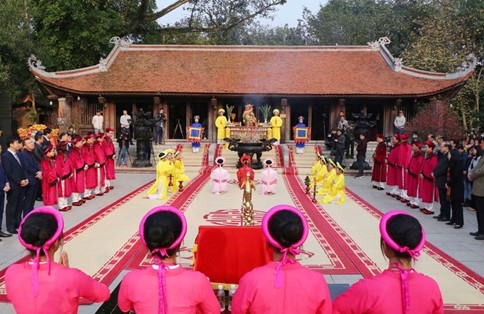 The ceremony of offering incense to commemorate and express gratitude for the merits of Ancestral Mother Au Co follows traditional rituals
Based on archaeological evidence, the first signs of human understanding of motherhood date back to approximately 50,000 years ago. Researchs have explored matriarchal societies (with female dominance) and goddess imagery in prehistoric cultures. In Vietnam, around 4,000 years ago, pottery depicting mother’s breasts appeared in rice-growing villages, early confirming the revered position of mothers. Until society developed to the pre-state and early state stages of Au Lac (Dong Son archaeological culture), the role of the mother and the accompanying feminism, remained very prominent.
The first prominent feature of the female element and feminism in Vietnam is the image of Mother Au Co giving birth to a bundle of one hundred eggs, which later hatched into one hundred sons. The genealogical records preserved at the Temple of Queen Au Co show that wherever Au Co and her children went, they won the hearts of the people, she taught them how to cultivate rice, make cakes, grow mulberry trees, raise silkworms and weave cloth. From the perspective of their relationship with men during this period, the woman had a clear advantage.
Throughout history, Vietnamese women have played an important role, especially in the resistance wars against foreign invaders. A prime example is the Trung Sisters, along with many female generals, who raised the banner of rebellion against the invading Eastern Han army with the goal of: “Firstly, in order to avenge our nation’s humiliation. Secondly, praying to restore the former legacy of the Hung dynasty. Thirdly, lesting my husband’s heart be unjustly wronged. Fourthly, praying to fulfill this royal decree completely”.
Historian Le Van Hưu remarked: “Trung Trac and Trung Nhi were women, yet with a single call, the districts of Cuu Chan, Nhat Nam, Hop Pho and 65 cities in the border regions all responded, establishing a kingdom and proclaiming themselves queens was as easy as turning one’s hand”.
Another person, the mother of the Trung Sisters, Man Thien (Empress Man), played a role in organizing the forces and liaising with local officials in the surrounding areas to support her daughters’ rebellion. Notably, the majority of the leaders of the rebellion were female. Continuing that tradition, the rebellion of Lady Trieu (Trieu Thi Trinh) is also considered a prime example of the dominance of women and feminism in Vietnamese history. She was a woman of great strength, ambition and intelligence. At the age of 19, she and her brother gathered various groups of people to prepare for an uprising against the harsh colonial policies of the Ngo dynasty.
The subsequent disruption of women’s rights was fundamentally caused by the influence of the patriarchal ideology of Confucianism, where subordinates obeyed superiors, this ideology, imposed by the invading forces from the North for a long time, led to the creation of a patriarchal system manifested in the family through the father's decision-making power and the husband’s “husband leads, wife follows” principle (The husband initiates, the wife must follow).
However, in later periods, under independent feudal dynasties, some female figures also demonstrated their power, such as: Empress Y Lan (Linh Nhan Empress Dowager); Empress Linh Tu Tran Thị Dung and Empress Tuyen Tu Nguyen Thi Anh. Although they no longer played a dominant role in the patriarchal system, the female empowerment of these figures was by no means insignificant.
3. Feminism in Vietnamese Folk Beliefs
The veneration and worship of female deities has a long history and is a fairly common phenomenon. Studying ancient texts and religious practices suggest that women were revered and held dominion over the supernatural world. Vietnamese cultural researchers tend to favor female titles such as: Sample/Grandmother/ Mother/Ms, with expressions leaning towards “feminine qualities” being noted. In the list of Vietnamese deities, those associated with the essence of the universe all possess a feminine element, such as Metal, Wood, Water, Fire, Earth (Mrs. Metal, Mrs. Wood, Mrs. Water, Mrs. Fire), Sun Goddess, Moon Goddess. Natural phenomena such as clouds, rain, thunder and lightning are also sanctified as “female” and Buddha-like as the “Four Dharmas” (Dharma Cloud, Dharma Rain, Dharma Thunder, Dharma Lightning) in the form of women. Currently, there are over 1,200 temples, shrines and sanctuaries that serve as places of worship for female deities, not including the system of Buddhist pagodas with shrines dedicated to the Mother Goddess.
These mothers reflect the role and position of women in the historical process of nation-building and national defense: Mother Au Co founded the Lac Viet lineage; Mother Lieu Hanh encourages good deeds and punishes evil; and Lady Chua Xu, Lady Den and Lady Thien Yana specialized in healing the sick, exorcising demons and dispelling evil spirits. Whether they originated from real historical figures or legends, goddesses have been historicized and closely linked to the process of nation-building and national defense of the Vietnamese people.
Within the diverse belief system of the Vietnamese people, the worship of the Mother Goddess is the clearest manifestation of “feminism”. Feminism in the worship of the Mother Goddess is specifically expressed in the following aspects:
Firstly, the principal deities in the Mother Goddess worship are all female. Research into the Tam Phu and Tu Phu mother goddess worship systems includes the addition of the Thuong Ngan Mother Goddess. The Mother Goddess shrines from the North, Central and South of Vietnam all worship female deities as their principal gods, such as Mother Lieu Hanh (at Phu Day temple); Thien Y A Na Holy Mother (Ba Tower complex); Linh Son Thanh Mau (Ba Den Mountain); Ba Chua Xu (Lady of the Land Temple).
Secondly, the objects of worship are primarily female. Although there are altars dedicated to male officials, their number is far less than that of female deities. The altar system focuses on the Three Holy Mothers, the four Palaces Goddesses, the four Palaces Holy Maidens.
Thirdly, the chief priest (master of ceremonies) of the Mother Goddess worship tradition were formerly women, often referred to as female mediums or female shamans. Nowadays, male spirit mediums have also appeared, but these men, when performing the rituals must also dress up to resemble women.
Fourthly, followers of the Mother Goddess worship are predominantly women. Women have more free time and are responsible for overseeing the “spiritual realm” (rituals for worshipping the dead) of the entire family and clan. With a belief in the protection of the Mother Goddess, they often go to the Mother Goddess shrine to pray for peace, protection from harm, wealth and children.
With its immense cultural value, in 2016, the Mother Goddess worship belief was honored by UNESCO as a representative intangible cultural heritage of humanity. This belief system is a very unique form that demonstrates the authority of women both in earthly life and in the creation of the world.
4. The origins of feminism in Vietnamese folk beliefs
Firstly, the historical development of Vietnamese culture is a process of adjustment from a matriarchal system to a patriarchal system. The matriarchal social structure and matriarchal system have existed in Vietnam for quite a long time, so they are preserved and clearly reflected in religious and spiritual life. This is especially true in some ethnic minority groups, such as: Cham, E-de, and Gia-rai, due to their less direct influence from Confucianism, still maintain a matriarchal system, actively participating in marriage, with husbands living in their wives’ homes and children being named after their mothers.
Secondly, this is due to natural conditions associated with socio-economic development. In the context of a tropical monsoon agricultural society where the role of women is highly valued, the deification of nature in the form of goddesses is common. The goddesses of the Sun, Clouds, Rain, Thunder and Lightning are the result of the synthetic and dialectical thinking of people rooted in an agricultural culture.
Thirdly, the role of the domestic manager in a patriarchal society. Despite the significant influence of the patriarchal system, the division of labor (men handle external affairs, women handle household chores and family) implies that women are the heads of the household, or “internal commanders”, managing finances, the economy, the family estate and possessing inheritance rights. Despite its important economic position, Vietnamese culture still leans towards femininity; society does not overly pressure women to rigidly adhere to Confucian doctrines of “three obediences” and “four virtues”; remarriage is not condemned; women are still allowed to receive an education.
Fourthly, the Vietnamese mentality and consciousness emphasize the elements of birth, upbringing, and education. All Vietnamese people possess attributes of the mother (the Holy Mother). In essence, nature and femininity share fundamental common characteristics: “procreation, preservation and protection”. This ideology gave rise to fertility cults, a belief system that venerates the procreation and abundance of nature and humankind.
Thus, historical, economic, cultural, and ideological evidence shows that in the early days of creation and for many centuries afterward, the position and role of women were affirmed in many fields, moreover, they are honored and worshipped as divine beings with supernatural powers, the creators of the universe and all living things.
5. The value of feminism in folk beliefs
When images of women are honored and worshipped as divine beings in the spiritual world, it clearly demonstrates the spirit of feminism. The very act of honoring women throughout history as saints and deities reflects a spirit of gender equality, even highlighting the superior role of women in many fields, with spiritual life occupying a leading position. The Vietnamese belief in Mother Goddess worship reflects the richness of its objects of worship: the female deities can be human or nature deities. Goddesses may belong to the aristocratic class, but there are also goddesses who come from the common, impoverished classes and are still revered.
“Feminism” in Vietnamese folk beliefs also fully reflects the tolerance and openness of the Vietnamese people in the process of interacting with and absorbing foreign cultural values, when worshipping both local and foreign goddesses representing different ethnic groups and cultural regions. The worship of the goddess guided people towards compassion and selflessness, like that of a mother (the Holy Mother).
The belief system, which emphasizes femininity, clearly reflects the most important qualities of Vietnamese women: diligence, loyalty, love for their husbands and children and self-sacrifice for their families. Behind this veneration, admiration, and worship lies the aspiration for equality, fertility, abundance, and prosperity, of which the Mother Goddess is the quintessential symbol.
The patriarchal system that emerged and lasted for thousands of years in Vietnam bound women within a strict, sometimes extreme, social order and family traditions that weighed heavily on their material and spiritual lives. The worship of goddesses helped to alleviate, soothe and comfort the feelings of resentment about women’s lowly status, and served as a great spiritual support to uplift women in the real world. Believers feel peaceful and at ease before the goddess, because she is a symbol of compassion, tolerance, gentleness; the image of the Mother Goddess not only protects and comforts but also clearly demonstrates her authority in punishing evil. Therefore, the position of the Mother Goddess has a profound influence on the spiritual life of the Vietnamese people.
6. Conclusion
The research findings show that the feminine element, the female element, and femininity are expressed in diverse ways within the Vietnamese religious and belief system. Sometimes they are nature deities: to be Mother Earth, Mother Forest, Mother Sea, Mother of fertility and abundance; but sometimes they are real people in history (human-gods). Whether they are “nature gods” or “human gods”, they are all revered and worshipped by the people throughout the country. Even in Buddhist pagodas, which are places of worship for Buddha, Vietnamese people have dedicated an entire section (or altar) to the worship of the Mother Goddess. All of this has created a picture of Vietnamese religion and beliefs that is strongly influenced by female elements. This is also a prominent feature of feminism in Vietnamese religion and beliefs, differentiating it from many other countries in the world.
References
1. Southern Vietnam Women’s Museum (2021), Empress Man Thien - the mother of the first two female generals in history, https://baotangphunu.com/man-thien-hoang-hau-nguoi-me-cua-hai-nu-tuong-dau-tien-trong-lich-su/ [accessed on April 1st, 2025].
2. Dai Viet Su Ky Toan Thu (1697), Cabinet edition, woodblock print from the 18th year of Chinh Hoa (1697), edition, translated in 2004, Vol. 1, Social Sciences Publishing House, Hanoi.
3. Dao Mai Hao, Mai Thi Ngoc Chuc (1984), Vietnamese Goddesses, Women’s Publishing House, Hanoi.
4. Tran Van Giau (1983), Philosophy and Ideology, Ho Chi Minh City Publishing House.
5. Nguyen Thi Thanh Mai (2013), Confucian moral thought and its influence in our country today, https://lichsu.tnus.edu.vn/chi-tiet/342-Tu-tuong-dao-duc-Nho-giao-va-anh-huong-cua-no-o-nuoc-ta-hien-nay [accessed April 1st, 2025].
6. Thanh Nhan (2014), Famous goddesses in Vietnamese folk religious culture, National Museum of History.
7. Phan Ngoc (2002), Identifying Vietnamese Culture, Literature Publishing House, Hanoi.
8. Nguyen Lan Phuong (2018), Historical and Cultural Relics of Vietnam, National Culture Publishing House, Hanoi.
9. Truc Phuong (2020), The Trung Sisters’ Uprising: Awakening the National Spirit, https://cand.com.vn/Phong-su-Tieu-diem/Khoi-nghia-Hai-Ba-Trung-Thuc-tinh-tinh-than-dan-toc-i551370 [accessed March 28th, 2025].
10. Tran Ngoc Them (2000), Fundamentals of Vietnamese Culture, Hanoi Education Publishing House.
11. Ngo Duc Thinh (2014), Vietnamese Mother Goddess Religion, Religious Publishing House, Hanoi.
12. Thanh Hoa Tu (reprinted 2021), Hoi Chan Bien, Hanoi University of Education Publishing House.
13. Dang Nghiem Van (2003), Religious Theory and the Religious Situation in Vietnam, National Political Publishing House, Hanoi.
14. Nguyen Viet (2023), Male or Female Power in the Dong Son Period? (Part 3): Up to the Dong Son period, many things still always came from the mother, https://baotanglichsu.vn/vi/Articles/3101/74240/nam-hay-nu-quyen-trong-thoi-ky-djong-son-ky-3-djen-thoi-djong-son-nhieu-thu-van-luon-tu-me.html [accessed March 27th, 2025].
15. Nguyen Thi Thanh Xuan (2013), On the establishment of gender consciousness and feminism in traditional Vietnamese literature, Journal of Education and Society.
