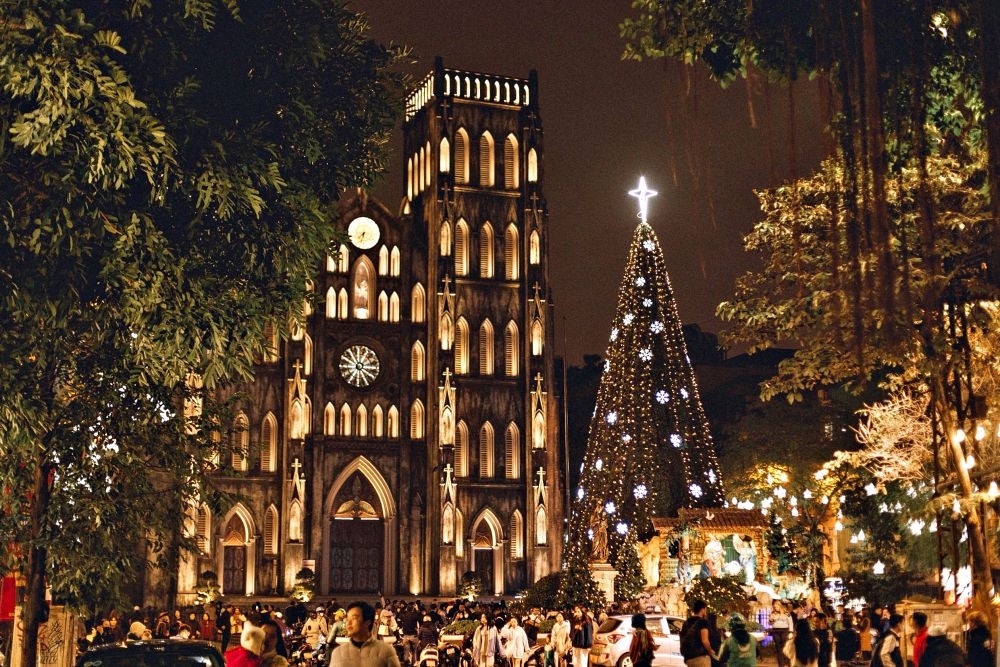
 Christmas celebration at Hanoi Cathedral
Keywords: Freedom of belief and religion; Vietnam; Human rights.
1. Freedom of belief and religion - a recognized human right in Vietnam
On September 2nd, 1945, at Ba Dinh Square in Hanoi, President Ho Chi Minh, on behalf of the Provisional Government, read the Declaration of Independence, giving birth to the Democratic Republic of Vietnam. He began with the words: “All people are born equal. The Creator has endowed them with certain inalienable rights; among these are the right to life, liberty, and the pursuit of happiness”. “With these eloquent words, it can be affirmed that the 1945 Declaration of Independence of Vietnam is the Vietnamese Declaration of Human Rights, a harmonious voice in the eternal chorus of humanity for the fundamental rights and freedoms of humankind” [3].
On September 3rd, 1945, at the first meeting of the Government Council, President Ho Chi Minh addressed six urgent issues that needed to be resolved, and the sixth issue was religion. He affirmed the following policy: “Freedom of religion, unity between religions.” Subsequently, Party documents and State policies and laws all reflected the idea of freedom of religion. Article 10, Chapter 2: Duties and Rights of Citizens, of the 1946 Constitution stated: “Vietnamese citizens have the right to freedom of religion”.
More than two years after the above events in Vietnam, on December 10th, 1948, the United Nations General Assembly adopted the Universal Declaration of Human Rights, with Article 18 stipulating: “Everyone has the right to freedom of thought, conscience and religion; this right includes the freedom to change one’s religion or belief and the freedom to express one's religion or belief through teaching, practice, worship and ritual, either alone or with others, in public or in private”. And more than 20 years later, the International Covenant on Civil and Political Rights and the International Covenant on Economic, Social and Cultural Rights were also recently adopted by the United Nations General Assembly, in which the right to freedom of belief and religion was reaffirmed and concretized. Since the establishment of the Democratic Republic of Vietnam, the right to freedom of religion and belief has always been recognized by the Vietnamese Party and State in the highest-ranking legal documents. The Second National Congress of the Party, held from February 11th-19th, 1951, adopted the Political Platform of the Vietnam Labor Party, which emphasized: “Respecting and protecting the right to freedom of belief of all citizens”.
On June 14th, 1955, President Ho Chi Minh signed Decree No. 234/SL, Article 1 of which states: “The Government guarantees the freedom of religion and worship of the people. No one shall infringe upon that freedom. “All Vietnamese people have the right to freedom to follow a religion or not follow any religion”. “It can be said that Decree 234/SL is the earliest legal document specifically for religion in Vietnam. In particular, there are many points that later, during the reform period, still retained their value, or rather, only during the reform period did conditions become available for implementation” [4].
The 1959 Constitution, in Article 26, continued to affirm: “Citizens of the Democratic Republic of Vietnam have the right to freedom of belief, to follow or not follow any religion”. The 1980 Constitution, in Article 68, retained the content of Article 26 of the 1959 Constitution and added the content: “No one shall exploit religion to violate the law and policies of the State”.
On March 12th, 2003, the Seventh Conference of the Central Committee of the Ninth Party Congress issued Resolution No. 25-NQ/TW on religious affairs. In this Resolution, alongside new understandings and approaches to religion, the Party steadfastly maintained the following principle: “Consistently implement the policy of respecting and guaranteeing the right to freedom of belief, whether or not to follow any religion, and the right to normal religious activities in accordance with the law. Religions operate within the framework of the law and are equal before the law”.
From Resolution No. 25-NQ/TW, “The 2013 Constitution was promulgated with three very new points on beliefs and religions: (1) Beliefs and religions are an important content of Chapter II - Human Rights, Rights and Obligations of Citizens; (2) The right to freedom of belief and religion is the right of everyone (not just the right of citizens as before); (3) The State respects and protects the right to freedom of belief and religion (not just guarantees as before). That is the foundation - constitutional provision of perfecting legal norms on beliefs and religions” [4].
In accordance with the 2013 Constitution and based on the domestic and international situation, on November 18th, 2016, the 14th National Assembly passed the Law on Beliefs and Religions (the Law), which came into effect on January 1st, 2018.
2. Some notable achievements after nearly 8 years of implementing the Law on Beliefs and Religions
Firstly, ensuring freedom of belief and religion in Vietnam
Vietnam is an active and responsible member of the international community when it actively participates in signing and ratifying most international conventions, protocols and international dialogues related to human rights, including the right to freedom of belief and religion - one of the human rights of concern to the world. Vietnam was a member of the United Nations Human Rights Council from 2014 to 2016, and made many positive contributions to the establishment and operation of the ASEAN Intergovernmental Committee on Human Rights. Vietnam is serious and committed to fulfilling its responsibilities, obligations, and international commitments in realizing international human rights standards in its legal system, policies, and practical activities; building and perfecting its domestic legal and policy system to be consistent with and compliant with the provisions of international human rights conventions to which Vietnam is a signatory; be ready to engage in dialogue and resolutely fight to protect human rights, including the right to freedom of belief and religion.
Annually, Vietnam has actively participated in dialogue mechanisms on democracy, human rights, and religion with partners such as the United States and the EU; successfully defended its National Report under the Universal Periodic Review (UPR) mechanism for the third cycle, its National Report on the implementation of the International Covenant on Civil and Political Rights at the United Nations Human Rights Council. Proactively providing information on achievements in ensuring freedom of belief and religion in Vietnam to parliamentary delegations, government officials from other countries visiting Vietnam, embassies of foreign countries; establishing working groups to visit the United States and some Western countries to directly dialogue and exchange views on religious issues. Expand cooperative relations and dialogue with countries in the region and around the world in the field of belief and religion; strengthening external communication efforts regarding policies, achievements and principles related to belief and religion.
Vietnam currently has 16 religions, but no single religion holds a dominant position. Religious organizations in Vietnam are all equal before the law, are not subject to discrimination, have the right to conduct religious activities within the framework of the law, and are equally protected by law. No religious organization or individual operating legally is prohibited from doing so. Everyone is free to choose whether or not to follow a belief or religion without coercion, bribery, or obstruction. People with beliefs and followers of religious organizations are free to express their faith at home, places of worship or registered groups with the authorities.
The State guarantees and facilitates the operation of religious organizations in accordance with the law and their charters and regulations recognized by the State. The recognition of religious organizations and the issuance of certificates of registration for religious activities are carried out in accordance with the law. Registration for centralized religious activities nationwide is facilitated. Major religious holidays include: Buddha’s Birthday and Vu Lan Festival for Buddhism; Christmas and Easter for Catholicism and Protestantism; The Yen Dieu Tri Cung festival of the Cao Dai religion; the Kate festival of the Cham people; the Ramadan fasting month of Muslims… are organized on a large scale, attracting a large number of followers. Many important religious holidays have become common holidays for the community.
Secondly, in the field of religious beliefs, the country has 73,298 religious establishments, including 20,751 ancestral temples and 8,702 private residences with religious activities. For religious establishments that have been classified as historical and cultural relics or scenic spots, the election of representatives or the establishment of management boards are carried out in accordance with the law on cultural heritage and Article 11 of the Law on Beliefs and Religions. The organization of religious activities and festivals is regularly notified to the competent state agency by the representatives or management boards of these establishments. Religious festivals, whether newly held, restored, or regularly scheduled but modified, must be registered with the People’s Committee of the province where they take place. Through religious activities, traditional festivals have contributed to promoting unity and solidarity among people of the same faith, building national unity.
Thirdly, in the religious sector, before the Law came into effect, there were 35 organizations recognized as religious organizations and 2 organizations granted certificates of registration for religious activities in provinces and cities. Up to now, the number of recognized religious organizations is 39, and 1 organization has been granted a certificate of registration for religious activities.
Before the Law came into effect, there were 2,691 approved religious groups for registration. Since the Law came into effect, an additional 1,746 religious groups have been approved for registration; 3 organizations have been granted certificates of registration for religious activities; 3 organizations have been recognized as religious organizations. Religious activities in the provinces and cities have become more orderly, stable and purely in accordance with the announced list of religious activities.
Over the past nearly eight years, 13,217 people have been ordained or elected to religious positions; 33,652 people have been appointed, elected, or elected to official positions. Currently, the country has 66,356 religious leaders; 120,475 official positions; and 40,075 people who hold both religious and official positions.
Most religions in Vietnam today originated from foreign countries. These religions inherently contain elements of international relations. Some indigenous religions also have clergy, officials and followers living abroad, thus creating international ties for these indigenous religions. Currently, there are approximately 5.3 million Vietnamese people living, studying, and working in 109 countries and territories around the world, of which about 2.5 million are followers of religious organizations. Thus, most religious organizations in Vietnam have extensive and diverse international relations.
Since the implementation of the Law, all levels and sectors, from the central to local governments, have consistently paid attention to creating favorable conditions for religious activities with foreign elements, such as: registering religious gatherings, inviting foreign or Vietnamese religious dignitaries to preach; allowing the import of religious cultural products from abroad into Vietnam; supporting procedures for religions to send dignitaries, officials and clergy to attend regional and world conferences, seminars and forums… Many major international events (United Nations Vesak Celebration 2019, United Nations Vesak Celebration 2025, Conference of Secretaries of the Asian Buddhist Forum for Peace, Summit of Buddhist Presidents of Vietnam - Laos - Cambodia, World General Assembly of the Dominican Order,...) have been successfully hosted and organized by Vietnamese religious organizations, receiving high praise from the international community.
State management agencies in charge of belief and religion at the Central level have approved religious organizations and affiliated religious organizations to send more than 200 delegations, with a number of 1,026 dignitaries, officials, monks and followers to participate in religious activities abroad; approved religious organizations and affiliated religious organizations to invite 289 delegations of foreign organizations and individuals to Vietnam to carry out religious activities and international religious relations activities.
The religious activities of foreigners legally residing in Vietnam are always ensured. Currently, there are 70 registered religious gathering points and groups for foreigners legally residing in Vietnam, with hundreds of participants, mainly in Ho Chi Minh City (41 points/groups) and Hanoi (13 points/groups), and comprising nationalities from many countries: South Korea, the Philippines, Singapore, Malaysia, Russia, France, the United States,...
Exercising their right to publish, produce, import, and export religious and cultural products, over the past nearly eight years, many religious organizations and individuals have registered to publish religious scriptures and other publications. From 2018 to 2024, the Religious Publishing House granted publishing permits for 4,364 publications, with nearly 14.3 million copies printed. Many religious texts were printed in English, French and ethnic minority languages. Religious texts from religious organizations were authorized for publication in 20 ethnic minority languages, largely meeting the religious needs of religious organizations, followers and readers.
In order to concretize and organize the implementation of legal regulations on beliefs and religions for inmates serving sentences in prisons, the Department of Police for Prison Management, Compulsory Education Facilities and Juvenile Detention Centers, Ministry of Public Security, has received 4,418 books containing content promoting ethnicity and religion and distributed them to 54 prisons to serve inmates in their religious activities; creating conditions for inmates and detainees to express their religious beliefs on the 14th, 15th, 29th and 30th days of the lunar calendar each month. The introduction of religious texts and publications into detention facilities contributes to the enforcement of laws on belief and religion, the right of all people, including those with and without civil rights, to access religious texts and publications. It also demonstrates the State’s consistent policy of respecting and guaranteeing freedom of belief and religion and conveys a message about the Vietnamese Government's efforts in implementing international conventions on civil and political rights.
The issuance of land use rights certificates and certificates of ownership of assets attached to land for local communities, religious organizations and affiliated religious organizations is receiving attention. Nationwide, 73.1% of religious land currently in use has been granted land use rights certificates, creating reassurance and trust among religious leaders, officials, followers, and all segments of the population in the Party and State’s policy of respecting and guaranteeing freedom of belief and religion.
3. Conclusion
These achievements have clarified the Party and State’s policy on respecting and guaranteeing the right to freedom of belief and religion. The law bears a strong Vietnamese identity in each provision but still has an international character by expanding its scope of application from “citizens” to “everyone”; recognizing the legal status of religious organizations, contributing to concretizing the principle of non-discrimination on religion, in line with international standards. With a focus on minimizing interference in the internal affairs of religious organizations, Vietnam ensures both respect for the freedom of belief and religion of all people and equality of religions before the law. The state management mechanism has been simplified, with many activities of religious organizations requiring only notification instead of registration or permits. Therefore, the claims that Vietnam lacks religious freedom are unreasonable, untrue, biased, unfair and do not accurately and fully reflect the situation, efforts and achievements of Vietnam in protecting and promoting the right to freedom of belief and religion for all people.
References
1. Ministry of Ethnic Minorities and Religious Affairs (2025), Report No. 3257/BC-BDTTG dated December 31st, 2025 summarizing the implementation of the Law on Beliefs and Religions, Hanoi.
2. Nguyen Thanh Xuan (2023), Religion and religious policy in Vietnam, Religious Publishing House.
3. Assoc. Prof. Dr. Chu Hong Thanh, The powerful and enduring vitality of the Universal Declaration of Human Rights, Journal of Law on Human Rights, Special Issue 33 - 2023, p.39-40.
4. Dr. Ambassador Le Thi Tuyet Mai, Seventy-five years of the Universal Declaration of Human Rights: Achievements and Challenges, https://www.tapchicongsan.org.vn/ web/guest/the-gioi-van-de-su-kien/-/2018/843902/ bay-muoi-lam-nam-tuyen-ngon-the-gioi-ve-quyen con-nguoi-%C2%A0thanh-tuu-va-thach-thuc.aspx#
