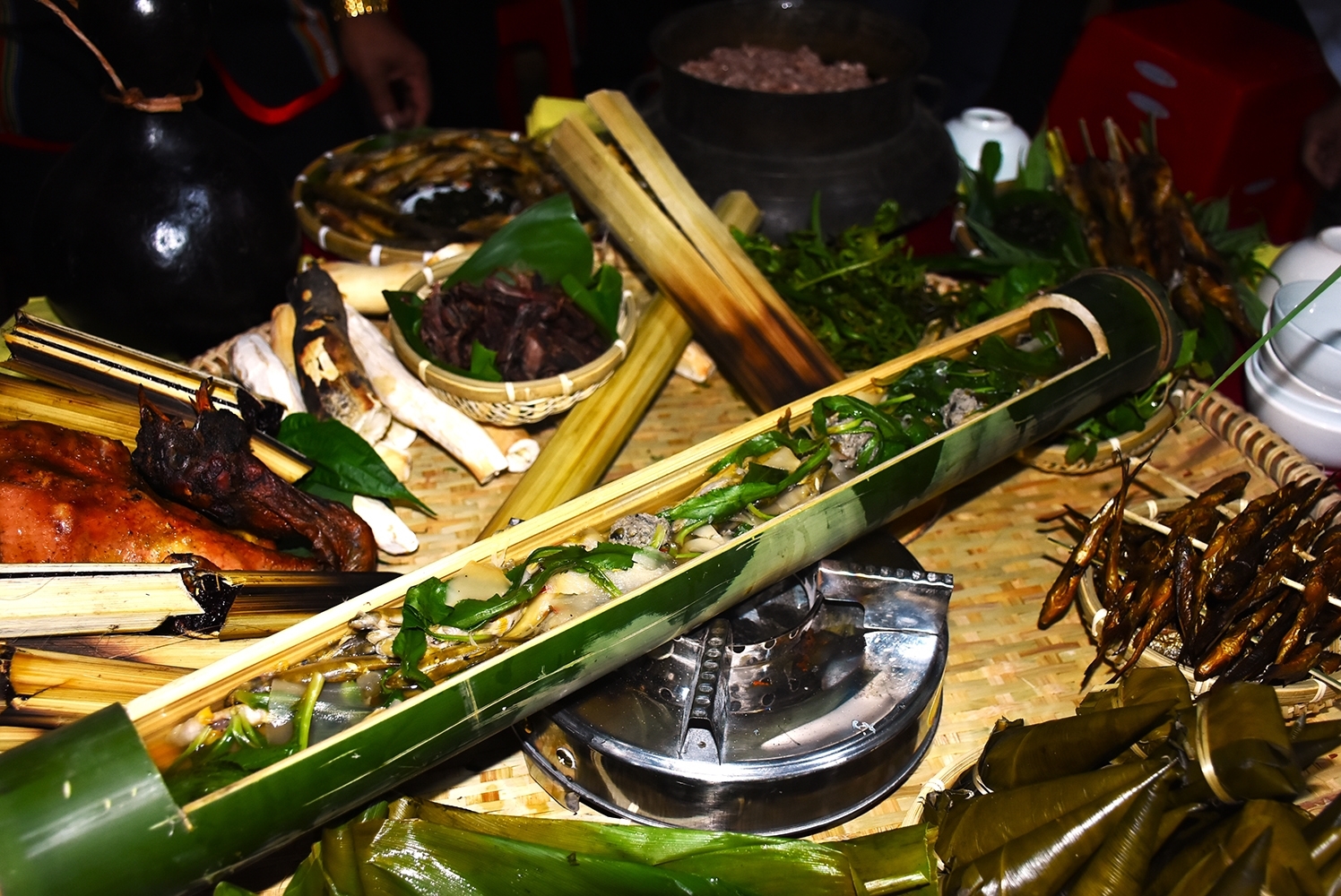
 Bamboo tube hotpot, red-tailed goby fish and forest dishes are specialties of the Xo-dang people
Keywords: Green cuisine; Community tourism; Ethnic minorities; Local knowledge.
1. Introduction
Food has always been a primary concern for humankind, both at the individual and communal levels. It is an essential need for sustaining life and reproducing labor power. However, in contemporary social science, food is not only viewed from a nutritional perspective but also as an important part of cultural life. Through the selection of ingredients, cooking methods, and meal organization, one can identify the living conditions, livelihoods, and value systems of a community. Therefore, studying cuisine is simultaneously studying ethnic knowledge and human interaction with nature; it goes beyond simply describing dishes and aims to understand the worldview and philosophy of life of the local inhabitants.
Based on that, the concept of “green cuisine” is understood as practices of selecting, processing, and consuming food in an environmentally friendly manner, prioritizing local ingredients, limiting the use of chemicals and minimizing negative impacts on the ecosystem. According to the World Tourism Organization (UNWTO, 2017), sustainable cuisine is an important component of tourism development, contributing to the preservation of local traditions and enhancing the value of destinations. The United Nations Food and Agriculture Organization (FAO, 2018) also emphasizes that a sustainable food system needs to ensure a balance between economic, social and environmental benefits, while maintaining the regenerative capacity of nature. Thus, green cuisine is not just about “eating clean”, but also an expression of a lifestyle that respects nature and is responsible to the community.
In Vietnam, the Tourism Development Strategy to 2030 (Decision No. 147/QD-TTg of 2020) identifies the development of green tourism products, linked to the preservation of cultural identity and environmental protection, as one of its key tasks. A 2023 report by the Vietnam National Administration of Tourism shows that cuisine is among the experiences highly valued by international tourists visiting Vietnam. Spending on food and beverages accounts for approximately 25-35% of the total spending of domestic tourists, demonstrating that cuisine not only holds cultural significance but is also an important economic resource in the current tourism product structure. These data confirm the increasingly prominent role of cuisine in guiding the development of green and sustainable tourism. Based on the national direction, identifying and promoting the value of green cuisine in specific regions becomes essential.
2. Practicing green cuisine in the mountainous region of Da Nang city
The mountainous ethnic minority areas of Da Nang city are where traditional culinary practices closely linked to the natural environment are relatively well preserved. This area possesses rich resources of traditional culture in general and culinary culture in particular, contributing to meeting the needs of tourists following the trend of green cuisine and green tourism. The outstanding value of the cuisine of the ethnic minorities in the mountainous regions is reflected first and foremost in the source of ingredients that are green, clean, safe and readily available for processing into dishes and drinks. Upland rice is the main food source for many ethnic groups. A distinctive feature of upland rice is its high disease resistance; it does not require fertilizer or pesticides to grow well. The rice grains, nurtured by the unique climate and soil conditions, possessing a distinctive aroma of the mountains and forests. After harvesting, the rice is pounded in a wooden mortar to remove the outer husk, preserving its natural red color; the Co and Xo-dang people often call it “red rice” or brown rice. The food sources of ethnic minority communities have also become distinctive products such as: “free-range chicken”, “hill chicken”, “local pork” and stream fish. Besides vegetables grown in the fields such as gourds, pumpkins, melons, eggplants and cassava leaves, there are also many products harvested from the forest such as bamboo shoots, wild greens, wild ferns, wild banana buds, wild bitter melon, mushrooms, rattan shoots, taro and cardamom... The bounty of nature has created favorable conditions for mountain dwellers to exploit local resources to support their livelihoods, at the same time gradually transforming them into marketable products. Dishes such as upland rice, wild bananas, wild vegetables, bamboo-cooked rice, rice wine, stream fish and smoked meat have been included in the menus at community tourism destinations. This transformation from self-sufficient food to products catering to tourism reflects the restructuring of culinary values within a market economy and the expansion of the cultural space of traditional cuisine.
From a social science perspective, these products and dishes reflect a system of ethnic knowledge accumulated over many generations. The methods of cultivating upland rice, harvesting wild vegetables according to season and raising livestock in a free-range manner demonstrate the long-term adaptation of mountain dwellers to the unique ecological conditions. These practices align with a socio-ecological perspective, according to which livelihood and culinary structures reflect the regulatory mechanisms between the need for sustenance and the regenerative capacity of the natural environment. It is this regulation that creates relative sustainability in the production activities and culinary culture of the community.
For a long time, the ethnic minorities in the mountainous regions have known how to utilize readily available natural materials and creatively create containers for food and drinks, serving and presenting them during family meals or community festivals. Rice cooked in bamboo tubes (com lam), meat, fish and vegetables are also prepared in bamboo tubes, a prime example being the “canh thut” soup. They cook mixed foods in bamboo tubes, then use bamboo sticks or rattan canes to mash them into a thick soup, called “forest soup”, Zira by the Katu people. Bamboo and reed tubes are common utensils used to hold and serve food and drinks by most ethnic groups in mountainous regions. These are also remnants of a bygone era, when bowls and chopsticks were unavailable and they used bamboo and reed tubes to hold water, rice and soup. Larger reed tubes were split in half; one part held soup, meat, or rice, while the smaller part served as a lid to preserve the food… Small bamboo tubes, cut crosswise or at an angle, become cups or glasses for drinking water, rice wine, doat wine, ta vac wine... The use of bamboo and reed tubes as containers, or the wrapping of food in banana and dong leaves, not only creates distinctive flavors but also demonstrates a preference for biodegradable materials, offering valuable insights into current sustainable consumption trends.
Banana leaves, both the dong leaf and the banana leaf, are an inexhaustible resource in the culinary life of ethnic groups. Wild banana leaves have many applications because they are large, flexible, waterproof and have a decorative value due to their forest green color. For the Co-tu people, wild banana leaves are used for cooking, grilling, wrapping and preparing dishes. Some festivals require nearly 20 baskets of wild banana leaves to hold food, demonstrating the important role of this natural material in community life. Many dishes of the ethnic minorities are wrapped in banana leaves and grilled over charcoal, a dish called Dha’jam, which not only creates a distinctive flavor but also preserves the pristine nature of mountain produce. Wild banana leaves are also used to wrap sticky rice, cassava, and other food to take along when going to the fields. In particular, they use banana leaves to “divide” food among households or individuals depending on the size of the hunted animal. This method of dividing food is not only convenient in daily life but also reflects the spirit of fairness and strong community bonds of the mountain dwellers.
In traditional festivals, food holds a central place in the ceremonial space. The Co-tu people usually place a feast in the center of the house, reserved for honored guests, respected village elders and elderly people skilled in storytelling and singing, ịm order to socialize or resolve important matters. This feast is covered with banana leaves, and only when the discussion and singing of folk songs have reached a state of mutual understanding can the leaves be removed and the food enjoyed. This ritual shows that cuisine is not just about eating and drinking, but is also connected to social order, to the mechanism of consultation and consensus within the community. Thus, the meal becomes a space for cultural expression, where moral values, respect, and solidarity are concretely demonstrated.
In cultural exchange activities at all levels and in the development of community tourism, ethnic cuisine is increasingly valued as an element that creates the identity of a destination. Green cuisine is gradually becoming a criterion for assessing the value of local specialties. Food competitions and fairs encourage the use of readily available natural ingredients for decorating, presenting and containing food and drinks. Particularly at some community tourism destinations, competitions, demonstrations, and culinary presentations have showcased traditional dishes served on banana leaves, banana flower stalks, bamboo tubes, gourd shells, and rattan trays. Besides being used in salads, boiled dishes and stir-fries, the local people also utilize the older flower stalks to hold food. Pumpkins are not only used as an ingredient but are also transformed into trays for serving cassava soup, meat soup or other specialties, creating visually appealing presentations. This method enhances the aesthetic value, satisfying the visual senses, at the same time leaving a lasting impression on diners, especially international tourists. This is the result of the creativity and skill of culinary artisans, contributing to the preservation of national cultural identity, aligning with the trend of environmental protection and green development.
3. Discussion
Culinary practices in the mountainous areas of Da Nang city demonstrate that “green cuisine” is not an exogenous concept that has only emerged with contemporary sustainable development discourses, but has long been present in the traditional life of the local community. The “green” aspect is formed from the very mechanisms of livelihood and the way residents interact with the forest and mountain environment: raw materials are mainly based on local products; harvesting activities are influenced by experience, seasonality and natural limitations; food processing and storage materials prioritize biodegradable materials. These characteristics embody a sustainable logic in the sense that inhabitants sustain life based on the ecosystem's regenerative capacity, at the same time limiting interventions that risk depleting resources.
From a socio-cultural perspective, food is not merely a material consumption but also a space for expressing community order and cultural institutions. The rituals of organizing feasts during festivals, the practice of “talking and singing” to reach consensus before opening the meal, or the customary practice of “dividing portions” with banana leaves according to community rules, all demonstrate how meals are closely linked to behavioral norms, cohesion and mechanisms for regulating social relationships. Therefore, green cuisine in this context cannot be simply understood as a consumer choice, but should be viewed as a cultural-ecological practice that functions to sustain community and reaffirm identity.
From an economic tourism perspective, incorporating local dishes and ingredients into menus at community tourism destinations contributes to creating unique experiential value and opens up opportunities to transform traditional knowledge into a source of livelihood. However, this process also poses risks if cuisine is exploited merely as a “performance product” detached from its original cultural context. In that case, the risk of commercialization and homogenization could diminish the symbolic meaning of the ritual, alter processing methods or distort how communities practice and transmit knowledge. Therefore, developing green cuisine in community tourism needs to be based on the principles of conservation and respect for the local community, with the community playing a central role in deciding the content of the experience, the standards of practice and the limits of exploitation in accordance with local ecological and cultural conditions.
4. Conclusion
From an ecological, cultural, and sustainable development perspective, green cuisine in the mountainous areas of Da Nang city is not a new trend shaped by modern development discourse, but rather a continuation of long-standing traditional practices in community life. The selection of ingredients based on local produce, the use of upland rice cultivation methods that do not rely heavily on chemicals, the seasonal harvesting of wild vegetables and the use of bio-based materials such as bamboo, reeds and banana leaves in food processing and storage demonstrate a relatively stable ecological adaptation mechanism. In this system, the natural environment is not only a source of material resources but also the foundation that shapes the livelihood structure and cultural identity of the local community.
Cuisine in rituals and community life clearly reflects social cohesion and traditional values. A meal is not simply a consumption activity, but a space for practicing cultural conventions, where social relationships are established, maintained and reaffirmed. It is within this interconnectedness of ecology, livelihoods, and cultural institutions that green cuisine is understood as a comprehensive cultural practice, ensuring balance with the environment and strengthening community bonds and transmitting knowledge across generations.
In the context of current community-based tourism development, identifying and promoting the value of green cuisine is crucial for building destination image and diversifying tourism products. However, the exploitation process needs to be placed within limits appropriate to local ecological conditions and cultural rhythms, avoiding the trend of commercialization that alters the original content and meaning of traditional culinary practices. Preserving local plant varieties, maintaining traditional processing methods and ensuring the active role of the community in tourism activities are essential conditions for green cuisine to become not only an experiential element but also a foundation for sustainable development.
* Dong A University
References
1. Ministry of Culture, Sports and Tourism. (2022). Vietnam’s cultural development strategy to 2030.
2. Food and Agriculture Organization of the United Nations. (2018). Sustainable food systems: Concept and framework. https://www.fao.org/3/ca2079en/ca2079en.pdf
3. Nguyen Huu Thong. (2001). Customary law of the Ta Oi, Co-tu, Bru-Van Kieu people in Quang Tri and Thua Thien Hue. Thuan Hoa Publishing House.
4. Nguyen Thi Thu. (2019). Cuisine and ethnic culture in Central Vietnam. Social Sciences Publishing House.
5. Nguyen Van Dung. (2025). Life cycle rituals of the Co-tu people in Quang Nam province: From tradition to transformation. News Agency Publishing House.
6. Nguyen Van Manh, Nguyen Xuan Hong, Nguyen Huu Thong. (2001). Customary law of the Ta Oi, Katu, Bru - Van Kieu people in Quang Tri, Thua Thien Hue. Thuan Hoa Publishing House.
7. Department of Culture and Sports of Thua Thien Hue. (2023). Report on the status of intangible cultural heritage of ethnic minorities in the province.
8. Tran Huu Son. (2020). Folk culinary culture of Vietnamese ethnic groups. National Political Publishing House.
9. Prime Minister. (2020). Decision No. 147/QD-TTg dated January 22rd, 2020 approving the Strategy for the Development of Vietnamese Tourism until 2030, https://chinhphu.vn/default. aspx?pageid=27160&docid=198927
10. Steward, J. H. (1955). Theory of culture change: The methodology of multilinear evolution. University of Illinois Press.
11. Tran Tan Vinh. (2009). The Co Tu people in Vietnam. News Agency Publishing House.
12. United NationsWorld Tourism Organization. (2017). Second global report on gastronomy tourism, https://www.e-unwto.org/doi/ book/10.18111/9789284418701
