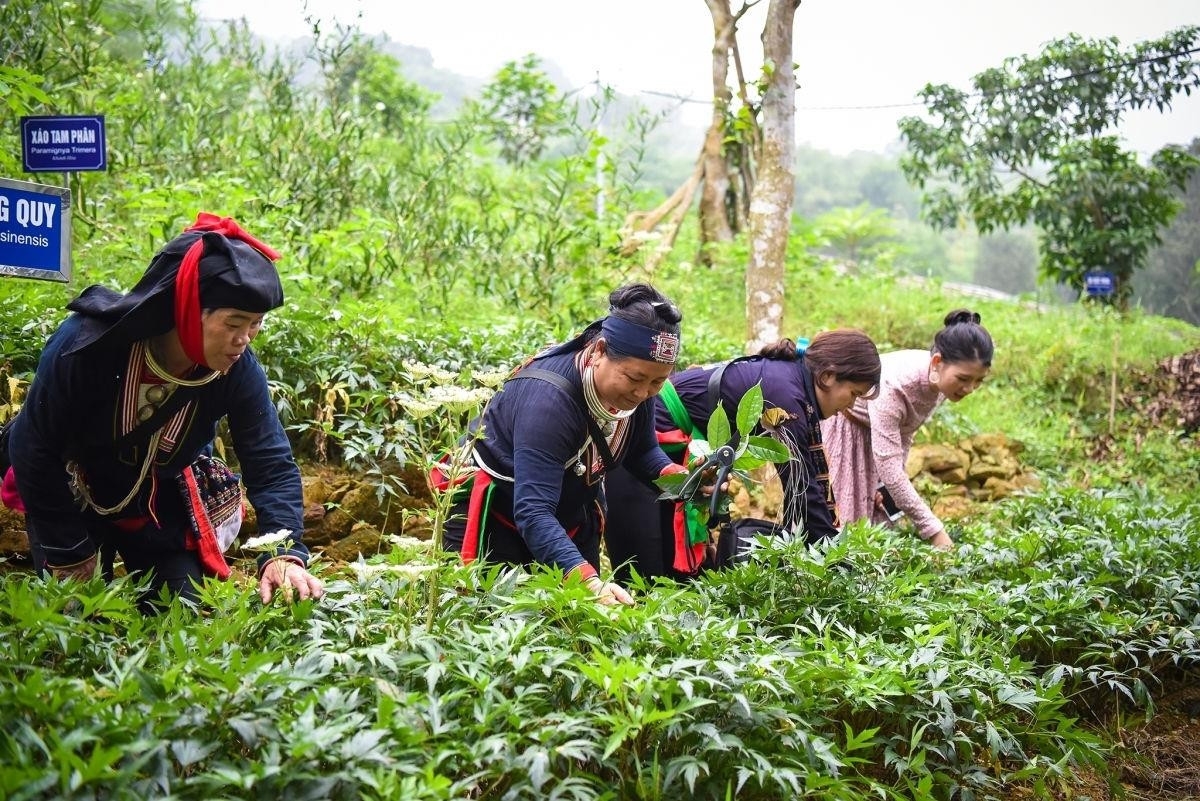
 Developing valuable medicinal plants in ethnic minority and mountainous areas creates sustainable livelihoods for the people
Keywords: Ethnic policy; Development capacity; Results-based management; Ethnic minority and mountainous areas; National target program.
1. Introduction
Resolution No. 257/2025/QH15 of the National Assembly approving the investment policy for the National Target Program on building new rural areas, sustainable poverty reduction and socio-economic development in ethnic minority and mountainous areas for the period of 2026-2035, and Resolution No. 424/NQ-CP of the Government have re-established the framework of the ethnic policy system being implemented in the period of 2021-2025 under the integrated National Target Program for the entire period of 2026-2035. Decree No. 272/2025/ND-CP provides a new legal basis for delineating ethnic minority and mountainous regions for the period of 2026-2030. This institutional context shows that the focus is no longer just on continuing investment, but on redesigning policy interventions to better meet the requirements of rapid and sustainable development in ethnic minority and mountainous areas.
Based on that practice, the article raises two main research questions. (i) What structural limitations of the 2021-2025 ethnic policy are hindering the transformation of public investment into genuine development capacity? (ii) Given that the National Target Program has been integrated, what are the potential challenges and some appropriate innovation directions to both ensure the specificity of ethnic policies and improve the efficiency of public investment and implementation capacity at the local level?
2. Results for the period of 2021-2025 and structural limitations
During the period of 2021-2025, the National Target Program for socio-economic development in ethnic minority and mountainous areas invested in 6,018 rural transport projects; paved 8,673 km of roads; and constructed 442 electricity projects. 1,787 community centers were built; 183 commune health stations were renovated and repaired; equipment was provided to 118 commune health stations; 629 school and classroom construction projects were invested in. These results have contributed to improving access to basic social services, reducing spatial isolation for development, and enhancing the capacity to provide essential infrastructure in many disadvantaged localities.
However, the impact of the Program has been uneven and not strong enough to create a breakthrough in development. Three out of nine target groups remain unfulfilled; many indicators related to reducing the number of extremely difficult communes and villages, improving social infrastructure and addressing land shortages for housing and production are still lagging behind. This reflects an important reality: while infrastructure investment and input support are necessary, they do not automatically translate into sustainable livelihoods, a better quality workforce or a significant narrowing of the development gap with other regions.
From the implementation results, at least four structural limitations can be identified: (i) policies are still skewed towards addressing immediate deficiencies rather than building long-term capacity; (ii) resources are fragmented across numerous projects, sub-projects and participating entities, reducing the ability to create sufficiently large clusters of impact in each locality; (iii) The management model is still heavily reliant on procedures and input verification, while adjustments to the 2024 investment policy show that the initial institutional design has not kept pace with implementation practices; (iv) Data serving policy governance is still fragmented, and the measurement of final outcomes regarding income, market access, digital capabilities, job quality and people’s quality of life is not yet fully adequate.
These limitations indicate that the current intervention model needs upgrading. During the period of 2026-2035, with an integrated structure, if budget allocation is spread thinly, and input management and evaluation continue primarily based on disbursement results, the greatest risk is that while investment resources are available, the ultimate effectiveness of the policy for the people will not be commensurate.
3. Why should we shift from “support” to “capacity building”?
Firstly, given the significant development disparities between regions, policies are only sustainable when they empower individuals and communities to create their own development capacity. Input support may alleviate immediate difficulties, but it is insufficient to create competitiveness, market adaptability, resilience to climate change, natural disasters, and livelihood risks. Conversely, investing in education, healthcare, vocational skills, production organization, market connectivity and digital capabilities can create a longer-lasting effect compared to short-term, fragmented support.
Secondly, the changing institutional landscape demands a new governance approach. Resolution No. 257/2025/QH15 and Resolution No. 424/NQ-CP have brought the three national target programs into a common integrated framework. In this model, if the component specific to ethnic minority and mountainous regions is not designed with capacity-building logic, ethnic policies are easily “diluted” into the overall goals, while the specific characteristics of the area, ethnic groups and development gaps remain deeply ingrained.
Thirdly, the demand for a transformation of the state governance model is occurring simultaneously with the demand for innovation in ethnic policies. Modern governance cannot stop at allocating budgets and checking disbursement procedures; it requires answering the question of what changes policies have brought about in people’s income, education, nutrition, access to clean water, healthcare, employment and satisfaction levels. In other words, for ethnic policies to be more effective, they must be governed by results and data, rather than solely by records and administrative procedures.
Fourthly, shifting from support to capacity building has profound socio-political significance. This approach transforms beneficiaries into active participants in development, reducing passive dependence and strengthening people’s confidence in the tangible effectiveness of policies. This direction aligns with the requirements of leveraging internal strengths, preserving cultural identity, enhancing community capacity and consolidating national unity in the new development phase.
4. Orientation for reforming ethnic policies in the period of 2026-2030
Firstly, human development and endogenous capacity should be at the center. Ethnic policies need to prioritize education, nutrition, primary healthcare, vocational training, digital skills and market participation skills. The focus is not just on building more schools, classrooms, and health centers, but on improving the quality of education, basic healthcare services, student enrollment rates, access to sustainable employment and the quality of the local workforce.
Secondly, resources should be allocated according to the level of difficulty and the potential for impact. Budgets should prioritize border areas, particularly disadvantaged communes and villages, ethnic minority groups facing significant difficulties, and areas severely lacking basic services. The allocation mechanism should combine criteria related to the level of deficiency, spatial strategic importance and the potential for creating a ripple effect.
Thirdly, there should be a strong shift towards results-based governance. Each policy, project, or component must be linked to a set of measurable output indicators and ultimate outcomes, such as average household income, percentage of households with stable livelihoods, percentage of workers with sustainable employment, percentage of access to clean water, reduction of housing and production land shortages, percentage of students completing their education, percentage of qualified grassroots officials and level of public satisfaction. When these criteria become the basis for management and supervision, the motivation for implementation at the local level will shift towards focusing on quality rather than form.
Fourthly, build an interconnected digital data platform on ethnic affairs. Data on households, villages, communes, ethnic groups, service deprivation levels and policy implementation results need to be standardized, updated, and connected with relevant national databases. A shared data platform not only serves reporting purposes but also supports early warning systems, more accurate resource allocation, real-time monitoring and enhanced accountability for stakeholders.
Fifthly, policy design should be based on an integrated development ecosystem. Support for production development is only effective when combined with credit, technology transfer, community organization, logistics, processing, e-commerce and business linkages. Therefore, ethnic policy should no longer be organized as a mechanical collection of disparate sub-projects, but must be designed as a synchronized series of interventions linked to the livelihoods, infrastructure, markets and social capacity of communities.
Sixthly, strengthening decentralization must go hand in hand with improving implementation capacity at the grassroots level. In the context of local governments being restructured towards streamlining, delegating power to lower levels is only meaningful when accompanied by technical guidance, digital tools, mechanisms for controlling power and support for capacity building for officials. Ethnic policy in the new phase needs to consider the capacity of grassroots officials as a development variable, not just a matter of organizational structure.
5. Forecasting challenges
Integrating three national target programs into a single unified program for the period of 2026-2035 represents a major institutional shift, positively impacting the reduction of overlaps and the concentration of resources. However, along with the opportunities come challenges that need to be anticipated early in order to design appropriate implementation mechanisms starting from the period of 2026-2030.
Firstly, the challenge lies in integrating mechanisms without "dissolving" the specific characteristics of each program, especially the component for ethnic minority and mountainous regions. The Government’s conclusion emphasizes that integration should not diminish policies, but rather help focus more on core poverty areas and ethnic minority and mountainous areas. However, in a general program, the risk of prioritizing based on averages or broad-based pressure exists if there are no specific goals, criteria and allocation mechanisms tailored to particular geographical areas.
Secondly, the challenges regarding institutional coordination and accountability will be significantly greater. The implementation plan under Resolution No. 424/NQ-CP assigns the Ministry of Agriculture and Environment as the lead agency for the Program; it requires the Ministry of Ethnic and Religious Affairs, along with many other ministries and agencies, to coordinate in issuing a series of decisions, circulars, sets of criteria, recognition procedures and credit policies in 2026. A large volume of guidance documents in a short period of time increases the risk of slow promulgation, lack of uniformity, or difficulty determining final responsibility if the coordination process is not really tight.
Thirdly, the challenge arises from consolidating criteria, target groups, and resource allocation methods that are already very different among the three programs. New rural development is based on a set of criteria for achieving standard, advanced and model communes, components such as the OCOP program; Sustainable poverty reduction is based on a multidimensional poverty standard and vulnerable groups; ethnic policies are linked to the demarcation of communes and villages in ethnic minority and mountainous areas according to Decree No. 272/2025/ND-CP. Transforming these three policy logics into a unified system of priorities, monitoring, and evaluation criteria is a complex technical problem, prone to conflicts if standard design is not established from the outset.
Fourthly, the challenge lies in highlighting the competition for resources between broad-based goals and deeply prioritized goals. In principle, integrated programs aim to focus more on disadvantaged areas, especially those inhabited by ethnic minorities and mountainous areas. However, the need to maintain the achievements of the new rural development program and reduce poverty in other areas remains very high. If the budget allocation formula is not clear enough regarding priority weighting, the consolidated program may fall into a new trend of spreading resources too thinly, meaning that while overlapping in form may be reduced, it may not necessarily increase the intensity of investment in the areas that need the highest priority.
Fifthly, there are challenges related to data integration and building a shared monitoring system. A unified program requires the interconnection of data on poor households, communes meeting new rural standards, ethnic minority and mountainous areas, land, policy credit, education, health and clean water. Without proper data standards, update methods, and information sharing responsibilities among agencies, the risk of duplicate target groups, omissions of priority areas and inaccurate evaluation results will continue on a larger scale.
Sixthly, the challenges of transition and local implementation capacity need to be recognized as a real risk. In 2025, the Government has continuously directed the removal of obstacles for national target programs in the context of operating a two-tiered local government model. This shows that even when operating three separate programs, many localities faced difficulties in guidance, decentralization and implementation. When transitioning to an integrated program, without a clear transition roadmap, staff training, model procedures and operational tools, administrative pressure and the risk of implementation disruptions at the grassroots level will increase significantly.
6. Some of the policy recommendations are groundbreaking
Firstly, in the integrated National Target Program for the period of 2026-2035, the position of the specific component for ethnic minority and mountainous regions needs to be clearly maintained, with appropriate objectives, allocation criteria, appraisal mechanisms, and monitoring mechanisms. Integration is intended to increase consistency, not to obscure the specificity of ethnic policies.
Secondly, the resource allocation formula should be reformed to combine the level of difficulty, strategic importance of the area, and its potential for development impact. This approach helps shift resources from a scattered allocation to a focused and targeted approach.
Thirdly, a concise yet highly effective set of governance indicators needs to be developed for the period of 2026-2030. These indicators should allow for monitoring not only infrastructure outputs but also outcomes related to livelihoods, human resources, access to basic services and citizen satisfaction.
Fourthly, it is necessary to establish a shared ethnic data platform and ethnic policy framework, interconnected with national databases on population, social security, education, health, employment and land. This is a necessary condition for policies to be implemented in a modern, transparent and timely manner.
Fifthly, it is necessary to strongly develop the "capacity building" policy group, such as: policy credit linked to capital utilization advice; vocational training linked to market demand; support for business startups; development of cooperatives, community-based economy and e-commerce; strengthening institutions supporting community-based development. These policies have the potential to transform support into a driving force for self-development.
Sixthly, strengthen the oversight of the National Assembly, the Fatherland Front, socio-political organizations, the community and the beneficiaries themselves. Oversight must shift from procedural checks to evaluating the quality of the ultimate impact of policies. When the voice of the community is given more weight in the policy cycle, the effectiveness and legitimacy of ethnic policies will be enhanced.
7. Conclusion
Innovating the ethnic policy approach in the period of 2026-2030 is not just a technical requirement of state management, but a strategic choice of national development. Experience in the period of 2021-2025 shows that public investment has created many important results, but is not enough to create a breakthrough on its own if the intervention model is still heavy on input support, resource spread and procedural management. Given the integration of national target programs and the increasing demands for state governance, the appropriate direction is to shift strongly from “support” to “capacity building for development”. Only by helping people, communities, and local authorities enhance their endogenous capacity can ethnic policies truly become a driving force in narrowing the development gap, consolidating social stability and making a sustainable contribution to national growth. At the same time, early identification of the challenges of the integrated model is essential for the new program to avoid institutional risks, not obscure the specificity of ethnic policies, and ensure that resources truly reach the areas and population groups that need the highest priority.
* Chief of Office, National Office for Ethnic minorities and Mountainous regions
References
1. 9th Central Committee of the Communist Party of Vietnam (2003). Resolution No. 24-NQ/TW dated March 12th, 2003 on ethnic affairs.
2. Politburo (2019). Conclusion No. 65-KL/TW dated October 30th, 2019 on continuing to implement Resolution No. 24 NQ/TW of the 9th Central Committee of the Party on ethnic affairs in the new situation.
3. Government (2025). Decree No. 272/2025/ND-CP dated October 16th, 2025 on the demarcation of ethnic minority and mountainous areas for the period 2026-2030.
4. Government (2025). Resolution No. 424/NQ-CP dated December 30th, 2025, promulgating the Plan for implementing Resolution No. 257/2025/QH15.
5. National Assembly (2019). Resolution No. 88/2019/QH14 dated November 18th, 2019, approving the overall plan for socio-economic development of ethnic minority and mountainous areas for the period of 2021-2030.
6. National Assembly (2020). Resolution No. 120/2020/QH14 dated June 19th, 2020, approving the investment policy for the National Target Program for socio-economic development in ethnic minority and mountainous areas for the period of 2021-2030.
7. National Assembly (2025). Resolution No. 257/2025/QH15 dated December 11th, 2025, approving the investment policy for the National Target Program on building new rural areas, sustainable poverty reduction and socio-economic development in ethnic minority and mountainous areas for the period of 2026-2035.
8. Prime Minister (2021). Decision No. 1719/QD-TTg dated October 14, 2021, approving the National Target Program for socio-economic development of ethnic minority and mountainous areas for the period of 2021-2030, Phase I: 2021-2025.
9. Prime Minister (2022). Decision No. 1657/QD-TTg dated December 30th, 2022, promulgating the Action Program to implement the Strategy on Ethnic Affairs for the period of 2021-2030, with a vision to 2045.
