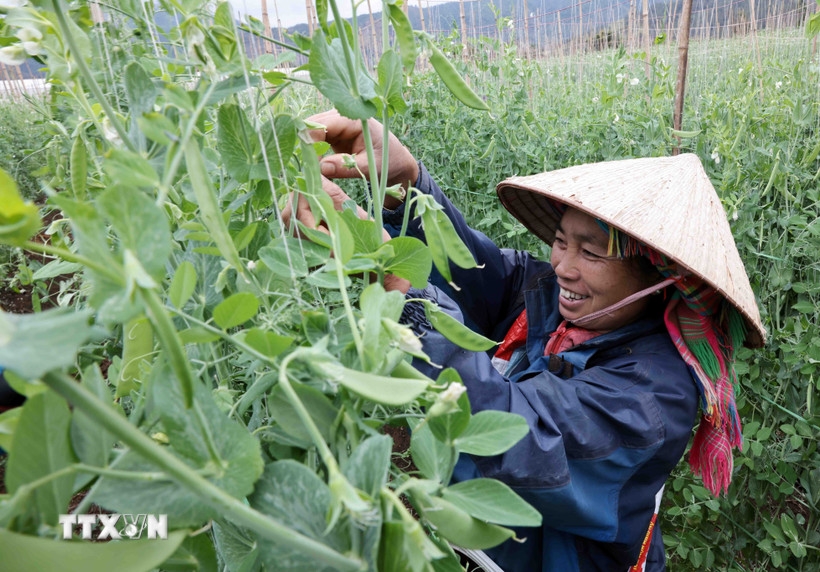
 Agricultural production models have helped poor and near-poor households apply science and technology, improving productivity and product quality
Keywords: National Target Program; Ethnic minority and mountainous areas; New rural areas; Sustainable poverty reduction; Socio-economic development; Integration.
1. Some key results from the implementation of the three national target programs
In implementation of the National Assembly’s Resolution, in 2021 and 2022, the Prime Minister issued Decision No. 1719/QD-TTg dated October 14th, 2021, approving the National Target Program for socio-economic development in ethnic minority and mountainous areas for the period of 2021-2030, Phase I: From 2021 to 2025 (Program 1719); Decision No. 90/QD-TTg dated January 18th, 2022, approving the National Target Program for Sustainable Poverty Reduction and Decision No. 263/QD-TTg dated February 22nd, 2022, approving the National Target Program for New Rural Development for the period of 2021-2025.
The three national target programs have different beneficiaries. The beneficiaries of the Sustainable Poverty Reduction Program are poor households, near-poor households and newly escaped-from-poverty households within 36 months from the time they are recognized as having escaped poverty by the competent authority. Priority is given to supporting poor ethnic minority households, poor households with members who are war veterans; children, people with disabilities and women from poor, near-poor and newly escaped-from-poverty households.
The target groups of the New Rural Development Program are people, communities, cooperatives, businesses and socio-economic organizations in rural areas.
The target groups of Program 1719 are communes and villages inhabited by ethnic minorities and mountainous areas; ethnic minority households and individuals; Kinh ethnic households and individuals classified as poor or near-poor living in particularly difficult communes and villages; Enterprises, cooperatives, cooperative unions and economic organizations operating in particularly difficult communes and villages.
Following the issuance of the Prime Minister's decisions, ministries, sectors and localities have actively organized their implementation and achieved many important results. At the end of the period of 2021-2025, the New Rural Development Program had completed 5 out of 8 main indicators, exceeding the set targets. 13 provinces were recognized by the Prime Minister as having completed the task of building new rural areas, including several provinces and cities in ethnic minority and mountainous regions: Hanoi, Quang Ninh, Ninh Binh, Dong Nai, Ba Ria - Vung Tau (formerly, now Ho Chi Minh City) and Tra Vinh (formerly, now Vinh Long province) are among the provinces targeted for rural income. The average income of rural residents in 2025 is projected to reach approximately 58 million VND/person/year (an increase of 1.4 times compared to 2020, essentially achieving the target set for the period of 2021-2025).
The Sustainable Poverty Reduction Program has met and exceeded the annual poverty reduction targets set by the National Assembly and the Government. The poverty rate in poor districts at the end of 2024 was 24.86%, an average reduction of 6.7% per year, exceeding the target of a 4-5% reduction per year. The poverty rate among ethnic minorities at the end of 2024 was 12.55%, an average reduction of 4.45% per year, meeting the target of a 3% reduction per year.
With Program 1719, out of the 9 specific target groups assigned by the National Assembly, 6 basic target groups have achieved or exceeded the set goals, including: The poverty reduction rate averaged 3.4%, and is projected to reach 3.2% for the entire period (meeting the target of over 3% as planned); The average income of ethnic minorities is expected to reach 45.9 million VND by the end of the period, a 3.3-fold increase compared to 2020 (the target is to increase by more than 2 times); Target groups include: education; vocational training for working-age people; preservation and development of the valuable traditional cultural values and identities of ethnic groups; Strengthening healthcare services to ensure ethnic minority communities have access to modern healthcare services, continuing to control and eventually eliminate diseases in ethnic minority and mountainous areas.
2. Strategic orientation and policies of the Party and the State
The Party and State of Vietnam have set a goal to become a developing country with a modern industrial base and a high-middle income by 2030; by 2045, Vietnam aims to become a developed, high-income country. In order to achieve this goal, the Socio-Economic Development Strategy for the period of 2021-2030 requires: “Implementing comprehensive, sustainable and inclusive multidimensional poverty reduction solutions, especially in areas inhabited by ethnic minorities”. Resolution No. 19-NQ/TW dated June 16th, 2022, of the 13th Central Committee on agriculture, farmers, and rural areas clearly states: “Increasing investment from the state budget, prioritizing disadvantaged areas, mountainous areas, border areas and islands, striving to avoid large disparities between regions”. Resolution No. 42-NQ/TW dated November 24th, 2023, of the Central Committee of the Communist Party of Vietnam on continuing to innovate and improve the quality of social policies to meet the requirements of national construction and defense in the new period emphasizes the goal by 2030: “Continue to implement comprehensive and sustainable poverty reduction solutions in a multidimensional and inclusive manner, ensuring a minimum standard of living and basic social services; support production development, diversify livelihoods, gradually increase income and stabilize the lives of poor households, near-poor households, people in remote areas, ethnic minority and mountainous areas”. In particular, Conclusion No. 65-KL/TW dated October 30th, 2019, of the Politburo on continuing to implement Resolution No. 24-NQ/TW of the IXth Central Committee of the Party on ethnic affairs in the new situation requires: “Focusing on effectively resolving urgent issues” and “Striving to eliminate all disadvantaged areas by 2030”.
Based on the major orientations and policies of the Party and State, the implementation of the three National Target Programs for the period of 2021-2025 is of significant importance, serving as a driving force to help develop agriculture and rural areas, achieve sustainable poverty reduction and promote comprehensive socio-economic development in ethnic minority and mountainous areas, linked to ensuring national defense and security. However, because each program has different objectives, funding sources and implementation mechanisms, it is difficult for localities to integrate them, leading to overlapping, dispersed resources, duplicated tasks and fragmented policies.
In light of this situation, the Prime Minister and the Chairman of the National Assembly have agreed on the principle of integrating the three National Target Programs into one National Target Program. On December 11th, 2025, the 10th session of the 15th National Assembly voted to approve the Resolution on the investment policy for the National Target Program on building new rural areas, sustainable poverty reduction and socio-economic development in ethnic minority and mountainous areas for the period of 2026-2035, aiming to overcome the limitations of the previous period and moving towards more unified, effective, substantive and sustainable management; Promoting complementarity and interconnectedness, ensuring close links between the goals of building new rural areas, sustainable poverty reduction, and development of ethnic minority and mountainous regions, at the same time preserving the specific policies, cultural identity and natural conditions of each region.
The structure of the National Target Program after integration consists of 02 components: Component 1: Building New Rural Areas and Sustainable Poverty Reduction; Component two: Socio-economic development in ethnic minority and mountainous areas, striving to ensure that by 2030, 70% of communes in ethnic minority and mountainous areas meet the new rural standards, focusing on infrastructure investment, creating livelihoods, contributing to sustainable poverty reduction and achieving new rural standards in communes and villages in ethnic minority and mountainous areas; Preserving and promoting the fine cultural identity of ethnic groups goes hand in hand with eliminating outdated customs and practices; consolidating and strengthening the great unity of ethnic groups, enhancing the trust of ethnic people in the Party and the State.
The second component of the Program adheres closely to the principles set forth in Conclusion No. 65-KL/TW dated October 30th, 2019, of the Politburo; Persistently implementing the objectives set forth in Resolution No. 88/2019/QH14 and Resolution No. 120/2020/QH14 of the National Assembly approving the overall plan and investment policy for the National Target Program for socio-economic development in ethnic minority and mountainous areas for the period of 2021-2030 and resolutely taking innovative actions to comprehensively and effectively address the “five most pressing” issues that remain highly relevant in ethnic minority and mountainous areas, including: (1) Most difficult infrastructure conditions; (2) Lowest quality of human resources; (3) Slowest socio-economic development; (4) Most difficult access to services; (5) Highest poverty rate.
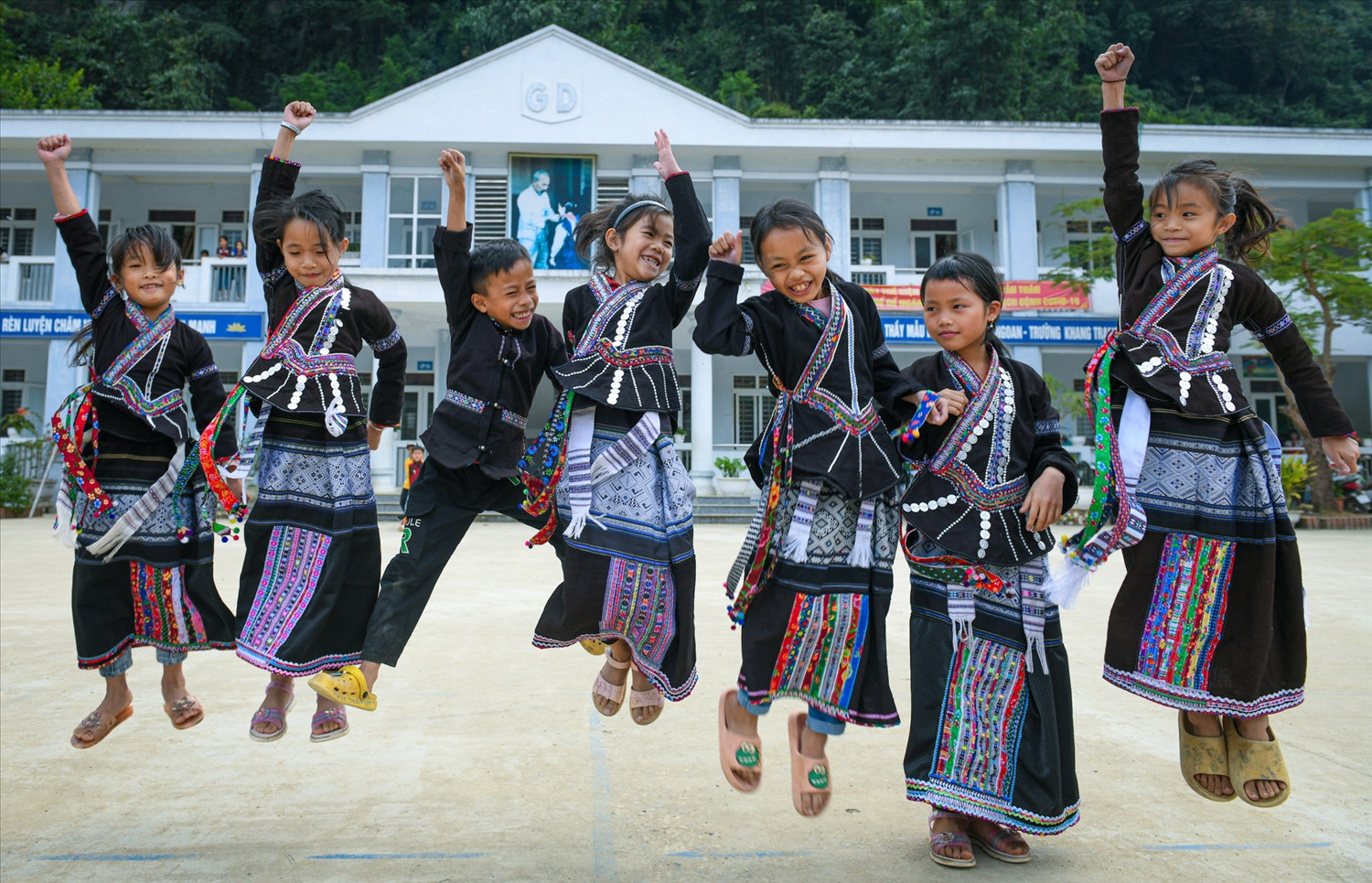 Education in ethnic minority areas has made remarkable progress during the period of 2021-2025. (In the photo: Every day at school is a joyful day for Lu ethnic minority pupils)
3. New development opportunities for ethnic minority and mountainous areas
Firstly, integrating the three National Target Programs demonstrates the high political determination of the Party and the State, under conditions of a streamlined apparatus, in order tto improve the effectiveness and efficiency of state management, ensuring the integration of multi-sectoral goals and strengthening inter-regional and inter-level coordination.
After the reorganization is completed, from July 1st, 2025, the whole country will have 3,321 commune-level administrative units. Based on the initial review results, approximately 1,516 communes are located in ethnic minority and mountainous areas, divided into 3 regions according to development level, including: There are 700 communes in Zone III - extremely difficult communes, 288 communes in Zone II (difficult communes), 528 communes in Zone I (developing communes) and approximately 13,496 extremely difficult villages. In addition, there are some communes and villages in border areas and security zones.
The new program both further concretizes the Party’s direction and serves as a tool for organizing the implementation of national strategies and plans issued by the Government; To be a crucial solution for directly implementing many of the Sustainable Development Goals (SDGs) in the United Nations’ 2030 Agenda, especially those related to poverty eradication, hunger eradication, quality education, clean water and sanitation, employment, inequality reduction, sustainable community development and climate change adaptation. The spirit of “leaving no one behind” is instilled throughout the structure and content of the Program, demonstrating the strong socio-political commitment of the Party and the State in ensuring access to basic services and comprehensive development for all citizens, especially in ethnic minority and mountainous areas.
Secondly, program integration allows for the formation of a continuous development chain. In practice, many fundamental issues remain unresolved, hindering the goal of sustainable development and requiring more comprehensive, long-term and decisive policies. For example, while many localities in the delta region have achieved high levels of new rural development, the midland and mountainous areas of the North, the Central Highlands, the Mekong Delta and border regions still have many communes that do not meet the criteria, have high poverty rates, and lack basic development conditions. The “core of poverty” is concentrated in remote and disadvantaged areas, making it very difficult to implement sustainable poverty alleviation solutions. Ethnic minorities account for more than two-thirds of the total number of poor households nationwide, indicating that poverty reduction and social security efforts still face many difficulties and challenges. The lack of essential infrastructure and basic services in particularly disadvantaged areas remains very serious. Many poor communes, mountainous and border communes still lack stable transportation, clean water, schools and health stations that meet standards…
For ethnic minority and mountainous regions, 3 out of 9 specific targets assigned by the National Assembly in Resolution No. 120/2020/QH14 have not yet been achieved, including two targets that are projected to face many difficulties and challenges: The target groups include improving technical and social infrastructure in particularly disadvantaged communes and villages; addressing the issue of land scarcity for housing and production among ethnic minorities. These target groups require a higher level of focus and longer implementation time compared to many other tasks due to typical challenges in the area (rugged terrain, difficult transportation, some population groups living in areas vulnerable to flash floods and landslides...). Therefore, it is essential to restructure policies and investments to prioritize disadvantaged and particularly difficult areas, focusing on key areas and tailored to the specific characteristics of each region.
Thirdly, implementing a two-tiered local government system from 2025 will place significant pressure on the program’s implementation system, necessitating a redesign of management, supervision and inter-sectoral coordination mechanisms that are flexible, streamlined and efficient. In the context of limited public resources, integration is no longer a technical option but a necessity. Maintaining three programs, each program has its own system of guiding documents, lead agency and management process, but integration requires a coordination mechanism strong enough to overcome the “program management” mindset that is deeply ingrained in the administrative apparatus. Designing the program on a 10-year cycle (2026-2035) is necessary to ensure policy continuity, facilitate local development of medium and long-term plans, improving the efficiency of public investment and attracting social resources. Our country is entering a period of rich, strong, civilized and prosperous development, requiring more perseverance and steadfastness to achieve the goal of building “ecological agriculture, modern rural areas, civilized farmers” and “multi-dimensional poverty reduction, inclusive development”. For ethnic minority and mountainous areas, given the unique characteristics of the target group, the specific geographical area and many specific policy contents, the development and implementation of the second component will give maximum autonomy to localities, based on the principle of strong and thorough decentralization, ensuring the principle of “local authorities decide, local authorities act and local authorities are responsible”. Central agencies only manage targets and indicators, perfecting institutions, mechanisms, and policies to create a favorable environment for localities to implement. Localities are responsible for carefully reviewing and assessing the current situation, needs and characteristics of their areas to propose key tasks, focusing on a number of main pillars including: (1) Investing in the construction and improvement of infrastructure in ethnic minority and mountainous areas; (2) Supporting production development, creating livelihoods and increasing income for ethnic minorities; (3) Developing human resources in ethnic minority and mountainous areas; (4) Support and development of ethnic minority groups that still face many difficulties, with specific difficulties; (5) Communication and propaganda work; Inspection and supervision; Information and reporting system.
Fourthly, regarding resources, the total projected capital for the Program during the period of 2026-2030 is approximately 1,044 trillion VND. Initially, the central government budget will provide direct support of 100,000 billion VND. During implementation, the Government will continue to balance the central budget to prioritize additional support for the Program, in accordance with actual conditions and proposed needs, in order to ensure sufficient resources to support the achievement of assigned goals and tasks. One of the principles of capital allocation is to prioritize the allocation of the highest level of central government budget to particularly disadvantaged communes and villages, ethnic minority and mountainous areas, security zones, border areas and islands in order to create significant changes in socio-economic development, building new rural areas and achieve sustainable poverty reduction.
Fifthly, program integration opens up opportunities to enhance the role of citizens as active participants. Instead of receiving numerous separate programs, citizens and communities can participate in a comprehensive local development plan, thereby increasing their initiative, responsibility and social cohesion. This is particularly significant for ethnic minority and mountainous regions, where communities play a central role in maintaining livelihoods, culture and social order.
4. Conclusion
Integrating the three National Target Programs is essential for the Program to effectively fulfill its role as one of the key tools for implementing the Resolution of the 14th National Congress of the Party. For ethnic minority and mountainous regions, the Program will directly contribute to concretizing Conclusion No. 65-KL/TW dated October 30th, 2019, of the Politburo on continuing to implement Resolution No. 24-NQ/TW dated March 12th, 2003, of the Seventh Conference of the Central Committee of the Party (9th term) on ethnic affairs in the new situation, and the Party’s resolutions on agricultural, rural and farmer development, sustainable poverty reduction, ensuring social security and striving to ensure that no one is left behind in the new development phase.
References
1. Government (2025). Report proposing investment policies for the National Target Program on building new rural areas, sustainable poverty reduction and socio-economic development in ethnic minority and mountainous areas for the period of 2026-2035.
2. Communist Party of Vietnam (2019). Conclusion No. 65-KL/TW dated October 30th, 2019 of the Politburo on continuing to implement Resolution No. 24-NQ/TW of the Central Committee of the 9th Party Congress on ethnic affairs in the new situation.
3. Communist Party of Vietnam (2021). Socio-economic development strategy for the period of 2021-2030.
4. Communist Party of Vietnam (2022). Resolution No. 19-NQ/TW dated June 16th, 2022 of the 13th Central Committee on agriculture, farmers and rural areas.
5. Communist Party of Vietnam (2023). Resolution No. 42-NQ/TW dated November 24th, 2023, of the Central Committee of the Party on continuing to innovate and improve the quality of social policies to meet the requirements of the cause of building and protecting the Fatherland in the new period.
6. National Assembly (2019). Resolution No. 88/2019/QH14 approving the overall plan for socio-economic development of ethnic minority and mountainous areas.
7. National Assembly (2020). Resolution No. 120/2020/QH14 approving the investment policy for the National Target Program for socio-economic development in ethnic minority and mountainous areas.
8. National Assembly (2025). Resolution No. 257/2025/QH15 approving the investment policy for the National Target Program on building new rural areas, sustainable poverty reduction and socio-economic development in ethnic minority and mountainous areas for the period of 2026-2035.
