Keywords: Commercialization of culture; Traditional festival; Religious researchs; Spiritual tourism; Heritage preservation; Community subjects.
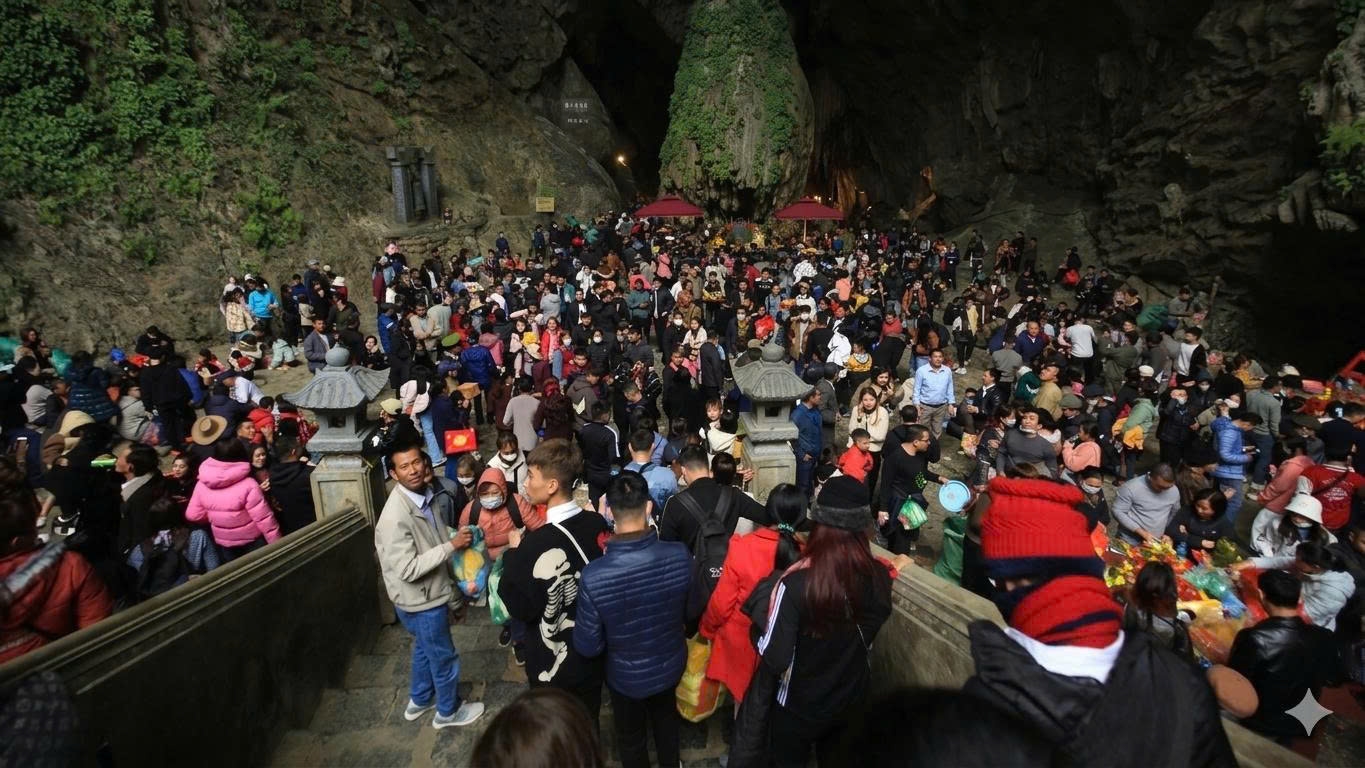 Tourists flocked to the Huong Pagoda festival
1. Introduction
Traditional Vietnamese festivals are a vibrant entity, bearing the imprint of national identity. In the view of researchers such as Dao Duy Anh or Toan Anh, festivals are spaces where people can escape from daily life, immerse themselves in the sacred to regenerate energy and strengthen community solidarity. However, with the advent of integration and development under a market economy, festivals are no longer exempt from the laws of supply and demand. The phenomenon of “commercialization” has transformed spiritual values into quantifiable commodities. This is not just a story about shops encroaching on historical sites, but also about the erosion from within the structures of belief, where festivals are “scripted” and “performed” to serve profit.
In the process of searching for the causes, it is also necessary to clarify the manifestations of commercialization, which occur on two levels: Firstly, superficial commercialization manifests itself through the explosion of related services, from ticket sales and offering services such as arranging ceremonies and praying on behalf of others, to gambling-related games; Secondly, commercialization in depth is manifested through changes in the structure of rituals. Many rituals originally intended for local communities have been modified to attract tourists, or monuments have been newly constructed on a massive scale with the aim of commercializing spiritual tourism instead of preserving historical value.
2. Causes of the commercialization of festivals
Firstly, the deviations in the religious mindset and behavior of modern populations.
The first and most fundamental reason lies in the transformation of the people who go to religious ceremonies. In traditional society, people went to religious ceremonies with the mindset of venerating and admiring their ancestors or praying for inner peace. However, modern people, with their economic and social anxieties have brought market-oriented thinking into the religious space. Furthermore, a large number of worshippers today view deities as business partners. They believe that the larger the donation and the more generous the offerings, the more blessings they will receive. This has led to the emergence of services that hire people to perform rituals and prayers and the widespread problem of scattering small change indiscriminately. Money, the medium of economics has been mistakenly used as a medium of faith. In addition, the festival has been transformed into a kind of experiential commodity. People go to religious ceremonies not necessarily for spiritual practice or to learn about history, but in order to check in, in order to show off their success or simply to relieve stress in the most practical way. When faith is measured in monetary terms, its sacredness is reduced to the level of civil transactions, creating conditions for profiteering to take root.
Secondly, local economic pressures and growth targets.
The second reason stems from the perspective of regional economic management. Festivals are no longer just cultural activities but have become a non-polluting industry, an important source of revenue for localities. At the same time, a conflict has emerged between conservation and exploitation; in order to achieve tourism growth targets, many localities have materialized their heritage sites. They prioritize scale over cultural depth. New religious structures are being built at a breakneck pace, on a massive scale, in order to attract large numbers of visitors. Overemphasizing the number of visitors has inadvertently transformed the festival space into a giant marketplace, where opportunistic services are prioritized over preserving the solemnity of the occasion.
In many festivals, travel companies and investors are involved, often prioritizing profit when organizing the event. In order to maximize revenue, festival scenarios are altered, festivals are extended, exotic entertainment elements are added or essential services are monopolized. This shift has caused the festival to lose its natural character, turning it into a pre-packaged product to be sold to tourists.
Thirdly, the weakening of the role of the village community as the main actor.
This is the most profound anthropological reason for the loss of control leading to the commercialization of festivals. Festivals traditionally belong to the village, nurtured and maintained by the villagers. The phenomenon of “state control” and “administrative control”, where state agencies directly organize and manage festivals in an event-like manner, relegates local people, who are the custodians of the heritage, to the roles of servants or spectators. When the community is no longer the true owner, its sense of responsibility towards the historical site diminishes. Furthermore, a generational disconnect is also a contributing factor due to labor migration, causing young people to leave the village and the number of those knowledgeable about traditional rituals is dwindling. This void is filled by freelance workers from other areas who come to do business at the festival. These people have no reverence for the local deities; they view the festival purely as an opportunity to make quick money. When the self-governance of village communities is broken, mechanisms of oversight based on public opinion and customs are rendered ineffective, giving way to the chaos of spontaneous business.
Fourthly, the legal system and administrative practices still have many loopholes
Finally, it is impossible to ignore the role of the state administrative apparatus and the legal framework which have not kept pace with the speed of social development, including the causes of overlapping responsibilities and lack of professionalism. Festival management typically involves multiple stakeholders: culture, police, health, industry and trade…; however, this coordination is often only seasonal and sporadic. Regulations regarding the management of donations and business services at historical sites remain lax, creating areas where profiteering is possible. About penalties, there is a lack of deterrent effect for violations such as price gouging, soliciting customers, fortune telling or practicing superstition, which are often only subject to light administrative penalties compared to the enormous profits these individuals reap. Furthermore, the indiscriminate licensing of new festivals or spiritual tourism projects without thorough assessment of their cultural impact has created an unhealthy competitive festival market, fostering commercialization that permeates every aspect of spiritual life.
Analysis of the causes reveals that the commercialization of festivals is a multifaceted problem. In order to overcome it, administrative prohibitions alone are insufficient. A sustainable solution must begin with reorienting people’s perceptions, restoring the role of local communities as key stakeholders, at the same time developing a responsible cultural tourism plan. Only when festivals are considered heritage to be preserved rather than resources to be exploited to the point of depletion, can the sacredness and beauty of Vietnamese culture sustainably survive the onslaught of the market economy.
3. Solutions to address the problem of commercialization and move towards a sustainable balance of festivals
The solution to overcome the commercialization of festivals is to implement a roadmap for transitioning from an extreme exploitation model to a sustainable conservation model, focusing on human values and the community. Addressing the commercialization of festivals requires a multi-layered strategy that simultaneously impacts the organizers, the performance space, public perception and the economic products. The ultimate goal is not to completely eliminate the economic element, but rather to “culturalized” the economic activities within the festival.
Firstly, restoring self-determination to the community
This is the key and fundamental solution. Traditional festivals originate from the inherent needs of the village community. When festivals become overly “bureaucratic”, communities lose their ownership and become alienated from their own heritage, leading them to focus only on exploiting short-term benefits. When festivals become overly “bureaucratic”, communities lose their ownership and become alienated from their own heritage, leading them to focus only on exploiting short-term benefits. At the same time, the role of the main actors needs to be re-established. The state and regulatory agencies need to shift from the role of organizer to that of supporter and supervisor. The authority to decide on rituals, festival scripts and internal management should be returned to a management board elected by the local people. When communities feel they are the true owners of their heritage, they will have mechanisms to resist blatant commercialization. Community supervision is always more effective and thorough than any inspection force. Along with that, there must be a fair sharing of benefits. A portion of the revenue from festival tourism should be reinvested directly in local infrastructure and community welfare. When people can earn a living from professions related to heritage preservation in a civilized manner, they will no longer have the need to overcharge or engage in opportunistic business practices. The heritage-based community tourism model needs to be standardized to ensure that every local resident is a cultural ambassador rather than a street vendor.
Secondly, spatial planning and service flow allocation
The chaos of commercializing festivals often stems from encroachment on public space. When stalls surround the pagoda gates, the loud noise of loudspeakers selling goods drowns out the sound of the temple bells, the sacredness of the event is lost. Therefore, spatial planning is an urgent technical solution. It is necessary to establish clear physical boundaries by dividing functional zones such as core areas, buffer areas and service areas. The core area is a sacred area, where important ceremonies take place, requiring absolute silence. Here, all buying, selling, advertising and food, beverage services are strictly prohibited. The buffer area is where cultural activities, folk games and heritage displays are held. Services here are limited to cultural introductions. The service area is where commercial, dining and accommodation activities are concentrated. This area needs to have a consistent architectural plan that does not disrupt the overall landscape of the historical site. In addition, the stalls must be arranged in accordance with cultural aesthetics standards, prioritizing natural materials and there should be a system of signage and traffic flow management to avoid congestion, creating a relaxed environment for worship and helping visitors maintain a respectful attitude.
Thirdly, education and communication should reorient the mindset regarding religious practices
The commercialization of festivals survives because of demand. As long as worshippers have a transactional mindset with the deities, profit-driven services will continue to thrive. The sustainable solution lies in changing the operating system of society’s mindset. The media should not focus too much on grandeur or mystical sacred elements, but should promote education about history, the significance of human and celestial deities and the moral values that the festival aims to uphold. When tourists understand the philosophy of “drinking water, remembering the source” or the chivalrous spirit of a festival, their behavior will naturally adjust towards a more respectful one. Religious and faith-based institutions and festival management boards need to issue and widely disseminate specific guidelines: from attire and offering methods to limiting the burning of votive paper and scattering of small change. School education should also incorporate content about festival culture to cultivate a generation of civilized tourists in the future. Going to church is for spiritual practice and showing gratitude, not for investment and profit; this message needs to become a common understanding in society.
Fourthly, diversifying high-quality cultural products
While the festival shouldn’t exclude economic activities, it needs a heritage economy with a high intellectual content. Negative commercialization is often associated with cheap, counterfeit and unoriginal products. Therefore, instead of allowing unregulated stalls to sell plastic toys or unhygienic food, localities need to invest in research and development of distinctive souvenir products such as handicrafts, folk cuisine with standardized packaging and quality, or cultural publications about festivals. This not only increases sustainable revenue but also helps spread the festival’s values beyond the event’s space and time.
The festival should also utilize VR/AR technology to recreate lost traditional rituals or building virtual reality tours, giving visitors a deeper insight into the heritage without putting pressure on physical infrastructure. When tourists are willing to pay for sophisticated cultural experiences, low-quality, rip-off services will automatically be eliminated by market laws.
4. Conclusion
The commercialization of festivals is a consequence of the clash between sacred values and the laws of the market economy. Analysis reveals that the root of the problem lies in the transformation of individual mindsets, pressure for local growth, the weakening of the community’s role as an active participant and loopholes in state management. In order to overcome this challenge, implementing a synchronized set of solutions will create a sustainable self-protection mechanism for the heritage. The ultimate goal is for the festival to continue to function within the economic flow while preserving its sacredness and national identity, serving as a space to nurture the soul and community bonding.
References
1. Le Hong Ly (2008), Traditional Festivals in Contemporary Life, Social Sciences Publishing House, No. 4, Hanoi.
2. Nguyen Van Huy (2001), The role of the community in heritage preservation, Journal of Cultural Heritage.
3. Dao Duy Anh (2002), Outline of Vietnamese Cultural History, Culture and Information Publishing House, Hanoi.
4. Tran Ngoc Them (1996), Searching for Vietnamese Cultural Identity, Ho Chi Minh City Publishing House.
