Folk dance is a popular form of expression among ethnic communities in Vietnam, widely used in community cultural activities. Each ethnic group has its own distinctive folk dances. For the Khmer people of Southern Vietnam, dance is an indispensable form of cultural art during festivals, New Year celebrations or housewarming ceremonies, weddings, creating an atmosphere of joyful interaction and unity within the community. The Khmer people have two types of dance: community dance, also known as folk dance and court dance. While court dance is scientific, profound, solemn, ancient, folk dance is the opposite, with movements that are relaxed, optimistic, cheerful and humorous. Today, this form of folk dance is still preserved and widely passed down in the community life of the Khmer people in the Mekong Delta provinces.
During Khmer festivals in Southern Vietnam, everyone participates in joyful singing and dancing. People can dance at home, in temple courtyards, in fields and there is no limit to the number of participants. As the rhythmic drumming and intoxicating singing of the Rom Vong melody fill the air, individuals, young and old, joining together in a graceful and fluid group dance. Rom vong dance means a circle dance, where young men and women dance while turning to look at each other affectionately and intimately. The female movements are gentle and discreet, with both arms gracefully swaying in front of the chest, while the male movements are vigorous, with arms spread wide as if to shield and protect the woman, combined with leg movements, the leg in front corresponds to the arm positioned lower and in opposite, the left palm facing up while the right palm faces down and in opposite.
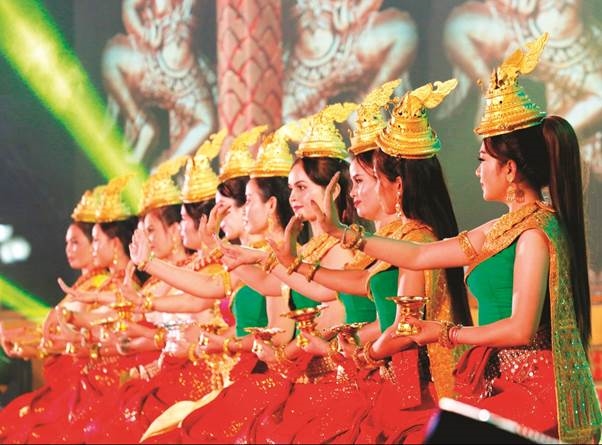 Khmer Folk dances are preserved and passed down through generations in the lives of the Khmer people
Next is the Lam Leo dance, also known as the Lao dance, which is lively and energetic in terms of speed and movements. The dance movements are similar to Rom Vong; one hand is used for “catching” or “catching” - palm facing upwards, using the thumb and index finger to press together with enough force to stretch the other three fingers outwards; a hand, also known as a cover - use force to press your fingers together as if shielding yourself from the sun, but with your palms and the way they alternate that posture between their hands in their footwork demonstrates the performer’s harmonious coordination.
Another lively dance is the Saravan dance. The main dance movement involves pressing the wrists in time with each beat of the music. The dance is typically performed in circles, rows, in pairs or facing each other in horizontal formations, chasing each other up and down or left and right. The arms are sometimes spread wide at shoulder level, sometimes hanging loosely by the body and sometimes crossed in front of the stomach with wrists pressed together evenly like a swallow flapping its wings.
In addition to the typical dances mentioned above, Khmer folk dance also includes other dances such as: the dances include the shrimp-catching dance (using a cymbal) (Chnieng), the coconut shell dance (Khos Trolot), the rice-harvesting dance (Caseko), the Sadam drum dance, the Yak dance (Chan dance) and the fence-opening dance in wedding ceremonies…
Folk dances have become an integral part of Khmer culture, deeply ingrained in their consciousness and daily lives.
