Keywords: Labor migration; Khmer ethnic group; Cultural transmission; The Mekong Delta.
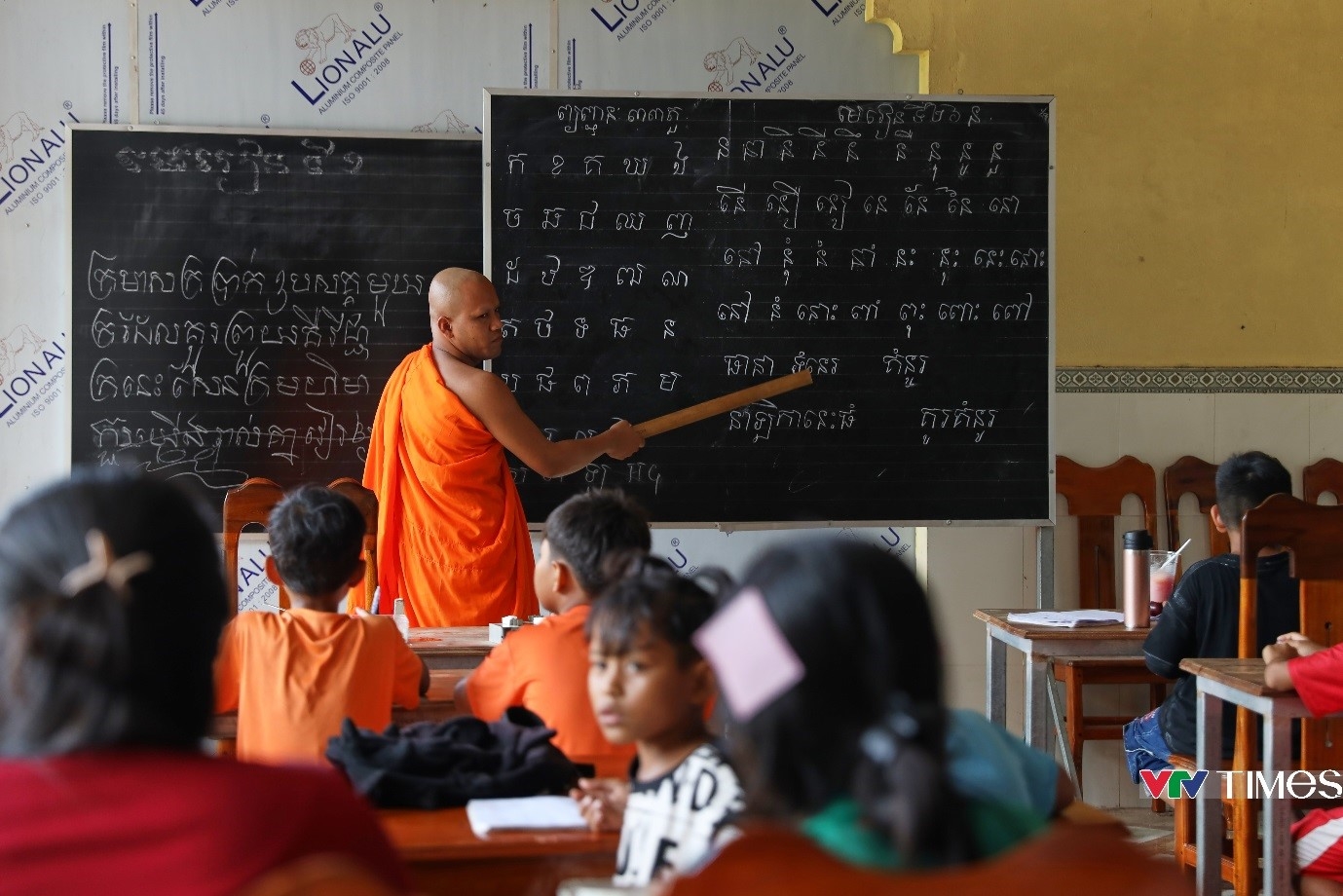 Many Khmer pagodas in the Southwestern region of Vietnam maintain free Khmer language classes during the summer, contributing to the preservation of the ethnic group’s spoken and written language
1. Labor migration among the Khmer ethnic group in the Mekong Delta
Following the reorganization of administrative units and the establishment of a two-tiered local government model, the Mekong Delta region now comprises the following provinces and cities: Vinh Long, Dong Thap, Ca Mau, An Giang and Can Tho city (Government, 2025: 7), with an area of approximately 40,000 km². This is home to 28 ethnic groups, of which the Khmer ethnic group comprises 1,158,292 people (6.6%), mainly distributed in Vinh Long, Can Tho, Ca Mau and An Giang provinces (Ministry of Ethnic and Religions - Statistics Department, 2025). With their settlements primarily in villages/hamlets, the Khmer ethnic group is concentrated around Theravada Buddhist temples, their lives are mainly agricultural and their socio-economic conditions remain challenging. These characteristics have slowed down socio-economic development in areas with large Khmer populations, thereby creating pressure for labor migration to other localities.
In reality, the fragmentation of land has reduced the average cultivated area, making the traditional agricultural livelihoods of the Khmer ethnic group increasingly precarious. This is one of the important causes of labor migration. From 2005 to 2020, the Mekong Delta consistently experienced a negative net migration rate; 1.8% in 2005 and increasing to 10.6% in 2020 (Earth Journalism Network, 2022). Particularly in Vinh Long and Can Tho provinces, where the Khmer community accounts for over 30% of the population, the land is mainly infertile rice paddies, dependent on irrigation, with low yields and precarious income, leading to increasingly strong emigration (VCCI and Fulbright, 2024). Moreover, the traditional livelihood combining rice farming, fish farming and handicrafts, which once ensured the well-being of the people, to be no longer suitable in a market economy. Rising input costs and an unstable consumer market have resulted in lower-than-average incomes for the Khmer ethnic group, making migration a viable option for employment, primarily in Ho Chi Minh City, Binh Duong province and other industrial zones (VCCI and Fulbright, 2024).
Besides economic factors, the impact of climate change is a far-reaching cause. The Mekong Delta is one of the regions most severely affected by saltwater intrusion, drought and erosion. Coastal villages/hamlets with a high concentration of Khmer people are high-risk areas where saltwater intrusion is often prolonged, occurring 2.5-3.5 months earlier and receding one month later than the multi-year average (Earth Journalism Network, 2022). When agricultural production becomes unstable, Khmer youth are forced to leave their hometowns to find a livelihood, creating a vicious cycle of declining local labor and weakening the cultural foundation of the villages (VCCI and Fulbright, 2024).
The attractiveness of urban areas and industrial zones in the Southeast region also plays a decisive role. Between 2009 and 2019, the Khmer population in the Southeast region increased by 43%, mainly due to migration from the Southwest region. Ho Chi Minh City alone has over 50,000 Khmer ethnic group, Binh Duong province 65,000 and Dong Nai province 23,000 (Nguyen Phu Loi, 2022: 60). In addition to employment needs, the trend of migration for education and knowledge enhancement, especially to Theravada Buddhist educational institutions and colleges and universities is becoming increasingly evident.
Thus, the migration of the Khmer ethnic group is the result of a combination of factors: vulnerable living conditions, declining traditional livelihoods, increasingly extreme climate change and the strong attraction of dynamically developing regions... Therefore, migration reflects both socio-economic pressures and the adaptation of communities to the new context. However, this also carries the risk of disruption in cultural transmission, decline in language, traditional crafts and the consolidation of villages/hamlets through the pillars of Khmer ethnic group’s identity.
2. Problems posed in cultural transmission among the Khmer ethnic group due to the impact of labor migration
The Khmer people in the Mekong Delta have concentrated living spaces and distinctive Theravada Buddhist characteristics. Culture is both the identity and the foundation that binds a community together. However, due to the impact of labor migration, especially informal migration, the process of cultural transmission is facing many challenges, requiring consideration of both traditional cultural characteristics and the long-standing mechanisms of cultural transmission.
Firstly, regarding the cultural characteristics of the Khmer ethnic group in the Mekong Delta.
For the Khmer ethnic group, the Theravada Buddhist pagoda is the center that unites the community. Each village/hamlet has a pagoda that serves as a central religious, educational, cultural and community-building center. By 2020, the entire region had more than 445 Theravada Buddhist temples, and significant changes were taking place in the tradition of practice, monks and the religious faith transformation of a segment of the Khmer ethnic group (Nguyen Phu Loi, 2022: 61). Thus, the pagoda serves as a multi-functional religious institution, from teaching literacy and organizing festivals to preserving and disseminating Buddhist scriptures and fostering community cohesion through rituals. Images of temples with spires, reliefs and traditional musical instruments in festivals are vivid symbols of Khmer cultural identity.
Furthermore, the festival system creates a unique cultural rhythm with festivals associated with seasons, beliefs and agricultural cycles; it is a space for community art performances where the younger generation can receive, practice and preserve cultural identity. This contributes to creating a cultural map that is increasingly clearly defined in the context of globalization and deeper integration today. However, as young laborers migrate, the number of people participating in festivals decreases, causing the vitality of the festivals, as well as the values in oral culture and community life in the daily lives of the Khmer ethnic group to gradually diminish.
Secondly, regarding the mechanism of transmitting traditional culture among the Khmer ethnic group.
In the traditional cultural structure of the Khmer ethnic group, the family plays a pivotal role. Grandparents and parents are the ones who pass on the language, customs, production experience and especially the moral values of the community. Folk tales, lullabies, proverbs and rituals related to “officials, marriage, funerals and sacrifices” are preserved through oral tradition. This is a natural, intrinsic transmission that creates a sense of community identity from a young age among the Khmer ethnic group. However, in the context of labor migration, the traditional Khmer family model is changing. Young people leave their hometowns to work as factory workers, leaving a generational gap and weakening the function of cultural transmission within families. Besides family, the temple is a special cultural and educational center. The temple teaches Khmer, Pali, Buddhist scriptures and religious rituals. Khmer children, especially boys, often go to the pagoda to learn to read and write and to study religious doctrines. Many temples maintain free summer classes, forming a lasting tradition that has spanned generations. Moreover, villages are the most vibrant spaces for cultural transmission, as they host festivals and folk art performances, contributing to the preservation and transmission of culture based on collective memory.
The cultural transmission mechanism of the Khmer ethnic group is based on a triangular relationship: the family, the pagoda and the community have created a harmonious system over the centuries, ensuring that this transmission continues uninterrupted in the lives of the Khmer ethnic group. However, this mechanism is facing significant challenges from the reality of labor migration, as the absence of young people in particular and adults in families in general has weakened the family’s role in teaching, reduced the rate of Khmer literacy education at pagodas, and diminished the participation of the younger generation in community activities. This signals a potential disruption in the cultural transmission chain, highlighting the urgent need for conservation and adaptation policies.
Thirdly, the impact of labor migration on the disruption of cultural transmission among the Khmer ethnic group
From a research perspective based on the relationship between ethnicity and religion, the impact of labor migration on the cultural transmission mechanism of the Khmer ethnic group in the Mekong Delta is seen as a dual phenomenon involving two factors, both an essential livelihood strategy and a weakening of the traditional institutions (family - pagoda - community) that play a core role in the Khmer ethnic identity.
In the culture of the Khmer ethnic, the Theravada Buddhist pagoda is the center of community cohesion through the teaching of Pali language, Buddhist scriptures and rituals; The family is the cell that transmits culture within the family, where grandparents and parents teach the mother tongue, life cycle rituals and morality to young people; The village community is a space for collective performance through traditional folk art forms in the life of the Khmer ethnic group. As young people, especially young men of monastic age leave the Mekong Delta for other localities, the generational density within the Khmer ethnic group decreases, links in the chain of succession are broken as fewer people remain at the temples to study and receive the inheritance and transmission of culture, including traditional crafts and community arts; few people learn to read and write or study traditional cultural and religious rituals and few young people participate in community work through religious, artistic or spiritual activities…
Conversely, the Theravada Buddhist temple itself and the community continue to make efforts to compensate by organizing free Khmer language classes every summer, which are increasingly receiving attention from the local government. In areas with large Khmer ethnic populations, many schools have begun incorporating the Khmer language into their main curriculum. However, in some remote and rural areas, implementation remains limited due to a shortage of bilingual teachers and facilities. Furthermore, these classes remain seasonal, making it difficult to compensate for the generational gap throughout the year due to long-term labor migration or even informal labor migration in the Mekong Delta in general and for the Khmer ethnic group in particular.
Furthermore, the migration of Khmer ethnic group to other economic regions has altered the linguistic ecosystem, thereby contributing to a disruption in cultural transmission among the Khmer ethnic group. Accordingly, in areas where the Khmer ethnic group has migrated, such as industrial zones and educational centers, Khmer workers or students have to conduct their work and studies in a Vietnamese-speaking environment, with limited opportunities to use their own language. Along with that, the sense of kinship through the pagoda has become distant and opportunities to use the Khmer language or Pali script on a daily basis have decreased. Children who migrate with their parents or are born in the place of migration have less exposure to their mother tongue, especially literacy skills, which are primarily developed in Theravada Buddhist pagodas and summer classes in their hometowns.
An international research on migration and language reveals the pattern of traditional linguistic divergence, whereby the 1.5 and second generations experience a rapid decline in their mother tongue proficiency upon environmental transition, this phenomenon has been clearly observed in the Khmer community in the United States (Wayne E. Wright, 2010) and has methodological comparative value for the case of the Khmer ethnic group in Vietnam in general and the Mekong Delta in particular.
Furthermore, in the cultural life of the Khmer ethnic group, traditional cultural festivals associated with Theravada Buddhism are not only spiritual rituals but also elements of social cohesion, connecting the community of villages/hamlets, and facilitating the learning of traditional rituals or arts… However, due to changes in daily life, work and researchs, especially for young people, most Khmer ethnic group only participate in traditional festivals during holidays and festivals, following the general holiday schedule of society. If it were like before these activities were previously closely linked to agricultural life, changes in labor methods, social migration patterns and other factors have disrupted these festivals, aligning them with the pace of industrial life. Moreover, migration for a change in livelihood has led to changes in the Khmer ethnic group’s culture, worship customs and religious beliefs, influencing cultural activities within the migrated community in various ways.
3. Conclusion
The labor migration of the Khmer ethnic group in the Mekong Delta reflects socio-economic changes and reveals challenges in preserving their ethnic cultural identity. When young workers leave their hometowns for work elsewhere, families, pagodas and communities lack a successor generation, putting languages, festivals and traditional crafts at risk of disappearing. However, migration is not entirely negative if managed with appropriate policies, as it can expand cultural space and foster creative adaptation within communities. It is crucial to link cultural preservation with sustainable livelihood development, strengthen the role of pagodas and schools, creating cultural spaces in migration areas and secure support from family-community networks. With comprehensive solutions, the Khmer ethnic group can both integrate into society and preserve their identity in the current development context.
* Academy of Politics Region IV
References
1. Ministry of Ethnic and Religions - Statistics Department (2025), Results of the survey collecting information on the socio-economic situation of 53 ethnic minority groups in 2024, http://www.cema.gov.vn/thong-bao/ket-qua-dieu-tra-thu-thap-thong-tin-ve-thuc-trang-kinh-te-xa-hoi-cua-53-dan-toc-thieu-so-nam-2024.htm
2. Government (2025), Government Resolution No. 306/NQ-CP dated October 5th, 2025 on adjusting the National Master Plan for the period of 2021-2030, vision to 2050.
3. Earth Journalism Network (2022), “Floods and Migrants of Vietnam’s Mekong Delta: 25 Lessons from the Data”, https://earthjournalism.net/stories/floods-and-migrants-of-vietnams-mekong-delta-25-lessons-from-the-data
4. Nguyen Phu Loi (2022), The transformation of Khmer Theravada Buddhism in the Southwest region today, Journal of Religious Studies, No. 5 (221), p.58-75.
5. VCCI và Fulbright (2024), Annual Economic Report of the Mekong Delta 2024: Mobilizing Investment for sustainable development, Can Tho University Publishing House.
6. Wayne E. Wright (2010), Khmer as a Heritage Language in the United States: Historical Sketch, Current Realities, and Future Prospects, Heritage Language Journal, Vol. 7(1) Winter, 2010, https://brill.com/view/journals/hlj/7/1/article-p117_6.xml
