Keywords: Wedding ceremony; Religious marriage; Religious rituals in marriage.
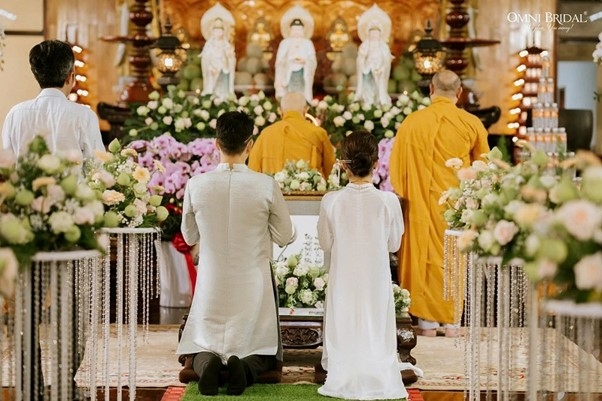 The wedding ceremony is considered a beautiful cultural tradition in Vietnamese life
1. Traditional Vietnamese wedding ceremony
According to traditional Vietnamese customs, the wedding ceremony in the past went through the following stages: when the parents of the son found a girl of suitable social standing, the matchmaking process began. The parents on the groom's side choose someone, usually a close friend or relative, who is tactful and polite, in order to act as the matchmaker. This person will go to the girl’s house to make a preliminary proposal. The bride’s family usually doesn’t express their opinion immediately, taking time to gather more information about the family and the son himself, therefore, after a short while, the matchmaker visits the bride’s family again.
If the marriage proposal is accepted by the girl’s family, the boy's family sends a matchmaker with a swallow to the girl’s house as a sign that they have chosen her; this ritual is called the betrothal ceremony. Swallows were chosen because they are very loyal and always stay in pairs. Afterward, the groom's family sends a matchmaker to ask for the girl’s birth date, time, month, year, at the same time providing the girl’s family with similar information about the boy; this ceremony is called the inquiry ceremony. The information exchanged between the two parties is used for horoscope readings and fortune telling to determine whether the destinies of the boy and girl are compatible. A marriage can be annulled if the results indicate that their destinies are incompatible. If the couple is compatible, the groom's family will proceed with the next ceremony called the “nap cat” ceremony, which is to inform the bride’s family that there is good news, that the boy and girl are destined to be together, at this point the marriage is considered decided.
Next, the boy’s parents join the matchmaker in bringing the betrothal gifts to the girl's house for the betrothal ceremony, which means the boy’s family brings silk, gold, silver and other precious items to affirm and witness the marriage of the young couple. At this point, the marriage is considered complete, all that remains is to set the date and time. Afterward, the groom’s family will proceed with the “requesting the date and time” ceremony to welcome the bride and hold the final ritual, the “wedding procession” ceremony.
2. Buddhist wedding ceremony
Firstly, it must be said that Buddhist teachings do not specifically prescribe this ritual, nor do they require Buddhist followers to follow this procedure when holding a wedding ceremony. However, when the couple makes a vow before the Three Jewels to live happily together according to the basic moral principles of Buddhism, on the one hand, it creates a spiritual foundation for family life, and on the other hand, the promise before the Three Jewels will have the strength to support the couple in overcoming difficulties in married life. With love, a sense of responsibility and a purpose in life, the young couple built their happy home together on the foundation of Buddhist ethics for lasting happiness.
The Buddhist wedding ceremony, also known as the Buddhist wedding ceremony or the Buddhist prayer ceremony is a ritual held at a temple consisting of 15 items, the most significant of which for couples are the main rituals, including: Offering incense, bowing to Buddha, receiving enlightenment, exchanging vows, exchanging rings, and making wishes. Depending on their spiritual needs, economic circumstances, time constraints and organizational needs, the bride and groom may perform all these rituals or omit some.
The initiator of the wedding ceremony was Mr. Do Nam Tu, whose real name was Nguyen Trong Thuat (1883-1940), from Hai Duong province. He advocated the view that Buddhism should be engaged and integrated into the masses. Inspired by this idea, in 1930 an intellectual organized a wedding for his daughter at Tu Dam Pagoda (Hue). Responding to the call of Mr. Do Nam Tu, in 1937, Venerable Thich Thien Hoa used the two words “hang thuan”, meaning eternal harmony, in order to refer to marriages performed in front of the Buddha. In Buddhist temples, monks and nuns don't call weddings “engagement ceremonies” but rather “Hang Thuan ceremonies” and a special feature of the ceremony is that a monk must preside over it.
As mentioned above, in the incense offering ceremony, the first ritual of the ceremony, the bride and groom are led to the altar of the Three Jewels and stand with their hands clasped in reverence. When the head monk (the officiant) offers incense, the bride and groom kneel on either side to listen to the officiant’s advice on marital duties. These rules and guidelines of conduct are very familiar and are considered norms of marital and family life, including the duties of husband and wife in treating each other.
Next comes the initiation ceremony, usually a short Dharma talk, followed by the couple bowing to each other, exchanging rings and making vows. At the beginning of this ceremony, before the bride and groom exchange rings, the officiating monk recites a short sermon, advising the young couple to live according to the rules of Dharma and morality and the standards of conduct in life. After the groom gives the ring to the bride, the officiant speaks about the meaning of the ring, essentially saying that when two people exchange rings, it symbolizes mutual respect, love and understanding between them. A marriage lacking these elements will not be very stable.
After the ring exchange, the groom and bride promised each other, the monks and Buddhist followers present and their families that they would wholeheartedly love and care for each other. Next, both families made promises before the Three Jewels and relatives from both sides to help the young couple build their happiness, at the same time creating all the conditions for them to fulfill their roles as husband and wife, as well as their responsibilities as daughter-in-law and son-in-law to their parents and relatives on both sides.
3. Catholic wedding ceremony
For Catholics, marriage is an event of immense significance because it is a sacrament given by God to humankind, known in the faith as the Sacrament of Matrimony. Catholics only accept same-sex marriages. Therefore, if either the bride or groom is a non-Catholic, they must complete a certain period of time to officially become Catholics before the wedding can take place.
The first ritual in a Catholic wedding is choosing a venue. For Catholics, the church is the holiest place, therefore their preferred choice for a wedding. They believe that a wedding held there will be witnessed by God. God will be the witness and protector of the marriage that unites these two devout followers of His.
In a wedding ceremony, a witness is indispensable, understood as someone representing God, such as a parish priest or religious leader. A Catholic wedding may not be held in a church, but it cannot be without witnesses. The parish priest or priest, representing God in this important ceremony, acting as a witness and signifying God’s will that permits the two to marry.
Catholic weddings are considered a religious event. They include prayers, church songs and a biblical sermon about marriage. Catholic weddings are considered a religious event. They include prayers, church songs and a biblical sermon about marriage. Similar to Eastern cultures, weddings are held in the presence of numerous relatives and friends of the bride and groom, and of course, a priest is an indispensable witness.
The groom stood waiting on a raised platform in front of the witnesses, awaiting the bride. The bride was usually led up by her father or an elder in the family and handed over to the groom. In front of all the witnesses, if they agree to marry, they will vow to love each other for life. Their vows are made public in front of everyone. A vow is incredibly important; it’s not just a commitment to share a life together between husband and wife, but it also carries a spiritual meaning as a promise they make to God. Once both have agreed and made their vows before God, the officiant will declare them officially husband and wife. The groom will give the ring and kiss the bride in front of everyone, as a way of publicly announcing their marriage to all.
4. Protestant wedding ceremony
Protestantism does not prescribe any mandatory rules for the wedding ceremony of Protestant believers everywhere. Depending on the locality, the way the church operates and the actual circumstances of the bride and groom, the wedding ceremony can be organized in a way that suits them. Protestantism separated from Catholicism on the basis of simpler rituals and doctrines, so Protestant marriages are also simpler and shorter than Catholic marriages. Protestantism does not recognize the Sacrament of Marriage, so the only obligatory ritual in a wedding ceremony is the vows exchanged in the presence of God and the newlyweds must remember what God has taught in the Bible about their responsibilities.
Protestant weddings are also typically held in churches. The first step in a Protestant wedding ceremony is the couple’s vows before God. Protestant weddings are also often held in churches. The first step in a Protestant wedding ceremony is the couple’s vows before God. The vow was: “We swear before God to live together for the rest of our lives, never to leave each other in adversity or in good times”. In the vows of marriage, only death can separate the two. As long as the husband lives, the wife is bound to him; if the husband dies, the wife is free to marry whomever she pleases, as long as it is according to God’s will.
After exchanging vows before God, the bride and groom will exchange wedding rings as a declaration before God and everyone that they have taken each other as husband and wife. Unlike Catholicism, Protestantism does not require the witness of a pastor because it has the witness of God. After the couple exchanges wedding rings, the pastor will lead a prayer service, asking for God’s grace for the newlyweds in their new married life.
5. Cao Dai religion’s wedding ceremony
Caodaism views marriage between young men and women within the faith as a natural occurrence, therefore does not encourage young men and women to remain single for spiritual practice. This is because Caodaism believes that the law of karma is clearly manifested in marriage: a couple marries due to karmic ties from a previous life. Therefore, marriage is the fulfillment of karma. Those who remain single are believed to have fewer grievances and lighter karmic consequences, thus will progress very quickly when entering the path of spiritual practice. Marriage is also a part of humanity; it creates a number of subsequent responsibilities such as the responsibilities of being a husband and wife, the responsibilities of being a father and mother. If these duties are fulfilled perfectly, then the human path is complete and progressing to the heavenly path will be easier.
In the book on marriage and funeral rites of the Cao Dai religion, the section on marriage clearly outlines the wedding rituals of Cao Dai followers. Accordingly, Cao Dai followers are not allowed to marry people of other faiths. Those of other faiths must agree to convert before a wedding ceremony can take place. Eight days before the wedding, an announcement must be posted at the local temple. When holding a wedding ceremony, both families must request permission to hold the marriage ceremony at the pagoda or shrine.
In the event of force majeure, if it is impossible to hold the wedding ceremony at the Cao Dai temple, the religious regulations require the couple to seek permission from the Head of the religious sect (or Head of the religious clan) for the marriage. In the event of force majeure, if it is impossible to hold the wedding ceremony at the Cao Dai temple, the religious regulations require the couple to seek permission from the Head of the religious sect (or Head of the religious clan) for the marriage. When organizing a wedding ceremony, it is necessary to invite the Board of Trustees or the Head of the religious district to witness or guide the performance of the rituals to avoid any unforeseen problems. On the wedding day, the groom’s family brings all the necessary gifts to the bride’s family, presenting the wedding ceremony according to tradition. After paying homage to the Supreme Being and the Holy Assembly, the bride's family calls their daughter to stand with the groom, together they perform the ancestral worship ceremony, followed by the ceremony of introducing the bride to relatives and welcoming her to the groom’s house. The wedding procession immediately went to the local temple for the wedding ceremony, followed by a visit to the Temple of the Mother Buddha to offer prayers. Upon arriving at the groom's house, both families prayed to the Supreme Being, then the newlyweds paid homage to the Supreme Being and the Holy Church, followed by the bride and groom paying respects at the ancestral temple. Finally, the ceremony honors the grandparents, parents, and relatives. The wedding ceremony is now complete. The groom’s family hosts a vegetarian feast to entertain both families.
6. The wedding ceremony of the Cham people who follow Islam
Islamic doctrine requires that believers must marry before living together, so it is considered inappropriate for Cham Muslims to live together without a formal wedding ceremony. From that perspective, marriage plays a crucial role in the lives of Cham Muslims and it can be said that it is the first standard used to measure the status of a Muslim believer.
The Cham people follow either Bani Islam or Brahmanism, their ideology is matriarchal, so their wedding customs are somewhat different. When the girl reaches adulthood, her parents will find a suitable young man in the area and ask a matchmaker to propose marriage. The Cham people, who follow Islam, believe that the engagement ceremony must take place discreetly and secretly, for fear that a failed matchmaking attempt could negatively impact the family and the status of the girl. If the groom’s parents agree, a date is set for the bride's family to send representatives to the groom’s family for the engagement ceremony, at which point the public engagement ceremony can proceed.
On the appointed day for the engagement ceremony, the bride’s family prepares the traditional gifts and, together with the matchmaker goes to the groom’s house. The groom’s family usually invites their closest relatives to meet with representatives from the bride's family. If there are no problems, they will discuss the marriage arrangements together.
After the engagement ceremony is agreed upon by both sides, the bride’s family sends a representative with some cakes and fruits to the matchmaker’s house to express gratitude and ask the matchmaker to formally discuss the date of the engagement ceremony with the groom’s family.
The engagement ceremony is the stage where the two families discuss and set an official date for the wedding, at the same time confirming whether the groom agrees to marry the bride. According to tradition, engagement ceremonies are usually held at night on Mondays and Tuesdays according to the Cham calendar. The first ritual involves the matchmaker pouring wine and praying to the ancestors of the groom’s family, informing them of the engagement of a family member, at the same time asking for their blessings. Then, the head of the groom's family stood up and asked the girl if she agreed to marry him. The girl answered yes, and the ceremony was accepted. The man then asked the boy if he accepted the girl as his wife. If both parties agree, then the engagement ceremony is naturally complete.
fter the engagement ceremony, the Cham Muslim community has a custom where the prospective groom serves the bride’s family unconditionally for a week. This is a test of the prospective son-in-law’s capabilities. Often, the prospective groom does tasks such as plowing, chopping wood and doing odd jobs around the bride’s family home. In addition, during this time, the bride also goes to the groom's house to help with chores such as cooking and carrying water for her future parents-in-law.
7. Conclusion
Marriage is a momentous event in a person’s life, regardless of religion, wedding ceremonies are always conducted with great solemnity and reverence. It is also a way for couples to feel a sense of meaning, their roles and responsibilities regarding family and marital relationship and their connection to the community. In today’s social context, preserving and promoting the positive values of religious wedding ceremonies is of practical significance in maintaining the cultural and moral foundation and sustainability of married life.
References
1. Le Nhu Hoa, Wedding Rituals Past and Present in Vietnam, Culture Publishing House, 1998.
2. Nguyen Thanh Xuan, Some Religions in Vietnam, Religious Publishing House, 2005.
3. Various authors, The Cham People, Vietnam News Agency Publishing House, 2009.
4. Duc Nguyen, Electronic Cao Dai Dictionary
5. Venerable Master Sheng Yen, Orthodox Buddhism, Translated by the Vietnam Institute of Buddhist Research.
6. Website Giacngoonline.
