The Cao Lan ethnic group’s New Year celebration is usually prepared from the 27th day of the 12th lunar month and lasts until the 15th day of the 1st lunar month. In the days leading up to Tet, everyone is busy preparing food and drinks, especially local specialties such as: Chung cake, chim gau cake, gai cake, donuts, rice cake,... are offered to ancestors and served to honored guests.
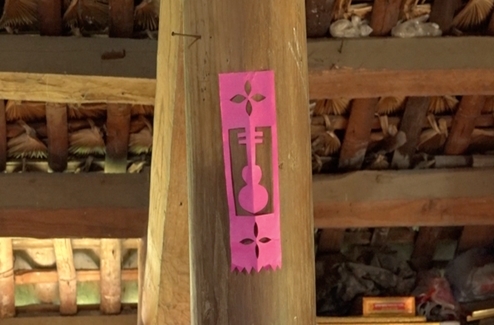 The entire house was covered in red paper so that… these objects could also take a “holiday” during Tet
The Cao Lan ethnic group also pays close attention to cleaning and decorating their homes. According to their beliefs, red paper symbolizes good fortune, prosperity, a bountiful harvest and the power to ward off evil spirits. When red paper is pasted on important places in the house, it symbolizes the belief in a prosperous and happy new year, bringing good fortune in business.
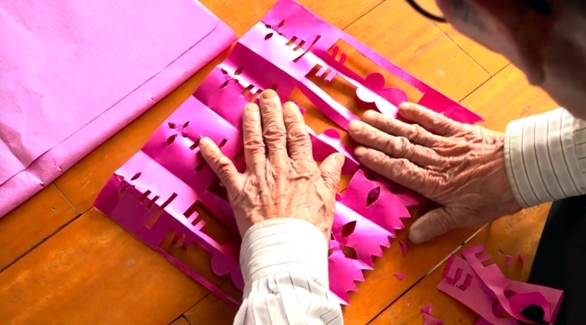 A piece of paper shaped like a musical instrument, with symbolic Chinese characters in the corner and eight folds is pasted onto the ancestral altar area
During Tet (Vietnamese traditional New Year), before the paper offerings are burned, the ancestors are still in the house celebrating Tet with the family, so the incense on the altar must not be allowed to go out. The 30th day of the Lunar New Year is the most important day of the year. On the ancestral altar, a tray of fruits, cakes and sweets is arranged, alongside branches of peach and plum blossoms. The altar is divided into two areas; the most solemn area is for worshipping ancestors beyond five generations, displaying only fragrant flowers, sweet fruits and tea, because it is believed that if the ancestors are more than five generations old, they have become immortals, so the offerings are pure vegetarian food. As for the ancestral altars of less than five generations, the offerings consist only of savory foods and a pig’s head and a rooster are indispensable. Chickens offered to ancestors must meet certain requirements: golden legs, smooth feathers, not too young and not too old and especially, they must not have mated yet.
On the morning of the first day of Tet, only the men go out to wish their neighbors a happy new year, while the women stay at home to look after the ancestral altar and prepare the cooking for guests who come to offer New Year greetings. On the morning of the second day of Tet, the homeowners once again prepare offerings to take to the communal temple and shrine to pray to heaven, earth and the village guardian deity. Here, shamans will help families pray to heaven and earth and the village guardian spirits, asking for blessings and good fortune for the villagers in the new year. After the offering ceremony, half of the offerings are eaten on the spot and the other half is taken home for family members. During village festivals and ceremonies, the shamans will also determine the auspicious day to open the mills and mortars for the villagers.
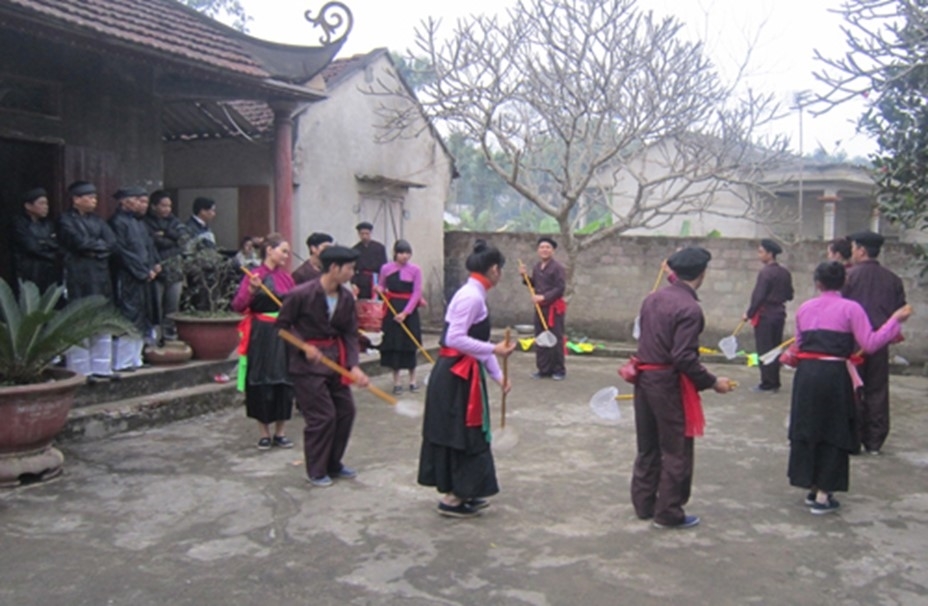 The Cao Lan ethnic group performs the “Chim gau, xuc tep” dance during Tet (Lunar New Year)
From the third day of Tet onwards, women visit relatives near and far to offer New Year greetings and participate in the Spring Festival with lively games such as tug-of-war, bird catching, stilt walking, crossbow shooting, swinging and young men, women singing love songs, while the elderly sing ancient songs about epics, legends and fairy tales, discussing literature and poetry… In the evening, everyone returns home to light incense at the ancestral altar and gather around the family dinner table.
The Cao Lan ethnic group believes that the harmony of yin and yang is essential for the flourishing of all things and this is clearly reflected in the way they make their cakes. One of the traditional dishes eaten during Tet (Lunar New Year) by the Cao Lan ethnic group is chung cake. The Cao Lan ethnic group living in different localities have different ways of wrapping chung cake. In some places, it is essential to make “father cake” and “mother cake” during Tet (Vietnamese traditional New Year), these are two types of chung cakes: the long, round cake representing the father and the thick, square cake representing the mother. In some places, they wrap the cakes into two parts, with the larger cake tapering at both ends to give it a turtle-shell shape and the slightly flat center so that two cakes can be tied together as a pair when placed on the altar; these small cakes, which have a similar shape but are tied together end-to-end with string, are also called shoulder-tie cakes.
During Tet (Vietnamese traditional New Year), the Cao Lan ethnic group has a custom of sealing two rice mills or mortars with red paper, after consulting a shaman to choose an auspicious day that is compatible with the homeowner’s age, they open them up to grind or pound rice, hoping for a bountiful harvest and plenty to eat in the new year; if the ritual is not performed correctly, the mills will suffer from crop failure in the coming year.
For the Cao Lan ethnic group, the Lunar New Year has traditionally been not only a time for enjoying delicious food and beautiful clothes, but also a time to strengthen bonds between family members, clans and the entire village community, everyone feels closer through the New Year’s meal and joyful greetings. The Cao Lan ethnic group have always cherished and preserved these beautiful traditional cultural aspects, passing them down to future generations.
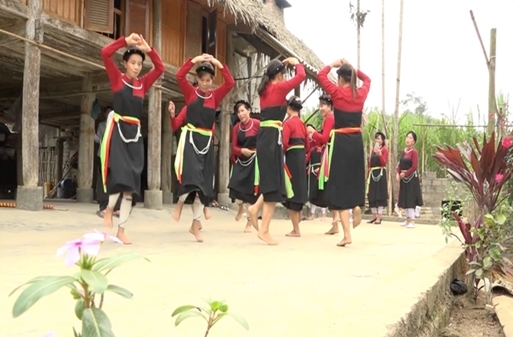 The Sinh Ca dance during the Lunar New Year of the Cao Lan ethnic group