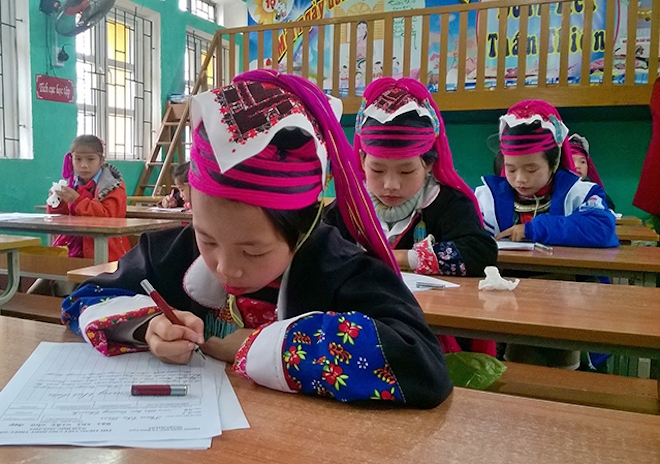
 According to statistics from the Ministry of Education and Training, there are 535 schools nationwide that offer instruction in ethnic minority languages
Keywords: Minority languages; Language policy; Bilingual education; Cultural preservation; Digital transformation; Sustainable development.
1. Policies for the preservation and development of ethnic minority languages
Language is not just a means of communication; it is collective memory, a system of folk knowledge and the “spiritual map” of each community. The loss of a language means a shrinking cultural world.
Vietnam has 53 ethnic minority groups. The spoken and written languages of each ethnic minority group are both valuable assets of that group and shared cultural assets of the country. Therefore, the consistent policy of the Party and the State is to respect, preserve and promote the spoken and written languages of ethnic minorities, considering them as integral parts of a unified yet diverse Vietnamese culture. Resolution No. 24-NQ/TW dated March 12th, 2003, of the IXth Central Committee of the Communist Party of Vietnam on ethnic affairs requires: “Promoting the teaching and learning of ethnic languages”. In order to concretize this policy of Resolution No. 24-NQ/TW, the State issued Government Decree No. 82/2010/ND-CP dated July 15th, 2010, regulating the teaching and learning of the spoken and written languages of ethnic minorities in general education institutions and continuing education centers. Article 2 of the Decree clearly stipulates: “The State focuses its investment and prioritizes the teaching and learning of ethnic minority languages for ethnic minority groups with small populations”.
In 2019, the Government issued Decree No. 76/ND-CP dated October 8th, 2019, on policies for officials, civil servants, employees, and those receiving salaries in the armed forces working in areas with particularly difficult socio-economic conditions. Clause 2 of Article 12 stipulates: Teachers and education administrators who teach ethnic minority languages are entitled to an allowance equal to 50% of their current salary (according to the salary scale stipulated by competent Party and State authorities) plus leadership position allowance and seniority allowance exceeding the standard rate (if any).
On January 27th, 2022, the Prime Minister issued Decision No. 142/QD-TTg approving the Program “Improving the quality of teaching ethnic minority languages in the general education curriculum for the period of 2021-2030”.
On April 29th, 2025, the Government issued Decree No. 96/2025/ND-CP amending and supplementing a number of articles of Decree No. 82/2010/ND-CP dated July 15th, 2010 of the Government regulating the teaching and learning of the spoken and written languages of ethnic minorities in general education institutions and continuing education centers. Accordingly, Article 4a is added, concerning the organization of printing and distribution of textbooks and teaching materials for ethnic minority languages; and Article 4b is added, concerning the authority to decide and the procedures for transferring textbooks and teaching materials for ethnic minority languages printed and distributed by the Ministry of Education and Training.
Based on the policies of the Party and the State, the Ministry of Education and Training has issued the 2018 General Education Program, which includes the implementation of teaching eight ethnic minority languages as elective subjects from grade 1 to grade 12. In 2020, the Ministry of Education and Training issued Circular No. 34/TT-BGDĐT stipulating the general education curriculum for the subjects of the Bana, Cham, E-de, Gia-rai, Khmer, Mong, Mnong and Thai languages. On November 22, 2021, the Minister of Education and Training issued Circular No. 32/TT-BGDĐT guiding the implementation of several provisions of Government Decree No. 82/2010/ND-CP dated July 15th, 2010, regulating the teaching and learning of the spoken and written languages of ethnic minorities in general education institutions and continuing education centers; Circular No. 01/2025/TT-BGDĐT dated January 10, 2025, on the list of minimum teaching equipment for ethnic minority languages in general education institutions and continuing education centers…
In addition, the National Target Program for socio-economic development in ethnic minority and mountainous areas for the period of 2021-2025 also allocates funds to implement training in ethnic minority languages.
According to statistics from the Ministry of Education and Training, there are 535 schools nationwide that teach ethnic minority languages. Of these, Cham, Gia-rai, Bana and Thai people are taught at the primary level; E-de and Mong people are taught at the primary and lower secondary levels; and Khmer is taught at all three levels: primary, lower secondary and upper secondary. Tens of thousands of students in the Central Highlands, Southern Vietnam, Northwestern provinces have been learning their ethnic languages in schools. Some ethnic languages have had their writing systems standardized and curricula and textbooks have been compiled. Teaching and learning ethnic minority languages in educational institutions helps ethnic minority students acquire knowledge more easily in their mother tongue, while preserving and promoting their ethnic cultural identity and national pride. Implementing the National Target Program for socio-economic development in ethnic minority and mountainous areas for the period of 2021-2025, localities organized 146 classes with 7,160 trainees receiving training in ethnic minority languages.
2. Some findings from the investigation
According to the results of the third survey of 53 ethnic minority groups (2024) published by the General Statistics Office (Ministry of Finance) and the Ministry of Ethnic and Religious Affairs (November 2025), the percentage of ethnic minority households using their ethnic language in communication among family members reached 74.8%. 31 out of 53 ethnic minority groups had a higher percentage of family communication primarily in their ethnic language than the general average of 74.8%.
Nationwide, out of a total of 14,551,468 ethnic minority people, 12,188,901 aged 5 and above are able to understand their own ethnic language, equivalent to 83.76%. However, this figure means that approximately 16% of the population, or more than 2.3 million people, no longer have or are unable to use their mother tongue in daily communication. Delving into individual ethnic groups, the level of mother tongue preservation shows significant disparity. The Khang ethnic group has the highest rate, at 92.2%; the lowest is the O Du ethnic group at 21.8%. This difference of over 70% represents a huge gap between the group that “maintains its language” and the group at “red alert” within the same policy system… Groups with rates above 85-90% are mainly concentrated in relatively densely populated communities with enduring cultural spaces, such as: Co-tu (88.68%), Bana (89.06%), Gia-rai (88.32%), E-de (88.93%), Kho-mu (89.11%) or Co-ho (89.6%). These are communities where the mother tongue is still frequently used in families, community life, and local cultural institutions. This fact reveals a noteworthy rule: language is most effectively preserved when it exists in a natural, continuous environment of use, not solely through administrative measures or conservation efforts.
Conversely, some ethnic minority groups recorded very low rates of maintaining their mother tongue, indicating a serious risk of extinction. Notably: O Du (21.8%), Ngai (32.19%), Co Lao (44.79%), San Diu (59.84%), La Ha (64.48%) and Xinh-mun (67.73%). Thus, among these ethnic groups, the number of people still using their mother tongue constitutes only a minority in the community. From a sociolinguistic perspective, when the percentage of speakers falls below 50%, the language is unlikely to be naturally transmitted between generations. This means the risk of “intergenerational disruption”, a precursor to language disappearance. For ethnic minorities with very small populations like the O Du or Ngai, this decline is even more alarming, because if the language is no longer used regularly for just one or two generations, it may only exist in collected documents.
Another noteworthy finding is that the decline is not limited to ethnic minority groups with small populations. Several communities with large populations still record low rates of native language comprehension, such as the Hoa (72.79%), Tay (76.45%), San Chay (76.05%) and San Diu (59.84%). These are ethnic groups with populations ranging from hundreds of thousands to millions of people. Therefore, when declines occur in these large ethnic groups, the social consequences become much more serious, as the absolute number of people who “lose their mother tongue” can reach tens or hundreds of thousands. This shows that urbanization, economic exchange, and pressure for linguistic homogenization are strongly impacting even communities with long-standing cultural traditions. Thus, the risk of language extinction is not only a problem for ethnic minority groups with small populations but is also a challenge for ethnic minority groups with large populations.
This is a social issue that needs attention, reflecting the unevenness in living conditions, the level of socio-economic integration, and the effectiveness of policy implementation in each locality. This also implies that policies for preserving and developing ethnic minority languages should continue to be implemented, but they cannot be applied indiscriminately. Instead, they need to be tailored to specific target groups, prioritizing urgent interventions for communities where the percentage of ethnic minorities who can hear and understand their own language is below 50%, while simultaneously strengthening and promoting existing effective models.
3. Some policy recommendations
When more than 2.3 million ethnic minority people aged 5 and above can no longer hear, speak, or understand their mother tongue, the issue is no longer simply about preserving culture, but has become a challenge for human development, educational equality, and national cultural security. Therefore, a comprehensive, interdisciplinary approach to solutions is needed.
Firstly, the preservation of ethnic minority languages needs to be integrated into the overall strategy for cultural development, education and ethnic affairs, rather than existing as separate projects. The State needs to establish stable, long-term financial mechanisms for teaching and learning ethnic minority languages to create positive and sustainable impacts. At the same time, it is necessary to develop a set of criteria to monitor “language vitality” for periodic assessment, thereby prioritizing resources for ethnic groups where the percentage of people aged 5 and above who can hear, speak, and understand their own language is below 50%, as this group is at risk of intergenerational ethnic minority languages disruption.
Secondly, the most fundamental solution lies in bilingual education based on the mother tongue. Both international and domestic practices show that children learn better when they have access to knowledge in their familiar language. Therefore, it is necessary to expand the bilingual teaching model in preschool and primary school in ethnic minority areas, viewing ethnic minority languages as a bridge, not a barrier in compulsory general education. This also includes training and recruiting local teachers; standardizing writing systems and curricula; increasing teaching time and innovating teaching methods to be more engaging, linked to folklore, games and traditional arts. When ethnic minority students are proud of and feel that their ethnic language is “useful”, the language will be passed on naturally.
Thirdly, in addition to the important role of schools, families and communities must become the central actors in preserving ethnic minority languages. A language cannot survive if it only exists in a few lessons each week. Therefore, it is necessary to encourage the use of the mother tongue in family life, village meetings, festivals, rituals and community cultural activities. The role of village elders, community leaders, artisans and influential people should be promoted as “linguistic cores”. Teaching folk tales, folk songs, epics, and customary laws in the ethnic language not only helps preserve the language but also maintains the knowledge system, the core of the ethnic cultural identity.
Fourthly, link language preservation with livelihood development and cultural economy, especially in tourism. Linking language preservation with livelihood development and cultural economy does not mean simply using the ethnic language in communication, because if tourists do not understand, economic value is difficult to generate. The appropriate approach is to establish a bilingual mechanism, where the ethnic minority language plays the role of representing identity and experience, while the common language or a foreign language acts as a bridge to the market. Ethnic minority people can explain, perform and tell folk tales in their mother tongue and then translate it, creating authentic emotions while ensuring the ability to receive information. Simultaneously, the language is integrated into product brands, place names, labels, festivals and performing arts. When it becomes a competitive advantage and generates specific income, ethnic minority languages are not only preserved but also actively used as a resource for development. This is an approach of “preservation through development”, helping ethnic minority languages become a resource participating in socio-economic development.
Fifthly, in the modern context, digital transformation is an important tool, but it absolutely cannot replace the social and educational foundations of language. Digitizing dictionaries, building a corpus, developing language learning applications or producing media content in ethnic minority languages on digital platforms can contribute to preserving knowledge and increasing accessibility of the young generation - a group that is moving strongly to the online environment. However, if children do not speak their mother tongue in their families, if they are not taught systematically in schools, and if there is no space for regular use in the community, then digital products, no matter how modern, will only stop at the level of “digital display”.
In reality, a language only truly thrives when it is used daily in communication, work, and cultural life. Technology then plays the role of an “amplifier”, helping the language spread faster and further. Therefore, technology needs to be positioned to support, connect, and accelerate educational and community solutions, not replace them. In other words, for language to survive in the digital space, it must first be firmly established in real life.
4. Conclusion
Quantitative analysis results reveal a mixed picture regarding the spoken and written languages of ethnic minorities in Vietnam. On the one hand, the overall rate of 83.76% of people aged 5 and above who can still hear and understand their mother tongue affirms the significant vitality of ethnic minority languages in many communities. On the other hand, the fact that more than 2.3 million people are no longer able to use their ethnic languages and nearly one-fifth of ethnic groups fall into high-risk areas is a clear warning sign of intergenerational decline. The fact that up to 70% of ethnic minority people aged 5 and above can hear, speak, and understand their own language between the highest and lowest groups highlights the need for a change in approach. Language preservation cannot stop at collecting, archiving or simply introducing it into schools. Ethnic minority languages only exist when used regularly in family and community life and associated with livelihoods. Therefore, the policy focus needs to shift to bilingual education as the foundation, the community as the main actors, the cultural economy as the driving force, and digital transformation as the supporting tool. Ultimately, preserving and developing ethnic minority languages is not just about protecting a cultural heritage, but about protecting the right of ethnic minorities to speak their own languages and ensuring the diversity and sustainability of the national culture. This is both a socio-political responsibility and a long-term strategy for the development of Vietnamese culture and people.
References
1. Central Executive Committee of the Communist Party of Vietnam (2014), Resolution No. 33-NQ/TW dated June 9th, 2014 on building and developing Vietnamese culture and people to meet the requirements of sustainable national development.
2. Central Executive Committee of the Communist Party of Vietnam (2019), Conclusion No. 65-KL/TW dated October 30th, 2019 of the Politburo on continuing to implement Resolution No. 24-NQ/TW on ethnic affairs in the new situation.
3. Ministry of Education and Training (2020), Guidelines for teaching spoken and written languages of ethnic minorities in general education institutions.
4. Statistics Department - Ministry of Ethnic and Religious Affairs, Results of the survey collecting information on the socio-economic situation of 53 ethnic minority groups in 2024, Economic and Financial Publishing House, 2025.
5. Statistical data processed by the author from: Number of ethnic minority people aged 5 and above who can hear and understand their own ethnic language (original data table), Results of the survey collecting information on the socio-economic situation of 53 ethnic minorities in 2024, Economic and Financial Publishing House, 2025.
6. Prime Minister (2021), Decision No. 1719/QD-TTg dated October 14th, 2021 approving the National Target Program for socio-economic development of ethnic minority and mountainous areas for the period of 2021-2030.
