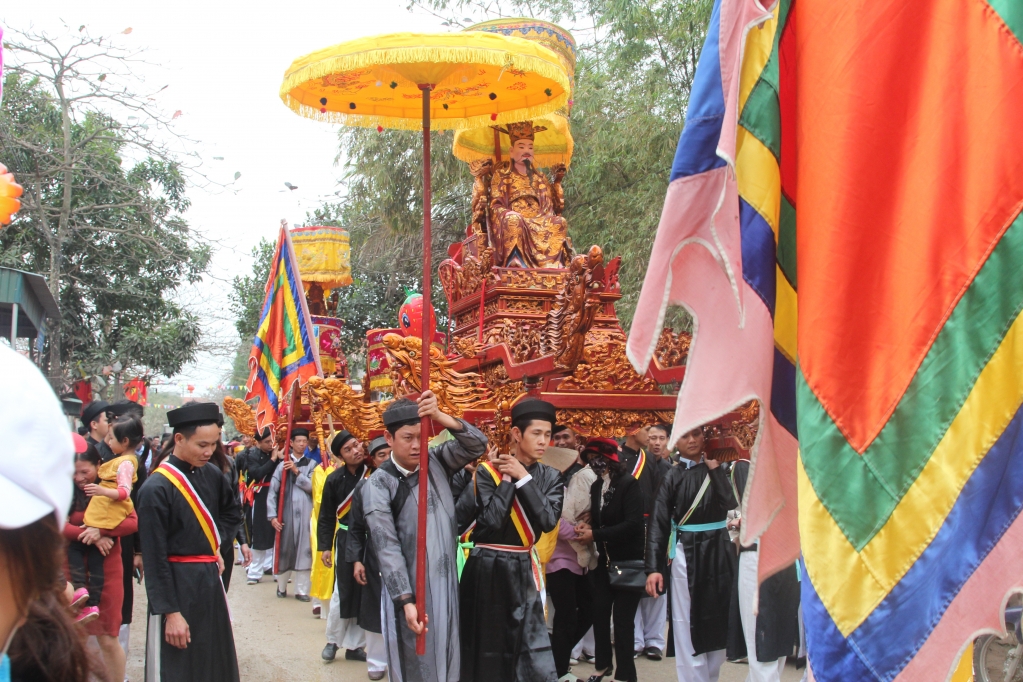
 Worshiping the village tutelary deity has become a beautiful cultural feature and symbol of many localities in Northern Vietnam
Keywords: Promoting; Beliefs; The village tutelary deity; Northern Vietnam.
1. The origins of the belief in worshipping the village tutelary deity in the Northern Delta region
The village tutelary deity is the “greatest” god in the village. The custom of worshipping the tutelary deity of the village began in the 15th century, associated with the formation of the village model, after the “manorial estate” model of the Tran dynasty ceased to exist. The tutelary deity of the village is usually worshipped at the village communal house, but can also be worshipped at the temple (shrine), depending on the characteristics of each village [5]. The worship of the village tutelary deity is a belief within the village community, stemming from the tradition of wet-rice agriculture. Therefore, the inhabitants of the Northern Delta often venerate some supernatural force that they believe can bring favorable weather, abundant crops and protection, ensuring a prosperous life for the people. Therefore, in many villages, residents chose to worship gods of water, rivers, clouds, rain,... Some villages, depending on their residential characteristics, gradually developed the belief in worshipping the village tutelary deity. Older villages near rivers often worshipped water gods, while villages on mountain slopes worshipped mountain gods,... Many villages worship their tutelary deities, who are national heroes or historical figures who contributed to the reclamation of land and the establishment of settlements and who helped the villagers. In short, it can be seen that for the people in village communities, the tutelary deities of the village are extraordinary individuals, from their strength and abilities to their physical appearance... “For people in village communities, the tutelary deity of the village is considered a saint. Each village has its own saint: each village beats its own drum, each village worships its own saint. For the dynasties, the village tutelary deity was considered an “official” representing the court, the king, to take care of a specific village, because this “official” was sent to the villages by the king through a specific decision: imperial decree (also called divine decree)” [4; p.98]. The worship of the village tutelary deity by the people combines elements of reality and fantasy, strongly reflecting their belief and aspirations for a better future. The veneration and worship of the village tutelary deity is both a spiritual need, an indispensable source of spiritual support and a beautiful traditional cultural feature of the people in the Northern Delta region since ancient times.
2. The value of the village tutelary deity worship belief in the Northern Delta
A strong source of emotional support
Village communal house is an important cultural, religious, and belief symbol in the village life of the Vietnamese people. Village communal house “is recognized by everyone as having a special multi-purpose nature in terms of religion and society, executive, judicial, legislative, entertainment, economy, marriage, funeral... only Vietnam has it” [2; p.239]. People in the past believed that the village tutelary deity was the supreme deity who governed the village, with the power to help and bless the villagers’ labor, production, and lives to be better: “For the people, the village tutelary deity is a spiritual support, a place to entrust their faith, helping them overcome the difficulties of a turbulent life” [4; p.100]. People often encounter many changes and hardships in life due to natural disasters, wars, or illnesses,... Therefore, they often have to rely on supernatural forces, praying for the protection of deities as a spiritual remedy to help them have faith to overcome difficult times. “The villagers collectively appoint and worship their own village tutelary deity as their guardian god, mainly to ensure favorable weather and bring peace to the community” [2; p.60].
Maintaining and preserving traditional cultural values
The belief in worshipping the tutelary deity of the village among the people of the Northern Delta region reflects the traditional moral principle of the nation - remembering the source of one’s blessings, showing reverence and gratitude towards ancestors who contributed to the village in reclaiming land, establishing settlements, fighting invaders, helping villagers, passing on skills, teaching,... In most villages, there is a tutelary deity worshipped, whose origins and contributions vary. This worship stems from the villagers’ gratitude towards those who have served their village. In many villages in the Northern region of Vietnam, the village tutelary deity is worshipped as a figure associated with teaching and saving people, such as the renowned figure Chu Van An, who is mainly worshipped in Thanh Liet and Tam Hiep communes, Thanh Tri district (formerly), Hanoi capital; Hai Bà Trưng district (formerly) also worships him as a village tutelary deity. Some villages worship national heroes such as the Trung Sisters, Lady Trieu, Duong Dinh Nghe, Ly Thuong Kiet, etc. In addition, many localities in the Red River Delta region express their religious beliefs and gratitude to the tutelary deities who helped pass on their skills to the villagers, such as: The ancestor of the bronze casting craft, Nguyen Cong Truyen, is worshipped in Dai Bai village, Gia Binh district, Bac Ninh province; the Lo Ren communal house at No. 1 Lo Ren street worships the ancestor of the blacksmithing craft; the communal house of Dong Xam village, Hong Thai commune, Kien Xuong district, Thai Binh province (formerly) worships Nguyen Kim Lau - the ancestor of the silver engraving craft of the village; Bat Trang pottery village, Hanoi capital, venerates the ancestor of the pottery craft, Hua Vinh Kieu;...
The belief in worshipping the tutelary deity of the village also stems from the awareness of preserving the laws, customs and traditions of the village community. Each traditional Vietnamese village has its own unique customs and practices, which shape the traditions of the village. In the minds of Vietnamese people in the Northern Delta, the tutelary deity is the most sacred god, capable of overseeing and witnessing the entire life of the villagers, protecting and blessing them with good health and prosperity. The tutelary deity is the supreme commander of the village, not only spiritually but also in a significant aspect of the villagers’ material lives. The worship of the tutelary deity is often linked to village customs and regulations, thus shaping many aspects of human behavior towards the community and significantly influencing individual conduct within the village. Therefore, worshipping the village tutelary deity is a binding thread for the village community, and honoring the village tutelary deity is essentially honoring the laws, customs, and traditions of the village community. “The worship of the village tutelary deity is, in the end, the worship of village laws, customs and traditions of the village” [3; p.95].
The role of community bonding
The worship of the village tutelary deity plays a significant role in strengthening community cohesion, serving as a focal point for shared cultural, spiritual and religious values among the people. The village tutelary deity is a witness to the activities and changes of each member of the village community, blessing and protecting those who do good deeds and punishing the wicked. The space dedicated to the tutelary deity becomes the shared soul of a community, where, under the watchful eye of the tutelary deity, everyone always adheres to the long-standing customs and traditions unique to the village. If ancestor worship is the foundation that binds all members of the same family, then the worship of the tutelary deity of the village community is the foundation that binds all members of the village community, contributing to a democratic and equal way of life, a sense of collective solidarity and mutual support and forming the basis of a life that values affection, a beautiful aspect of Vietnamese cultural behavior.
Preserving the beauty of traditional festivals, culture and arts
Similar to other religious and spiritual practices, the worship of the village tutelary deity is not only a way to remember the merits of the deities but is also expressed through festivals. Typically, festivals associated with the worship of the village tutelary deity in the Northern Delta region are held during the Lunar New Year or at the beginning of spring. These festivals feature traditional rituals and ceremonies, deeply rooted in folk culture, combined with cultural and artistic activities and folk games such as singing competitions, swinging, wrestling, cockfighting, duck catching and walking on a floating bridge… In recent years, villages in the Northern Delta have actively restored festival activities within their communities. For example, in Dong Ky village, Dong Quang commune, Tu Son district, Bac Ninh province (formerly), every spring they organize a festival to commemorate the merits of the High-Ranking Village Guardian Deity, the famous general Thien Cuong during the Hung King era, with a solemn procession of firecrackers. Amidst the festive atmosphere of the firecracker procession, villagers and visitors from all over have the opportunity to interact and enjoy the unique cultural and spiritual values of the area, thereby contributing to preserving the good customs and traditions of each village and promoting the traditional cultural and artistic values of the nation.
3. Several issues arise in preserving and promoting the cultural and religious values of worshipping the village tutelary deity today
In some localities, the worship of the village tutelary deity has been distorted, with individuals exploiting this cultural and spiritual space for commercial purposes, engaging in superstitious activities that harm the material, physical and mental well-being of the people. The village tutelary deity festival has become a profit-making, commercialized activity, serving the financial purposes of a select group of people in management and organizational roles. Some individuals have exploited superstition to scam people out of money through fortune telling, rituals to ward off bad luck, praying for good fortune and exorcise evil spirits... especially during the New Year’s festival. Rituals of worship to express gratitude to the deities are gradually becoming measured by money, with excessive emphasis on lavish offerings. This ostentatious display to assert the village’s prestige has diluted the pure, long-standing spiritual and cultural values of our ancestors. The restoration and reconstruction of communal houses, temples, and shrines dedicated to the tutelary deity of villages in some villages in the Northern Delta region are too grand and imposing, causing waste of state and public funds and at the same time, destroying much of the ancient architectural beauty that bears the distinctive mark of traditional Vietnamese village culture.
Some outdated customs of the village tutelary deity worship have not been eliminated and many beautiful aspects of traditional national culture and art in the practice of village tutelary deity worship have been lost. Village festivals in some localities still retain old customs that are little or no longer suitable for new conditions, and have a significant impact on the psychology of modern people, such as: the traditional pig slaughtering ritual in Duyen Tuy village, Hong Thai commune, Phu Xuyen district (formerly), Hanoi capital; The Giong Temple festival in Soc Son features an unorganized ritual of looting, resulting in a repulsive scene of people trampling on each other to grab the offerings... The spiritual value of the village tutelary deity worship has been distorted; some fanatical people have spent all their time and money on rituals, believing that simply offering many items to the deity will bring them blessings, health, success and wealth. Due to superstitious practices and a rush to perform rituals, people are often scammed by unscrupulous individuals, leading to financial ruin and debt. This is one of the typical negative impacts of the worship of the village tutelary deity on contemporary cultural and spiritual life. The reality is that traditional folk games and singing and dancing activities in village tutelary deity festivals are gradually disappearing, replaced by market-driven phenomena such as betting, gambling, lotteries and bingo. As a result, the cultural value and beauty of these festivals are at risk of being lost and not passed on to future generations. Several other consequences regarding traffic safety and security during the festival also require solutions from the authorities. To a certain extent, each village worships a tutelary deity, contributing to the autonomy and self-governance of the village, maintaining order and discipline within the village; On the other hand, it gives rise to leveling attitudes, excessive deference and a tendency to prioritize sentiment over reason. A significant number of people exploit the belief in worshipping the village tutelary deity, creating difficulties in educating and raising legal awareness... The power of emotional relationships, especially blood relationships, community relationships, relationships of gratitude,… sometimes transcends the boundaries of reason, moral norms and even law [1; p.18].
4. Conclusion
The worship of the village tutelary deity in the Northern Delta region is a long-standing form of folk belief, involving the worship of gods revered by the villagers or individuals who have contributed to the people and the nation or who have taught skills to the people… It can be seen that, in the beliefs of the villagers, the tutelary deity is the sacred god who governs the village, a force that protects and helps and also a spiritual support for the entire community. Since ancient times, with its extremely strong religious beliefs, the worship of the village tutelary deity has had a tremendous influence, capable of transforming the spiritual life of the people in the Northern Delta region in many aspects such as: viewpoints, ideologies; ethics, lifestyles; culture and arts... However, nowadays, the negative aspects of the market economy and the decline in human morality are impacting religion and beliefs. The worship of the village tutelary deity has shown many negative manifestations, eroding the traditional values of the nation and the cultural identity of each locality and outdated customs that are incompatible with modern values have not yet been eradicated. Therefore, it requires us to implement synchronized solutions regarding propaganda and education to raise awareness, build and implement mechanisms, policies, and solutions for economic and human development, thereby helping to promote the value of the worship of the village tutelary deity, contributing to enriching the picture of advanced Vietnamese culture with a strong national identity.
References
1. Tran Thi Ha Giang, Ho Chi Minh National Academy of Politics, Abstract of Doctoral Thesis, The influence of the belief in the worship of the village tutelary deity on the spiritual life of residents in the suburbs of Hanoi capital today, Hanoi, 2020.
2. Tran Dang Sinh (editor), The principle of remembering the source of water - philosophical basis and value in national history, Education Publishing House, Hanoi, 2017, p.239; p.60.
3. Nguyen Thi Tho (editor), The social ontology of filial piety in contemporary Vietnam, Social Sciences Publishing House, Hanoi, 2017, p.95.
4. Tran Quoc Vuong (editor), Fundamentals of Vietnamese Culture, Vietnam Education Publishing House, Hanoi, 2014, p.98; p.100.
5. https://baothanhhoa.vn/van-hoa-giai-tri/net-dep-tin-nguong-tho-thanh-hoang-lang/148310.htm.
