Keywords: Respected people; Ethnic policy; Development administration; Social capital; Community Management.
1. Introduction
Recognizing the significant role played by influential figures within ethnic minority communities, the Party and the State have over the years implemented various policies offering both material and moral support to encourage, cultivate and leverage their contributions.
However, processes such as digital transformation, shifts in social structure within ethnic minority areas, the implementation of a two-tier local government model, the promotion of decentralization and the delegation of authority and the transition from a management mindset to development governance are transforming both governance methods and the roles of grassroots social actors. Respected people, possessing social capital derived from community trust, the ability to harmonize social relationships and the capacity to mobilize public participation and foster consensus, directly engaging in implementing and enhancing the effectiveness of various public policies at the grassroots level. They act as co-creators of community governance alongside the State. From this perspective, policies concerning these respected people should be approached as a means to develop social resources and invest in social capital and community governance capacity, rather than merely focusing on providing material and moral support.
2. Some results of implementing policies for respected people among ethnic minority communities
Over time, the Prime Minister has issued various decisions regarding selection criteria and policies for respected people within ethnic minority communities. Notably, there is Decision No. 18/2011/QĐ-TTg concerning policies for prestigious individuals among ethnic minority groups; Decision No. 56/2013/QD-TTg amending and supplementing a number of articles of Decision No. 18/2011/QD-TTg; Decision No. 12/2018/QD-TTg on criteria for the selection and recognition of, and policies towards, respected people among ethnic minority communities; Decision No. 28/2023/QD-TTg amending and supplementing a number of articles of Decision No. 12/2018/QD-TTg. These decisions outline relatively comprehensive policies covering a wide range of aspects from training and information provision to material support, personal visits, and moral encouragement for respected people. This demonstrates that the Party and the State regard these individuals not merely as influential figures within their communities but also as a vital social force that helps translate Party guidelines and State policies and laws into actual practice.
A key feature of the policy regarding influential figures is the emphasis on capacity building through the provision of information, the organization of training and knowledge enhancement sessions and the facilitation of study tours and experience-sharing visits. These are not merely support activities but represent a state investment aimed at strengthening the capacity of these individuals to participate in community governance.
Under this policy, individuals of high prestige are on a periodic or ad-hoc basis kept informed and provided with the latest information regarding the Party’s guidelines and directives, the State’s policies and laws, the socio-economic development and national defense and security situation and the results of the implementation of local ethnic-related programs, projects and policies. They are provided, free of charge, with a print publication from the official media outlet of the state management agency responsible for ethnic affairs, as well as a local print publication or another form of information provision selected by the locality. On an annual basis, influential individuals receive training, professional development, and information delivered via locally determined, appropriate methods covering law, national defense and security; fundamental information and knowledge regarding ethnic affairs and policies; knowledge and skills for accessing, utilizing and processing information on the Internet and social media; as well as skills in mediation, dissemination and mass mobilization.
In implementation of this policy during the period of 2021-2025, local authorities organized 1,423 dissemination conferences providing information to 89,900 participants identified as “respected people”; held 984 training and capacity-building sessions for approximately 58,496 such individuals; arranged 54 intra-district study tours and exchange visits for 1,659 participants; organized 298 intra-provincial study tours and exchange visits for 12,811 participants; facilitated 348 visits to Hanoi and other provinces for 12,069 participants; distributed millions of press publications; and conducted 2,841 other information-sharing activities (such as distributing newsletters, documents or specific information) reaching 17,508 participants…
Through training and capacity-building programs, influential figures have enhanced their understanding of the Party’s guidelines and the State’s policies and laws, as well as local socio-economic development and legal matters across various aspects of social life; they have also improved their skills in public outreach and mobilization. Furthermore, access to newspapers, magazines and informational materials has broadened their access to official information, enabling them to both raise awareness and proactively shape public opinion within their communities.
From the perspective of development governance, the content of this policy has progressively established a foundation of knowledge including legal understanding, that enables influential figures to more effectively bridge the gap between Party committees, authorities, and ethnic minority communities. Their effectiveness is no longer measured merely by the dissemination of information or the promotion of policy compliance; rather, it is gauged by the community’s ideological consensus and unity of action in participating in socio-economic development, new rural area construction, environmental protection, the maintenance of security and order and the preservation of ethnic cultural identity.
In addition to receiving information, individuals of high repute are entitled to policies involving visits and gift-giving during the Lunar New Year or traditional festivals of ethnic minority groups (as selected by local authorities); visits during illness or hospitalization and upon the passing of immediate family members (parents, spouse, or children); and support in the event of unexpected hardships caused by accidents, natural disasters or fires, provided such incidents are certified by the commune-level authorities of their place of residence. They are also eligible for commendation, awards, and recognition for outstanding achievements in production, socio-economic development, the assurance of national defense, security, and social order and safety, the preservation of cultural identity, and the strengthening of the great national unity bloc, in accordance with the Law on Emulation and Commendation and current guiding regulations; they may also attend commendation and recognition conferences at various levels if they meet the established criteria. When participating in delegations for work, exchanges, meetings, discussions, and experience-sharing at Party, National Assembly, State, and Fatherland Front bodies, as well as ethnic affairs agencies at both central and provincial levels, they receive reception and support in accordance with regulations...
In implementing this policy during the period of 2021-2025, various levels and sectors organized 3,631 visits and gift-giving events for 149,796 instances of “respected people” on the occasion of the Lunar New Year; 1,648 visits involving 29,943 such individuals during ethnic minority festivals; 10,359 visits and support actions for 13,704 instances of respected people facing illness; 2,315 visits and financial aid provisions for 5,860 families of such individuals facing hardship; 3,104 visits to offer condolences regarding the passing of 3,486 such individuals and their relatives; and 433 other visits and support activities benefiting 6,138 instances of such respected people... A total of 223 commendation conferences were held, attended by 20,083 influential figures, with 7,487 such individuals receiving various forms and levels of recognition. The Committee for Ethnic and Religious Affairs hosted approximately 300 delegations comprising over 8,000 influential figures from various provinces and cities for visits to Hanoi and working sessions with the Committee. The total budget allocated for implementing policies regarding influential figures during the period of 2021-2025 exceeds VND 500 billion.
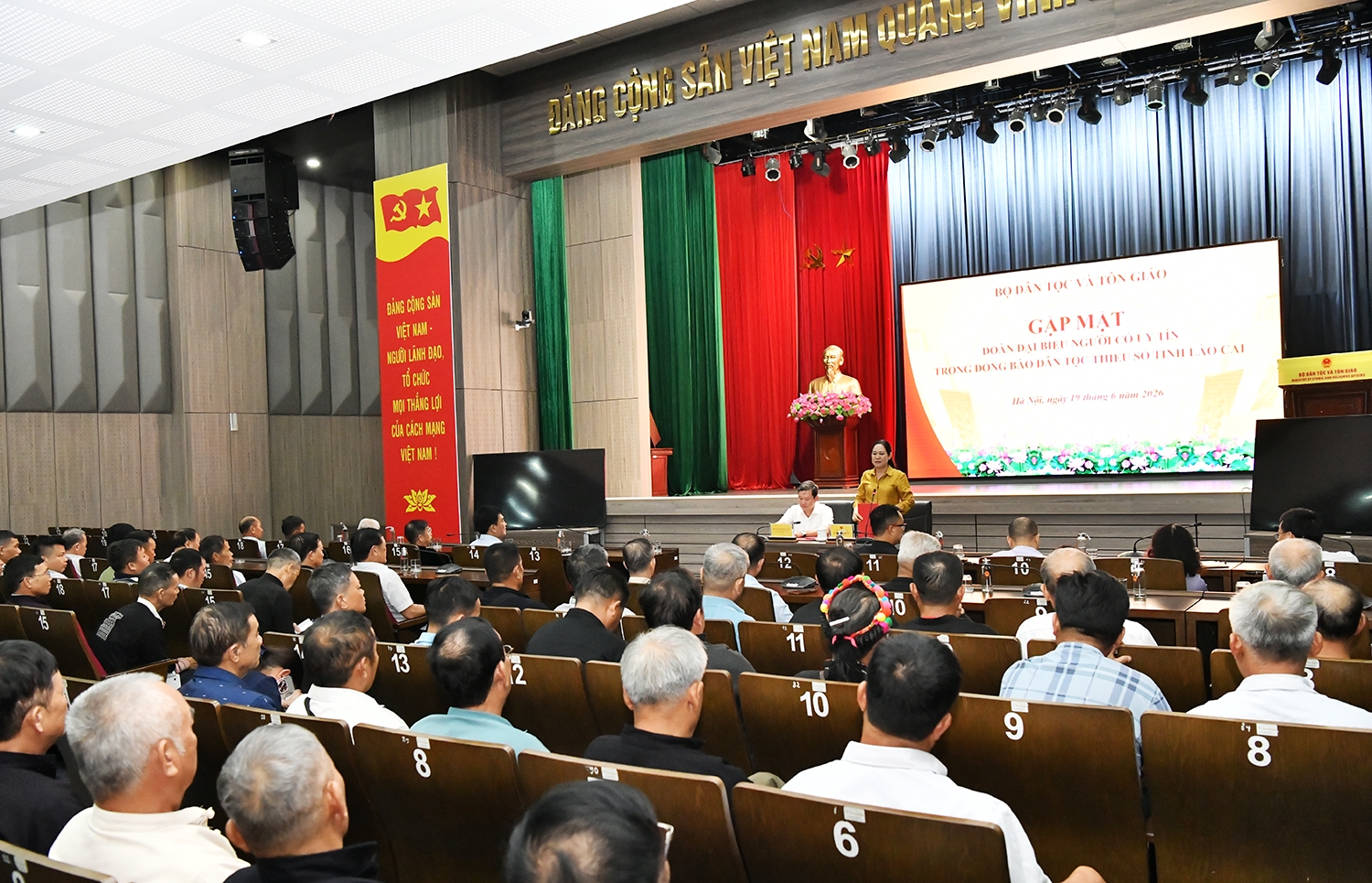 Deputy Minister of Ethnic Minority and Religious Affairs Nong Thi Ha meets with a delegation of exemplary respected people from ethnic minority communities in Lao Cai Province (June 2026)
In addition to the central government's general policies, several localities such as Binh Phuoc, Can Tho, Soc Trang, Tra Vinh, Dong Nai, Phu Yen, and the former Quang Ngai province have issued their own specific policies. These include providing monthly financial support and purchasing health insurance for (respected people” who do not qualify for coverage under the Law on Health Insurance. Notably, Hanoi provides monthly support to respected people among ethnic minority communities at a rate of 50% of the base salary per person; this measure has created favorable conditions and encouraged these respected people to effectively fulfill their roles and responsibilities.
Years of implementation have demonstrated that policies targeting respected people in the community have yielded positive results. Receiving timely encouragement and recognition has motivated them to affirm their roles in disseminating information and mobilizing fellow citizens to comply with the Party’s guidelines and the State’s policies and laws. Furthermore, they actively participate in economic development, poverty reduction, new rural development, the preservation of ethnic cultural identities, environmental protection, the assurance of national defense and security and the strengthening of the great national unity bloc.
3. Issues arising during the implementation of policies regarding respected people and the need for reform in the new era
In the context of development management, the capacity of respected people within ethnic minority communities is measured not only by their ability to receive and disseminate information but also by their competence in organizing the community, harmonizing social relations, resolving conflicts and mobilizing public participation in addressing socio-economic development issues… As the educational level of ethnic minority communities steadily rises and their socio-economic conditions improve, coupled with rapid, robust digital transformation and an increasing desire among residents to participate in community management and development, the expectations placed by the State and the community upon “respected people” have risen correspondingly. Expectations for influential figures go beyond mere familiarity with guidelines and policies for the purpose of advocacy and outreach; they also demand management acumen, communication skills, the ability to foster community connections, and the capacity to effectively handle practical issues. These individuals must act as community leaders who build social consensus and participate alongside local authorities in co-creating governance. To achieve this, they require additional knowledge and skills to meet the demands of their roles in the new context.
However, current training and professional development programs for influential figures primarily focus on disseminating guidelines and policies and updating general knowledge, rather than providing in-depth training on skills such as community leadership, dialogue, mediation, media crisis management and digital transformation. This can result in a gap between practical demands and the competencies actually possessed by these respected people.
As the socioeconomic issues requiring resolution become increasingly diverse, the effective implementation of many development policies relies on strong community consensus. This places a demand on influential figures to not only grasp the guiding principles and policies but also possess the capacity to mobilize the public, explain new issues, shape public opinion and address emerging situations right at the grassroots level. This is a requirement that the current policy on providing information to influential figures only partially meets.
On the other hand, the process of accelerating national digital transformation is reshaping how information is accessed, social interactions take place and community governance is organized. Many new issuessuch as online misinformation, high-tech crime, online fraud, information conflicts, and the impacts of artificial intelligence are directly affecting the lives of ethnic minority communities. In this context, influential figures must become a force capable of guiding the flow of information, spreading positive values, and contributing to the creation of a healthy digital media environment within the community. However, current training programs only touch upon the application of information technology and do not yet fully equip respected people with digital skills and digital communication capabilities.
Furthermore, the continued promotion of the policy on decentralization and the establishment of a two-tier local government structure also necessitates expanding the scope for the participation of respected people in local governance. As local authorities are granted greater autonomy, the role of mobilizing community participation becomes increasingly vital. Furthermore, the consolidation of villages and residential groups significantly expands the operational scope for respected people, thereby increasing the demands placed upon them. Consequently, policies providing material and moral support must be enhanced commensurately.
4. Some implications for policy innovation regarding respected people
(i) (i) In the context of the country entering a new stage of development, reputable people are not only objects of concern and encouragement but should be recognized as a special social resource of ethnic minority and mountainous areas. According to that approach, the goal of policy towards them should not only be aimed at ensuring operating conditions but should shift to developing capacity, building social capital and increasing community governance capital.
(ii) Developing comprehensive development policies for respected people. In addition to maintaining existing policies that provide material and moral encouragement, greater emphasis must be placed on training programs designed to enhance their capabilities in areas such as community leadership, communication, social dialogue, mediation, digital transformation, information technology usage and grassroots-level governance participation. Training content should be tailored to the specific characteristics of each region, ethnic group and subgroup of influential figures, rather than applying a one-size-fits-all program across all localities. The duration and frequency of these training sessions should also be appropriately increased.
(iii) Digital transformation is bringing about profound changes in the social lives of ethnic minority and mountainous communities. Therefore, policies regarding “respected people” need to be updated to include capacity-building in digital skills, enabling them to disseminate official information, shape public opinion and assist residents in accessing digital services. In addition to equipping individuals with information technology skills, it is essential to establish online communication channels linking regulatory bodies with influential community figures; this facilitates the timely dissemination of information, the receipt of grassroots feedback, and the creation of a network for sharing experiences among such figures across different localities. Such measures not only enhance the effectiveness of outreach and communication but also contribute to building a digital community and fostering comprehensive digital transformation in ethnic minority and mountainous areas.
(iv) Increasing expenditure levels for visits, gift-giving and support covering cases of illness, unexpected hardship, and emulation-based rewards for respected people, ensuring alignment with the policies on visiting, congratulating, gifting, encouraging, meeting, commending and honoring exemplary ethnic minority organizations and individuals as stipulated in Article 12a of the Government’s Decree No. 05/2011/ND-CP dated January 14th, 2011 (as amended and supplemented by Decree No. 127/2024/ND-CP dated October 10th, 2024) regarding ethnic minority affairs and ensuring suitability for current practical conditions.
5. Conclusion
The results achieved in recent times confirm the correct policy of the Party and State in building and implementing policies towards respected people. However, given the imperatives of rapid, sustainable development and the modernization of national governance, the refinement of policies concerning influential figures must be grounded in a new mindset. Rather than merely providing material and moral support, these policies should be designed as investments in social and community governance capital, thereby enabling these individuals to effectively co-create governance alongside the State in ethnic minority and mountainous areas.
References
1. Committee for Ethnic Minority and Religious Affairs (2026): Draft Decree dossier stipulating criteria for the selection and recognition of and policies regarding, “respected people” in ethnic minority areas, as well as policies concerning visits, congratulations, gift-giving, encouragement, meetings, commendation and honoring of specific ethnic minority organizations and individuals, http://www.cema.gov.vn/ thong-bao/du-thao-to-trinh-du-thao-nghi-dinh-cua-chinhphu-quy-dinh-tren-cong-thong-tin-dien-tu-bo-lan-02.htm
2. Central Committee of the Vietnam Fatherland Front (2019), Proceedings of the thematic seminar “Promoting the role of respected people among ethnic minority communities”.
