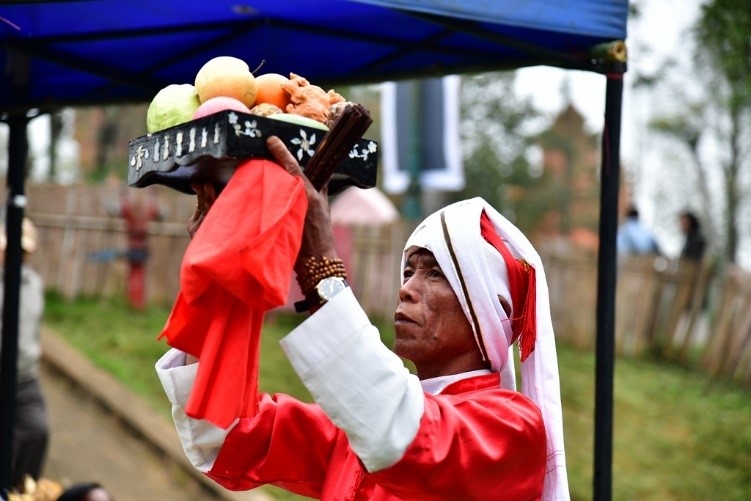
 Teacher Ka-in, in the guise of the goddess Po Nai performs a dance offering fruits and flowers during the Rija Nugar ceremony
Rija Nugar is the Cham name for the dance festival that takes place on the Thursday and Friday of the first half of the lunar month in January each year according to the Cham calendar (Sakawi Ahiêr), which falls around April in the Gregorian calendar. This is the planting season, when the weather is usually hot and dry. While the rice and other crops are waiting for water, the Cham people often hold the Rija Nugar ceremony to bid farewell to bad things and pray for favorable weather, a bountiful harvest, the health, prosperity and happiness of the villagers… Many documents refer to this as the New Year’s Tong On dance Festival.
Compared to other folk religious festivals of the Cham people that still exist today, this festival is held continuously, with full rituals, in almost all Cham villages in Ninh Thuan (now Khanh Hoa province). Rija Nugar signifies bidding farewell to bad luck, illness, storms, floods, droughts, crop failures, poverty, misfortune of the past year, while simultaneously praying for good things in the new year such as favorable weather, abundant harvests, and the health, well-being and happiness of the villagers…
The offerings used in Rija Nugar rituals are agricultural products such as goats, chickens, rice, soup, wine, eggs, betel leaves, areca nuts and fruits. Among the essential offerings are fire and water. Many believe that by participating in the festival and making offerings, they and their families will gain more faith, experience good fortune, enjoy peace and well-being throughout the year… The musical instruments used in the Rija Nugar festival include: Ginang drums, Paranung drums and Saranai horns.
The deities worshipped in the Rija Nugar ceremony include: nature deities (god of Rain, god of Wind, god of Water, god of Fire, god of the Sun, god of the Moon, god of Earth, god of Mountains, god of the Sea,...); the kings who rendered meritorious service to the country and the nation were deified (Po Nugar, Po Klong Girai, Po Rome, Po Tang Hauk, Po Riyak, Po Patao Binthuer, Po Bhum); the gods in Brahmanism (Brahma, Shiva, Vishnu) and Allah in Islam…
The most unique aspect of Rija Nugar is the fire stepping ritual performed by Ka-ing (the shaman) who escorts Salih (a substitute effigy) to a crossroads or places it on a wooden raft to float down a river or canal near the festival site.
The religious figures performing the rituals in Rija Nugar include: Mr. Muduen/Maduen (drummer), Mr. Ka-ing (shaman - the one who performs the fire stepping dance), Muk Pajau (female shaman), Ginang drum player and Saranai horn player. In the Cham Muslim villages of the Bani people, there is also Po Acar (a religious leader of the Bani religion).
The Rija Nugar festival also includes a fertility dance, a common theme evoking the face of ancient Cham society, an agricultural society whose inhabitants always aspired to a peaceful, tranquil and prosperous life. That is the overarching, humanistic dream of the Cham people…
A unique aspect of the Rija Nugar ceremony is that, as the ceremony is nearing its end, participants use raw rice flour to mold human figures, including two men and two women, which the Cham people call Salih (many sources refer to them as substitute human figures). When the ceremony was over, Mr. Ka-ing placed the effigy on a wooden tray and set it adrift down the river. The effigy will represent the villagers in carrying away the evils, poverty and misfortunes of the past year, at the same time imploring the gods to grant favorable weather, good health and prosperity for the villagers in the new year. When the effigy is released to float away, Rija Nugar - the New Year’s Tong On dance festival comes to an end.
Among the folk religious rituals of the Cham people in Khanh Hoa province, Rija Nugar is a festival with many valuable traditional values of the Cham people that need to be preserved, promoted and developed to enrich the culture of ethnic groups in Vietnam.
