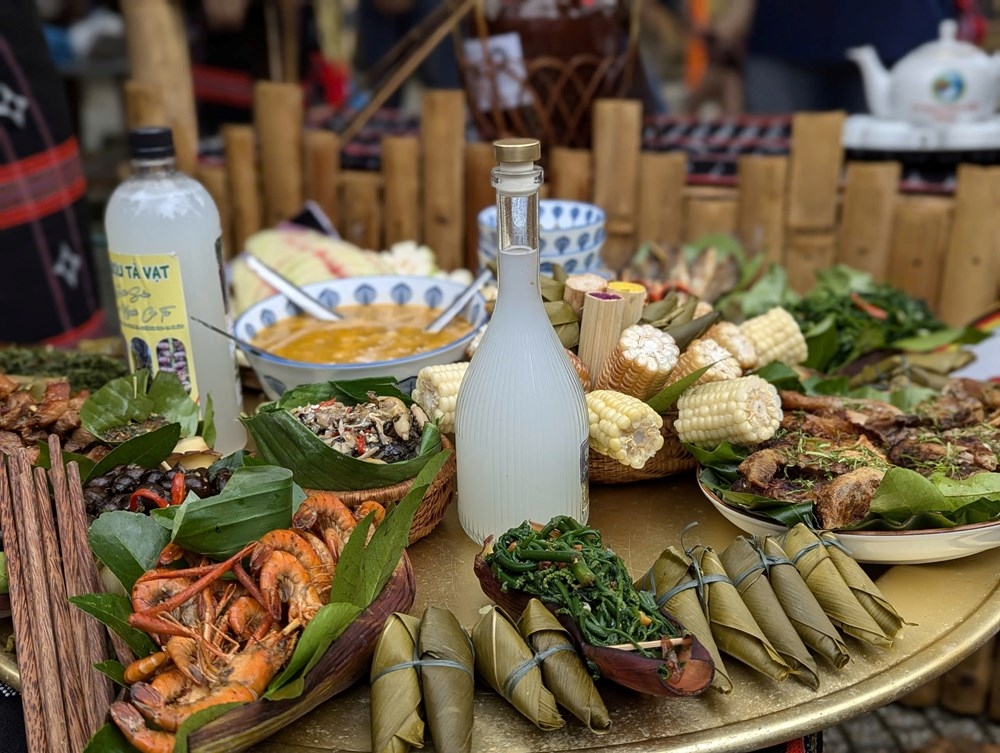
 A ceremonial meal offering of the Co-tu people, Da Nang city
Keywords: Symbol; Culinary culture; Ethnic minority; Symbolic anthropology; The mountainous area of Da Nang city.
1. Approaching the concept of the symbol
Symbols are cultural products that emerge naturally throughout the “cultural journey” of humanity. Symbols are polysemous but can be categorized into two primary meanings: visible signs and ideas. In its initial stages, symbolic language was typically simple and conventional. Subsequently, driven by the development of human society, symbolic language increasingly expanded to encompass all cultural elements and every aspect of human life.
Symbolic anthropology views culture as a system of meanings expressed through symbols, enabling people to interpret the world around them and guide their behavior. Symbols are a special form of language for people to communicate with each other, with other communities and more importantly, with their Ancestors and gods. A symbol is the crystallization of cultural values created by human beings. It is also a way for people to express themselves and perceive the world.
Symbolic anthropology is a significant branch of cultural anthropology that focuses on the study of symbols within human cultural life. The focus of symbolic anthropology is the study of how people understand and interpret the phenomena around them such as actions and expressions in relation to other members of society. This expression represents the way meanings are exchanged within a cultural system, fostering mutual understanding among the various strata of a society's members. For instance, a mother’s breast and a bronze pot in the Central Highlands serve as symbols of the matrilineal system; The Cham linga-yoni symbol represents fertility and procreation; the peacock and elephant tusk of the Mnong people symbolize wealth; The buffalo and its horns symbolize strength, well-being and prosperity in Co-tu sculpture... In the traditional cultures of various ethnic groups, the forms, content and significance of symbols are found in visual arts, architecture, festivals, customs,... In particular, culinary-related symbols and symbolic systems are prominent and widespread, manifesting in food and beverages, the organization of dining during traditional festivals, decorative arts, sculpture and wedding rituals…
2. The significance of symbols in the culinary cultures of ethnic groups
2.1. Symbolic meanings in traditional dishes
In the culinary culture of the ethnic groups inhabiting the Truong Son mountain forests, sticky rice cakes wrapped in dot leaves are a distinctive specialty. The dot plant also known in some regions as chit tree grows abundantly in the wild across these forests; locals harvest its leaves to wrap the cakes, hence the name of dot leaf cake. Among the Co-tu and Ta Oi peoples, the name varies by region such as avi cuot, a cuot, a koat or a quat... The Bho Nong people call it oc cake (banh oc), while the Cor people call it cot cake (banh cot). Although simple to make, the process requires meticulousness and skill. The leaves used for wrapping must be broad and intact; after being gathered and thoroughly cleaned, they are quickly pressed to prevent them from drying out. These “buffalo-horn” cakes are crafted from fragrant, chewy upland glutinous rice, offering a rich, nutty flavor.
For ethnic groups belonging to the Katuic language family, the a cuot cake is regarded as a symbol of love, as it invariably features in their traditional wedding ceremonies. The cakes are wrapped in pairs: the larger one represents the groom, while the smaller one symbolizes the bride. The pair of cakes symbolizes a steadfast, devoted and enduring romantic union. During the wedding ceremony, the appearance and flavor of the cakes embody the couple's bond, signifying wishes for abundance and marital harmony. The Co-tu ethnic wedding features a unique custom known as blanket draping (Pa zum). A woman performs this ritual: she drapes a brocade blanket over the heads of the bride and groom, hands them a piece of buffalo-horn-shaped cake to share and then offers them a handful of rice. The young couple cupped their hands together to receive the rice, accompanied by words of blessing and prayers for a happy, prosperous life, free from illness and disease and with rice always filling their hands just as it did that day. Afterwards, this rice is used to cook a meal for the couple, symbolizing that from then on, they will share the same cooking pot and the same pillow.
Pounded glutinous rice cakes mixed with sesame, similar to the glutinous rice cake (banh giay) of the Vietnamese and the ethnic groups of the northern highlands are also a popular dish among the Co-tu, Ta Oi, Bru-Van Kieu and Pa Co ethnic groups. Each ethnic group has a different name for it: the Co-tu people in Nam Dong (Hue city) call it a zuh, the Van Kieu people in Quang Tri province call it a yoh and the Ta Oi and Pa Co people call it a deep man. During ancestral worship ceremonies, weddings, harvest celebrations and the Lunar New Year, the people prepare various types of cakes, including a yoh cake. The ingredients include glutinous rice, black sesame, and coarse salt, yet the process of making the cakes is painstaking, demanding both patience and dedication. The women chosen to make the cakes are strong, with sturdy calves and full hips, physically capable of working in the upland fields and wielding the pestle to pound the rice for the cakes.
According to Van Kieu custom, the bride’s family must carry a yoh cakes and traditional skirts (xan) to the groom’s house for the ceremony sending the daughter off to her new home. The a yoh cake is an essential part of the wedding; the subsequent rituals can only proceed once this cake is present. For the Pa Co people, this type of cake is an essential part of the offerings at the A Za festival (a harvest prayer ceremony). These cakes are both delicious and convenient; because they can be stored for a long time, the community prepares them as a food reserve, much like dry rations. People often carry a few pieces of this cake to stave off hunger when heading into the forest, hunting or working in the fields. The a yoh cake symbolizes the finest qualities, steadfast loyalty and deep bonds of affection.
Five-colored sticky rice has recently been adopted by the ethnic minority communities in the mountainous regions of Quang Nam learning from groups like the Tay and Thai who migrated from the northern highlands, as well as through media and social networks… Five-colored sticky rice is created by soaking naturally ivory-white rice with ingredients such as gac fruit for orange, pandan leaves for green, butterfly pea flowers for blue and black glutinous rice for purple. According to the local people's beliefs, black represents fertile land; red symbolizes aspiration; purple signifies faithfulness; yellow stands for abundance; green represents the mountains and forests; and white symbolizes pure love and nobility. Colored sticky rice also holds deep spiritual significance. People believe that eating five-colored or seven-colored sticky rice during Tet brings good fortune for the year ahead.
2.2. Symbolic significance of culinary objects
Certain culinary implements such as winnowing trays, rattan platters, trays for holding cakes and food, rice-pounding mortars and pestles, bowls and chopsticks and dried gourd shells also embody profound humanistic significance. Shaped like a teardrop, a dewdrop of heaven and earth, the winnowing tray embodies the hope for lush vegetation and rice stalks heavy with grain. It cradles grains of paddy and rice just as a mother tenderly embraces her children. The Co-tu people express their aspirations for a life of prosperity, abundance, and happiness through the teardrop shape of the winnowing tray. The motif of Co-tu women pounding and winnowing rice is a common theme in paintings, statues and decorative reliefs found in traditional village communal houses. The teardrop-shaped winnowing tray is always a striking visual element, alongside the pestle and mortar, sieves and a flock of chickens pecking at grain, depicting familiar scenes of highland village life in the bas-reliefs, freestanding sculptures and paintings found in traditional communal houses (guol).
Decorative shapes on pestles and mortars are also a unique feature in the culinary life of highland ethnic groups. Pounding rice is a long-standing job of agricultural residents when people knew how to grow rice. On Dong Son bronze drums, the ancient Vietnamese vividly carved scenes of a young couple pounding rice alongside two figures dancing and playing the panpipe (khen), evoking the joyful atmosphere of a village harvest. Given the reliance on upland farming, rice served as the primary source of sustenance for many ethnic groups inhabiting the mountainous regions. The image of rice-pounding is frequently encountered in the decorative arts of many ethnic groups. In particular, within the decorative art of the Co-tu people, specifically on the central pillar (sinuar) and main support post (r’mang) of the communal house (guol), one consistently finds depictions of the rice mortar alongside earthenware and bronze pots; these symbolize the rice spirit (yang haroo), the mother figure and the source of life.
2.3. The symbolic significance of food through ritual practice
Traditional rituals are often associated with symbolic foods. The Cor people enjoy chewing betel. They typically chew it with the bark of the chai nui tree (kha-li). Depending on personal preference, a small amount of shredded or powdered tobacco may be added. Betel and areca nuts, along with tobacco, are mandatory offerings in Ca Dong wedding ceremonies. The officiant hands a piece of prepared betel and a tube of powdered tobacco to the bride and groom, the couple smears a few grains of cooked rice onto each other’s foreheads. This solemn ceremony conveys the profound significance of two souls becoming one, symbolizing a bond of deep affection and unwavering fidelity. With this significance in mind, the Ca Dong people often adorn their gunpowder containers (talok) beautifully with clusters of small bronze bells, a style known as talok grao cring ning. Notably, these containers are cherished gifts from parents to their daughters, serving as a form of dowry.
In order to create a gift for his newborn daughter, the father went into the forest to find a piece of bamboo about a handspan in length, then carved and shaped it into a container for powdered medicine. Afterwards, the mother attached a cluster of tiny bells, strings of beads and tassels made from twisted vreang fibers, which had been dyed to the handle. For Ca Dong women, this tube is not merely a vessel for betel and tobacco; it is a gift bestowed by parents upon their daughter, a piece of “life’s essential kit” to take with her when she starts a family. During festivals, Ca Dong girls often wear it around their waists, accompanied by necklaces and bracelets. It also serves as a woman’s most sacred keepsake, cherished even as she grows old.
For the Co-tu people, to secure a marriage that includes the full array of required offerings, the groom’s family must prepare various foods sourced from the forest such as pigs, muntjacs and porcupines with the assistance of the community, relatives, and skilled hunters. Foodstuffs were dried, stored in bamboo tubes, and hung above the hearth, kept until the wedding day to be served to the bride’s family and distinguished guests. Similarly, the bride's family would demonstrate their skill in raising poultry, fishing and cultivating sticky rice fields to treat the groom’s family. On the wedding day, the groom's family brings offerings to the bride’s family including pigs, buffaloes, cattle, goats, and game meat (various four-legged animals) that the men have personally hunted or gathered from the mountains and forests. These are arduous, demanding tasks, requiring the men to demonstrate their capabilities to the bride’s family. Conversely, handling two-legged creatures such as chickens, ducks and birds as well as small animals like fish and frogs, is considered “light” work suitable for women. The ceremonial offerings and gifts reveal the division of labor between men and women. The food items provided by the groom’s family symbolize the husband’s strength, his role as a protector and provider and his responsibility for securing the family’s future livelihood and wealth.
3. Conclusion
A symbolic anthropological approach has shed light on the culinary symbolism of the ethnic minority groups in the mountainous regions of the Truong Son and Central Highlands. From the buffalo-horn-shaped cake (a cuot/avi cuot), which symbolizes romantic love and enduring prosperity; The a yoh (or a deep man) cake represents steadfast loyalty and the bonds of community; Five-colored sticky rice embodies the aspiration for good fortune and harmony with nature, while various implements carry their own symbolic significance: the teardrop-shaped winnowing tray represents the nurturing abundance provided by the earth and sky; the rice mortar and pestle evoke the image of the woman as the source of life; the chopstick serves as a bridge between yin and yang; and the powdered medicine container represents an essential possession for a Ca Dong girl as she embarks on her journey through life. Many symbols are multi-layered, conveying diverse meanings: they are simultaneously products of a swidden agricultural economy and mediums of communication with deities and ancestors, as well as among people embodying noble, humane aspirations. They not only maintain social cohesion and conduct but also initiate and guide behavior, while upholding the rules governing the observance of rituals. Traditional rituals are often associated with iconic foods such as bamboo-tube rice, buffalo-horn-shaped cakes, and traditional wines which serve not only a practical function in offerings and hospitality but also embody profound cultural and spiritual significance, helping to preserve the community’s collective memory and culinary identity. Surveys and investigations indicate that the majority of respondents consider the preparation of such specialties to be an indispensable element; notably, the group of residents surveyed in Song Kon Commune, Dong Giang district, Quang Nam Province (formerly), showed the highest level of agreement, with a rate reaching 97%.
Today, in a globalized world, symbolic language has become a vital channel of communication across cultures and languages and among people of diverse backgrounds. Recreating and innovating symbols associated with culinary culture through community-based tourism activities, food festivals and ethnic cooking competitions helps affirm local cultural values while serving as a “common language” for interaction among ethnic groups and with visitors. The application of culinary symbols for sustainable tourism development and community education aims to preserve identity, reinforce national pride, and contribute to the cultural diversity of the great family of Vietnamese ethnic groups.
* Dong A University
References
1. Dinh Hong Hai (2007), “Research on Symbols and the Approach to Symbolic Anthropology in Vietnam,” in Proceedings of the Ethnology Conference, Institute of Ethnology.
2. Vuong Xuan Tinh (2025), “Culinary Identity of the Brau and Ro-mam - Two Very Small Ethnic Minority Groups”, Journal of Ethnology and Religion, No. 1 (01), 2025, p.54-69.
3. Tran Tan Vinh (2015), Cơ-tu Wood Carving, Vietnam News Agency Publishing House, Hanoi.
4. Tran Tan Vinh (2022), “Aesthetic Elements in the Culinary Culture of Ethnic Minorities in Vietnam”, Dong A University Journal of Science, No. 3 (2022), p. 105-121.
5. Tran Tan Vinh (2025), “Fragrant Cakes from the Great Forests”, Heritage Magazine, December 2025, p.58-61.
6. Nguyen Dang Vu (2024), Traces of the past halfway up the mountain: A Region of Ca Dong Cultural Identity, Social Sciences Publishing House, Hanoi, p.330-332.
7. Lévi-Strauss, C.(1973). Structuralism and ecology. Social Science Information, 12 (1), 7-23.
8. Hudson, S., Smith, C., Loughlin, M., & Hammerstedt, S. (2009). Symbolic and interpretive anthropologies. Retrieved December, 6, 2013.
