Keywords: The doctrine of peace; Catholic; Education.
1. Filial piety in Catholic families
The Bible contains many verses, passages and proverbs that encourage filial piety in children towards their parents. Therefore, filial piety towards one’s parents is a condition for salvation: “He who honors his father atones for his sins, he who respects his mother accumulates treasures” [5, p.1282]; “Honoring your father and mother so that you may live long in the land that the Lord your God gives you” [5, p.144]. Filial piety is also one of the Ten Commandments, a fundamental moral principle of Christianity. The Ten Commandments are divided into two groups: the first three relate to God (worship God and love Him above all things; do not take God’s name in vain; observe the Sabbath); the following seven precepts relate to others, of which honoring one’s father and mother is the foremost (honor your father and mother; do not murder; do not commit adultery; do not steal; do not bear false witness; do not covet your neighbor's wife or husband; do not covet your neighbor’s possessions). This shows that honoring one’s parents is the most important commandment among those related to others. The Bible also teaches that if people do not know how to be filial to their own parents and siblings, those who love and sacrifice for them in a tangible way, how can they truly revere the invisible God in heaven, whose sacrifice for us can only be perceived through faith?
Thus, Catholic doctrine also emphasizes filial piety and considers it a fundamental aspect of its morality. The Bible teaches believers that the more they love God, the more Christians must recognize their duty to love and honor their parents and siblings, the more filial a person is towards their parents and siblings, the more likely they are to have love for God and love for their neighbor.
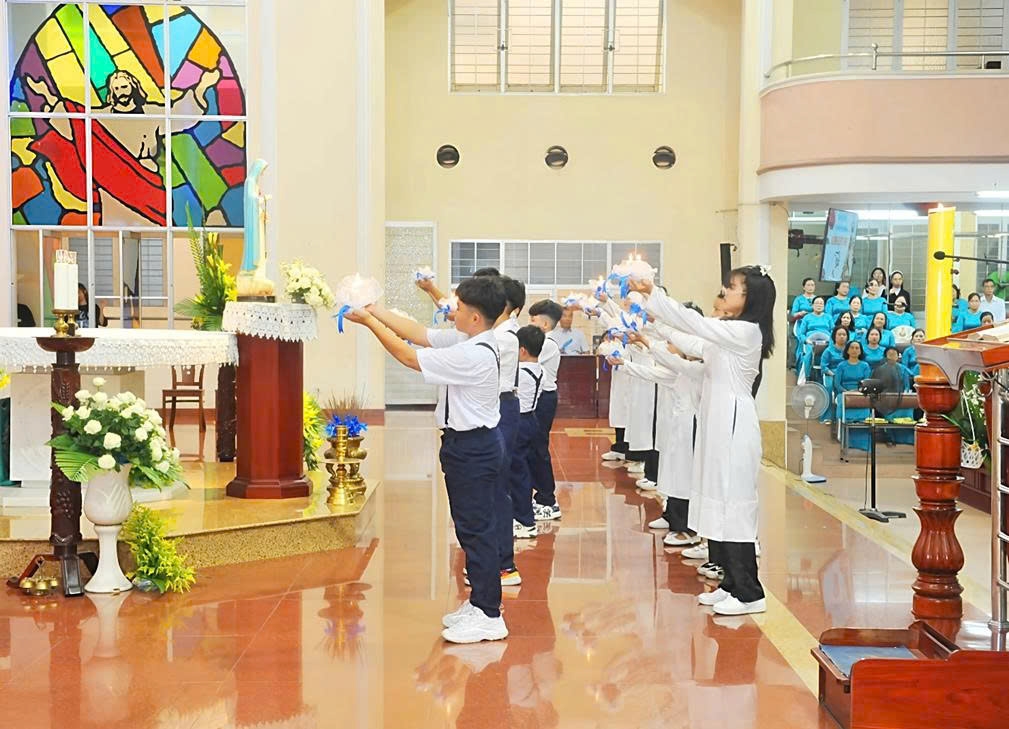 Tan Chi Linh Parish inaugurates the month of May in honor of the Virgin Mary
Currently, the family foundation in the world and in Vietnam is facing many challenges. In Europe, the divorce rate among couples has reached an alarming 50%. In Vietnam, the rates of divorce, domestic violence and filial impiety are on the rise. In society, the wealthy are highly respected, material possessions become the goal of life, and all directions for human purposes and ideals are dependent on money. All values such as filial piety, loyalty and chastity in family and social relationships seem to have been overturned or are no longer considered measures of morality, character, virtue and influence of a person. Faced with this problem, the Catholic Church in Vietnam has adopted a policy of proposing solutions to strengthen the foundation of the family, based on the fundamental teachings of the Bible. Strengthening the family foundation and the foundation of personal morality is also a mission that the Church has set for itself in strengthening faith in God and it is an important task in the missionary work and religious development that the Church aims for. Maintaining filial piety within the family fulfills one's duty before God; the family is the Church at home.
The Catholic Church is deeply concerned with the issue of the family, the relationship between husband and wife, and the relationship between parents and children. Marriage and conjugal love are a plan, a creation and a masterpiece of God, and “what God has joined together, let no man separate” [5, p. 1878]. Unhappy marriages or abandonment should be considered a form of atonement in this life and true happiness will come in the afterlife. Any extramarital sexual relationship, in whatever form or for whatever reason, constitutes a grave sin that destroys the vocation of chastity demanded by the Sacrament of Eucharistic Baptism and defiles the temple of the Holy Spirit as well as the person’s own body. Human life must be absolutely respected and protected in its entirety from the moment of conception; the right to life is an inalienable right, therefore, abortion or murder are both subject to excommunication. These doctrines are propagated and taught rigorously, over a long period and continuously by the Church through various forms to its faithful. For clergy, fulfilling filial piety is not limited to the family but must extend to society at large, to others, that is, to caring for the vulnerable such as the elderly, the unfortunate, the sick, the disabled and sinners.
Human moral behavior is like a habit; if we learn moral lessons and see moral examples every day, we will have more motivation to change our behavior. The Church’s rigorous, long-term, and persistent approach to educating the faithful about “filial piety” has deeply permeated their lives and they practice it voluntarily and consciously. Therefore, in areas with a large Catholic population, the divorce rate is usually very low, the abortion rate is also low, and social ills such as theft, prostitution, gambling, drug addiction, domestic violence and other social crimes are less prevalent compared to other areas. The rate of Catholics being convicted is also low.
However, domestic violence, adultery and divorce still exist within Catholic families and remain a major concern for the Church.
In order to address family tragedies, many parishes in Vietnam have reformed the content of their regular catechism classes, young men and women now attend pre-marital classes and instead of just preparing future couples for religious knowledge, faith, or receiving the sacraments, these classes now focus on educating young people in life skills. In addition, there are sermons in church, private counseling in confessionals, retreats, Eucharistic adoration, visits by the parish priest to individual homes,... All of this has contributed to educating believers to be faithful to their faith and laws, and to become good “resistance” citizens against social evils.
Thus, strengthening the family foundation, starting with the Catholic spirit of filial piety is of great significance in shaping and guiding the character and behavior of individuals within family relationships. When people practice filial piety towards their parents, they will certainly have a moral foundation that will enable them to fulfill their duties towards their spouse and children. Treating parents with filial piety and gratitude will also cultivate essential virtues such as self-sacrifice, patience and respect for others. A person who is not filial to their parents and is not willing to love and sacrifice for their spouse and children will find it difficult to love and sacrifice for others. Conversely, when children are truly filial to their parents, educating them within the family becomes easier. Children who receive a good education from their families will mostly become good citizens for society.
2. In harmony with others and society
The Bible teaches: “Put your sword back in its sheath, for all who take the sword will perish by the sword” [5, p. 1895], “If someone slaps you on the right cheek, turn the other cheek also” [5, p. 1852], “Give to anyone who asks and do not turn away from anyone who wants to borrow” [5, p. 1852].
The Bible clearly states its position that it does not surrender to evil but must persistently fight against evil by the solution of “bringing the sheep into the midst of wolves” [5, p. 1962], using the power of love and charity to transform evil. The Bible describes the Passion of Jesus as a struggle for the right to life, peace and against evil, with the following concept: evil is never defeated by another evil; if we choose that path, instead of subduing evil, we will be defeated by it. Saint Paul also said: “Do not let evil overcome you, but overcome evil with good” [5, p.2119].
The Catholic view of reconciliation with evil and wickedness, as described above, leads many to believe that it is an utopian moral code, so beautiful that it is difficult to implement and therefore impractical. The Catholic solution of putting sheep among wolves may be considered ineffective because of the increasing crime and social wrongdoing, and the fact that even many believers do not practice virtue or cultivate good character, leading us to doubt the transformative power of peace, we may choose violence and struggle to fight against evil and crime.
In Vietnam, from within families to society at large, the decline and degradation of morality, personality disorders, behavioral deviations and emotional numbness have reached alarming levels. The series of horrific murders that have occurred recently has caused public alarm, especially with the increasing number of young criminals and the increasingly brutal nature of their actions. Law enforcement agencies are vigorously fighting against crime, but crime is not being pushed back; instead, it is increasing and even new types of crime, unprecedented in the history of the criminal underworld are emerging often on a transnational scale.
Most juvenile offenders fall into the category of lacking proper family supervision and education; gaps in moral, character, legal education from schools and society; being heavily influenced by friends and an overly complex living environment, while still young and experiencing many psychological and physiological changes, they tend to be rebellious, adventurous, expressive and have not yet defined the values of truth, goodness, and beauty. Therefore, when negatively affected by society and friends, they often lose direction in their thoughts and actions, easily leading to deviant, extreme behaviors and crimes. Psychologists and criminologists have identified the core problem as a lack of education and an imbalance between economic growth and holistic human development, at that time, the ego, genetic factors, and education within each individual were not yet strong or resilient enough to cope with the impacts of rapidly changing living environments.
In order to address this, we have implemented various solutions. In addition to measures such as disseminating legal knowledge, moral education, life skills and social norms, we advocate for amending and improving the legal system to ensure it is sufficiently deterrent and preventative of crime…
Law and punishment are recognized as necessary and valuable methods in educating people in the spirit of “spare the rod and spoil the child”. Many educators also argue that eliminating punishment in education is a manifestation of false humanism.
The educational method known as “pedagogical explosion” is widely introduced in contemporary educational theory. It involves using sudden, powerful impacts (including force) on the subjects of education to create psychological and cognitive changes, break down negative thoughts, habits, behaviors and generate new thoughts, feelings and behaviors that meet the demands of education. During the Middle Ages, in many countries, criminals were punished by beheading, public display of the head, or public burning at the stake. In this civilized era, people are striving to abolish the death penalty by violating the physical integrity and dignity of human beings, even if the person is a heinous and inhumane criminal. Currently, more than 100 countries worldwide have abolished the death penalty for humanitarian reasons. The Catholic solution of putting the lamb among the wolves has its reason and meaning in that, in doing so, one should not use force or challenges to provoke the wolves’ aggression, even though the wolves deserve to be exterminated. Educating people towards perfection and beauty must be achieved by fostering self-awareness and self-consciousness of human dignity so that they can live as true human beings. Goodness cannot be multiplied by publicly punishing evil and retaliating in a somewhat barbaric manner, just as the evildoer committed the crime. Ultimately, education is about helping people ascend to higher levels of civilization, and civilization is the opposite of barbarism. Combating evil must be carried out on moral principles and precepts, but absolutely not on prejudice and hatred. I believe that an educator, a judge, an executioner, or even a supreme saint should have faith that the seed of goodness is inherent in every human being and even in the most evil-doer, without that belief, when confronted with evil, all punishments become meaningless, and all efforts at education and persuasion will lack the perseverance and hope to correct people’s behavior and allow the seeds of goodness within them to sprout and flourish. Not only religious fanaticism, but also atheism and extreme conservative political ideologies are the source and incitement of evil plots and actions by evil-doers.
3. Conclusion
Peacefulness is a natural, instinctive human emotion. Theories that teach about peace only serve to reinforce feelings and raise awareness in people so that they naturally adhere to those moral norms and rules, gradually turning them into habits. The belief in peace, when taught continuously and consistently through various forms, will influence the consciousness and conscience of the individual, enabling them to understand, judge and self-assess its meaning, leading them to voluntarily practice it and adjust their behavior. The doctrine of peace is not just for religious believers, but for all of us. The path of peace is not a solitary, cold, harsh or ascetic path reserved exclusively for believers. Peacefulness should be seen as a value that all people should adhere to, as a spiritual need, an unwavering belief like religious faith. A society without a foundation of ethical and moral values of peace and harmony as its cornerstone will find it difficult to successfully build a humane economy, a humane politics and a humane society.
References
1. Nguyen Van Dung (2012), Religion with socio-political life in some countries around the world, National Political Publishing House, Hanoi.
2. Hanoi National University (2010), Religious culture in the context of globalization, Religious Publishing House, Hanoi.
3. Ho Chi Minh National Political Academy (2015), Religious culture and sustainable development in Vietnam, Political Theory Publishing House, Hanoi.
4. Vietnam Bishops’ Conference (2007), Summary of the Social Doctrine of the Catholic Church, Religious Publishing House, Hanoi.
5. The Complete Bible, Old Testament and New Testament (1998), Ho Chi Minh City Publishing House, Ho Chi Minh City.
6. Mortimer Chambers et al (2004), History of Western civilization, Culture and Information Publishing House, Hanoi.
7. S.J.Valies, R.Paul, S.J.Conliff (2010), The stepping stones on the path to holiness, Religious Publishing House, Hanoi.
8. Institute of Social Sciences Information (2004), Religion and Modern Life, Social Sciences Publishing House, Hanoi.
