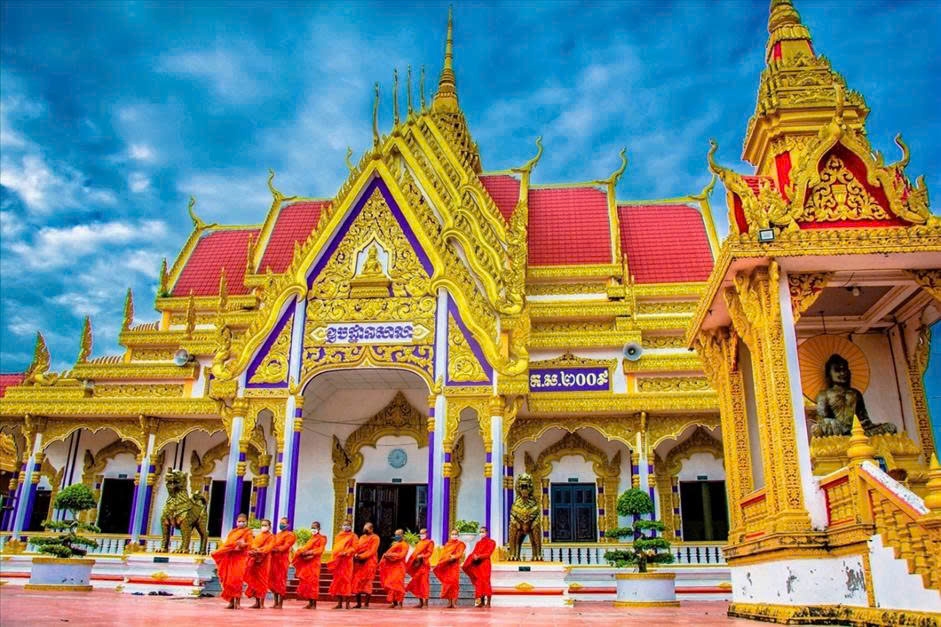
 Buddhism in the South (Vietnam) made very important contributions to the struggle for national independence.
Keywords: Buddhism in the South (Vietnam); Contributions; Resistance against French colonialism, Anti-American imperialism.
Received: 24/9/2025; Reviewed: 30/9/2025; Revised: 05/10/2025; Accepted: 05/11/2025.
1. The contribution of Buddhism in the Southn (Vietnam) to the August Revolution and the resistance against French colonialism (1945-1954)
The August Revolution (1945) took place in the context of World War II, when fascists occupied Vietnam in 1940 and the French coup d'état occurred in 1945. The Vietnamese people suffered under a triple yoke of oppression: from the French, the Japanese and the feudal monarchy. Under the leadership of the Party and the Viet Minh Front, the people of Southern Vietnam and the entire country rose up in rebellion to “fight the French, expel the Japanese, and seize power for the people”, leading to the success of the August Revolution (September 2nd, 1945) and the establishment of the Democratic Republic of Vietnam.
During this period, the uprising movement in the South (Vietnam) was very active because the South (Vietnam) was a colony subjected to oppression and exploitation by the French colonialists, because the Party paid great attention to the uprising movement in the South (Vietnam) with the direct guidance of the Southern Regional Party Committee and the Viet Minh Front. During this period, many uprisings in the provinces of My Tho, Ben Tre, Tra Vinh, Soc Trang, Can Tho, Bac Lieu,… all involved the participation of monks, nuns and Buddhist followers. In Saigon alone, in August 1945, under the direction of the Southern Regional Party Committee and the guidance of the Viet Minh Front, Venerable Thien Tong (Truong Thanh Pagoda), Hong Tu (Giac Vien Pagoda), Hong Hung (Giac Lam Pagoda),… mobilized nearly 400 monks, nuns and Buddhists to open a rally at Truong Thanh Pagoda, marching with the slogan: “Bao Dai must abdicate - Long live independent Vietnam - Welcome the Viet Minh Front - The government must fall into the hands of the Viet Minh”.
Having gained independence for only a short time, the people of Southern Vietnam faced the threat of reoccupation by the French colonialists. Therefore, during the nine years of resistance against French colonialism (1945-1954), under the leadership of the Party through the Southern Regional Committee and the Viet Minh Front, Southern Buddhism actively participated and made new contributions to the revolution. Saigon and Gia Dinh were the centers where the Buddhist resistance movement against French colonialism began.
Many temples during this period became communication hubs for patriotic monks and nuns in the Mekong Delta, such as Long Thanh pagoda (Binh Chanh District), Truong Thanh pagoda (District 1),… Linh Thu pagoda (Tien Giang province) served as a liaison station between the Southern Regional Party Committee and the My Tho Provincial Party Committee.
(Ảnh )Buddhism in the South (Vietnam) made very important contributions to the struggle for national independence.
During this period, in the South (Vietnam), national salvation organizations of social and religious groups were established. Many monks, nuns, and Buddhists enthusiastically joined these national salvation organizations, such as: Youth National Salvation, Elderly National Salvation, Monastic National Salvation, Buddhist National Salvation,... Many monks from Long An, Giac Lam, Giac Vien, Sung Duc, Long Van, and Giac Hoang pagodas responded to, supported and participated in these national salvation organizations,...
2. The contribution of Buddhism in the South (Vietnam) to the resistance war against American imperialism (1954-1975)
The resistance war against American imperialism took place in a new context, therefore the contributions of Buddhism to the revolution in the South (Vietnam) also entered a new chapter in history. Under the banner of the National Liberation Front of the South (Vietnam), the forms, extent and number of monks, nuns, Buddhist followers participating in revolutionary activities increased steadily. Firstly, the late 1950s and early 1960s saw the reactions of the Buddhist community in the South against the dictatorship and religious discrimination of the Ngo Dinh Diem regime. In particular, the self-immolation of Bodhisattva Thich Quang Duc for national independence and for the Dharma at the nerve center of the Saigon government became a powerful spark that ignited the fervent struggles of monks, nuns, Buddhists and youth in Saigon. There were examples of sacrifice by monks, nuns and Buddhist followers in resisting the Saigon government, such as: Nun Thich Nu Niem Quang, Venerable Thich Tieu, Buddhist follower Quach Thi Trang, Venerable Thich Quang Huong, Venerable Thich Thien My, Buddhist follower Dao Yen Phi, Nun Thich Nu Thanh Quang, Venerable Thich Thien Tue, Nhat Chi Mai,...
The Buddhist movement against the Saigon government in the late 1960s and early 1970s entered the orbit of the struggle for the liberation of the South (Vietnam) under the leadership of the Party. In the heart of the Saigon government, Buddhism developed a movement against the American regime and the Saigon government in many diverse and varied forms.
Following the Paris Agreement (1973), in various forms, Buddhist monks, nuns and followers, along with people from all walks of life in Saigon, took to the streets to present their demands, collaborated with the press, organized seminars, meeting and fought for the withdrawal of US troops from Vietnam, for peace and national reunification and for freedom of the press, belief and religion. This struggle continued uninterrupted from 1973 to April 1975.
The Southwestern Vietnam Patriotic Buddhist Monks’ Solidarity Association has three levels (region, province, district), and is a unique socio-political organization within the Khmer Buddhist community. It is a member of the National Liberation Front and operates as a mass organization within the political system. Based on the understanding that “To save the religion, one must save the nation; without national independence and without defeating the invading American imperialists, true Buddhism cannot exist and develop”, the content and methods of operation of the Patriotic Monks’ Solidarity Association were to propagate and mobilize Khmer monks and Buddhists to support and participate in the revolutionary movement.
Following the establishment of the Patriotic Buddhist Monks’ Solidarity Association of the Southwest Region, provinces and cities in the Mekong Delta successively established provincial-level Patriotic Buddhist Monks’ Solidarity Associations. Specifically: Soc Trang (1963), Tra Vinh (1965), Ca Mau (1966), Kien Giang (1968),… From its early days and throughout the resistance war against the US for national liberation, the Association of Patriotic Buddhist Monks of the Southwest Region played a crucial role, making significant contributions, it mobilized and united a large number of Khmer people and Buddhist monks to fight against the US, supporting the revolution, participating in numerous demonstrations and hunger strikes to protest the war and demand peace, contributing alongside the entire nation to the liberation of the South and the reunification of the country. Many Khmer Theravada Buddhist temples in the Southwestern region of Vietnam became revolutionary bases, hiding and protecting revolutionary cadres, such as: O Mich pagoda, Me Lang pagoda, Can Nom pagoda, Prokhup (Tra Vinh province), Rach Cui pagoda (Ca Mau province),…
3. Prominent Buddhist monks, nuns, and followers in the South (Vietnam) who contributed to the August Revolution during the period of 1945-1975
Venerable Thích Minh Nguyệt (1907-1985), whose lay name was Ly Duy Kim, participated in the August Revolution under the pseudonym Tam Khong, and was later entrusted with positions such as: President of the Southern Vietnam National Salvation Buddhist Association, President of the My Tho Province National Salvation Buddhist Association, President of the Saigon - Gia Dinh Region National Salvation Buddhist Association, Member of the My Tho Province Front, Member of the Saigon - Gia Dinh Region and the Southern Vietnam Viet Minh Committee.
Venerable Thich Thai Khong (1902-1983), whose real name was Hoang Long Phi participated in the Buddhist Revival Movement of the Southern Vietnam Buddhist Studies Association in 1930. In 1941, Venerable Thich Thai Khong joined the revolution and directly participated in the resistance against French colonialism in the resistance zone. In 1945, Venerable Thich Thai Khong was elected Head of the Executive Committee of the Buddhist National Salvation Association of Ben Tre province and was a member of the Viet Minh Front in Giong Mieu district. When the French colonialists reoccupied Southern Vietnam, Venerable Thich Thai Khong urged and encouraged the monks to: “Taking off his monk's robe and donning a soldier's uniform”. From 1947-1949, the Venerable Monk also launched a movement to share food and clothing with the National Guard in Ben Tre province,... Thai Khong was nominated to serve as a member of the National Liberation Front of South Vietnam in Ben Tre province and also as Chairman of the National Liberation Front of Thanh Phudistrict.
Venerable Thich Thien Hao (1911-1997), whose lay name was Truong Minh Dat. In 1945, the Southern Vietnam Buddhist National Salvation Association was founded, with the Venerable Monk as its president. During his time working in My Tho and Ben Tre, Venerable Thich Thien Hao had the opportunity to meet with senior monks and leaders of the National Salvation Buddhist Association of My Tho and Ben Tre provinces, such as Venerable Thich Thai Khong, Venerable Phuoc Chi,... In 1952, Venerable Thich Thien Hao was invited by the Lien Viet Front to attend the National Religious Festival Congress in the Dong Thap Muoi war zone and studied the policies of the Vietnam Labor Party to participate in religious affairs,...
During the resistance war against American imperialism, when the National Liberation Front of South Vietnam was established, Venerable Thich Thien Hao was invited to be a member of the Committee of the National Liberation Front of Southwestern Vietnam. In 1961, he was a member of the Presidium of the Central Committee of the National Liberation Front of Southern Vietnam. In 1964, Venerable Thich Thien Hao was re-elected as a member of the Presidium of the Central Committee of the National Liberation Front of South Vietnam. In 1968, he was appointed as a member of the Advisory Council of the Provisional Revolutionary Government of the Republic of Southern Vietnam.
Venerable Hữu Nhem (1929-1966) participated in revolutionary activities from 1947, making many contributions to mass mobilization work, especially among the Khmer ethnic community. In 1947, Venerable Hữu Nhem was elected as a member of the Rach Gia Provincial Front Committee. In 1962, Venerable Thich Huu Nhem was elected Vice Chairman of the National Liberation Front of the Southwestern Region. In 1963, he was elected Vice Chairman of the National Liberation Front of South Vietnam and Vice Chairman of the Committee for World Peace. When the Association of Patriotic Buddhist Monks of the Southwestern Region was established, Venerable Huu Nhem served as its advisor. On February 20th, 1964, Venerable Huu Nhem was admitted to the Communist Party of Vietnam. On July 10th, 1966, Venerable Thich Huu Nhem sacrificed his life while on duty at Tam Hiep Pagoda, Tran Hoi commune, Tran Van Thoi district, Ca Mau province.
Venerable Thach Som (2011-2006) embarked early on the arduous path of revolutionary struggle during the resistance against French colonialism. A notable contribution to the revolution was that Venerable Thach Som led over 10,000 monks and Khmer people from Cau Ke to participate in a large-scale struggle involving over 40,000 people in Tra Vinh province during the Dolta festival in 1960. In 1961, the Venerable Monk led the political struggle of “Buddhist Exodus” when the Saigon army occupied the O Mich Cau Ke pagoda with the slogan: “A pagoda is only a pagoda when there is Buddha. Without Buddha, the temple is nothing more than an enemy outpost!”. The political struggle of “Buddhist Exodus” at O Mich Pagoda created a huge stir throughout the southern provinces of Vietnam. Following these events, Venerable Thach Som was captured by the enemy, subjected to brutal torture, and rescued by the revolutionaries who took him to the resistance zone to continue his activities. From 1964, the Venerable Monk held the positions of Chairman of the Khmer Monks’ Solidarity Association of Southern Vietnam, Vice Chairman of the National Liberation Front of the Southwestern Region and Member of the National Liberation Front of Southern Vietnam. For a long time, the Venerable Monk was assigned to lead the movement of monks and Buddhist followers in three provinces with large Khmer populations: Tra Vinh, Soc Trang and Bac Lieu.
Abbess Huynh Lien (1923-1987), whose lay name was Nguyen Thi Tru, actively encouraged nuns and Buddhist followers to participate in activities fighting for peace, national independence and the continued existence of Buddhism. During this period, Ngoc Phuong Monastery, built by Abbess Huynh Lien, became the center of the Buddhist nuns of the mendicant order, a key link in the struggle against American imperialism and the Saigon government in the Saigon - Gia Dinh region before 1975.
After the liberation of South Vietnam (1975), in her capacity as Vice President of the Ho Chi Minh City Fatherland Front, Member of the Central Women’s Union, Vice President of the Patriotic Buddhist Liaison Committee of Ho Chi Minh City, Member of the Vietnam Fatherland Front Committee of Ho Chi Minh City and Member of the National Assembly in the 6th term (1976-1981),… Abbess Huynh Lien participated in many social activities and attended numerous forums for peace. In 1981, when the Vietnam Buddhist Association was established, Venerable Nun Huynh Lien held the position of Central Control Commissioner and Vice President of the Ho Chi Minh City Committee for World Peace Protection until her death on April 16th, 1987. Abbess Huynh Lien is an indomitable role model, an embodiment of Buddhism and the nation.
4. Conclusion
Thus, Buddhism in Southern Vietnam actively participated in the August Revolution (1945) and the struggle against the invasion of French colonialism and American imperialism (1945-1975). The Buddhist struggle in the South (Vietnam) against French colonialism and American imperialism was intense, demonstrating the indomitable fighting spirit of monks, nuns and Buddhist followers, along with the people of Southern Vietnam and the entire nation, in their struggle for independence and freedom.
References
1. This article is the result of the basic scientific research project “The Contribution of Religions to the Vietnamese National Liberation Movement in the Period 1945-1975”, project code HVDT/2025.01.
2. Government Religious Affairs Committee (1987), Association of Patriotic Buddhist Monks and Nuns of the Southwestern Region, Archival Documents, Hanoi.
3. Government Religious Affairs Committee (2022), Statistics on religions in Vietnam - 2022, Hanoi.
4. Le Cung (2003), The Buddhist Movement in the South (Vietnam) in 1963, Thuan Hoa Publishing House, Hue.
5. Tran Van Dung (2021), Venerable Thach Som - an example for Buddhism and the nation, Tra Vinh Newspaper - May.
6. Thich Giac Duyen (2014), The Mendicant Order - 70 Years of Formation and Development, Religious Publishing House, Hanoi.
7. Thich Thien Hoa (1970), 50 years (1920-1970) of the revival of Vietnamese Buddhism, Saigon.
8. Nguyen Lang (2019), Vietnamese Buddhist History - Volume III, Hong Duc Publishing House, Hanoi.
9. Tran Hong Lien (2000), Buddhism in the Vietnamese community in the South (Vietnam) (from the 17th century to 1975), Social Sciences Publishing House, Hanoi.
10. Tran Van Giau (2006), Anthology of Southern Vietnam’s Unwavering Defense of the Fortress, People’s Army Publishing House, Hanoi.
11. Buddhist nuns of the mendicant order (1994), Proceedings of Abbess Thich Nu Huynh Lien, Ho Chi Minh City Publishing House.
12. Abbess Thich Nu Huynh Lien (2012), Sacred Lotus Flower, Ho Chi Minh City General Publishing House, Ho Chi Minh City.
13. Vo Minh Phat (2023), The Contribution of Buddhism to the Patriotic Movement in Southern Vietnam during the period of 1945-1975 through some figures, Master’s Thesis in Religious Researchs, Hanoi.
14. Bach Thanh Sang (2020), Patriotic Buddhist Monks’ Solidarity Association of the Southwestern Region, Doctoral Thesis in Religious Researchs, Hanoi.
