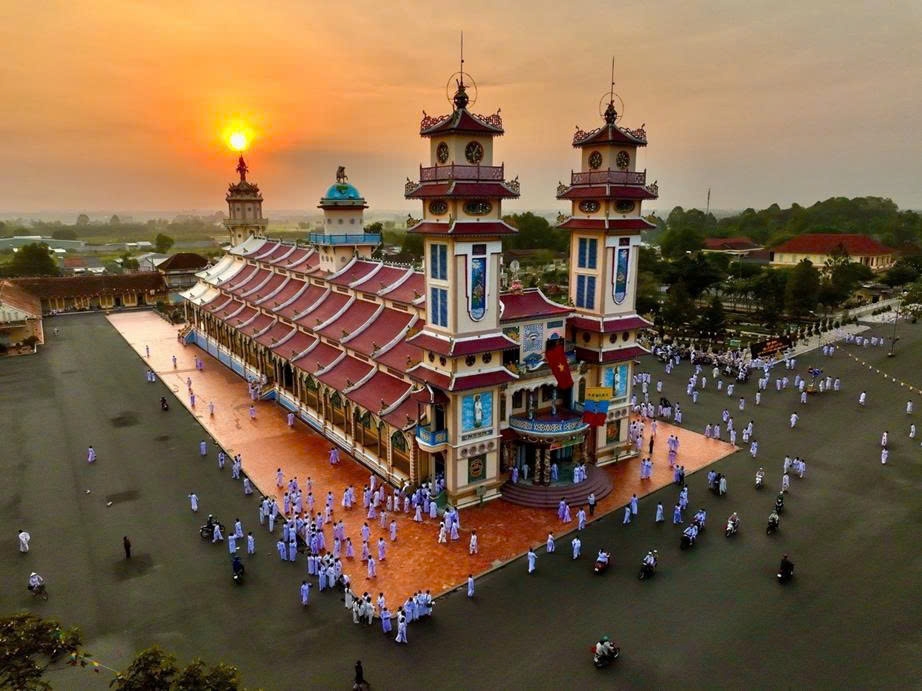
 Tay Ninh Holy See - a unique architectural masterpiece of the Cao Dai religion
Keywords: Caodaism; Contributions; Resistance against French colonialism; Anti-American imperialism.
1. An overview of the Southern region of Vietnam and Caodaism
The history of the Vietnamese people’s exploration and settlement of the Southern region of Vietnam spans over three hundred years, but the history of this land dates back much further and has undergone many ups and downs due to the changes in nature, society and people. To date, the Southern region of Vietnam has gone through three historical periods: Funan from the beginning of the Common Era to the 7th century, Chenla from the 7th to the 17th century and Vietnam from the 17th century to the present day.
The reclamation of the Southern region of Vietnam began with spontaneous, unannounced migrations of Vietnamese people from the late 16th to early 17th centuries. Initially, they lived interspersed with the Stieng, Mạ, Choro, Khmer, and other ethnic minorities. In the late 17th century, groups of Chinese immigrants also came to settle in Southern region (Vietnam). In 1671, Mac Cuu and his entourage arrived to establish themselves in Ha Tien land. In 1679, several Chinese military commanders such as Yang Yan Di, Chen Shang Chuan, Huang Jin, Chen An Ping,… came to settle in what is now Bien Hoa and My Tho. Later, waves of Vietnamese, Chinese and Cham people continued to come and cultivate the Southern region (Vietnam). In the 18th century, during the reign of Lord Nguyen Phuc Khoat (1738-1765), thanks to the administrative achievements of Minister Nguyen Cu Trinh, the boundaries of the Southern region were basically defined as they are today, from latitude 8035 to latitude 110. The book “A Brief History of the Southern Region of Vietnam” states that: “In just over a century, from the beginning of the 17th century to the middle of the 18th century, the entire Southern region came under the rule of the Nguyen Lords and quickly became a dynamic socio-economic development area”.
In the 19th century, along with the migrations of Vietnamese and Chinese people, the land reclamation efforts were further promoted by the Nguyen dynasty with significant contributions from Le Van Duyet and Nguyen Van Thoai (Thoai Ngoc Hau). At the beginning of the 20th century, Vietnamese people from the North, Central regions and Chinese people from Fujian and Guangdong, migrated to the South to do business, resulting in a fairly rapid increase in population.
Regarding the population of Southern region (Vietnam), some documents provide an idea of population growth over time as follows: in 1819, Gia Dinh province had 97,100 able-bodied men; in 1847, there were 165,598 able-bodied men. The population of Southern region (Vietnam) in 1867 was 1,204,278 (including 585 French people), in 1905 it was 2,876,417; in 1909 it was 2,975,838; in 1920 it was 3,600,000,… And currently (2019), the population of the 19 provinces in Southern region (Vietnam) is 35.38 million people.
The Southern region (Vietnam) is a region with diverse religions, including Caodaism. Caodaism officially originated in Tay Ninh in 1926, founded by several influential figures in contemporary society. However, the Caodaism was born and succeeded thanks to the social environment in Southern region (Vietnam) at the beginning of the 20th century. In Southern region (Vietnam) after World War I (1914-1918), with the French colonial exploitation policies, especially the policies of plundering and exploiting agriculture, primarily through land seizure to establish plantations and increased taxes, pushed the people of Southern region (Vietnam) into extreme poverty, misery and a hopeless situation. Under French colonial rule, Vietnamese farmers in general, and Southern Vietnamese farmers in particular, suffered under a double or triple yoke of oppression. During that period, the people of Southern region (Vietnam) constantly rose up to fight fiercely against the enemy, with the struggle becoming increasingly intense and fierce. But due to class constraints, the peasants were unable to liberate themselves. At that time, there was a lack of a leading political party of the progressive class, namely the working class. Therefore, the peasant struggles were successively crushed in a sea of blood by the French colonialists. Facing life’s dead ends, people in Southern region (Vietnam) turn to religion to alleviate their pain, in order to find comfort and solace.
Besides the main causes of poverty and the deadlock in the struggle of the people of Southern region (Vietnam), the Caodaism emerged due to the decline and decay of traditional religions and beliefs, especially the decline of Buddhism and the disintegration of traditional social institutions and Confucian ethics as Southern region (Vietnam) entered colonial society and the penetration of Western civilization. Therefore, the emergence of Caodaism is seen as filling the spiritual void created by the crisis of religion and morality at the time.
All the aforementioned factors in Southern region (Vietnam) came together to create a very favorable economic, cultural, social and ideological environment for the emergence of Caodaism, which was either absent or insufficient in previous and subsequent periods. Therefore, it can be concluded that the emergence of Caodaism in Southern Vietnam was a social inevitability in the Southern region (Vietnam) after World War I (1914-1918). In other words, Cao Dai religion could only have originated in Southern region (Vietnam) sometime between World War I and the August Revolution (1945); it is unlikely to have originated elsewhere or at any other time.
Thus, from a socio-political perspective, the emergence of Caodaism was also an expression of the people of Southern region (Vietnam)’s reaction to the French colonial policy of economic exploitation, political oppression and cultural enslavement. From a political and social perspective, the emergence of Caodaism is seen as a nationalist movement, a patriotic movement in religious form. And to a certain extent, the emergence of Caodaism can be compared to early Christianity, the movement of the Jews against the invasion and social rule of the Roman Empire.
For various reasons, Caodaism is divided into different sects. Shortly after its inception, from the early 1930s to 1945, Cao Dai religion had over a dozen sects and by 1975, there were nearly twenty organizations and sects. Of particular interest is that after the Cao Dai religion split, unification efforts immediately emerged, lasting continuously until 1975 with typical organizations such as the Cao Dai Federation, later renamed the Cao Dai United General Association (1936), the Cao Dai National Salvation Twelve Unified Sects and the Unified Holy See (1947), the Cao Dai Unified, later renamed the Cao Dai Unified (1952),...
By 1975, Caodaism had 2.5 million followers, approximately 23,000 officials and clergy and over 1,100 places of worship belonging to nearly two dozen independent sects and organizations, in there, some of the sects with the largest number of followers and clergy included: Cao Dai Tay Ninh, Cao Dai Ban Chinh Dao, Cao Dai Tien Thien, Cao Dai Minh Chon Dao,... Specifically:
Cao Dai Tay Ninh has over 1 million followers, 355 temples (parishes), 99 shrines dedicated to the Mother Buddha, 2,500 religious officials and over 7,000 religious functionaries present in 33 provinces and cities, such as Tay Ninh, Long An, Sa Dec and Cao Lanh, Ben Tre, Saigon and Gia Dinh, Long Xuyen and Chau Doc, My Tho and Go Cong, Can Tho,...
The Cao Dai Ban Chinh Dao sect has 930,000 followers, 271 religious leaders and 245 congregations located in 26 southern provinces and cities. Some provinces have a high concentration of followers, such as Ben Tre, Long An, Tra Vinh, Saigon, My Tho and Go Cong,…
Cao Dai Tien Thien has approximately 350,000 followers across 107 congregations in 15 provinces and cities. Some provinces with a high concentration include Ben Tre, My Tho, Go Cong, Vinh Long and Soc Trang…
The Cao Dai Minh Chon religion has approximately 100,000 followers, over 400 officials and functionaries and 49 parishes in four provinces of the Southwestern region of Vietnam, including Ca Mau, Bac Lieu, Rach Gia and Ha Tien,…
Besides the aforementioned Cao Dai sects, in Southern region (Vietnam) there are other sects such as: Cao Dai Minh Chon Ly with nearly 50,000 followers and over 500 officials and functionaries representing 25 deities; Cao Dai Bach Y with nearly 10,000 followers and 15 temples; Cao Dai Chieu Minh Long Chau. Cao Dai Vietnam Ben Tranh with 3,000 followers in 2 temples; Cao Dai Vietnam Binh Duc with approximately 7,000 followers in 9 temples,... In Central Vietnam, there are two Cao Dai sects: Cao Dai Missionary and Cao Dai Tam Quan, with approximately 100,000 followers and 60 congregations in 12 provinces and cities, mainly in the central region, such as Da Nang and Quang Nam,…
Thus, Caodaism was one of the religions with a large number of followers, clergy and officials, creating a significant influence in all aspects of life in Southern region (Vietnam) in the period before 1975.
2. The contributions of Cao Dai sects to the Revolution during the period of 1945-1975
The contribution of Caodaism to the August Revolution and the resistance war against French colonialism (1945-1954). In 1945, under the leadership of the Party and the Viet Minh Front, the people of Southern region (Vietnam) and the whole country rose up in rebellion to “fight the French, expel the Japanese and seize power for the people”. That was the successful August Revolution (1945) that established the Democratic Republic of Vietnam. During this period, the uprising movement in Southern region (Vietnam) was very active because Southern region (Vietnam) was a colony subjected to French oppression and exploitation, because the Party paid great attention to the uprising movement in Southern region (Vietnam) with the direct guidance of the Southern Regional Party Committee and the Viet Minh Front. During this period, uprisings in various localities all involved followers and dignitaries of the Caodaism. In particular, under the leadership and guidance of Mr. Cao Trieu Phat, Vice Chairman of the Viet Minh Front of Bac Lieu province, followers and dignitaries of the Cao Dai Minh Chon Dao played a crucial role in the uprising to seize power. In Tay Ninh, on August 25th, 1945, under the guidance of Grand Master Dang Trung Chu, a large number of Cao Dai followers, dignitaries and people in the province held a rally to support the Viet Minh Front against the French and Japanese, aiming to seize power for the people.
Having gained independence for only a short time, the people of Southern region (Vietnam) faced the threat of reoccupation by the French colonialists. Therefore, during the nine years of resistance against French colonialism (1945-1954) under the leadership of the Party through the Southern Regional Committee and the Viet Minh Front, Caodaism actively participated and made new contributions to the revolution. Firstly, there was the sound of gunfire from the Cao Dai Minh Chon Dao sect, under the command of Mr. Cao Trieu Phat, fighting against the French in their attempt to reoccupy Southern region (Vietnam) in April 1946 at the “Giong Bom Front” in Bac Lieu, where they eliminated more than 100 French soldiers.
The Caodaism’s contribution to the revolution during the resistance against French colonialism was exemplified by the establishment and activities of the Unified Twelve Sects of the Cao Dai National Salvation Association. During the movement leading up to the August Revolution, many dignitaries and followers of the Cao Dai religion actively participated in national salvation organizations as part of their respective groups. Following the successful August Revolution, especially after the French reoccupied Southern region (Vietnam), under the leadership of the Regional Committee and the Resistance Administrative Committee and the Southern region (Vietnam) Viet Minh Regional Committee, particularly with the role of Mr. Cao Trieu Phat, in June 1947, the Unified Eleven-Faction Cao Dai National Salvation Association was officially established based on the members of the Cao Dai National Salvation Conference held in 1945. Later, in November 1947, it was renamed the Unified Twelve Sects of Cao Dai National Salvation Association placed under the leadership of the Party, including: Cao Dai Minh Chon Dao, Cao Dai Ban Chinh Dao, Cao Dai Tien Thien, Cao Dai Minh Chon Ly, Cao Dai Bach Y, Cao Dai Chieu Minh, Cao Dai Cao Thuong Buu Toa, Cao Dai Hoi Giao, Cao Dai Tuyet Coc, Cao Dai Chon Ly Tam Nguyen, Cao Dai Lien Hoa Tong Hoi and Cao Dai Toa Thanh Tay Ninh. The Unified Twelve Sects of the Cao Dai National Salvation Association issued a very specific Declaration and Action Program to mobilize human and material resources to serve the Resistance War against the French.
The Unified Twelve Sects of the Cao Dai National Salvation Association established an organizational structure from the regional, provincial, district and grassroots levels. From its founding in 1947 until 1954, the Unified Twelve-Faction Cao Dai National Salvation Association held four General Assemblies to reorganize its structure and implement specific activities in accordance with its Declaration: “In order to thoroughly participate in the national liberation revolution”. In 1954, with the victory of the resistance war against French colonialism, the Unified Twelve Branches of the Cao Dai National Salvation Association completed their historical mission. In recognition of the meritorious contributions of the Unified Twelve Sects of Cao Dai National Salvation Association in the resistance against French colonialism, on December 18th, 1954, the Government of the Democratic Republic of Vietnam awarded them the Resistance Medal, Second Class for the achievement: “Having upheld the spirit of solidarity in the resistance to save the nation”.
And due to the unique circumstances at that time, there was one important point that was only agreed upon verbally, not in writing: Religious and secular matters united in the struggle to demand the implementation of the Geneva Accords and the reunification of the country.
The contribution of Caodaism to the resistance war against American imperialism (1954-1975). On February 7th, 1955 (the 15th day of the first lunar month of the Year of the Goat), at the Ngoc Sac Holy See (Bac Lieu) of the Cao Dai Minh Chon Dao sect, the dignitaries of the five Cao Dai branches representing over half a million followers, officials met and decided to establish the Cao Dai Federation, later known as Federation I. The dignitaries representing the five branches of Cao Dai as: Chief Dharma Master Huynh Ngoc Ton - Cao Dai Minh Chon Dao, Chief Dharma Master Vo Van Tan - Cao Dai Tien Thien, Chief Administrator Nguyen Van Giai - Cao Dai Chieu Minh, Chief Administrator Truong Sy Tan - Cao Dai Bach Y and Chief Coordinator Nguyen Van Nhat - Cao Dai Cao Thuong Buu Toa. the First Inter-religious Alliance adopted a seven-point Common Agreement: 1- Religion is closely connected with the nation, fulfilling the Supreme Being’s principle and purpose of relieving human suffering; 2. Praying for peace and protection for national prosperity and the well-being of the people; 3. In order to unite and help each other in spiritual practice, doing good, doing right and wholeheartedly serving humanity; 4. Providing mutual support, both materially and spiritually, when fellow believers face difficulties or hardships; 5. Supporting genuine practitioners of Buddhism and protect monks and nuns; 6. Protecting freedom of religion; 7. Do not interfere in each other’s internal affairs.
The activities of the First Inter-religious Alliance were aimed at peacefully demanding that the Ngo Dinh Diem government implement the Geneva Accords and hold general elections to unify the country. Following that were struggles against the dictatorial regime of Ngo Dinh Diem, against “denouncing and eliminating communists” and for religious freedom,... Following the Dong Khoi movement of 1960-1961, the National Liberation Front of South (Vietnam) was established, Cao Dai dignitaries joined the Front in various provinces and cities, such as: The Can Tho Provincial Front has Catholic layman Dang Thanh Su (Cao Dai Tien Thien); the Soc Trang Provincial Front has The Dharma Protector Ngo Thien An (Cao Dai Minh Chon dao) and Associate Master Nguyen Van Nghiem (Cao Dai Tien Thien); the Ca Mau Provincial Front has Associate Master Le Ngoc Cu and Professor Ho Thi Tho (Cao Dai Minh Chon dao); The Sa Dec provincial front had Professor Nguyen Minh Canh (Cao Dai Tien Thien); the Long An provincial front had Associate Master Nguyen Van Nhi (Cao Dai Tien Thien); The Tra Vinh Provincial Front has Catholic layman Tran Van Hieu (Cao Dai Tien Thien); the Vinh Long Provincial Front has Associate Master Nguyen Van Lo (Cao Dai Tien Thien); The Ben Tre Provincial Front has Associate Master Doan Van Trang (Cao Dai Tien Thien); The Rach Gia Provincial Front had Associate Master Nguyen Kim Khue (Cao Dai Minh Chon Dao),...
Throughout its three-year existence, from its founding until the liberation of South (Vietnam) (1972-1975), the Cao Dai branches within the Second Inter-Religious Bloc were very active and made significant contributions to the revolutionary cause of the entire nation. Mr. Ngo Tam Dao, the head of the Cao Dai Minh Chon Dao Church and a key figure in the Second Inter-Religion, summarized some of the main tasks accomplished by the Second Inter-Religion as follows: Firstly, it thwarted the plot to unify Cao Dai religion to provide support for the America and the Saigon government. Secondly, they opposed the conscription of young men and monks of the Cao Dai religion into the Saigon army (the Cao Dai factions in the Second Alliance managed to keep 18,000 young Cao Dai followers from being conscripted - Cao Dai Tien Thien alone kept 3,000 young men). Thirdly, launch a movement to fight against the America and the Saigon government through prayers for peace. Then, the peace prayer movement transformed into a struggle for people’s livelihoods, democracy and for the America and the Saigon government to implement the Paris Agreement.
Specifically for Cao Dai Tay Ninh, during the period of 1954-1960, amidst the complex relationship between the Tay Ninh Holy See and the Saigon government, struggles by Cao Dai followers continued to take place in Tay Ninh. Specifically, Cao Dai followers in Phu Khuong district (which the Liberation Front government called the Holy See district) fought against the “anti-communist” campaign launched by the US-Diem regime under Truong Tan Buu in Tay Ninh in 1956, the “referendum” campaign for the 1956 government elections, and the protests boycotting Ngo Dinh Diem’s visit to the Tay Ninh Holy See in 1960,... The results of the Cao Dai movement mentioned above, along with other factors created the conditions and strength for Tay Ninh to have the famous Tua Hai battle (1960), contributing to the beginning of the Dong Khoi movement in the South. Following that were movements such as the struggle against the 1966 parliamentary elections and the movement against the establishment of strategic hamlets in the years 1966-1971, legitimate movements fighting against American aggression and domination and the Saigon government, demanding civil rights and democracy, opposing conscription and the militarization of schools, opposing the 1971 presidential election, the Cao Dai University student movement demanding the implementation of the 1974 Paris Agreement,...
For Cao Dai Tay Ninh, a significant and positive activity of its leaders and followers is their participation in the Peaceful Coexistence movement, based on the ideology put forth by Protector of the Faith Pham Cong Tac in 1955 in Cambodia. One of the activities of the clergy and followers of the Tay Ninh Holy See against the Ngo Dinh Diem regime (1956-1960) was led by Scholar Nguyen Minh Ngoi, Secretary Le Quan Tan and Scholar Pham Duy Nhung. The struggle resulted in nearly 2,000 people being arrested and imprisoned, including some who sacrificed their lives. Another line of activity was participation in the revolution, like the Catholic layman Thuong Thau Thanh, the religious leader Le Van Buoi, Major Huynh Thanh Mung,… under the name of the Committee for Consolidating Peaceful Coexistence - later members of the National Liberation Front of South (Vietnam).
3. Conclusion
Caodaism is a religion that originated in South (Vietnam) within a historical context with very unique political, social, and cultural factors - the French colonial period, associated with French exploitation and exploitation that caused poverty and suffering for the people and the bloody suppression of anti-French uprisings by the French. Caodaism is a religion that reflects the psychology and sentiments of the people of South (Vietnam) - their national spirit. General Secretary Le Duan assessed: Cao Daiism is a national movement, therefore, when given attention, leadership and guidance, it will promote the positive aspects of Caodaism.
Caodaism is a major religion in Southern Vietnam. Its contributions to the revolution during the years 1945-1975, in addition to its own unique elements, also included the leadership and guidance of the Party. Of the three regions, South (Vietnam) was a newly opened area with its own unique history, population and culture. During the years 1945-1954 and even later in the resistance against American imperialism, the Party, government and front organizations, such as the Regional Committee, the Resistance Administrative Committee and the Southern Vietnam Viet Minh Committee were built and strengthened and paid close attention to Caodaism.
The contributions of Cao Dai followers, along with those of other segments of the population, contributed to the great victories of the nation in the August Revolution (1945), the resistance war against French colonialism (1945-1954), and the resistance war against American imperialism (1954-1975). The contributions of Caodaism to the revolution during the years 1945-1975 laid a solid foundation for Caodaism to continue its path of “National Glory - Religious Enlightenment” in the country’s period of renewal./.
* Ho Chi Minh National Academy of Politics
References
1. Government Religious Affairs Committee (1982), Religious data in Vietnam in 1982. Archival documents. Hanoi.
2. Government Religious Affairs Committee (1982), Agreement on Interreligious Cooperation of 18 Cao Dai Sects in 1972. Archival documents. Hanoi.
3. Government Religious Affairs Committee (1982), Overview of Cao Dai with the Revolution, Hanoi.
4. Executive Board of the Cao Dai Tien Thien Church (2001), A Brief History of Cao Dai Tien Thien Great Way of the Three Periods of Universal Salvation, Ben Tre.
5. To Minh Duc (2001), A brief overview of Cao Dai Minh Chon religion through the two national resistance wars, Journal of Religious Studies, No. 4/2001.
6. Vietnam Historical Science Association (2006), A Brief History of the Southern Region of Vietnam, The Gioi Publishing House, Hanoi.
7. Nguyen Hung (1997), The Two Roles of Life and Religion - Memoirs of Ngo Tam Dao, Literature Publishing House.
8. Ben Tre Provincial Party Committee (1985), Report on the achievements of Caodaism in participating in the resistance war against France and the Amerrica and in building the country (Ban Chinh Dao), Ben Tre.
9. General Statistics Office (2019), Population and Housing Statistics Yearbook, Statistics Publishing House, Hanoi.
10. Nguyen Thanh Xuan (2013), Caodaism - Two aspects: history and religion, Religious Publishing House, Hanoi
