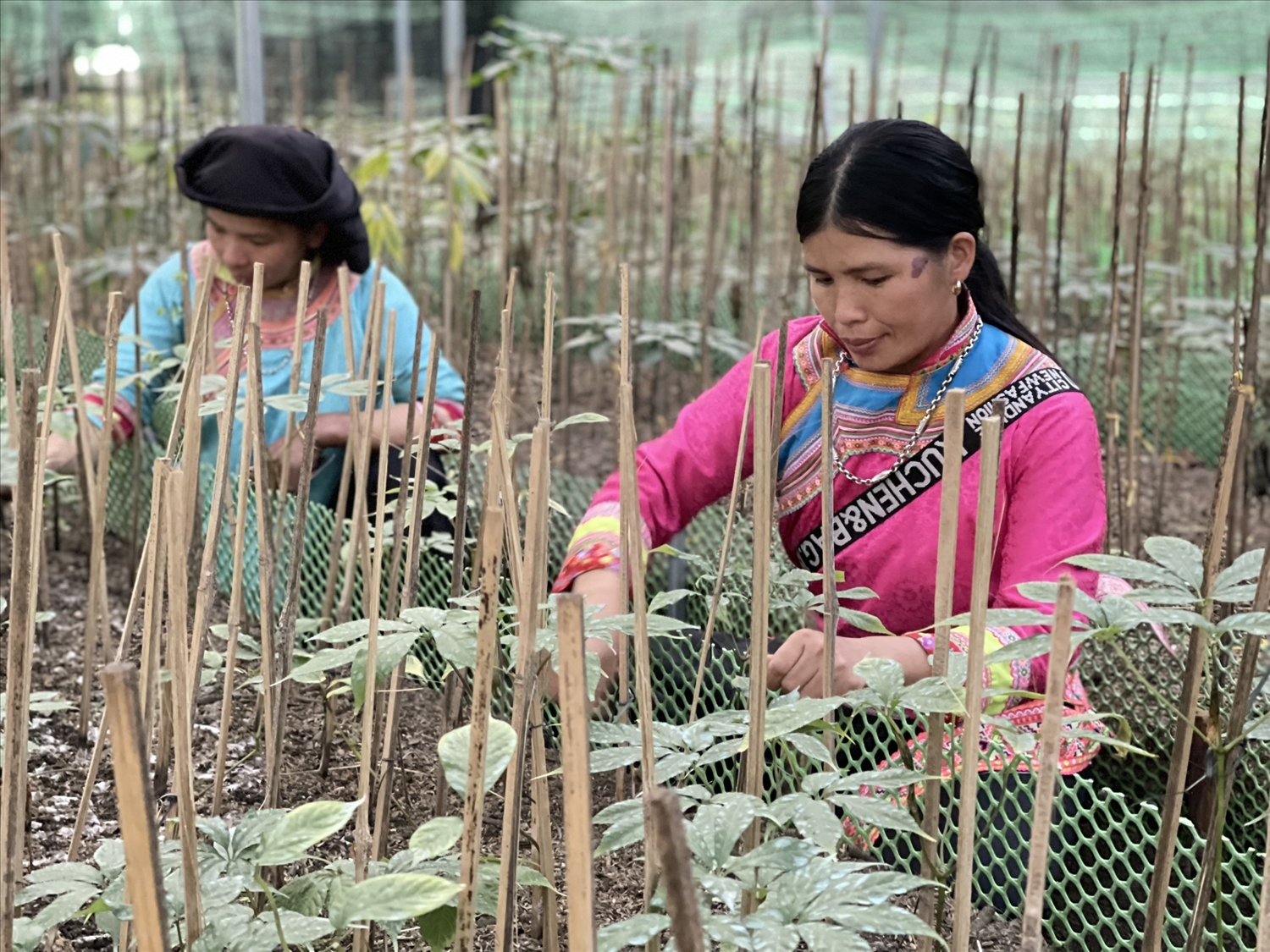
 Developing medicinal plants is one of the solutions to help ethnic minority communities achieve sustainable poverty reduction
Keywords: Multidimensional poverty reduction; National Target Program; Ethnic minority.
1. Multidimensional poverty line and poverty situation in ethnic minority and mountainous areas
Prior to 2016, Vietnam measured poverty based on income. This approach failed to capture non-monetary aspects that play a significant role in people’s well-being.
During the period of 2016-2020, in order to effectively pursue the goal of sustainable poverty reduction and ensure the social security rights of the poor, Vietnam became one of the first 30 countries globally and among the first in Asia to adopt a multidimensional poverty standard, which guarantees a minimum living standard in alignment with sustainable development goals. The multidimensional poverty criteria take into account not only the assurance of a minimum income but also the level of access to basic social services such as employment, healthcare, education, housing, clean water and sanitation and information.
For the period of 2021-2025, Vietnam’s multidimensional poverty criteria have been upgraded compared to the period of 2016-2020. The poverty threshold is now more closely aligned with the minimum standard of living, a feat previously unachievable due to resource constraints. This approach allows for a more nuanced understanding of the nature of poverty by incorporating indicators such as nutritional status, children’s school attendance, and the educational attainment of adults, at the same time adding metrics to assess employment-related deprivations among the poor. Employment is viewed both as an outcome and as a public policy instrument for achieving other results within a multidimensional framework; it reflects the income and living conditions that ensure stability for individuals. Furthermore, it serves as a basis for categorizing poor households, enabling the implementation of targeted interventions and the delivery of conditional, time-bound support policies. These changes are well-suited to Vietnam, a lower-middle-income country striving to reach upper-middle-income status in the medium term. A higher poverty threshold, combined with more rigorous multidimensional poverty criteria, reflects the determination of the Party and the State to improve living standards for all and ensure that no one is left behind.
As part of the nation’s broader development agenda, poverty reduction among ethnic minority and mountainous communities has been a priority, requiring intensive efforts from all levels of government, various sectors, and the entire political system. This is because, heading into the period of 2021-2025, poverty among ethnic minority groups posed a significant challenge: there were nearly 741,000 impoverished ethnic minority households accounting for over 63% of the total number of poor households nationwide, with high concentrations in the Northeast, Northwest and Central Highlands mountainous regions. In several provinces, ethnic minority households account for over 80% of the total number of poor households, for instance, in Cao Bang (99.5%), the former Ha Giang province (99.3%), Lai Chau (98.7%), Dien Bien (98.6%), the former Kon Tum (92.6%) and Gia Lai (86.5%). Among many ethnic minority groups, the poverty rate exceeds 40%, nearly eight times the national average including the La Hu, Mang, Chut, O-Du, Co, Kho-mu, Xinh Mun, La Ha, Khang, Mong and Xo-Dang groups.
In response to the need to reform ethnic minority policies shifting toward a more comprehensive, integrated, and sustainable approach, the National Assembly issued Resolution No. 120/2020/QH14 on June 19th, 2020, approving the investment policy; subsequently, the Prime Minister issued Decision No. 1719/QĐ-TTg on October 14th, 2021, approving the National Target Program for socio-economic development in ethnic minority and mountainous areas for the period of 2021-2030, with the first phase covering 2021-2025 (the Program). This marks the first time Vietnam has implemented a dedicated National Target Program for ethnic minority and mountainous regions, a large-scale, comprehensive initiative employing a multi-sectoral approach. It aims to achieve multidimensional poverty reduction, enhance development capacity in particularly disadvantaged ethnic minority and mountainous areas and gradually narrow the development gap between different regions of the country.
2. Some results in multidimensional poverty reduction for the period of 2021-2025
The National Target Program for Socio-Economic Development in Ethnic Minority and Mountainous Areas for the period of 2021-2025, backed by significant investment, serves as a breakthrough solution by the Party and the State. It is a vital policy decision designed to operationalize the guidelines and strategic orientation set forth by the Politburo in Conclusion No. 65-KL/TW dated October 30th, 2019, which concerns the continued implementation of Resolution No. 24-NQ/TW of the 9th Party Central Committee regarding ethnic affairs in the new context. Resolution No. 120/2020/QH14 of the National Assembly approved the investment policy for the National Target Program on socio-economic development in ethnic minority and mountainous areas for the period of 2021-2030. The results achieved during Phase I of the Program have contributed to a significant reduction in the various dimensions of deprivation regarding access to basic social services, a core component of multidimensional poverty reduction.
In the education sector, the program has renovated and repaired 629 school and classroom facilities to meet established standards. It has also supported investments in infrastructure and modern teaching equipment such as smart Televisions and laptops for 1,032 ethnic minority boarding schools, ethnic minority semi-boarding schools, and other general education schools that accommodate semi-boarding students. A total of 4,752 literacy classes were organized, with 95,033 participants. Support was provided to 843 students for undergraduate studies, 315 individuals for master’s degree programs and 18 doctoral candidates for PhD programs…
With these results, the Program is directly impacting “human development capacity”, a core element of multidimensional and sustainable poverty reduction. Renovating school facilities and investing in modern teaching equipment for ethnic minority boarding and semi-boarding schools not only improves learning conditions but also gradually narrows the gap in educational access between students from ethnic minority areas and those from more developed regions. Literacy classes help local people learn to read and write, improving their access to information, scientific and technical knowledge, support policies, and livelihood opportunities, thereby enhancing their self-reliance in economic development and daily life.
Supporting the education and training of ethnic minority undergraduate students, graduate students, and doctoral candidates demonstrates that the Program aims not only at immediate poverty reduction but also at developing high-quality human resources for ethnic minority and mountainous areas. This is a factor of strategic significance, as sustainable poverty reduction in the long term cannot be separated from the development of a local pool of intellectuals, officials, and human resources with high levels of professional expertise.
In the healthcare sector: A program to support the renovation and repair of 183 commune-level health stations, and to provide equipment for 118 such stations; investment in facilities and the procurement of essential equipment for 52 district-level health centers; and the recruitment of 114 physicians (holding a Level I Specialist degree) to work at healthcare facilities in impoverished and disadvantaged districts, as well as in areas inhabited by ethnic minority and mountainous communities; 471 commune health stations received training, technical transfers, and formal certification of such transfers; 756 instances of allowance support were provided to village-based birth attendants; 3,125 training sessions on Thalassemia were organized for healthcare personnel at various levels; 1,517 training sessions were held to enhance knowledge and capacity regarding maternal and child healthcare and nutrition aimed at reducing maternal and child mortality, as well as improving the stature and physical fitness of ethnic minority populations; 3,885,902 maternal and child healthcare service packages, in accordance with the Ministry of Health’s professional guidelines, were delivered; and 137,596 initiatives for advocacy and behavior-change communication regarding maternal and child healthcare and nutrition were implemented…
For ethnic groups facing significant hardships including those with specific, unique challenges, the Program has provided prenatal check-ups, pregnancy management, medical care, and screening for common congenital conditions for 2,199 pregnant women. Additionally, it has supported the provision of nutritionally balanced, pre-formulated meals (such as instant fortified rice or porridge) and school milk for 2,423 children attending public preschool educational institutions…
Healthcare-related initiatives and activities have contributed to improving the physical and mental well-being, stature and life expectancy of ethnic minority populations. These efforts have also strengthened grassroots healthcare services, ensuring that ethnic minority communities have access to modern healthcare. Consequently, residents in ethnic minority and mountainous areas are now able to access medical services and primary healthcare right within their own localities. Primary healthcare facilities are being equipped with advanced, specialized medical techniques to manage and treat certain non-communicable diseases (such as hypertension, diabetes, and bronchial asthma). This helps reduce travel time and treatment costs for patients, while also easing the burden of patient referrals to higher-level healthcare institutions.
In the housing sector, the Program has provided housing support to 42,567 households and extended housing-related loans with an outstanding balance of VND 809.891 billion. This has contributed to the implementation of the national initiative to eliminate makeshift and dilapidated housing, particularly in areas facing extreme hardship, including regions inhabited by ethnic minority and mountainous areas. Improving living conditions helps people stabilize their lives, reduces the risks posed by natural disasters and creates an environment conducive to economic development. In many localities, housing support is implemented in a manner that respects the unique cultural characteristics of each ethnic group. Various housing models which blend traditional architecture with modern safety and sanitary standards have contributed to enhancing the quality of life for these communities.
In the sector of domestic water supply, the Program has provided support for decentralized water supply systems to 479,358 households and invested in the construction of 809 centralized water supply facilities, helping to alleviate clean water shortages in many highland areas and regions facing water scarcity. Improving access to clean water and environmental sanitation contributes to better public health, reduces the risk of disease, and enhances the quality of life for the local population.
In the field of information: 60 information technology projects have been approved and implemented; 81 conferences and seminars on digital transformation have been organized; 933 support centers have been established to assist ethnic minority communities in applying information technology for socio-economic development and the maintenance of security and public order; and 248 training sessions covering the management and use of equipment, as well as the maintenance and operation of these information technology application centers have been conducted, with 6,060 participants. Supporting the establishment of information technology hubs in communes facilitates local residents” access to knowledge, public services, security and public order alerts and market opportunities, while enhancing digital integration for people living in ethnic minority and mountainous areas.
In the area of employment: The program has provided vocational training and job placement assistance to 115,575 workers and has implemented 403 projects to support production development along value chains. The number of ethnic minority households participating in value chains has reached 13,596. A total of 2,562 community-based production development projects have been implemented, engaging 20,453 households. Twelve startup and business-initiation models have been established in ethnic minority and mountainous areas. Additionally, 383 livestock and crop cultivation projects and models have been supported, with the participation of 36,654 households...
The implementation of value chain models and projects to support production development and livelihood diversification associated with the potential of crops and livestock has contributed to creating jobs, increasing income, improving material life, creating a change in people’s awareness and gradually creating a shift in regional economic structure towards commodity production to more effectively promote the potential, strengths and conditions of the labor force in ethnic minority and mountainous areas.
In summary, a significant achievement is the reduction in the poverty rate among ethnic minority communities averaging nearly 4% per year which outpaces the national poverty reduction rate and contributes to narrowing the development gap between regions. The average income for individuals from ethnic minority groups has reached 45.9 million VND, a 3.3-fold increase compared to 2020 (surpassing the target of a more than 2-fold increase). Policies focused on support and livelihood development have enabled people to escape poverty, improve their living standards, and foster economic growth. The general educational level, quality of education, and human resource capacity in ethnic minority and mountainous regions are steadily improving, contributing to poverty reduction efforts. Initiatives supporting vocational training and employment have helped secure stable jobs for a substantial portion of the local workforce. Furthermore, impoverished ethnic minority individuals now enjoy better and more comprehensive access to public services provided by the State...
3. Three pillars for multidimensional poverty reduction in the periodof 2026-2030
On January 31st, 2026, the Minister of Agriculture and Environment issued Decision No. 417/QĐ-BNNMT, approving the National Target Program for New Rural Development, Sustainable Poverty Reduction and Socio-Economic Development in Ethnic Minority and Mountainous Areas for the period of 2026-2035, Phase I: From 2026 to 2030. One of the objectives of the Program is the “comprehensive development of ethnic minority and mountainous areas”, alongside the implementation of “multidimensional, inclusive, and sustainable poverty reduction”. Achieving this goal requires comprehensive policy measures grounded in the three pillars of multidimensional poverty reduction, which is essential for realizing rapid and sustainable poverty alleviation across all dimensions and in all locations.
Firstly, promote employment and labor mobility both geographically and across different occupations to enable ethnic minority workers to participate more effectively in the labor market, particularly in productive employment; a lack of employment or underemployment is the primary driver of poverty. Productive employment ensures that the income earned from one’s labor is sufficient to allow workers and their dependents to maintain a standard of living above the poverty line. Efforts should focus on increasing the incomes of the poor through projects that support production development, with priority given to addressing critical needs such as livelihoods, vocational training, technology transfer, employment and the attainment of a stable income...
Secondly, providing high-quality social services in the fields of education and healthcare. Within the framework of multidimensional poverty reduction, education and healthcare serve as the foundation for enhancing human development capacity. Education enables ethnic minority groups to access knowledge, skills and employment opportunities, thereby helping them break the cycle of intergenerational poverty. Healthcare contributes to safeguarding well-being, improving the quality of human resources and reducing the risk of falling back into poverty due to illness. The provision of quality education and healthcare services not only addresses fundamental deprivations but also fosters the internal capacity for individuals to participate equitably in the socio-economic development process.
Thirdly, poverty reduction strategies should focus on areas facing extreme hardship, with investments in socio-economic infrastructure; this includes implementing production development projects based on value chains, as well as establishing specialized zones for agriculture and livestock farming to serve as a catalyst for development in impoverished regions. For poor households, it is necessary to shift from providing individual, household-specific support to facilitating assistance through organized production models. Households should contribute whether through labor, in-kind resources, or capital, thereby gradually phasing out “handout” policies and fostering a spirit of self-reliance and determination to overcome poverty. Emphasis must be placed on vocational training, job creation, and the development of sustainable livelihoods for ethnic minority groups, enabling them to transition into employment that aligns with the demands of the labor market.
4. Conclusion
The National Target Program for socio-economic development in ethnic minority and mountainous areas for the period of 2021-2025 has generated positive impacts on the achievement of multidimensional poverty reduction goals in Vietnam. Beyond contributing to higher incomes, the program has also significantly reduced deprivations across various dimensions including education, healthcare, housing, access to clean water, information, and overall living conditions among ethnic minority communities.
Through investments in infrastructure, livelihood support, improved access to basic social services, and the strengthening of community capacity, the Program gradually narrows the development gap between mountainous regions and the lowlands, while simultaneously establishing a vital foundation for the sustainable development of ethnic minority and mountainous areas. The achievements in multidimensional poverty reduction during the period of 2021-2025 establish a vital foundation for the implementation of the National Target Programs covering new rural development, sustainable poverty reduction, and the socio-economic development of ethnic minority and mountainous regions for the period of 2026-2035 (with Phase I spanning 2026-2030). This effort aims to realize key development goals, including the reduction of poverty across all dimensions for ethnic minority communities.
References
1. Government, (2025), Report No. 901/BC-CP dated October 10th, 2025, on the review of the National Target Program for Socio-Economic Development in Ethnic Minority and Mountainous Areas for the period of 2021-2030, Phase I: from 2021 to 2025.
2. National Assembly, (2020), Resolution No. 120/2020/QH14 dated June 19th, 2020, approving the investment policy for the National Target Program on socio-economic development in ethnic minority and mountainous areas for the period of 2021-2030.
3. Prime Minister, (2021), Decision No. 1719/QD-TTg dated October 14th, 2021, approving the National Target Program for socio-economic development in ethnic minority and mountainous areas for the period of 2021-2030, Phase I: from 2021 to 2025.
