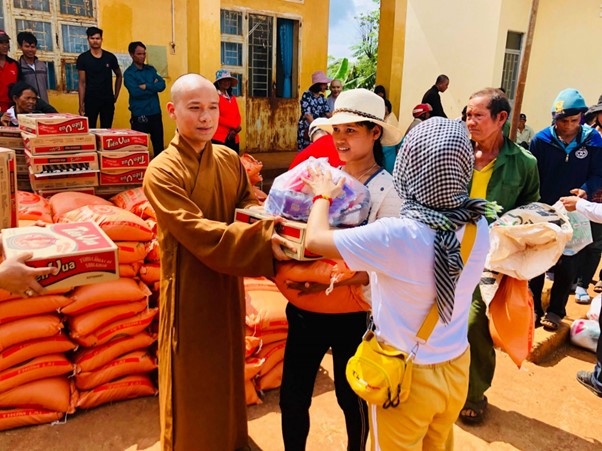
 Religions have always been actively involved in social and charitable activities
Keywords: Religion and Morality; A virtuous way of life; Vietnamese people today.
1. The Party’s viewpoint and policies on promoting religious and ethical values in the period of national renewal
Our Party and State have consistently implemented a policy of respecting freedom of belief and religion. In particular, since the country’s reform in 1986, the Party and State have adopted a policy of encouraging religions to promote positive cultural and moral values to contribute to national development.
Resolution No.24-NQ/TW dated October 16th, 1990, of the Politburo on strengthening religious work in the new situation affirms: “Religious ethics have many aspects that are compatible with the construction of a new society”. Next, Directive No.37-CT/TW dated July 2rd , 1998, of the Politburo on religious affairs in the new situation affirms: “The positive cultural and ethical values of religion are respected and encouraged to be promoted”. In the section presenting the viewpoint on “Cultural Policy towards Religion”, Resolution No. 03-NQ/TW dated July 16th, 1998, of the Fifth Conference of the Central Committee of the Communist Party of Vietnam (8th term) on building and developing an advanced Vietnamese culture imbued with national identity, clearly states: “Encourage ideas of justice, compassion and goodness… within religion”. Resolution No. 25-NQ/TW dated March 12th, 2003, of the Seventh Conference of the Central Committee of the Party (9th term) on religious affairs, further affirms the principles of Resolution No.24-NQ/TW, while adding the policy of promoting the role of religion in participating in various aspects of practical life. Resolution No. 25-NQ/TW states: “Resolving the issue of religious participation in implementing the State's policy of socializing health, cultural, social and educational activities… according to the principle: The State encourages religions recognized by the State to participate in accordance with their functions, organizational principles and legal regulations. Individual believers, religious leaders, officials and monks participating as citizens are encouraged and facilitated to do so in accordance with the law”. Resolution No. 25-NQ/TW of the Party has become an important basis for the State to formulate policies and laws, creating a framework for religious organizations and people to actively engage more in life, bringing the moral and cultural values of religion into contributing to the building of Vietnamese people and society.
The documents of the 13th National Congress of the Communist Party of Vietnam in 2021 continue to affirm the need to promote the cultural and ethical values of religion. The political report of the 12th Central Committee of the Party at the 13th National Congress of the Party clearly states that one of the solutions to building a truly clean and healthy cultural environment and improving the people’s access to culture is: “Promoting positive and humane elements in religions and beliefs. Criticize and prevent negative manifestations, superstition and irrational beliefs”. In section “XII - Promoting the strength of national unity, socialist democracy and the people’s right to self-governance”, the Report emphasizes the need to: “Promoting the positive cultural and ethical values and resources of religions for national development”. In the 10-year socio-economic development strategy for 2021-2030, the Party identified: “Promoting the positive cultural and ethical values of religion in preserving and enhancing traditional social ethics, building cultural life in residential areas and contributing to preventing social evils”.
The draft Political Report of the 13th Central Committee of the Party at the 14th National Congress of the Party continues the policy of mobilizing, uniting, and gathering religious compatriots to live “good lives and beautiful faith”, to walk alongside the nation and to actively participate in patriotic emulation movements and campaigns. It is evident that people of all religions will continue to be encouraged to participate in the building and development of the country in many aspects in the coming time.
Thus, the positive cultural and ethical values of religion in building morality and a healthy lifestyle in Vietnam have been and will continue to be recognized and appropriately encouraged by the Party and the State. Mobilizing resources and promoting the ethical and cultural values of religions in national construction and development is also a policy of our Party, which is significant in consolidating and strengthening the power of national and religious unity.
2. The contribution of religion to the development of morality and lifestyle of Vietnamese people today
Religions in Vietnam are all repositories and disseminators of many moral values, fostering healthy lifestyles. The teachings and precepts of religion all aim at building a virtuous way of life. Buddhist teachings emphasize compassion and altruism in interpersonal relationships, encouraging good deeds and eliminating evil, and avoiding the “three poisons”: greed, anger and delusion. Buddhism advocates: “Evil deeds should not be done/After doing them, one suffers; Good deeds should be done/After doing them, one does not regret it” (Dhammapada-318); Catholicism and Protestantism emphasize charity and love for all people, advising believers to live honestly and virtuously and not to cheat or lie. Endogenous religions such as Hoa Hao Buddhism, Cao Dai religion and Tu An Hieu Nghia all advocate doing good deeds, living dutifully towards parents, maintaining harmony with siblings, being altruistic and having social responsibility…
Such moral values and lifestyles are not only expressed in teachings but are also exemplified by the concrete actions of people of all religions. Many religious leaders and followers actively engage in charitable and social work, such as helping the poor, the sick, the lonely, the homeless and those without support, and providing relief to people in areas affected by natural disasters and epidemics. This contributes to nurturing and enhancing the long-standing tradition of mutual support, sharing and caring for the spirit of mutual support among the Vietnamese people has existed for generations. Religion also offers guidance on a positive way of life, from manners and conduct to family relationships, as well as how people should interact with each other, with society and with nature. Social evils, crimes, and bad behavior are all condemned by religions. Religious teachings encourage the practice of a clean, healthy, thrifty and honest lifestyle. Religious regulations and binding sanctions within the religious community have fostered a conscious adherence to ethical standards and a healthy lifestyle among believers. In that community, moral and religious cultural norms contribute positively to character building and moral behavior regulation, helping community members distinguish right from wrong and avoid deviant behavior. The human models that religious communities strive to create all possess many admirable qualities. For example, Buddhism venerates the ideal person who possesses the “Four Immeasurable Minds” - loving-kindness, compassion, joy and equanimity - and who “relieves suffering and distress”. Catholicism values people who are compassionate and honest. In order to regulate the behavior of its followers, each religion has a system of religious laws. Buddhism has the Five Precepts: Do not kill, do not steal, do not commit adultery, do not lie and do not drink alcohol. Catholicism has the ten commandments, which advise people to honor their parents, not to murder, not to commit adultery, not to covet their neighbor's wife or husband, not to bear false witness and not covet other people’s possessions. Hoa Hao Buddhism advises its followers to always examine themselves and eliminate bad habits such as drinking alcohol, gambling, laziness and excessive spending… Cao Dai religion has the Five Precepts: prohibiting killing, stealing or deceiving others, adultery, excessive indulgence in alcohol and meat, deceit and insolence and the Four Great Rules which emphasize the qualities of gentleness, respect, humility and yielding.
Religion not only has a benevolent nature but also embodies moral values of tolerance and altruism. Religious and moral values aim to reform those who have gone astray in their lifestyles and violated moral standards. In fact, some religions have undertaken activities to convey their moral values, such as the Buddhist summer retreat, which is becoming increasingly popular among Buddhists. This is considered one of the meaningful activities to cultivate good moral qualities in young people every summer. Or Catholic retreats for young people also provide an opportunity for young believers to reflect on and remind themselves, actively cultivating and improving their moral character. Some Protestant groups now also open rehabilitation centers, helping those who have previously led unhealthy lifestyles to reform their morals, eliminate social vices and become useful citizens for their families, communities and society. Through these activities, the spirit of altruism, emphasized by religions, spreads throughout society, contributing to the development of a more harmonious lifestyle and behavior in human relationships.
Along with fostering moral qualities and building a positive lifestyle in interpersonal and societal relationships, religions also contain ecological ethical values, guiding people towards a lifestyle that is friendly to and protecting the natural environment.
In general, in their scriptures and doctrines, religions all contain teachings and guidelines for practicing a lifestyle in harmony with nature, respecting life and protecting the environment surrounding religions is actively contributing to the transmission of ecological ethical values and the creation of an environmentally friendly lifestyle, contributing positively to environmental protection and combating climate change in Vietnam today.
This is also reflected in the policies and actions of religious organizations, such as: the Vietnam Buddhist Association calling on Buddhists to practice rituals in a solemn and economical manner and to refrain from burning votive paper. Many pagodas now have built incinerators for burning votive paper to ensure environmental hygiene. The Catholic Church in Vietnam advises its followers to practice a lifestyle in harmony with nature, respecting and caring for the natural world through specific daily actions such as saving water and electricity, maintaining public hygiene, not burning or littering in public places, not disposing of waste indiscriminately and not using chemicals or pesticides in agriculture. The Pure Land Lay Buddhist Association of Vietnam encourages its followers to practice saving electricity and water, disposing of waste properly, increasing the use of recyclable materials and reusable items, limiting the use of chemical fertilizers and pesticides in agriculture…
3. Conclusion
Religion plays a positive role in contributing to the development of morality and a healthy lifestyle for Vietnamese people in the present period. Most of the moral standards, teachings on behavior, conduct and relationships in religion guide people towards goodness. Many of the ethical standards and lifestyles encouraged by religious communities are becoming increasingly relevant to the current social development and human growth efforts in our country. Such moral values and religious lifestyles need to be further promoted in the future through more specific actions and policies. Firstly, it is necessary to replicate exemplary models and outstanding examples of lifestyle and morality among people of all religions. At the same time, we must continuously mobilize people of all religions, attracting and promoting the role of reputable religious leaders and followers in patriotic emulation movements, building cultural life, combating social evils and deviant behaviors in society. Along with promoting the ethical values and positive lifestyles of religion, manifestations of exploiting beliefs and religions for personal gain and superstition, also need to be addressed to ensure the health of religious communities in particular and the general public in general.
* Institute of Ethnology and Religious Research
References
1. Central Committee of the Communist Party of Vietnam, Resolution No. 25-NQ/TW dated March 12th, 2003, of the Seventh Conference of the Central Committee of the Ninth Party Congress on religious affairs, https://tulieuvankien.dangcongsan.vn/van-kien-tu-lieu-ve-dang/hoi-nghi-bch-trung-uong/khoa-ix/nghi-quyet-so-25-nqtw-ngay-1232003-hoi-nghi-lan-thu-bay-ban-chap-hanh-trung-uong-dang-khoa-ix-ve-cong-tac-ton-giao-3474
2. Central Committee of the Communist Party of Vietnam, Draft Political Report of the 13th Central Committee at the 14th National Congress of the Party, October 14th, 2025, p.39, https://xaydungchinhsach.chinhphu.vn/toan-van-du-thao-bao-cao-chinh-tri-cua-ban-chap-hanh-trung-uong-dang-khoa-xiii-tai-dai-hoi-xiv-cua-dang-119251015171703632.htm
3. Government Religious Affairs Committee (2022). Religion and religious policy in Vietnam, Religious Publishing House.
4. Duong Van Bien (2018). Religion - A community with moral authority in the Center for Contemporary Religious Studies: Religion and ethics in modern society, Religious Publishing House, Hanoi.
5. Communist Party of Vietnam. Documents of the 13th National Congress, Volume 1, National Political Publishing House, Hanoi, 2021.
6. Thich Minh Chau (1995). Buddhist ethics in the Vietnamese Buddhist Church: Buddhist ethics, Vietnam Institute of Buddhist Researchs.
7. Thich Minh Chau (2016). Dhammapada, Phuong Dong Publishing House, Hanoi.
8. Nguyen Hong Duong (2013). Catholicism in Vietnamese culture, Culture and Information Publishing House.
9. Nguyen Duc Lu (2007). Theory of religion and religious policy in Vietnam, Religious Publishing House, Hanoi.
10. Center for Contemporary Religious Researchs - University of Social Sciences and Humanities (2018). Religion and ethics in modern Society, Religious Publishing House, Hanoi.
11. Nguyen Thanh Xuan (2015). Religion and religious policy in Vietnam, Religious Publishing House, Hanoi.
12. Center for Contemporary Religious Researchs (2018). Religion and Ethics in modern society, Religious Publishing House, Hanoi.
