Keywords: Respected people; Ethnic minority; Social capital; Community Management.
1. Introduction
In the history of formation and development of ethnic minorities, besides the system of state management institutions, there have always been individuals with special influence on the community. They are village elders, village chiefs, family leaders, religious dignitaries, folk artists, typical intellectuals or leaders in productive labor... By virtue of their personal credibility recognized by the community, they have the ability to shape perceptions, influence social behavior and foster community consensus. These individuals are collectively referred to as respected people among ethnic minority communities.
Our Party and State have issued numerous guidelines and policies aimed at leveraging the role of this force in carrying out ethnic affairs. Conclusion No. 65-KL/TW, dated October 30th, 2019, of the Politburo regarding the continued implementation of Resolution No. 24-NQ/TW of the 9th Party Central Committee on ethnic affairs in the new situation emphasizes the requirement to: Promoting the active role of respected people among ethnic minority communities.
As the country accelerates digital transformation, builds streamlined and effective local governments, reorganizes villages and pursues rapid, sustainable development goals for ethnic minority and mountainous areas, the research and assessment of the position and role of respected people viewed as a unique social resource participating in this process hold profound theoretical and practical significance.
1. Theoretical and practical basis regarding the role of respected people among ethnic minority communities
A social capital perspective reveals that a community’s development depends not only on economic or human resources but also on the level of social cohesion, trust and cooperation among its members. These elements constitute social capital, an intangible yet invaluable resource for sustainable development.
Within ethnic minority communities, individuals of high repute serve as focal points for accumulating and disseminating social capital. Their standing stems not from administrative or economic power, but is built upon a foundation of long-standing dedication, moral integrity, experience and contributions to the community. It is precisely this social trust that empowers them to rally, mobilize and provide direction to the community.
Respected people serve as the core force ensuring the community's functioning by upholding customs and traditions, maintaining social order and safety, fostering production, and managing relationships with other communities as well as local political institutions. On a smaller scale within the family, daily life, social interactions and productive activities are invariably guided and shaped by the most respected member of the household. In each lineage, whether large or small, there is a leader who is the clan leader or family leader to maintain the activities of the lineage, especially in religious activities to remember Ancestors and roots; maintain order, order, rights, obligations and responsibilities of families to the clan, village, community and country.
In practice, within the villages of the Central Highlands, the village elder serves as a vital pillar in the process of community building and development. The village elder presides over all major and significant events, whether for the community or individual families ranging from festivals, weddings, and funerals to the construction of new homes, infant milestone celebrations and coming-of-age ceremonies.
In the Northern midlands and mountainous regions, village and hamlet heads play a very important role in the social life of the ethnic minority community. For the Mong people, the clan head and aunt are the most respected people in spiritual life. For the Dao, Muong, Thai and some other ethnic minorities, those who perform religious rituals, pray for the family, clan or village (shamans, shamans...) are highly respected by the people.
In the South, Theravada Buddhist monks play a major role in the life of the Khmer people. Islamic and Brahman dignitaries and officials also play an important role in the spiritual life of the Cham community.
On the other hand, within ethnic minority communities, 15.1% of individuals remain unable to read or write the national language. Among certain ethnic groups such as the La Hu, Lu, Co Lao, Mang, Mong and Ra-glai, nearly two-thirds of the population aged 15 and older lack literacy in the national language; furthermore, 12.1% (equivalent to 1.1 million people) of the ethnic minority population of working age are illiterate (according to the 2024 survey on the 53 ethnic minority groups). For these groups, the influence of respected people are crucial; leveraging their credibility, practical understanding of local conditions and customs and their status as fellow residents of the same village or hamlet, they can reach out to individuals, visiting every home and neighborhood to disseminate information and mobilize support in situations where modern mass media, relying on standard language and script, would prove ineffective.
From the perspective of community governance, respected people serve as the core agents of informal social institutions within ethnic minority communities. While formal institutions such as Party committees, government authorities, the Fatherland Front and socio-political organizations exercise state management functions through legal frameworks, administrative regulations and public authority, influential figures shape the community through their social standing, moral standards, and the trust and voluntary compliance of the people. These represent two distinct yet complementary governance mechanisms; they do not replace one another.
A distinctive characteristic of individuals held in high regard is that their influence stems not from official positions or legal authority, but rather from a long-term accumulation of moral integrity, life experience, fairness in conduct, competence in handling communal affairs and tangible contributions to the community. Consequently, their voices often carry greater persuasive weight than administrative directives when addressing matters directly related to local customs, beliefs, kinship ties and the daily lives of the people.
In the practice of community governance within ethnic minority areas, many social relations are primarily regulated by cultural norms, village conventions, customary rules and community consensus before administrative or legal measures are applied. Respected peope play a pivotal role in upholding, interpreting, and balancing these norms, thereby helping to prevent conflicts, foster solidarity and enhance the community’s capacity for self-governance. When disputes arise within families, clans, or villages, residents often turn to these respected individuals for mediation before seeking official intervention. This underscores their contribution to reducing the costs of social administration, curbing protracted grievances and strengthening consensus at the grassroots level.
In addition to their role in regulating social relations, respected people serve as a bridge between formal institutions and local communities. On one hand, they communicate the Party’s guidelines and the State’s policies and laws using language and explanations tailored to the cultural characteristics and level of understanding of each ethnic group; on the other, they promptly convey the sentiments, aspirations, difficulties and concerns of the people to Party committees and government authorities. Consequently, the policy-making and implementation processes become more grounded in reality, thereby strengthening public trust in the political system.
Currently, as digital transformation, urbanization, labor migration, and cultural exchange reshape the social fabric of many ethnic minority regions, the role of respected people extends beyond merely preserving traditional values to acting as intermediaries that help their communities adapt to new changes. They contribute to harmonizing the demands of modern development with the preservation of cultural identity and balancing law enforcement with respect for the nation's fine customs and traditions. This also serves as a foundation for enhancing the effectiveness of social governance, grounded in community consensus and participation.
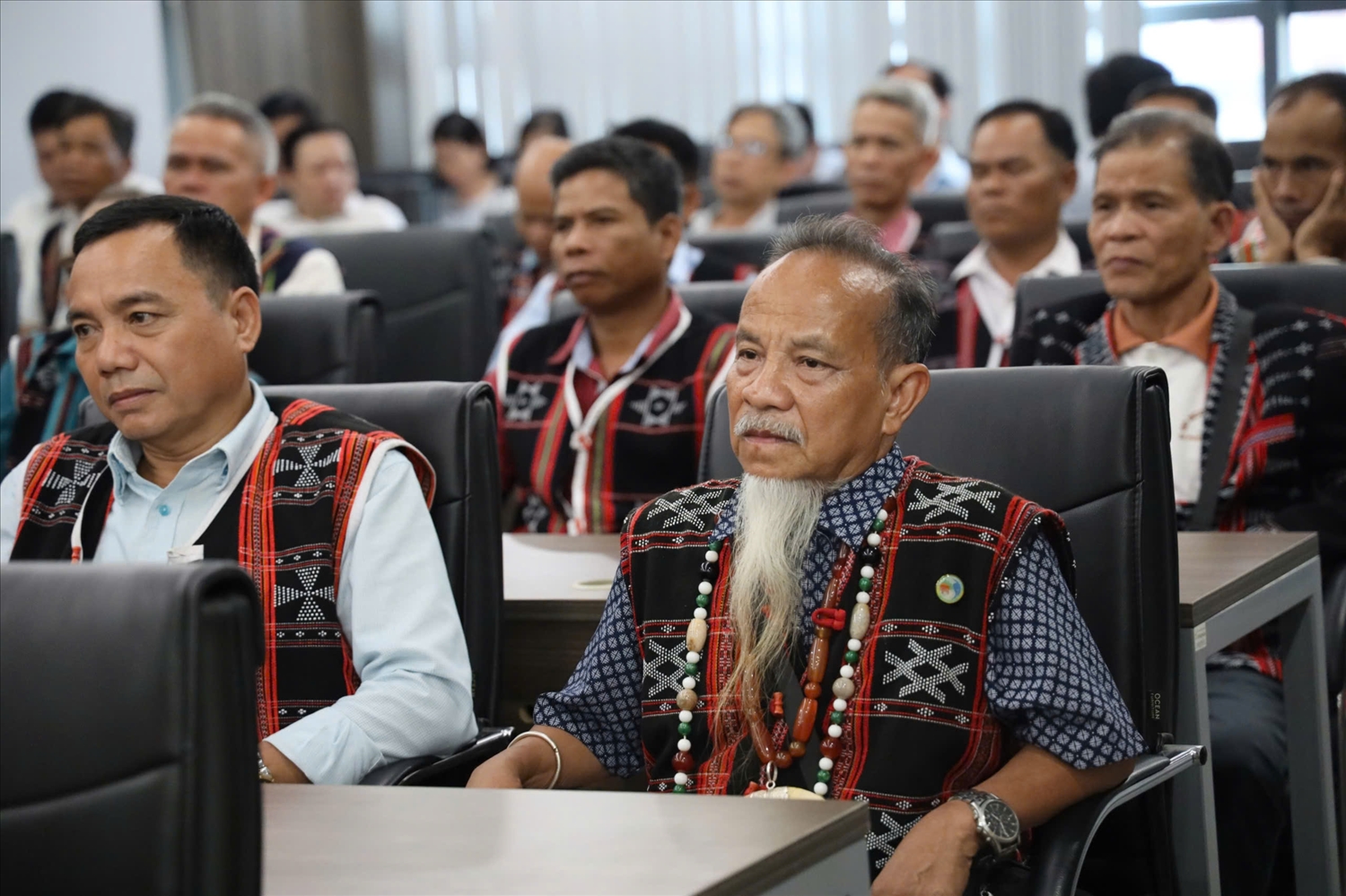 Respected people from ethnic minority communities in Da Nang City attended a meeting with leaders of the Ministry of Ethnic Affairs and Religious Affairs on July 14th, 2026
2. The role of respected people in community governance in ethnic minority areas
Firstly, respected people play a pivotal role in building and consolidating social consensus. Such consensus is a prerequisite for the effective implementation of guidelines and policies in ethnic minority areas. Leveraging their status and influence, these individuals serve as a crucial force in translating the Party’s guidelines and the State’s policies and laws into voluntary actions by the community.
In practice, numerous socio-economic development, new rural construction, poverty reduction, settlement and environmental protection programs and projects have achieved positive results thanks to the advocacy and mobilization efforts of influential figures. Their exemplary conduct generates a persuasive, far-reaching impact that is difficult for administrative measures alone to replicate.
Secondly, respected people serve as a bridge between the Party and the State and ethnic minority communities, acting as partners in co-creating community governance. Given the dispersed settlement patterns, challenging transportation infrastructure and uneven access to information, the connecting role of these respected people is of heightened importance. They help bridge the gap between policy and practice, thereby enhancing the feasibility of development programs in ethnic minority areas.
The effectiveness of social governance is not only determined by state power but increasingly depends on the ability to mobilize the participation of social actors in the process of planning, implementing and monitoring policies. Governance, therefore, is not merely a matter of administrative command and control; rather, it is a process of coordination between the State and social organizations and forces aimed at fostering consensus and mobilizing resources to address community issues. Under this approach, respected people within ethnic minority communities should not be viewed solely as a bridge between the Party, the State and the people; instead, they must be recognized as active participants who co-create community governance alongside the State.
Collaborative governance emphasizes the proactive role of influential figures throughout the entire cycle of social governance. They do not merely convey guidelines and policies from Party committees and authorities to the public, nor do they simply relay community feedback in the opposite direction. More importantly, leveraging their social standing, cultural knowledge, and ability to mobilize the community, they directly participate in forging consensus, building trust, harmonizing social relations and fostering public participation in the development process. It is precisely this engagement that fosters a form of governance rooted in consensus rather than mere administrative directives. When respected people mobilize the public to donate land for road expansion, diversify crops, protect forests, abandon outdated customs, or participate in poverty reduction programs, the key to success lies in the community’s voluntary cooperation, underpinned by trust. This demonstrates their direct role in shaping new social norms, helping to translate public policies into reality through the consensus of the people.
Conversely, respected people help enhance the quality of governance by providing honest feedback on issues arising in real-world practice. Living within the community gives them a distinct advantage in quickly identifying shifts in economic life, culture, beliefs and public opinion, as well as challenges encountered during policy implementation. This information serves as a vital source of practical data, enabling Party committees and authorities to adjust their leadership and management methods and refine policies to better align with the people’s needs. Thus, they not only participate in implementation but also contribute to improving the policy-making process right at the grassroots level.
Another significant value provided by respected people is their ability to reduce the costs of social governance. When these individuals mediate disputes, whether within families, clans or the broader community before administrative or judicial measures become necessary, conflicts are resolved at the grassroots level; this curbs protracted grievances, alleviates pressure on the authorities, and strengthens social stability. This serves as a vivid example of community governance rooted in self-management, where informal social institutions effectively complement state governance mechanisms.
Currently, the country is promoting decentralization, shifting from management thinking to development management thinking, the approach to the role of respected people also needs to innovate accordingly. If we only consider them as a propaganda force or bridge, it does not fully reflect their role in modern social governance. In fact, they and the State are sharing part of the function of creating social consensus, mobilizing community resources, strengthening people's trust and improving policy implementation effectiveness.
Thirdly, respected people serve as a core force in preserving and promoting ethnic cultural values. They directly safeguard, pass down and foster the traditional cultural values of their ethnic groups. Through religious practices, festivals, community activities and the education of the younger generation, they contribute to preserving the language, writing system, ethnic knowledge, traditional crafts folk arts and community ethical standards; they mobilize the people to build a new cultural lifestyle in their villages, strictly observe village conventions and regulations, and eliminate outdated customs regarding weddings and funerals; they promote hygienic living and the avoidance of social evils, superstition and illegal religious proselytization; they combat external cultural encroachment as well as trends of blind worship of foreign cultures, cultural hybridization and the loss of ethnic identity, trends incompatible with the fine customs and traditions of ethnic minority communities… Amidst the intensifying trends of globalization and cultural exchange, the role of respected people has become increasingly significant in safeguarding national cultural identity and preventing the erosion or distortion of traditional cultural values.
Fourthly, respected people play a vital role in ensuring national defense and security at the grassroots level. They participate in resolving community disputes, mobilize the public to prevent crime and eradicate social evils, and combat activities that exploit ethnic and religious issues to undermine the great national unity. In border areas, they serve as a core force in movements for border-area self-management and the protection of national boundary markers, thereby contributing to building a solid foundation of public support and safeguarding national sovereignty.
4. Conclusion
As the country develops and alongside the need to establish a modern, effective, and efficient system of national governance while harnessing the power of great national unity, the role of respected people within ethnic minority communities is becoming increasingly prominent. Leveraging their social capital, deep cultural understanding, and ability to build social consensus, respected people remain a vital resource in bridging the Party’s vision with the aspirations of the people; they contribute to preserving and promoting the cultural values of ethnic groups, upholding national defense and security, fostering socio-economic development and successfully achieving sustainable development goals for ethnic minority and mountainous areas. Therefore, accurately recognizing and assessing the position and role of respected people is not only a requirement of ethnic affairs work but also a crucial solution for consolidating the social foundation, fostering consensus and harnessing the endogenous strength of ethnic minority communities during the country’s new phase of development.
References
1. Central Committee of the Vietnam Fatherland Front (2019), Proceedings of the thematic seminar “Promoting the role of respected people among ethnic minority communities”.
2. Communist Party of Vietnam (2019), Conclusion No. 65-KL/TW dated October 30th, 2019, of the Politburo on the continued implementation of Resolution No. 24-NQ/TW of the 9th Party Central Committee regarding ethnic affairs in the new situation.
