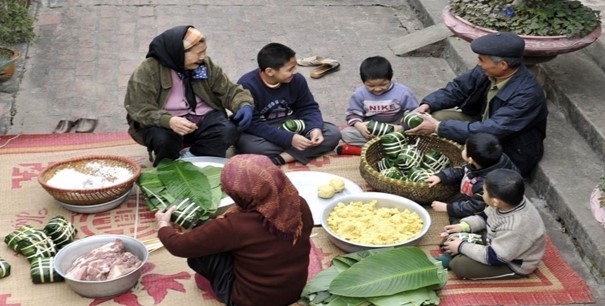
 A Nung family gathers to wrap chung cake (traditional Vietnamese rice cakes) in preparation for the traditional Lunar New Year
The Nung people usually begin preparing for Tet (Lunar New Year) from the 28th day of the 12th lunar month, when the local markets become bustling with all kinds of goods. Women handle most of the shopping and food preparation, while men tidy the house, cleaning the altar and decorating the living space. Tet truly begins with a “bad luck-warding” meal on the afternoon of the 30th of Tet, with duck meat as the main dish. According to folk beliefs, duck meat wards off the misfortunes of the old year, bringing good luck, health and peace to the whole family. Duck can be prepared in many ways, such as roasted duck with mac mat leaves, boiled duck or duck cooked with sour bamboo shoots, a specialty of the mountainous region of Lang Son province.
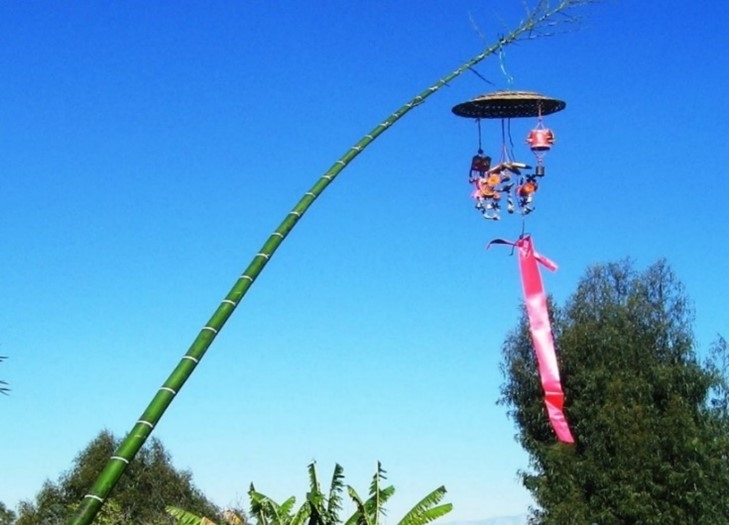 The New Year’s pole is believed to ward off evil spirits and bring about a bountiful harvest
The ancestral altar was meticulously prepared. The offerings included: sticky rice cakes (bánh chưng), boiled capon, sweets, pork, a platter of five kinds of fruit and two evergreen incense sticks. The altar is usually divided into two tiers; the upper tier is dedicated to the Goddess of Mercy, Quan Am and only fruits, sweets and chung cakes are used, without pork fat. Throughout the Lunar New Year celebrations, incense on the altar must remain burning, signifying respect for ancestors and a connection between people and the spiritual world. At the same time, the Nung people refrain from lighting fires outdoors on the nights of the 30th and 1st of Tet (Lunar New Year) to avoid bad luck.
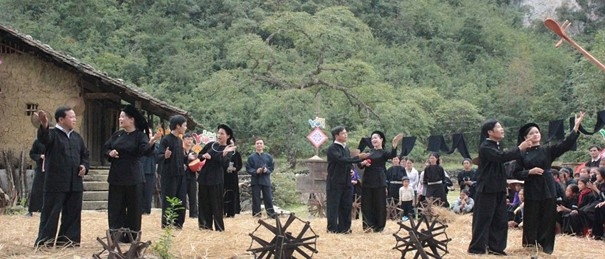 The Nung ethnic group possesses a rich and diverse treasure trove of traditional culture closely linked to their life, activities and beliefs
Traditional New Year customs hold a significant place in the spiritual life of the Nung ethnic group. They erected a ceremonial pole, hung votive paper money and chicken feathers to ward off evil spirits, protect their families and pray for a bountiful harvest. On the first day of the Lunar New Year, the Nung people refrain from sweeping the house, washing clothes, or using mortars and pestles to avoid bringing bad luck, they only visit each other to exchange New Year greetings from the afternoon of the first day onwards. Choosing the first person to enter a house at the beginning of the year is very important, because traditionally, if the first person to enter the house is a man who is successful in business and has a good character, the whole year will be lucky. Mr. “Khai Vai Xuan” is a healthy old farmer who goes from house to house wishing people a Happy New Year, pasting red paper on livestock pens, symbolizing vitality and good fortune. These customs are not just rituals, but also opportunities to connect with the community, share joy and start a new year with hope and optimism.
In the modern context, the Nung people’s Tet (Lunar New Year) still retains its spiritual values, but has adapted to new ways of life. For the Nung people of Lang Son province, Tet is a time for rest and recreation, as well as an opportunity to strengthen their ethnic cultural identity. Today’s Nung youth embrace Tet (Lunar New Year) with both enthusiasm and a deep awareness of traditional values. Many young people actively participate in activities such as making chung cake (traditional Vietnamese rice cakes), making bong cake (Vietnamese puffed rice cakes), attending festivals and playing folk games. Through this, they both learn about and directly experience the traditional culture of the nation.
The widespread availability of modern technologies such as telephones, cameras, and the internet has contributed to promoting the traditional Tet (Lunar New Year) culture of the Nung ethnic group of Lang Son province to the wider world. Many young people take photos, record videos, and create clips to share on social media, contributing to introducing the unique customs of the ethnic group to a wider community. Therefore, the Lunar New Year of the Nung ethnic group is not only an occasion to preserve traditions, but also becomes a bridge between generations, creating a vibrant cultural experience and spreading profound spiritual values. Traditional rituals, customs and foods are not only celebrated but also understood by young people, fostering pride in their roots and a sense of preserving their cultural identity.
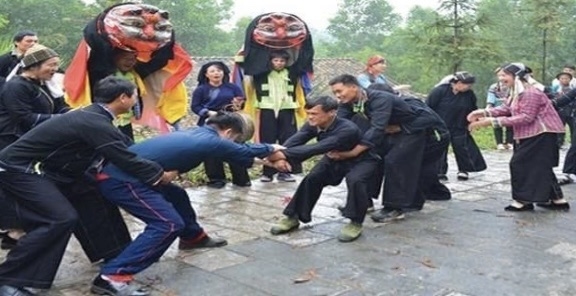 During the Lunar New Year, the Nung ethnic group often organizes competitions and folk games to strengthen community unity and solidarity
Therefore, the Lunar New Year of the Nung ethnic group in Lang Son province is not only a New Year’s festival but also a vibrant expression of ethnic culture, closely associated with distinctive cuisine, unique customs and traditions and a profound spiritual life.
With the enthusiastic participation of young people, traditional values continue to thrive, providing both educational value and joy and inspiration, contributing to community connection and fostering a spirit of solidarity and compassion within each family and society as a whole./.
